
The Bathroom Attendant
An imperfect thriller about desperation, betrayal, and survival, fueled by electrifying performances and resourceful staging in the heart of Las Vegas.
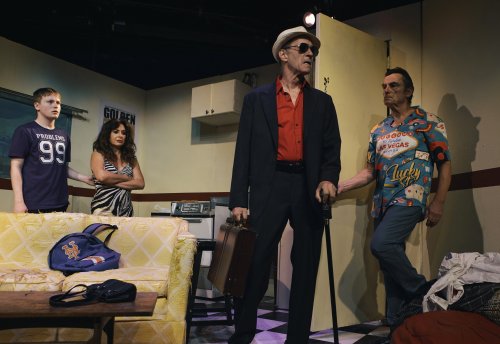
Evan Klein, Kate Miller, Jon Krupp and Dan Patrick Brady in a scene from Tom Kelly’s “The Bathroom Attendant” at the 124 Bank Street Theatre (Photo credit: Scott Federman)
Tom Kelly’s The Bathroom Attendant, now receiving its world premiere with SparkPlug Productions at 124 Bank Street Theatre, is one of those scruffy, unexpectedly ambitious Off-Off-Broadway dramas whose shortcomings are inseparable from its virtues. Set in a rundown apartment on the outskirts of Las Vegas in August 2018, it plunges into an America of gambling, sexual exploitation, debt, resentment, blackmail and economic desperation—a world the American theater does not often bother to visit. Kelly calls the play a “dark comic thriller.” The darkness is unmistakable; by the end of the first act and throughout much of the second, the thriller machinery is genuinely gripping. The comedy, however, is largely AWOL. What emerges instead is a rough-hewn but frequently compelling drama about people who have been discarded by a society that has learned to assign radically different values to human lives.
The title is itself a grim joke. Johnny Knight (Dan Patrick Brady), once a Golden Gloves boxer, now works part-time as a bathroom attendant at the Mob Museum, a job that scarcely qualifies as employment and certainly does not qualify as salvation. His shabby apartment looks out toward the glittering Las Vegas Strip, which appears through the single window like a mirage visible only to people too poor to reach it. Scott Fetterman’s production design makes eloquent use of very little: a torn yellow couch, crushed beer cans, a battered kitchenette, an empty bottle of Lagavulin and a poster commemorating the 1984 Golden Gloves tournament at Madison Square Garden. Johnny’s former glory hangs literally above his ruined present. He is trapped in gambling debts, loan-shark obligations and the wreckage left by a life spent believing that the next big score might somehow restore what the previous one destroyed.
Into this dismal little ecosystem comes Connor (Evan Klein), the son of one of Johnny’s old Brooklyn acquaintances. While vacationing in Vegas, Connor has recorded video of a celebrity baseball player brutally attacking his 15-year-old date in a Bellagio parking garage. TMZ has already offered him six figures for the footage, but Connor wants more: considerably more. He recruits Johnny and his neighbor Tina (Kate Miller), a former porn performer with a surprisingly tender sense of responsibility toward young women, to help turn the video into a $500,000 blackmail scheme. It is in the early conversations among these three that Kelly’s play is most alive. The dialogue has an earthy, improvisational quality, and the characters’ conflicting motives gradually reveal themselves without requiring the machinery of a thriller to announce every development. Klein is particularly good at making Connor’s apparent naïveté increasingly suspect; his relentlessly enthusiastic Mets-fan persona may be genuine, an act, or both.
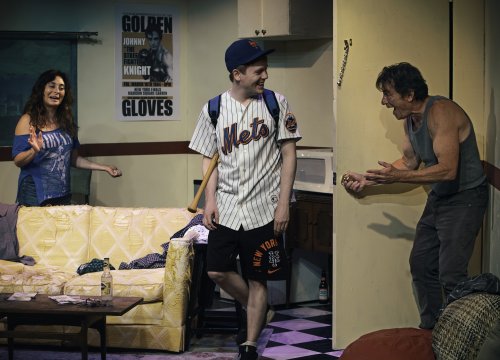
Kate Miller, Evan Klein and Dan Patrick Brady in a scene from Tom Kelly’s “The Bathroom Attendant” at the 124 Bank Street Theatre (Photo credit: Scott Federman)
Director Andrew Block’s greatest achievement is his casting, which gives the production an unusually persuasive ensemble. Brady looks every inch the battered former fighter, a man who has taken too many punches and has spent too long pretending that he hasn’t. His performance can be frustratingly one-note in its vocal delivery, and there are moments when he seems to be pushing the plot rather than living inside it, but physically he creates an affecting portrait of a man whose best years have become a kind of haunting. Miller is the production’s most consistently accomplished performer. Her Tina possesses authority, warmth, comic timing and a wonderfully lived-in quality; she can make the character’s improbable history as a retired porn actor seem as ordinary as anyone else’s biography. Most importantly, she gives Tina a moral center without turning her into a saint. Her modest apartment has become an informal refuge for vulnerable young women, suggesting that beneath the play’s hard-boiled surface lies a story about people trying, however imperfectly, to prevent others from falling as far as they have.
Klein and Mari Blake provide the production with its most volatile energies. Klein begins as an almost cartoonishly innocent young man—his bobbleheaded nodding and head-to-toe Mets regalia suggesting someone who might not be capable of a sophisticated criminal enterprise—but gradually lets us wonder whether the innocence is itself a performance. Blake, as Bambi, has the difficult task of embodying a teenager who has been sexually trafficked and brutally assaulted while still allowing us to see the frightened, angry person underneath the rhetoric of victimhood and revenge. Her opening monologue is agonizing, and there are moments when her volatility is genuinely heartbreaking. Yet the second act asks both Blake and the character to carry too much explanatory material, and the performance becomes less convincing as Bambi is transformed from a damaged young woman into a vehicle for the play’s larger arguments about trafficking and institutional indifference.
That second act is where The Bathroom Attendant loses much of the momentum it has so carefully accumulated. Jon Krupp’s Marcus, the fixer for the baseball star, finally arrives to make the threat behind the blackmail explicit, but Krupp attacks the dialogue with such relentless emphasis that menace turns into declamation. The character needs less volume and more calculation: a quieter, colder performance would make his contempt for Bambi—and the social order he represents—far more frightening. Kelly also burdens Marcus with extended speeches about the disposability of the girl’s life, trafficking, celebrity privilege and even politically charged references that feel imported from another play. The material is not irrelevant; on the contrary, Kelly has identified something serious and disturbing about the way wealth and celebrity can turn human suffering into an inconvenience. But the speeches explain what the drama has already shown us. They should be cut substantially, redistributed into action, or broken into shorter exchanges in which Marcus reveals himself through what he does rather than through an extended declaration of what the audience is supposed to think.

Mari Blake in a scene from Tom Kelly’s “The Bathroom Attendant” at the 124 Bank Street Theatre (Photo credit: Scott Federman)
The same principle would strengthen the first act. Kelly takes too long to deliver information about Johnny’s boxing career and the histories of the characters before allowing the central conflict to ignite. Some exposition is necessary, but much of it could be converted into behavior, interruption, implication or strategically withheld information. The play becomes noticeably better the moment the characters stop telling us about their lives and start fighting for something. The comedy, too, needs to be reconsidered. If Kelly and Block are aiming for the brutal black humor of Martin McDonagh, the production needs to discover a sharper relationship between horror and absurdity. The answer is not to insert jokes into scenes about trafficking and torture; it is to find the gallows humor already latent in these characters—their bad decisions, grandiose fantasies, pathetic schemes and desperate attempts to retain dignity. A few genuinely funny moments emerging organically from character would do more for the play’s “dark comic” identity than any number of punchlines.
Block’s direction is similarly strongest when it trusts the material’s rough intimacy. He makes ingenious use of the small playing space, extending the action into the aisles and occasionally forcing spectators to turn around to discover what is happening behind them. The cramped geography becomes an asset: these people are trapped together, just as they are trapped by debt, poverty and the consequences of their choices. At other times, however, the blocking becomes conspicuous, with actors seeming uncertain about where to go or appearing to force the plot forward rather than allowing it to unfold naturally. A more rigorous attention to transitions, sightlines and the motivation behind every movement would give the production a much firmer dramatic rhythm. Tony Lepore’s lighting and music are particularly valuable in establishing the bruised emotional atmosphere.
What makes The Bathroom Attendant worth seeing, despite its obvious rough patches, is that Kelly is reaching toward something larger than a Vegas blackmail caper. His characters are not the usual affluent theatrical specimens debating their identities in comfortable rooms. They are people awash in deprivation and resentment, people whose bodies and labor have been commodified in different ways, and whose lives have been shaped by an economy in which some people can buy their way out of consequences while others can barely buy another day. Johnny, Tina and Bambi are damaged people, but the play makes us care about their damage. That is no small accomplishment.
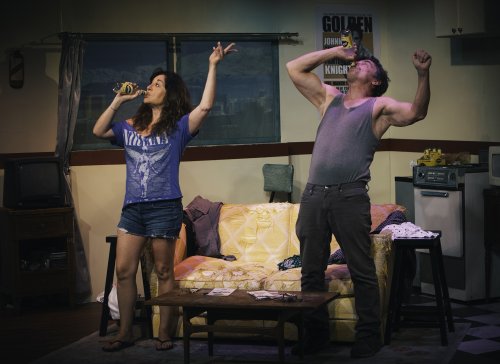
Kate Miller and Dan Patrick Brady in a scene from Tom Kelly’s “The Bathroom Attendant” at the 124 Bank Street Theatre (Photo credit: Scott Federman)
If Kelly can pare away the exposition, substantially tighten the second act, eliminate the extraneous political rhetoric, deepen the comedy through character rather than topical jokes, and give Marcus a more restrained and genuinely dangerous presence, The Bathroom Attendant could become considerably more than the intriguing but somewhat slipshod thriller it currently is. The ingredients are there: a perfectly matched cast, resourceful staging, a vivid setting and a playwright willing to look directly at the ugly underside of American life. What is needed now is not a new play so much as a more disciplined version of the very good one already struggling to emerge.
The Bathroom Attendant (through August 30, 2026)
Sparkplug Productions
124 Bank Street Theatre, 124 Bank Street, in Manhattan
For tickets, visit www.sparkplugproductions.com
Running time: two hours and five minutes including one intermission


Thanks for your thoughtful and insightful review.