
The Potluck
César Alvarez's haunting musical transforms grief into unforgettable theater, finding profound beauty in loss while igniting righteous anger and enduring hope.
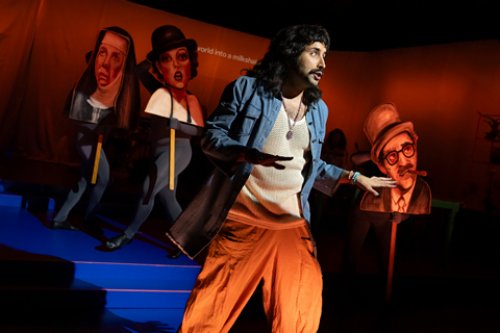
Anthony Alfaro as César in a scene from César Alvarez’s “The Potluck” at The Peter Jay Sharp Theater at Playwrights Horizons (Photo credit: Julieta Cervantes)
César Alvarez’s The Potluck, directed with uncommon daring by Sarah Benson, is that increasingly rare theatrical achievement: a musical willing to risk confusion, contradiction, and formal unruliness in pursuit of emotional and historical truth. Inspired by the 1979 Greensboro Massacre—in which members of the Ku Klux Klan and the American Nazi Party, aided by astonishing failures of law enforcement, murdered five labor organizers during an anti-Klan demonstration—the production refuses to transform political martyrdom into tidy historical pageantry. Instead, Alvarez, in concert with Benson’s characteristically adventurous theatrical imagination, constructs an expansive meditation on inheritance, memory, identity, and the uneasy obligations of art itself. The result is not documentary theater, nor autobiography, nor agitprop, nor conventional musical comedy, but an exhilarating synthesis of all four. It unfolds less as a linear narrative than as an act of excavation, uncovering the ways political violence reverberates through generations long after headlines have faded.
The historical tragedy is deeply personal. Alvarez was born in Greensboro only a year after the massacre, named for two of those killed, whose friendship with Alvarez’s parents forever shaped the family’s emotional landscape. Those five victims—Jim Waller, Bill Sampson, Sandi Smith, César Cauce, and Mike Nathan—hover over the production as absent presences before they eventually arrive as fully realized characters. Until then, Benson guides the audience alongside a fictionalized César, played with extraordinary charisma and vulnerability by Anthony Alfaro, as they struggle with a commission to write precisely the musical they least wish to create. Their hesitation is not simple procrastination but an existential dilemma. How does one transform profound grief into entertainment? How does a committed anti-capitalist create art inside institutions sustained by philanthropy and commerce? How does someone inherit a political movement that simultaneously nurtured revolutionary ideals while rejecting queer identity? The musical never simplifies these contradictions because they are, in fact, its very subject.
That self-interrogation becomes the engine of an unusually sophisticated work of metatheater. Rather than treating the creative process as clever narrative ornament, Alvarez interrogates the ethics of representation itself. Every false start, abandoned concept, comic diversion, and philosophical detour gradually reveals itself not as delay but as evidence of genuine artistic paralysis before history’s enormity. The familiar conventions of the “musical about writing a musical” are transformed into something considerably richer: an inquiry into whether certain stories can ever be adequately told, and whether failure itself might become part of the storytelling. By refusing immediate narrative certainty, The Potluck allows its eventual clarity to arrive with extraordinary force.
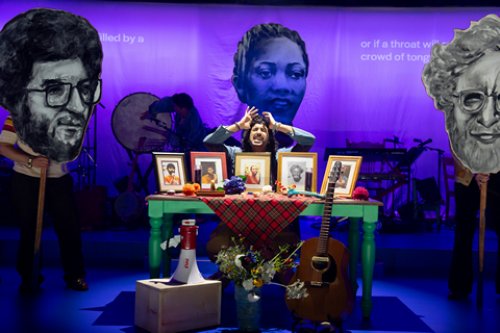
Anthony Alfaro as César in a scene from César Alvarez’s “The Potluck” at The Peter Jay Sharp Theater at Playwrights Horizons (Photo credit: Julieta Cervantes)
One of the production’s most arresting moments arrives not through theatrical invention but through historical evidence itself. The audience is invited to watch several harrowing minutes of archival footage documenting the Greensboro Massacre, although those who prefer not to witness the violence are offered an alternative: a memorial ritual in the lobby honoring the dead. It is an unusually compassionate dramaturgical choice, acknowledging that remembrance need not always require direct confrontation with atrocity. For those who remain, however, the footage is impossible to dismiss.
In a matter of minutes, it clarifies the volatile circumstances surrounding the demonstration—escalating tensions, combustible rhetoric, mortal danger, and, most chillingly, the conspicuous absence of the police until the killing had already been done. The images make painfully clear that this was not simply an eruption of violence but a catastrophe enabled by institutional failure. Knowing that the perpetrators were ultimately acquitted only deepens the sense of outrage. The state’s complicity, once shocking in its brazenness, now lands with the grim familiarity of a nation that has become all too accustomed to watching justice buckle beneath ideology.
The breakthrough comes with breathtaking theatrical elegance. After repeated attempts to approach the massacre intellectually, César and the delightfully perceptive Moss—Jasmine Rafael’s wonderfully understated intern, equal parts comic companion and spiritual guide—turn instead toward ritual. Through an act of communal summoning, the five murdered activists emerge not as historical symbols but as vivid human beings, possessed of humor, conviction, disappointment, affection, and unfulfilled dreams. Benson stages this transformation with magnificent theatrical imagination. Emily Orling’s scenic environment suddenly blossoms into something simultaneously earthly and supernatural as neon pigments seem to awaken across the stage, illuminated by Mextly Couzin’s haunting lighting and enveloped in Eamon Goodman’s richly textured soundscape. The effect feels less like a ghost story than an act of collective remembrance made physically manifest.
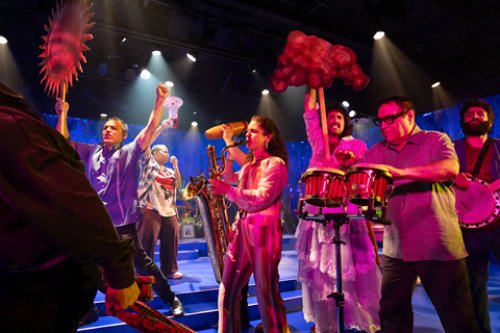
Rubén Flores, Dionne McClain-Freeney, Jessica Lurie, Anthony Alfaro, Sammy Figueroa and Jacob Brandt in a scene from César Alvarez’s “The Potluck” at The Peter Jay Sharp Theater at Playwrights Horizons (Photo credit: Julieta Cervantes)
Once these spirits begin speaking, the musical discovers its full emotional vocabulary. Jacob Brandt, Andrew R. Butler, Dionne McClain-Freeney, Gían Pérez, and Zack Segel establish an immediate chemistry that convinces us these activists truly shared years of struggle before history interrupted their lives. Butler, whose presence effortlessly bridges Brechtian political theater and American folk tradition, anchors several of the evening’s most stirring musical passages, while each member of the ensemble imbues their historical counterpart with remarkable individuality. Rather than sanctifying the dead, Alvarez grants them the complexity of unfinished lives. Their conversations with César become less debates across time than acts of mutual education, as both the living and the dead search for language capable of carrying ideals across generations.
Alvarez’s score proves astonishingly adventurous. Genre boundaries dissolve into an exhilarating musical vocabulary encompassing folk, jazz, rock, chamber music, and experimental composition. Yet stylistic eclecticism is never pursued for novelty’s sake. Every musical idiom emerges organically from emotional necessity, creating a soundscape where political rally songs, intimate confessionals, surreal theatrical spectacles, and quiet meditations coexist with startling coherence. The onstage band, whose members seamlessly transition between musicians and characters, including El Beh, Sammy Figueroa and Jessica Lurie in their brief roles, reinforces the sense that music itself functions as memory made communal.
Even more remarkable are Alvarez’s lyrics, which possess the density and associative beauty of contemporary poetry. Their imagery consistently transforms abstract political and emotional dilemmas into unforgettable metaphors. A longing for selfhood becomes “a sword made of rainbow light to cut the melon.” Grief becomes the burden of carrying an anvil into town. Spiritual transcendence emerges through “a trap door on the floor of my need for things.” These are not merely clever turns of phrase but expressions of consciousness searching beyond ordinary language. The production wisely projects every lyric and spoken line across the stage, allowing audiences to savor the extraordinary precision of Alvarez’s writing while emphasizing the equal importance of word and music.
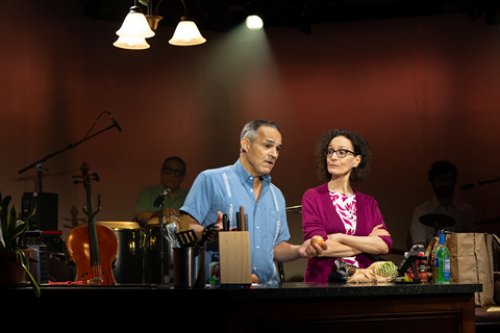
Rubén Flores as Dad and Barbara Walsh as Mom in a scene from César Alvarez’s “The Potluck” at The Peter Jay Sharp Theater at Playwrights Horizons (Photo credit: Julieta Cervantes)
The evening’s deepest emotional currents ultimately belong to the survivors. Barbara Walsh and Rubén Flores deliver performances of extraordinary restraint and devastating humanity as parents whose revolutionary commitments have been permanently altered by unimaginable loss. Walsh’s luminous rendering of “The Myth” becomes a meditation on inherited beliefs and the fragile structures that sustain political hope, while Flores’ magnificent “Mandela” stands among the most moving songs written for the contemporary American musical. Addressing his murdered friend across decades, he recounts both monumental historical transformations and humble personal milestones—the election of Nelson Mandela, the AIDS epidemic, grandchildren, hearing aids, technological revolutions—with heartbreaking simplicity. Time itself becomes the song’s melody, reminding us that survival carries both privilege and unbearable responsibility.
What distinguishes The Potluck from so many politically engaged works is its refusal to separate public struggle from private identity. Questions of labor organizing, anti-fascist resistance, queer liberation, family loyalty, gender identity, and artistic vocation gradually reveal themselves as interconnected expressions of the same moral inquiry: how does one live ethically within compromised systems while remaining faithful to both history and oneself? The ghosts ask César whether the world is truly better than it was in 1979. The tentative answer—”Write musicals?”—arrives less as uncertainty than as an affirmation that art itself constitutes a form of political action, however modest, when it preserves memory against erasure.
Benson’s production embraces this philosophical complexity without sacrificing theatrical pleasure. Choreography by Ana Maria Alvarez frequently moves between everyday gesture and ecstatic ritual, while Qween Jean’s richly expressive costumes subtly chart the production’s movement between historical realism and metaphysical encounter. The divided domestic spaces occupied by César and their parents gradually dissolve into a shared landscape where past and present coexist. Even the show’s most playful surrealist flourishes ultimately contribute to an atmosphere in which imagination becomes another instrument of historical recovery.
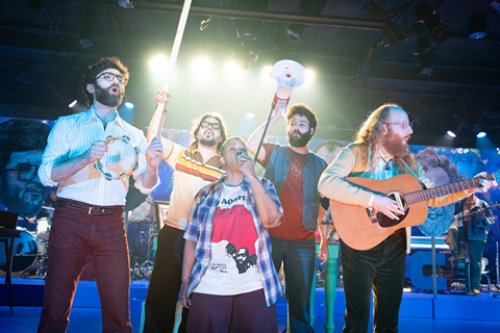
Zack Segal as Mike, Gían Pérez as Cesar, Dionne McClain-Freeney as Sandi, Jacob Brandt as Jim and Andrew R. Butler as Bill in a scene from César Alvarez’s “The Potluck” at The Peter Jay Sharp Theater at Playwrights Horizons (Photo credit: Julieta Cervantes)
The title itself finally reveals its profound resonance. The annual potluck gathering held by survivors becomes a metaphor for the musical’s own structure: disparate voices, memories, songs, political convictions, family stories, and generations each bringing something essential to a communal table. No single perspective can contain the Greensboro Massacre, but together they form something approaching collective truth. By evening’s end, The Potluck has accomplished something exceedingly rare. It transforms a neglected American tragedy into an act of living remembrance while simultaneously expanding the expressive possibilities of musical theater itself. It is intellectually fearless, musically adventurous, emotionally overwhelming, and formally original—a work that understands history not as something safely concluded but as an unfinished conversation demanding new participants. Like the activists it memorializes, The Potluck insists that remembrance itself is an act of resistance, and it leaves audiences carrying that conviction long after its final, luminous chord has faded.
The Potluck (extended through August 9, 2026)
Soho Rep and INTAR
The Peter Jay Sharp Theater at Playwrights Horizons, 416 West 42nd Street, in Manhattan
For tickets, visit www.sohorep.org
Running time: two hours and 30 minutes including one intermission


Leave a comment