
La Cage aux Folles (New York City Center Encores!)
Even with Billy Porter and Wayne Brady having scripts at hand, the sparkle to this joyous 1983 lovefest is never dimmed...the best of times is once again.
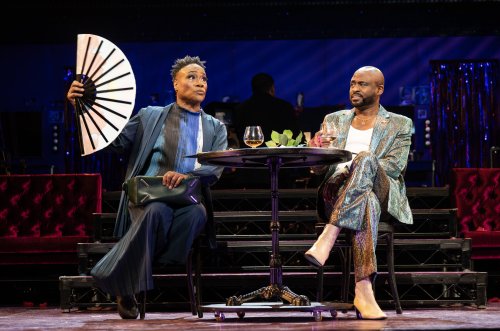
Billy Porter and Wayne Brady in a scene from the Encores! production of the Jerry Herman-Harvey Fierstein’s “La Cage sux Folles” as New York City Center (Photo credit: Joan Marcus)
Few musicals occupy quite the same place in the American theatrical imagination as La Cage aux Folles. Jerry Herman and Harvey Fierstein’s 1983 landmark arrived disguised as an old-fashioned musical comedy—complete with farce, mistaken identities, and melodies that seemed to float effortlessly into the ear—yet it carried within it a quietly radical vision of queer domesticity. More than four decades later, that vision remains startlingly potent. At a moment when drag artists once again find themselves the targets of political opportunism and manufactured moral panic, Robert O’Hara’s exuberant New York City Center Encores! revival feels less like an exercise in nostalgia than a reaffirmation of the show’s enduring conviction that family is defined not by conformity but by love.
O’Hara, one of the most inventive directors working in the American theater, approaches the material not as a museum piece but as a living text. His production reimagines the famous St. Tropez nightclub as a celebration of Black queer artistry, expanding the world of La Cage into a vibrant constellation of identities and experiences. The result is not merely a revival but a conversation between generations of queer performance traditions. The evening continually reminds us that the lineage running from drag clubs and cabaret stages to Broadway itself has always been richer, stranger, and more expansive than mainstream culture has often been willing to acknowledge.
The story remains delightfully familiar. Georges, the urbane proprietor of the titular nightclub, and Albin, his mercurial partner and star attraction, have spent more than two decades building a life together while raising Georges’ son, Jean-Michel. Their hard-won domestic equilibrium is disrupted when Jean-Michel announces his engagement to Anne, the daughter of a reactionary politician whose public career depends on denouncing people exactly like Georges and Albin. What follows is a cascade of disguises, deceptions, and comic catastrophes that Fierstein’s expertly engineered book still delivers with remarkable efficiency.
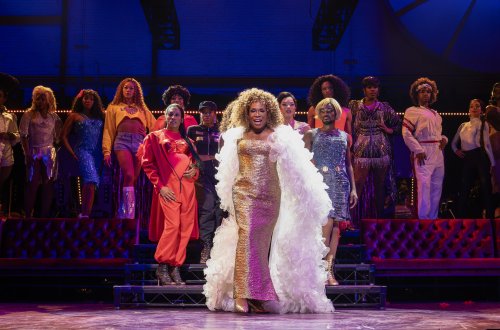
Billy Porter and the Cagelles in a scene from the Encores! production of the Jerry Herman-Harvey Fierstein’s “La Cage sux Folles” as New York City Center (Photo credit: Joan Marcus)
Yet beneath the farcical mechanics lies something unexpectedly tender. What gives La Cage aux Folles its emotional durability is not its satire of conservative hypocrisy but its portrait of a long-term relationship. O’Hara wisely keeps that relationship at the center of the evening, allowing the show’s emotional stakes to emerge from the pain of asking someone you love to erase themselves for the comfort of others. The musical’s politics may have evolved across the decades, but its central wound remains painfully recognizable.
The production is anchored by two charismatic stars who understand that Georges and Albin are first and foremost a couple. Wayne Brady brings extraordinary warmth to Georges, investing the character with an easygoing charm that never curdles into passivity. Few performers possess Brady’s ability to make geniality seem like an active choice rather than a default personality setting. His rendering of “Song on the Sand” is especially lovely, transforming Herman’s wistful ballad into a deeply felt declaration of devotion. One believes entirely that this Georges has spent twenty-four years building a life with Albin—and cannot imagine living without him.
Billy Porter, meanwhile, gives a performance of immense theatrical force. His Albin is by turns imperious, vulnerable, hilarious, and heartbreaking. Porter understands that Albin’s flamboyance is not merely a collection of mannerisms but a carefully cultivated armor protecting a profoundly sensitive soul. When he reaches “I Am What I Am,” the number arrives not as a showpiece but as an eruption of accumulated pain, pride, fury, and self-acceptance. Porter turns the anthem into something resembling a public reckoning, a declaration of identity that feels simultaneously personal and communal. The ovation that follows seems less like applause than collective release.
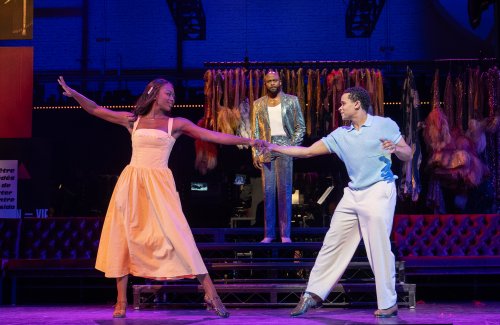
Rachel Webb, Wayne Brady and Alaman Diadhiou in a scene from the Encores! production of the Jerry Herman-Harvey Fierstein’s “La Cage sux Folles” as New York City Center (Photo credit: Joan Marcus)
Around them, the supporting cast contributes immeasurably to the evening’s pleasures. Alaman Diadhiou brings irresistible energy and athletic grace to Jean-Michel, particularly in Dormeshia’s sparkling tap-inflected choreography. Rachel Webb lends Anne an appealing sincerity, while Peter Francis James and Sharon Washington find comic texture in roles that might otherwise function merely as satirical targets. James Jackson Jr. nearly steals the production outright as the irrepressible Jacob, extracting every available laugh with impeccable comic timing. Tonya Pinkins, radiating glamour and authority, turns Jacqueline into a memorable presence whenever she steps onstage.
The ever-charismatic Michael McElroy, as Francis, earns one of the evening’s biggest laughs with an exit that appears, at first glance, to be simple leather drag. Look closer, however, and it becomes clear that the costume is winking at a very specific corner of queer culture—one that devotees of Heated Rivalry will recognize instantly. The joke is never underlined, which only makes it funnier. “If you get it, you get it.” And judging by the delighted reaction from portions of the audience, plenty did.
One of O’Hara’s most intriguing interventions is his reimagining of Les Cagelles. Rather than presenting a uniform chorus line, he populates La Cage with performers who evoke a dazzling spectrum of queer and pop-cultural icons. Clint Ramos and Michelle Ridley’s costumes transform the stage into a living archive of Black diva worship, while Edgar Godineaux’s choreography emphasizes individuality and self-expression over precision conformity. The effect is less a traditional Broadway chorus than a celebration of queer performance itself, a pageant of influences stretching from nightclub legends to contemporary superstars.
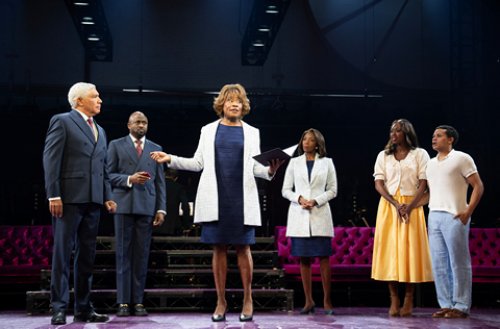
Peter Francis James, Wayne Brady, Billy Porter, Sharon Washington, Rachel Webb and Alaman Diadhiou in a scene from the Encores! production of the Jerry Herman-Harvey Fierstein’s “La Cage sux Folles” as New York City Center (Photo credit: Joan Marcus)
The visual world surrounding them is equally rich. David Zinn’s fluid scenic design creates a theatrical environment that feels simultaneously intimate and expansive, while Adam Honoré’s lighting bathes the proceedings in a shifting palette of nightclub glamour and domestic warmth. Robert Pickens’ hair and wig designs, together with Joe Dulude II’s makeup, complete an aesthetic that honors drag as both artistry and transformation. Every visual element contributes to a production deeply invested in the act of self-creation.
Special praise belongs to music director Joseph Joubert, whose contribution proves indispensable. Conducting the magnificent Encores! Orchestra in the original 1983 orchestrations, Joubert restores Herman’s score to its full symphonic splendor, reminding audiences just how sophisticated this seemingly effortless music truly is. The orchestrations bloom with color, wit, and emotional nuance under his baton. Herman’s melodies have always possessed the deceptive simplicity of great craftsmanship; Joubert reveals the architectural brilliance beneath them. The entr’acte alone is a masterclass in musical storytelling, each phrase unfolding with elegance and purpose. Throughout the evening, the orchestra serves not merely as accompaniment but as an active dramatic presence, carrying currents of longing, joy, melancholy, and triumph beneath every scene.
All of which prepares the audience for the inevitable arrival of “The Best of Times.” Few songs in the musical-theater canon generate such immediate exhilaration. Herman’s genius lay in his ability to express profound emotional truths through melodies of disarming simplicity, and nowhere is that gift more apparent than here. What begins as a buoyant ensemble number gradually accumulates force until it becomes an overwhelming affirmation of resilience, community, and shared humanity. In O’Hara’s production, the song lands with the impact of a tidal wave. The entire evening seems to gather itself toward this moment.
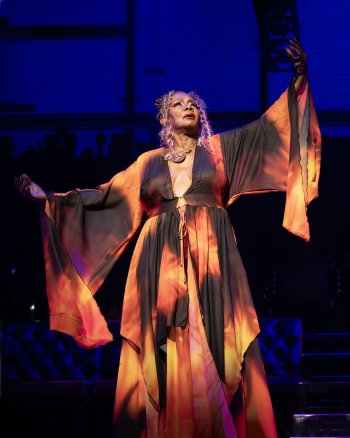
Tonya Pinkins in a scene from the Encores! production of the Jerry Herman-Harvey Fierstein’s “La Cage sux Folles” as New York City Center (Photo credit: Joan Marcus)
By the time the company reaches its final refrain, La Cage aux Folles has achieved something increasingly rare in contemporary theater: it leaves the audience feeling larger than when it entered. O’Hara’s revival honors the musical’s historic significance while locating fresh resonance in its themes of identity, belonging, and chosen family. Above all, it reminds us why Herman’s glorious anthem continues to endure. The best of times, the show insists, are not memories to be mourned but possibilities to be claimed. For an evening at City Center, that proposition feels not merely persuasive but gloriously true.
La Cage aux Folles (through June 28, 2026)
New York City Center Encores!
New York City Center, 131 West 55th Street, in Manhattan
For tickets, visit www.nycitycenter.org
Running time: two hours and 50 minutes including one intermission


Leave a comment