
Joe Turner’s Come and Gone
An engrossing revival of August Wilson's second play in his Pittsburgh Cycle covering 100 years, this one set in the summer of 1911.
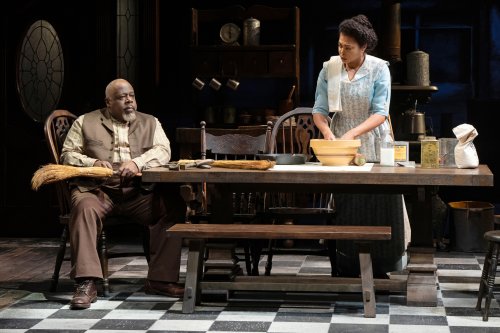
Cedric the Entertainer and Taraji P. Henson in a scene from August Wilson’s “Joe Turner’s “Come and Gone” at the Ethel Barrymore Theatre (Photo credit: Julieta Cervantes)
August Wilson’s poetic and spiritual play Joe Turner’s Come and Gone is the second entry in his Pittsburgh Century Cycle set in the second decade of the 20th century, though it premiered fourth in New York among his plays in 1988 at the Ethel Barrymore Theatre. Revived now on Broadway for the second time, the production stars Golden Globe winner Taraji P. Henson making her Broadway debut and Cedric the Entertainer returning to Broadway after his 2009 debut in American Buffalo. The cast also includes Ruben Santiago-Hudson, a long-time exponent of Wilson’s plays having won his Tony Award for Wilson’s Seven Guitars, appeared in Gem of the Ocean and directed the first Broadway production of Jitney. Debbie Allen’s production does some things better than the previous versions, and some things less well. Nevertheless, this is ultimately a powerful theatrical experience.
If you do not know who the mythical/historic Joe Turner was, you are at a disadvantage watching this play which assumes you know. “Joe Turner” was a representation of Joe Turney, brother of Governor Pete Turney of Tennessee, who in the last decade of the 19th century and early 20th century had the responsibility of taking African American prisoners from Memphis to the penitentiary in Nashville. Lining his own pockets, he would arrest African Americans along the roads to fulfill quotas and farm them out for seven years. The ballad “Joe Turner’s Come and Gone” which Wilson’s play take its name is a representation of this ugly piece of history.
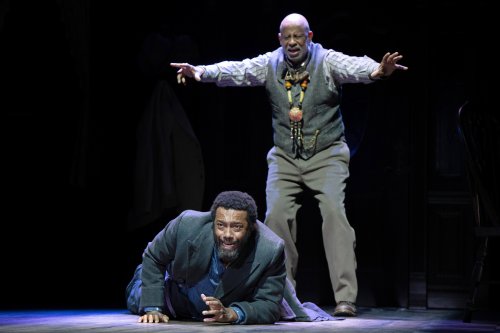
Joshua Boone and Ruben Santiago-Hudson in a scene from August Wilson’s “Joe Turner’s Come and Gone” at the Ethel Barrymore Theatre (Photo credit: Julieta Cervantes)
The play takes place in August 1911 at the respectable boarding house run by Seth Holly (Cedric) and Bertha, his wife of many years (Henson). Their residents are all Black people on their way up from the South going past Pittsburgh in the years of the Great Migration. Their longest resident is Bynum Walker (Santiago-Hudson), a conjurer man and root man who binds people together, that is helps them find their “song” or identity. People often come looking for Bynum’s services or those of peddler Rutherford Selig, “The People Finder,” a white man who stops by on Saturdays to buy the pots and pans that Seth makes in his workshop out back. Selig seems to know where everyone is living from his continual travels from town to town.
Currently also staying with them is Jeremy Furlow, a 25-year-old guitar player who has come north to find work in construction. When 25-year-old Mattie Campbell comes looking for Bynum to help her get back her boyfriend who left her after several years, she takes up with Jeremy as she cannot be without a man. Also the 26-year-old elegant Molly Cunningham turns up having missed her train to Cincinnati. An independent woman, she is Mattie’s opposite, a woman who does not need a man to complete her, her only other dictum being that she will never return south.
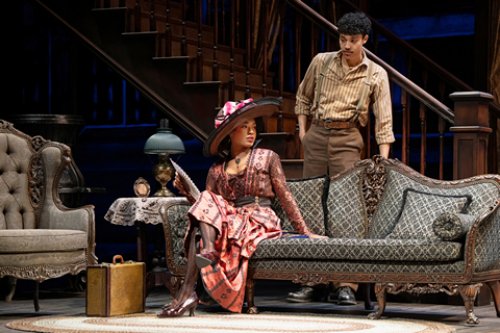
Maya Boyd and Tripp Taylor in a scene from August Wilson’s “Joe Turner’s Come and Gone” at the Ethel Barrymore Theatre (Photo credit: Julieta Cervantes)
The play centers around the arrival of Herald Loomis (Joshua Boone, Tony nominated for The Outsiders) and his 11-year-old daughter Zonia who turns up looking for a room. While Seth instantly takes a dislike to Loomis, he rents him a room for the sake of his daughter and he make him pays for it advance. Brooding, reticent and sinister, Loomis seems to have a deep story. Eventually we discover that he was captured by Joe Turner 11 years before, soon after his daughter’s birth, and was only released four years ago. When he went to look for his wife Martha, he discovered that she had gone north following her pastor and his congregation and had left their daughter with her mother. Loomis and Zonia have been on a search for her ever since.
The climax of Act I occurs when Herald returns home to the boarding house on a Sunday night and objects to the residents engaged in a singing and dancing juba at which point he has a hallucination and speaks in tongues, seeing his African ancestors. The second act ends when Loomis and Zonia’s rent having been used up they leave only to have his wife Martha (now Pentecost) show up with Selig. Loomis and Zonia are compelled to return at this moment. When she tells him that she has moved on, he goes into a rage and in the words of Bynum finds his song. This finale is as powerful as the conclusion of Wilson’s The Piano Lesson, his masterpiece.
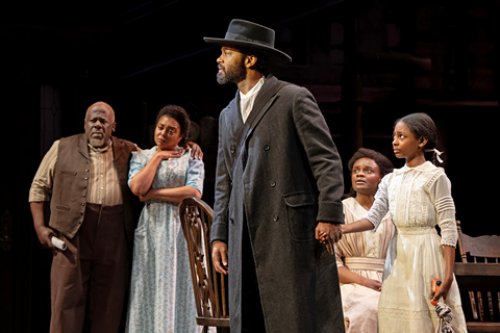
Cedric the Entertainer, Taraji P. Henson, Joshua Boone, Abigail Onwunali and Savannah Commodore in a scene from August Wilson’s “Joe Turner’s Come and Gone” at the Ethel Barrymore Theatre (Photo credit: Julieta Cervantes)
Unlike earlier New York productions, for this Joe Turner’s Come and Gone set designer David Gallo has moved the set and action up close to the audience. It is as though we have been invited into the boarding house ourselves. Surrounding the boarding house are the factories and bridges that make up Pittsburgh’s life blood. Boone is more sympathetic than previous actors who have played Herald Loomis, a troubled man but one we can sympathize with. As his wife Martha, Abigail Onwunali brings an otherworldliness that adds another level to the play. As Bynum, Santiago-Hudson also endows his character with authority, wisdom and spirituality.
As the Hollys, Henson is compassionate and good-hearted, overcompensating for Cedric the Entertainer’s gruff manner and often exasperated or outraged demeanor. Representing the next generation, Tripp Taylor as Jeremy is a man who knows what he wants but doesn’t know how to go about getting it, having met various kinds of racism in his short life. Maya Boyd’s Molly Cunningham and Nimene Sierra Wureh’s Mattie Campbell are two opposite kinds of women, one independent and on her own, the other dependent on the men in her life. Bradley Stryker as Rutherford Selig stands for much in the white race that is detrimental to African Americans but needed nevertheless. As 11-year-old Zonia Loomis, Savannah Commodore (alternating with Dominique Skye Turner) is very convincing as a girl who has been browbeaten by the adults in her life. Paul Tazewell has costumed these people to indicate their station and their aspirations in life.
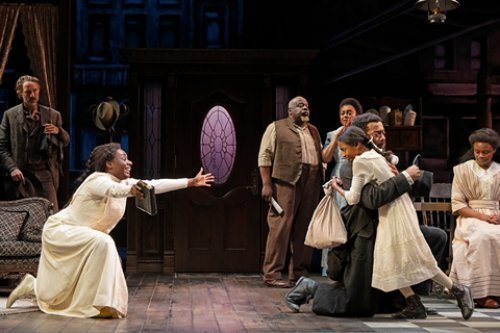
Bradley Stryker, Abigail Onwunali, Cedric the Entertainer, Taraji P. Henson, Joshua Boone, Savannah Commodore and Nimene Sierra Wureh in a scene from August Wilson’s “Joe Turner’s Come and Gone” at the Ethel Barrymore Theatre (Photo credit: Julieta Cervantes)
August Wilson’s Joe Turner’s Come and Gone depicts African American life after slavery at time when it was not a distant past but something that can still be recollected. Though the play seems to move in fits and starts, it teems with life as the various residents play out their different stories. It is excellent drama as its various age groups show us the past, the present and the future. Despite its defects, this Joe Turner’s Come and Gone is an admirable contribution to this theater season.
Joe Turner’s Come and Gone (through July 26, 2026)
Ethel Barrymore Theatre, 243 W. 47th Street, in Manhattan
For tickets, call Telecharge at 212-239-6200 or visit http://www.JoeTurnerBway.com
Running time: two hours and 25 minutes including one intermission


Leave a comment