
Beauty Freak
Leni Riefenstahl creating her Berlin Olympics film commissioned by the Third Reich is food for thought for American creatives today.
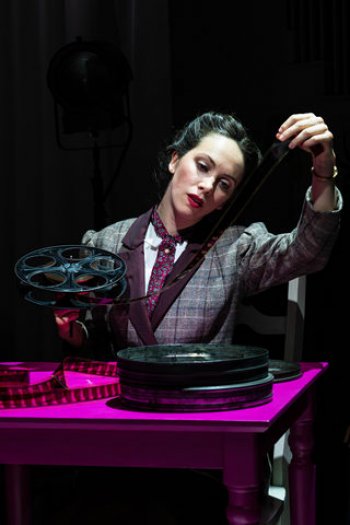
Baize Buzan as Leni Riefenstahl in a scene from James Clements’ “Beauty Freak” at the cell theatre (Photo credit: Alexia Haick)
In James Clements’ bracing and intricately wrought Beauty Freak, history is not merely recounted—it is anatomized, with a cool, glittering precision that reveals both the seductions of artistic genius and the perilous moral vacuums in which it can thrive. The subject is Leni Riefenstahl, that most vexing of 20th century figures: a filmmaker of undeniable formal daring whose legacy is forever entangled with the monstrous regime she served. What might, in lesser hands, become a didactic cautionary tale instead emerges here as something far more unsettling and alive—a drama of complicity, ambition, and the stories we tell ourselves in order to go on creating.
Clements wastes no time in plunging us into the charged atmosphere of 1938, where Baize Buzan’s Riefenstahl, poised and keenly alert, strides into the office of Joseph Goebbels with the confidence of someone accustomed to bending rooms to her will. The staging—spare, deliberate, and imaginatively configured—makes a virtue of constraint. A table becomes a platform, a boundary, a provocation; a row of actors, seated just off to the side, serves as a kind of silent chorus, their stillness amplifying the tension of each exchange. The economy of movement only heightens the sense that we are watching ideas, not just bodies, collide.
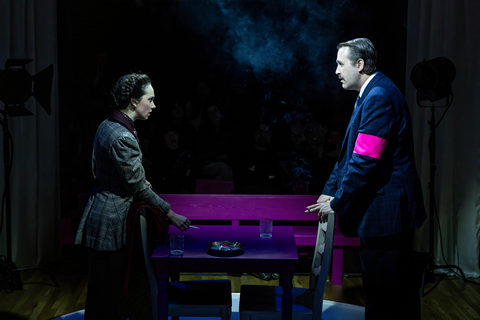
Baize Buzan as Leni Riefenstahl and Sam Hood Adrian as Werner Klingenberg in a scene from James Clements’ “Beauty Freak” at the cell theatre (Photo credit: Alexia Haick)
Buzan’s performance is the molten core around which the production coheres. She captures, with unnerving clarity, the paradox at the heart of Riefenstahl: a woman of formidable artistic vision and tireless drive, whose certainty in her own purpose shades, almost imperceptibly at first, into a willful blindness. This is not a portrait that pleads for absolution; rather, it invites us to witness the mechanics of self-justification as they unfold in real time. Buzan’s Riefenstahl is seductive, yes—flirtatious when it suits her, coolly strategic when it does not—but also increasingly hemmed in by the very narratives she constructs.
Opposite her, Peter Coleman’s Goebbels is a study in reptilian restraint, his measured cadences conveying both bureaucratic hauteur and something more insidious: the quiet satisfaction of a man who understands exactly how power operates. Their early exchanges crackle with intellectual and ideological brinkmanship, each line landing with the precision of a well-placed scalpel.
Yet as the narrative tightens its grip, the play traces, with a kind of inexorable clarity, the erosion of Riefenstahl’s artistic independence under the weight of the Nazi project—and, more perilously, her own enthrallment to Hitler. What begins as a negotiation between art and patronage hardens into something far more compromising, until the question before her is no longer aesthetic but existential: whether to hazard truth in the face of power, or to continue creating within a system that demands allegiance as its price.
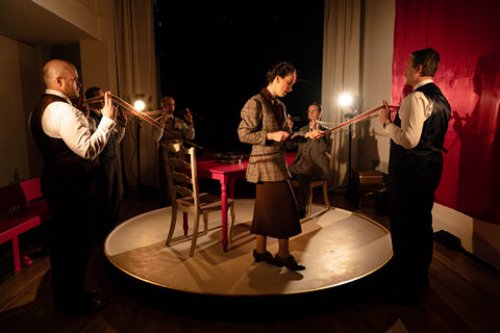
The Company of James Clements’ “Beauty Freak” at the cell theatre (Photo credit: Alexia Haick)
Set against her is Ernst Jäger, her screenwriter, confidant, and uneasy conscience, embodied by Keith Rubin with a quiet, piercing restraint, whose dilemma is at once more intimate and more immediate. Where Riefenstahl rationalizes, Ernst is forced to reckon. His choice—whether to remain at her side, complicit in the machinery she helps to animate, or to safeguard his Jewish wife from the tightening vise of persecution—carries a moral urgency that cuts through the surrounding rhetoric. In their divergence, the play finds one of its most resonant tensions: the gulf between those who can afford the luxury of abstraction and those for whom the stakes are devastatingly real.
Clements’ script, remarkably, compresses a formidable swath of history into a taut hour and 40 minutes without ever feeling hurried or pedantic. The writing is lucid yet layered, allowing complex ideas—about propaganda, aesthetics, and ethical responsibility—to surface organically through character and conflict. The recurring motif of film itself, evoked through a simple but striking device of actors threading strips of celluloid through their fingers, becomes both metaphor and mechanism: a reminder that what we see is always, in some sense, constructed.
Danilo Gambini’s direction meets the material with intelligence and restraint. His handling of language—German rendered into crisp English, accents subtly shifting with geography—creates a fluidity that keeps the audience anchored even as the play moves across continents and contexts. The American interlude, in which Riefenstahl attempts to promote Olympia, is especially deft, balancing moments of biting satire with an undercurrent of mounting dread. Her encounter with Walt Disney, portrayed by the playwright Clements, is a disarming layered cordiality that only deepens the unease. The play’s fleeting nod to Walt Disney acquires an added historical resonance when one recalls that, between 1941 and 1945, his studio became deeply enmeshed in the American war effort, producing a wide array of training films as well as anti-Nazi and anti-Japanese propaganda on behalf of the U.S. government. The irony, of course, is pointed but not heavy-handed: cinema, on both sides of the conflict, proves itself an instrument of persuasion as much as expression, a medium capable of shaping national mythologies with equal fluency, whether in the service of democracy or dictatorship.
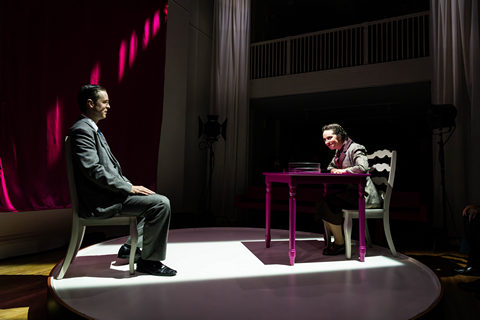
Keith Rubin as Ernst Jäger and Baize Buzan as Leni Riefenstahl in a scene from James Clements’ “Beauty Freak” at the cell theatre (Photo credit: Alexia Haick)
Of the production’s deliberately varied approaches to embodying its Nazi functionaries, it is Sam Hood Adrain’s Werner Klingenberg who proves most arresting, precisely because he resists the lure of caricature. Adrain plays him with an unnerving understatement, a kind of bureaucratic ease that suggests how seamlessly ideology can inhabit the ordinary. By contrast, Slate Holmgren’s Ambassador Dieckhoff leans into a more volatile register—the fervent, unhinged true believer—rendered with a brio that, while broader, effectively captures the manic zeal of a man wholly consumed by doctrine. Together, the performances sketch a chilling spectrum of complicity, from the quietly compliant to the rapturously extreme.
We are also introduced to Max, a gay tailor played with warmth and delicacy by Luca Fontaine, for whom both Riefenstahl and Ernst share an easy, unguarded affection. His presence, initially light-footed, acquires a sudden gravity when he is seized by the Nazis—a turn the production handles with chilling restraint. In the aftermath, Ernst implores Riefenstahl to intervene, to write directly to the Führer, in whom they still, astonishingly, place a vestige of faith. “He wouldn’t hurt a fly,” they insist, the line landing with a tragic irony that reverberates through the scene. What follows is one of Clements’s most incisive passages: the two collaborators drafting a letter steeped in the supple evasions and strategic flattery of Machiavellian rhetoric. It is language as performance, as self-deception, as a last, fragile grasp at influence. That the letter is never sent—she destroys it once she is alone, the letter becoming its own quiet indictment—is a gesture toward action that collapses under the weight of its own futility.
Design elements throughout are spare but eloquent. Suzu Sakai’s set, punctuated by jolts of hot pink, suggests both artifice and erasure—beauty pressed insistently against horror. Yung-Hung Sung’s lighting sculpts the space with evocative shadows, while Liam Bellman-Sharpe’s sound design—subtle, textural, punctuated by the soft clatter of film—threads the production together with quiet authority. Stephanie Bahniuk’s costumes delineate status and transformation with clarity, charting Riefenstahl’s evolution from tailored precision to something grander, and more troubling.
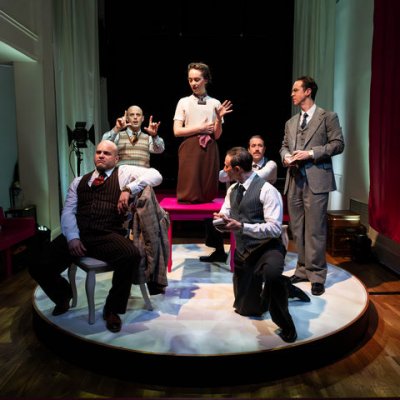
The Company of James Clements’ “Beauty Freak” at the cell theatre (Photo credit: Alexia Haick)
What lingers, long after the final moments—which are, indeed, superb—is not a tidy judgment but a series of disquieting questions. Clements refuses the comfort of easy condemnation, even as he lays bare the cost of moral evasion. Riefenstahl emerges neither exonerated nor simplified, but as a figure whose brilliance and blindness are inseparable. The play does not ask us to forgive her; it asks us to understand how such a figure could exist, and, more provocatively, what it means that she did.
It is a work of considerable intelligence and emotional force—one that grips, disturbs, and compels in equal measure. In excavating the uneasy intersection of art and ideology, Clements and his collaborators have fashioned a piece that feels not only historically incisive but urgently contemporary.
Beauty Freak (through May 17, 2026)
What Will the Neighbors Say? & the cell
Nancy Manocherian’s the cell theatre, 338 West 23rd Street, in Manhattan
For tickets, visit www.thecelltheatre.org
Running time: one hour and 40 minutes without an intermission


Leave a comment