
Fiddler on the Roof
Moving and solid 50th anniversary revival is strong on community and actors who also sing in a production that highlights contemporary relevance.
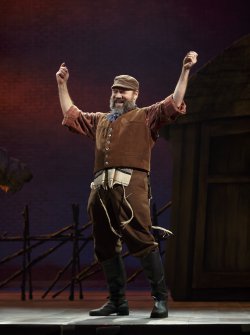
Danny Burstein as Tevye in a scene from “Fiddler on the Roof” (Photo credit: Joan Marcus)
[avatar user=”Victor Gluck” size=”96″ align=”left” ] Victor Gluck, Editor-in-Chief[/avatar]Director Bartlett Sher’s 50th anniversary revival of the modern classic Fiddler on the Roof is strong on a sense of community and dramatic values as it appears to be cast from actors who also sing and without bigger-than-life stars. Sher’s strong suit which was evident in his award-winning revivals of South Pacific and The King and I is much in evidence in this story of the Russian shtetl of Anatevka in 1905. Veterans Danny Burstein and Jessica Hecht whose names appear above the title of a Broadway musical for the first time bring a sympathetic verisimilitude rather than star wattage. This is an ensemble Fiddler and it works all the better for it.
Do not expect an exact reproduction of the original which after four revivals is probably to the good. With the consent of lyricist Sheldon Harnick, the only surviving creator, Sher has added a prologue and an epilogue that is new. When the curtain goes up, Burstein dressed in a contemporary parka is standing near an abandoned railway station in Anatevka reading from a book (the original Sholom Aleichem stories? a guide book?) and then he removes his coat revealing that he is in Tevye’s costume and joins the opening scene back in 1905. At the end of the musical, Burstein again in the contemporary parka joins the line of refugees leaving the town on their way to the border and picks up Tevye’s cart. The modern relevance to the current situation in Europe and in the Middle East is made patently clear.
This is also the first revival of Fiddler in which the Jerome Robbins estate has not required that his original ballets be recreated. Inspired by Robbins’ work, Israeli-born Hofesh Shechter has created rousing new dances for such iconic production numbers as “Tradition,” “To Life,” and “The Wedding” sequence. They have a modern sensibility and if memory serves, they seem a little less polished and more spontaneous than the Robbins ballets.

Melanie Moore, Samantha Massell, Alexandra Silber and Jessica Hecht as Golde in a scene from “Fiddler on the Roof” (Photo credit: Joan Marcus)
The inspiration for Michael Yeargin’s settings is the Marc Chagall painting which was the original inspiration for the title. In fact, fiddler Jesse Kovarsky in Chagall’s purple coat is revealed standing on a roof and flies over the set at one point. A view of the town with the houses wandering up a hill also suggests Chagall’s Russian village scenes. For the first time, the show uses a runway around the orchestra pit which is occasionally used by the dance chorus, bringing the action into the laps of the audience. However, the new set for the barn with its open slats where the townspeople are told they have only three days to leave Anatevka is uncomfortably a reminder of the Nazi’s box cars that would appear 35 years later, and the background wall of bricks during most of the village scene is a distraction.
Original lead Zero Mostel’s bigger-than-life portrayal of the hero Tevye made the show a star vehicle. Burstein’s interpretation of the philosophical Jewish milkman with five unmarried daughters who want to break with tradition and marry for love is of a little man who becomes the conscience of his community. His penchant for his talks with God when things are not going well make him both lovable and endearing, rather than a Borscht belt comedian. He is a gentle soul caught up in a rapidly changing world who realizes that the traditions of his forefathers will no longer work anymore. As his disapproving wife, Hecht also gives a full-bodied, three-dimensional performance as a harried, nervous woman with a family of seven to feed. At times she comes off as a nag, but this makes her reaction to Tevye’s “Do You Love Me” in their one duet all the more moving.
As the three older daughters of marriageable age, Alexandra Silber (Tzeitel), Samantha Massell (Hodel) and Melanie Moore (Chava) make them very different and easily distinguishable. Their trio, “Matchmaker, Matchmaker,” seems to have much more wry humor than is usual. As their suitors (Adam Kantor as Tzeitel’s timid tailor Motel, Ben Rappaport as Hodel’s radical student Perchik, and Nick Rehberger as Chava’s open-minded Russian gentile) seem less fully drawn than the sisters but they have much less stage time. Kantor’s “Miracle of Miracles” and Rappaport’s “Now I Have Everything” are exuberantly and beautifully sung. Alix Korey’s Yente the matchmaker nails every one of her laughs as she poses questions to which she seems to have all of the answers.
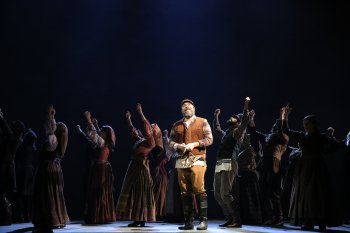
Danny Burstein (center) and cast of “Fiddler on the Roof” (Photo credit: Joan Marcus)
The lush Klezmer-tinged Jerry Bock score is beautifully played by the 22 piece orchestra under the baton of Ted Sperling and the sound design by Scott Lehrer allows all of Harnick’s shrewd and quick-witted lyrics to be understood when sung by the large cast of 38. Sher’s production team which he used in both South Pacific and The King and I also includes designer Catherine Zuber whose costumes make use of dark earth tones so appropriate for this rural community bounded by tradition. Joseph Stein’s book based on the Sholom Aleichem stories is still a marvel of storytelling and has held up remarkably well. If the show has one flaw it is that the one hour and 40 minute first act seems long, but the shorter, fast-moving second act with its many events surely makes up for it. The ending is extremely moving and will have many theatergoers on the brink of tears.
Surely Fiddler on the Roof has reached classic status by now and this 50th anniversary production (one year late) also points out its continuing modern relevance. Bartlett Sher’s revival has the depth of a straight play and may be the best sung Fiddler in recent memory. Danny Burstein, Jessica Hecht and cast make one fall in love with this musical all over again.
Fiddler on the Roof (through December 31, 2016)
Broadway Theatre, 1681 Broadway at 53rd Street, in Manhattan
For tickets, call 212-239-6200 or visit http://www.fiddlermusical.com
Running time: two hours and 55 minutes including one intermission


Leave a comment