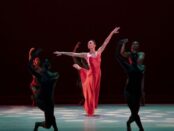
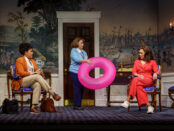
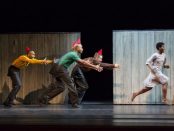
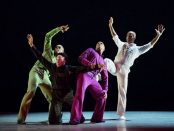
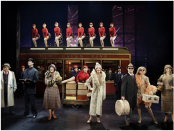
Paul Kolnik is a New York production photographer known for nearly 50 years of work with New York City Ballet, whose visual identity he helped create. A Chicago native, his portfolio also includes Alvin Ailey American Dance Theater, Broadway shows and Carnegie Hall performances.
At times the show directed by Stroman seems to be a satire or a parody, while the choreography by Bergasse mostly looks like ersatz Bob Fosse which seems inappropriate for the Marilyn Monroe story. As star Ivy Lynn playing Marilyn, Hurder seems to be doing a Megan Hilty impersonation from the TV series, rather than bringing anything new to the role. (Of course, Hilty is appearing around the corner in Death Becomes Her.) Bowman’s Karen is fine as far as she is allowed to go but the role seems underwritten. Nielsen ass The Actors Studio coach, (compared to Margaret Hamilton as the Wicked Witch of the West) is so unpleasant that you wonder why her character isn’t fired long before it happens in the story line. [more]
The second premiere was a battle of the sexes duet, “Me, Myself and You,” choreographed by Elizabeth Roxas-Dobrish to a Duke Ellington song, “In a Sentimental Mood” sung lustrously by Brandie Sutton. Caroline T. Dartey, in a long, silvery robe (costumes by Danté Baylor) rose from the floor and wandered beautifully towards a standing screen on the other side of the stage. Once unfolded, the screen was revealed to be a three-part mirror which seemed to fascinate Dartey as she almost made love to her own image. [more]
In the last few weeks I feel like I’ve been stepping back in time—in a nice way. I’ve enjoyed seeing the new Broadway musicals "New York, New York" (set in 1946-47) and (with some definite reservations, which I’ll get to shortly,) "Some Like It Hot" (set in 1933). And although the current nightclub act of Seth Sikes and Nicolas King is set in the present, most of the Great America Songbook numbers that they sing were written long before they were born; and they put those numbers across with terrific razzle-dazzle showmanship—the kind you always hope to see in clubs but all-too-rarely do. [more]
In "POTUS," Selina Fillinger’s first Broadway comedy, all is revealed by its unwieldy subtitle (“Behind Every Great Dumbass Are Seven Women Trying to Keep Him Alive”) which leaves little room for development or surprise. The repeated statement “that’s the eternal question” in answer to why none of these women are President may be the real message behind this play. As staged by famed choreographer and director Susan Stroman, POTUS is frenzied rather than funny, a problem in farce. The seven famous actresses are undone by their one-note characters which give them little to play off of or expand on. A pity considering how few Broadway comedies there are these days and the quantity of talent on stage at the Shubert Theatre. [more]
The Mariinsky Ballet performed the U.S. premiere of “At the Wrong Time,” which had been choreographed by Alexander Sergeev and had its world premiere March 26, 2019 in St. Petersburg, Russia, at the Mariinsky Theatre. The curtain rose to display a piano. A young man, Vladimir Rumyanstev, turned out to be the pianist who was waiting for a ballerina. Once she arrived, the music could begin. Eventually there were three ballerinas and three partners. The women wore pointe shoes and brightly colored dresses that were cleverly designed by Daria Pavlenko to appear simple but that allowed easy movement. Their partners wore dark shirts and pants. [more]
Tom Stoppard, our most cerebral modern playwright, has finally written a play that one would have expected from him all along. "The Hard Problem," his first play in ten years, is literally about concepts in neuroscience and its characters are psychologists, scientists and mathematicians all studying the brain. While the story and its outcome are intriguing, like many Stoppard plays, the characters are not likeable and you will find yourself not rooting for anyone. (Most likely, many real scientists aren’t lovable people either.) Jack O’Brien, who has previously directed Stoppard’s "The Coast of Utopia," "The Invention of Love," and "Hapgood," all for Lincoln Center Theater, has chosen his LCT cast without household names just as did the original London production in 2015 by Nicholas Hytner for Britain’s National Theatre. [more]
The middle work, “Walking Mad,” choreographed by the Swede, Johan Inger, has inadvertently taken on an urgency and timeliness. Always a surreal study of off-handed violence, the current tidal wave of sexual harassment revelations has given “Walking Mad”’s series of violent episodes against women an added shock value. [more]
Michelle Dorrance, this troupe’s director, has become a force in tap dance because she understands both its legacy and its future. She played Pied Piper to a large troupe of very talented dancers who were all given opportunities to shine and create moods that varied from sexy to flirtatious to hilarious and sad. With additional choreographic contributions by Ephrat “Bounce” Asherie and Matthew “Megawatt” West—fine soloists—“Myelination” ebbed and flowed as soloists floated out of groupings of the twelve dancers to express themselves in brilliant bits that combined tap with modern dance, jazz, break dancing and even a touch of ballet. [more]
The three-part ballet is considered Balanchine’s tribute to the three major artistic influences in his professional life: the French school, the Russian school and, of course, his own American style of classical ballet as taught in his School of American Ballet in Lincoln Center. Therefore, it was not just logical, but inspired, that the Paris Opera troupe would dance the dreamy “Emeralds” to Gabriel Fauré, the New York City Ballet, the fresh and jazzy “Rubies” to Igor Stravinsky, and the Russian troupe the very classical “Diamonds” to Piotr Ilyich Tchaikovsky. [more]
“r-Evolution, Dream.” was a jaunty new ballet by Ailey member Hope Boykin to music by Ali Jackson plus narration spoken by Leslie Odom, Jr. which included a Shakespeare sonnet, “A Negro’s Complaint” by William Cowper, “If I Can Help Somebody as I Pass Along” by Alma Irene Bazel, etc. This delightful romp pitted four groups of dancers against each other, occasionally joining forces, particularly in a fleet finale in which the lines interwove and “interbred.” The dancers—including members of Ailey II—were defined by the color of their chic costumes (black, white, purple and green, designed by Ms. Boykin) all led by Ailey veteran, Matthew Rushing whose Pied-Piper performance gave a center of gravity to what might have been a pleasantly disorganized entertainment. Standing out was Megan Jakel whose whirling, undulating solo evoked spontaneous applause. [more]
The annual School of American Ballet Workshop performances are more than occasions for fundraising. They are a chance to see the next generation of classical ballet dancers in what we hope will soon be their native habitat, the stage. The programs are optimism incarnate, an opportunity to believe in the future of dance. [more]
The Lincoln Center Theater revival of Rodgers & Hammerstein’s The King and I is a provocative, eye-filling and poignant experience. Both younger and older theater writers and audience members can learn a good deal about how to tell a story on stage that is both emotionally moving and makes you care about the characters from Rodgers & Hammerstein’s expert storytelling. "The King and I" will send you out of the theater feeling that you have had a fulfillingly memorable experience filled with unforgettable songs, dances and theatrical moments. [more]
Some of these great old songs will be unknown to the average theater-goer of today; they are so old they might as well be new. And they are a joy to hear. What a treat it is, for example, to hear Jelly Roll Morton's "Good Old New York." This is a superior melody by a major jazz composer. It will be new to most audience-members. It's done with respect and flair. And it's a just a pleasure to hear. That number is over all too soon. [more]
Doyle's innovative approach dispenses with set changes while placing the action in a black and white arena that suggests a dreary psychiatric ward. The story begins with a terrified young man in a straitjacket surrounded by people in white robes. As he sings the musical's opening words "Attend the tale of Sweeny Todd," we are summoned into his disturbing world. There is no turning back. The effect was as if someone had snapped a whip and commanded our attention.
[more]