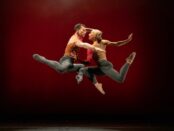
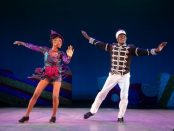
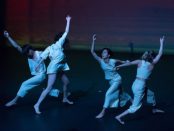
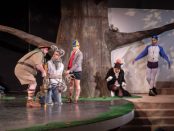
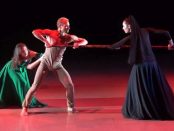
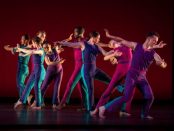
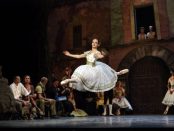
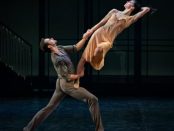
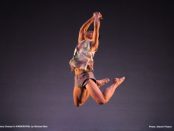
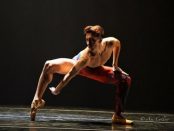
Parsons’ first work on the program was the tour de force solo “Balance of Power” performed by the phenomenal Zoey Anderson. Clad in Barbara Erin Delo’s brilliantly colored tight costume—the bright red left sleeve particularly inventive—Anderson first appeared upside down in a golden spotlight. (Lighting by Chambers.) As she turned right side up, she began undulating to Giancarlo De Trizio’s sparkling score, her body reacting to every nuance of the quite rhythmic music. Parsons unloaded hundreds of difficult tiny movements on her which she performed with skill and allure, stopping the show with her quickness and sensuality. [more]
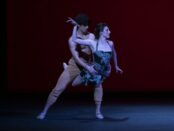
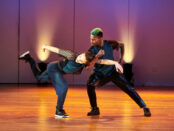
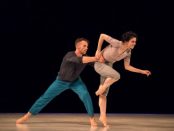
After a pause, there was the world premiere of "Second Duet." It was the most dramatic and emotional dance of the program. Wearing sneakers and casual sportswear, Cassandra Trenary and Aran Bell of American Ballet Theatre were the handsome couple whose tempestuous and turbulent relationship ranged from argumentative to violent to clinging and physically dependent. Tharp’s choreography included complicated partnering in which elements of the relationship were uncomfortable and disturbing, or sometimes amusing (as an example, Trenary stood solidly and dared Bell to just try and pick her up). Without an actual story line, the dance was emotionally charged, revealing and riveting. Trenary and Bell gorgeously performed the complex choreography. Looking more like members of a modern dance troupe than classical ballet dancers, they brought emotional depth as well as physical ability to this taxing piece of work. A modern music mix by Thomas Larcher and Aztec Camera played by the musicians Stephen Gosling (piano) and Gabriel Gabezas (cello) was sometimes as appropriately discordant as the relationship. [more]
For something completely different, New York City Center commissioned and presented Ayodele Casel’s tap dance company for the world premiere of "Where We Dwell." A crowd-pleasing, often rousing production of tap-dancing choreography, it highlighted the various ways that tap dancing can entertain and enlighten. Amplified, it was astonishing to hear all the sounds created by tap shoes on the feet of extraordinarily gifted dancers. [more]
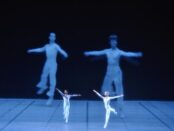
Before the dancers appeared live, "Dance" commenced with a burst of Glass’ iconic, pulsating music—here pre-recorded, originally performed live—and a still from LeWitt’s original video projected onto a scrim which covered the entire stage opening. LeWitt’s videos, intimate contributions to the work, also served to honor the performances of the original cast: Childs, Graham Conley, Cynthia Hedstrom, Erin Matthiessen, Daniel McCusker, Susan Osberg, Judy Padow, Ande Peck and Megan Walker. [more]
The final work on Program 1 was its finest. A.I.M. By Kyle Abraham presented its director’s “Our Indigo: If We Were a Love Song,” a deeply moving paean to the darker meanings of love. It was choreographed to Nina Simone’s glorious renditions of six songs in which she wrapped her moving contralto around the lyrics of “Don’t Explain,” “Black is the Color of My True Love’s Hair,” and “Little Girl Blue.” The opening moments found the seven-member cast gathered in a dramatically lit upstage corner—moody lighting designed by Dan Scully—bending and reaching, dispersing only to return to their sculptural starting image. [more]
The dances on this program are perfect examples of the Denishawn aesthetic which combined what was then exoticism with impeccable theatricality. The Denishawn troupe was very much of its time, the early twentieth century. The modern dance giants that came out of this artistic sensibility—Martha Graham, Doris Humphrey and Charles Weidman in particular—revolted against the exoticism to find a modern way of expressing themselves through movement, the way that artists who were their contemporaries put distance between them and the Impressionists. These modern dance pioneers learned the ins and outs of dramatic presentation as they forged new dance forms. [more]
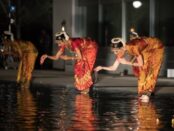
As the opaquely complicated plot played out on the stage, the three lead dancers (Ranee, Aparna and Ashwini Ramaswamy) took turns displaying impeccable Bharatanatyam technique: feet adorned with ghungroos (ankle bells), softly pounding out clear rhythms in varied positions, arms, exquisitely expressive, moving in striking patterns topped by constantly changing hand positions (mudras) which communicated character, mood and, to some extent, the story as it unfolded. [more]
It’s unlikely that New York City will ever see these five troupes sharing a stage again. This was a festive occasion despite being uneven in tone and not particularly representative of at least two of the large dance companies. Pretentious program notes were fortunately only available online so that they couldn’t mar the visceral enjoyment of several of these works in Program One. ... Each evening of the BAAND Together Dance Festival will feature a different program with contributions from each of these five wonderful dance companies. [more]
“Sea,” according to Magloire’s program notes is “loosely inspired by the movement of waves.” Five dancers—Anabel Alpert, Megan Foley, Amber Neff, Rachele Perla and Alison Tatsuoka-dressed in Sarah Thea’s beautifully flowing blue costumes, certainly moved in ways that were wavelike, but they also seemed to be performing a constantly shifting ritual that eased from quietly intense to agitated and back—from languor to vigor. [more]
Ephrat “Bounce” Asherie, the artistic director of the effervescent Ephrat Asherie Dance (EAD) has absorbed the disciplines of a number of dance forms: hip-hop, breaking, Latin-American and Vogue. She skillfully and wittily scanned all of these into Odeon, a 105-minute long work that showed off her six member troupe. They—including Asherie—danced with a verve, if not native authenticity, that matched the Brazilian-tinged score by Ernesto Nazareth, here interpreted by an on stage four-member band under the musical direction of Ehud Asherie. [more]
Now directed by the energetic and warm Enrique Cruz DeJesus, Alpha Omega provided welcome relief from months of quarantine and angst with “Solo Suites,” a breezy—in every sense of the word—outdoor, healthily spaced program created by three choreographers who have had the privilege of working in this inviting space, a beautifully appointed home base in the East Village.
Now directed by the energetic and warm Enrique Cruz DeJesus, Alpha Omega provided welcome relief from months of quarantine and angst with “Solo Suites,” a breezy—in every sense of the word—outdoor, healthily spaced program created by three choreographers who have had the privilege of working in this inviting space, a beautifully appointed home base in the East Village. These three choreographers presented four solos as the carefully spaced, masked and wine imbibing audience watched as breezes swept up the costumes. After calmly (and professionally) enduring a minor audio snafu, Ari Mayzick opened the program with his “Orphée,” a tense study of grief, an intense take on the Orpheus and Eurydice legend. [more]
“Rooms2020” was to have been presented in a live season which was aborted by the current Covid crisis. Instead, the troupe has presented the work artfully streamed in a version that is more realistic, each section filmed by the dancers themselves and edited with artistic precision and a feeling for its dramatic arc by associate artistic director Lauren Naslund to make a cogent whole. (The other directors are the founder Jim May, Samantha Geracht and Eleanor Bunker.) [more]
If one were to come to conclusions about the Netherlands after seeing the three ballets presented by the Nederlands Dans Theater at the New York City Center, the Netherlands would clearly come off as a place of doom and gloom where relationships are expressed by tossing each other around or totally avoiding contact. This world-class dance troupe is always welcome, but one has to wonder who programmed this mini-season. Of course, the company’s artistic director Paul Lightfoot who co-choreographed one of these works has to have been the driving force in putting this show together. [more]
Ballet Vlaanderen was founded in 1969 by dancer/choreographer Jeanne Brabants, and the present artistic director since 2015 is Sidi Larbi Cherkaoui, who is known for his own award-winning choreography. Under his direction, the Flemish company, based in two places, Antwerp and Ghent, is dedicated to creating innovative new pieces and bringing important works to the stage. Stylistically, the company bridges the gap between ballet and modern dance. For their presentation at The Joyce Theater (March 3-7, 2020), Ballet Vlaanderen danced three pieces: "Kaash," "Faun," and "Ten Duets on a Theme of Rescue. " [more]
Hosted by the Graham Company’s elegant director Janet Eilber, the program began with some historical comments after which two groups of dancers, one representing the Graham technique from Graham 2 and the other the Cunningham technique from the Merce Cunningham Trust entered the large studio/theater. They performed parallel exercise routines, the Graham side guided by Virginie Mécène, Graham 2’s director and former Graham star and the Cunningham contingent guided by two former Cunningham members Jennifer Goggans and the aforementioned filmmaker Madoff. [more]
“The legend returns” claimed the fliers and posters for "Matthew Bourne’s Swan Lake"’s short season at the New York City Center. That proclamation wasn’t far from the truth. "Swan Lake" is definitely Bourne’s most famous and prolifically performed work from a repertory that includes "Edward Scissorhands," "Sleeping Beauty" and "The Red Shoes," all having made touchdowns in New York City with varying success. Only his "Swan Lake" has caught the imagination of audiences throughout the world despite its daring take on a beloved classic. [more]
A recent iteration of the classic ballet "Swan Lake" was staged by Derek Deane and danced by the Shanghai Ballet and presented by the Shanghai Ballet with China Arts and Entertainment Group Ltd. at the David H. Koch Theater at Lincoln Center. The company called their version "Grand Swan Lake" because it promised to be bigger than any other, at least in the number of dancers on the stage. But was bigger any better? Actually, yes. I assumed that using 48 swans was just a gimmick to get attention, but it was a very effective dramatic device. Forty-eight white tutus in moving formation was impressive, and in the last act, all those swans magically rising up through the fog was really breathtaking, a memorably dramatic visual. [more]
Rennie Harris Puremovement American Street Dance Theater exploded onto the stage with raw vitality. Harris, who choreographed most of the works, combined various styles of street dancing (mostly hip hop). His dancers were diverse, athletic, very, very energetic, full of personality and thoroughly entertaining. [more]
The music included the catchy, familiar tunes of "The Nutcracker Suite" by Peter Ilyich Tchaikovsky, first featured in classical ballet. The Dorrance version uses the absolutely wonderful jazz arrangement by Duke Ellington and Billy Strayhorn. No doubt the music would have been enhanced with a live orchestra, but one assumes that there was neither the budget nor the space for a Big Band orchestra. Nonetheless, the music is a marvelous interpretation, providing the perfect accompaniment for tap dancing – and certainly worth hearing again on its own. On occasion, however, there is no music, just the rhythmic sounds of tap dancing providing its own accompaniment. [more]
Israeli-born choreographer Zvi Gotheiner created "Maim ('Water' in Hebrew)," a somber meditation on water, drought, misery, community and survival for seven members of ZviDance, all brilliant dancers with clearly defined personalities. Somehow, in under an hour, Gotheiner managed to dredge up memories and images of his early life on a kibbutz and how valuable water was in the life of his community. That, added to the current climate crisis’ causing drastic drought concerns, stimulated him to produce "MAIM ('Water' in Hebrew)." [more]
His more abstract ballets for The Chase Brock Experience, such as its current presentation at Theatre Row, "The Four Seasons" to the Vivaldi score (a revival from 2006), did not fare quite as well. Despite the fact that "The Four Seasons" had some spoken text (by David Zellnick) and an environmental subtext, the majority of the work was a pretty, but slightly anemic balletic expression of the famous (over-used?) score. [more]
Artistic director Enrique Cruz DeJesus presented a performance of Alpha Omega in preparation for the troupe’s fiftieth anniversary season next year. This concert featured two works by the brilliant modern dance choreography Eleo Pomare whose works have, for some reason, been neglected for years. Mr. Cruz DeJesus also presented two of his works, “Bittersweet” and “Tormenta.” [more]
Tiffany Mills’ "Not then, not yet," a world premiere dance/theater work at The Flea proposed a dark, slightly chaotic view of relationships and alienation choreographed on her own troupe, the Tiffany Mills Company. Only 45 minutes long, Not then, not yet was dense with activity and glum interactions among the six dancers (including Mills) and singer Muriel Louveau who composed the erratically performed score, co-written with Angélica Negrón. [more]
The first piece on the program was the most successful of the three: Mark Morris’ “The Letter V”. (There was no mention of any specific meaning of the title.) The classical music composition “Symphony No. 88 in G Major” by Joseph Haydn provided a substantial underpinning for the choreography because Morris had a beautifully uncanny way of making the movement seem to rise up from the music. The Orchestra of St. Luke’s, conducted by David Briskin, provided the fine, live, performance. Morris, in fact, always insists on live music, and that added so much to the experience. [more]
Last seen in New York in 2017, Danish choreographer Mette Ingvartsen has brought a newish work, "to come (extended)" to NYU Skirball Center. To come (extended) is actually a reworking and expansion of an earlier work. Unfortunately, Ms. Ingvartsen appears to be in a rut, a deep, monotonous sexual rut. She considers herself the one-woman expert analyzer of all things sexual via her repetitive choreography. Indeed, her work includes nudity and explicit sexuality (all forms of intercourse between every combination of genders, oral sex, group sex, etc.) all extremely unexciting, in fact, quite boring. [more]
Monica Bill Barnes totally changed the mood with her thoroughly delightful “The Running Show” which used physical contests as a metaphor for dance. Barnes stood in the midst of sixteen students from Hunter College as her creative partner, Robbie Saenz de Viteri acted as a sports announcer, egging the large group on as they performed complicated patterns of finger snapping. Saenz de Viteri was the backbone of “The Running Show,” his narration, in turn witty, humorous and deeply thoughtful, drove the action which included more competitions; Barnes trying to beat her turning record; and an appearance of a young ballet dancer, Charlotte Anub. She was clearly too young to dance on point, but she had a natural stage presence as she turned and performed basic pointe work, charming the audience. “The Running Show” left a positive buzz in the audience, casting a quiet spell. [more]
The final work, “Unveiling” by Sonya Tayeh, director of Tayeh Dance, known now as the choreographer of the Broadway hit 'Moulin Rouge!," used a trio which appeared to be about a female (the American Ballet Theatre star, Stella Abrera) an interloper interfering with a gay relationship between Robbie Fairchild (formerly of the New York City Ballet and the star of An American in Paris on Broadway and the West End in London) and Gabe Stone Shayer. What made “Unveiling” the hit that it proved to be was the music performed live by the super-humanly talented Moses Sumney who stood on a small platform singing, wailing, thumping, rattling and otherwise issuing a spectrum of gorgeous sounds that supported Tayeh’s complicated portrait. [more]
The Mariinsky Ballet performed the U.S. premiere of “At the Wrong Time,” which had been choreographed by Alexander Sergeev and had its world premiere March 26, 2019 in St. Petersburg, Russia, at the Mariinsky Theatre. The curtain rose to display a piano. A young man, Vladimir Rumyanstev, turned out to be the pianist who was waiting for a ballerina. Once she arrived, the music could begin. Eventually there were three ballerinas and three partners. The women wore pointe shoes and brightly colored dresses that were cleverly designed by Daria Pavlenko to appear simple but that allowed easy movement. Their partners wore dark shirts and pants. [more]
Antoine de Saint-Exupéry’s "The Little Prince" (1943) has been studied, analyzed, and staged as any number of plays, ballets, musicals and an unsuccessful film. So, it was with great interest that I went to BalletX’s The Little Prince choreographed by fast-rising choreographer Anabelle Lopez Ochoa to a brilliant score composed and miraculously played by Peter Salem. BalletX, directed by the forward looking Christine Cox, is a modern ballet troupe stationed 90 minutes south of New York in Philadelphia. The troupe combines classical ballet with modern dance and, in the case of the Little Prince, mime, singing, speaking and twisty modern dance. [more]
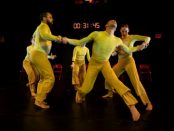
Co-presented by The Theater at the 14th Street Y, '…it’s time…" explored the dynamics of a small group of five—excellent—performers whose existence appeared to be controlled by a large digital countdown clock that frowned down upon them from the back wall. They were all dressed in tight outfits in shades of yellow, uniforms designed by Mondo Morales.To a stark, ingenious percussive score by Dani Markham, co-arranged and played brilliantly by drummer Price McGuffey situated high above the stage in his own cubbyhole, the dancers meandered onto a stage occupied only by five red folding chairs in a neat row. The score ranged from clicks to drum rolls to bossa nova rhythms. [more]
Quite simply, Rubberband, the Montreal-based dance troupe’s season at The Joyce Theater was a spectacular success. Directed by Victor Quijada, Rubberband performed his "Ever So Slightly," a 75-minute investigation of contemporary angst staged to original music by Jasper Gahunia and William Lamoureux, played live. "Ever So Slightly" came at the audience in waves, starting with calm, gentle waves and ending in a tsunami of roughness and near anarchy. [more]
Presented at Lincoln Center’s David H. Koch Theater by the China Arts and Entertainment Group Ltd., the company used its impressive resource of dancers in two large-scale ballets: "Goddess of the Luo River" choreographed by the Canadian, Peter Quanz to a Western-sounding violin concerto by the Chinese composer Du Mingxin and "Carmina Burana" choreographed by the Chinese national, Jiang Qi to the famous (infamous?) score by Carl Orff.The former was a run-of-the-mill ballet weighed down by fuzzily pretentious program notes. Three characters—Yi Ren (Fang Afang), Lian Jun (Huang Baimao) and Ruo Shui (Ma Minghao)—led the corps de ballet in several merry chases that involved processions, movements rolling down lines of dancers, non-romantic encounters and show-off solos by the male contingent, all ending in a pretty arrangement of the dancers across the Koch stage with one of the characters held imposingly high as if overlooking her kingdom. [more]
The fourth piece, titled “3 with D” was choreographed by Javier de Frutos and was the only performance that included live music. Patrick Gallagher was on piano in front of the stage and Dan Gillespie Sells sang and played guitar center stage, simply and straightforward, making the most of music, which was a compilation of songs by Ivor Novello, George Gershwin, and Cole Porter. Next to Sells were two chairs – something of a “set” compared to the other bare-stage designs. Danced by Watson and Fairchild, it was more of a drama than any of the other pieces. Although there was little linear plot, it was a gay love story. The familiar lyrics of Gershwin’s “The Man I Love” had a different connotation when referring to two men. The two performers were such gorgeous dancers, and very similar body types, so when they moved in synchronistic unison, it created a beautiful effect. [more]
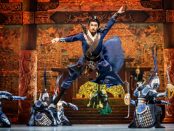
Lincoln Center’s Mostly Mozart Festival 2019 presented the lavish, yet somehow intimate, "Under Siege," a stunning production of the Yang Liping Contemporary Dance Company of China.Its chief choreographer and director Yang Liping had the audacity to put on stage an epic tale of an ancient war, the Chu-Han Conflict that pitted hundreds of thousands against each other. Her brilliant idea was to concentrate on each of the leading characters in the conflict and, by telling their fascinating stories, thereby revealing the immensity of war and its ghastly consequences. [more]
Joseph Sissens in Sir Frederick Ashton’s “Dance of the Blessed Spirits,” in The Joyce Theater’s Ballet Festival (Program A) (Photo credit: Maria Baranova)The Joyce Theater is presenting a two-week Ballet Festival, four programs under the artistic direction of Kevin O’Hare, director of The Royal Ballet. Each program is curated by a different dance expert, the first by O’Hare, himself.Program A was divided into two parts, the first the more sedately classical, the second showing newer, more contemporary fare. It was a fascinating, focused study of the state of ballet today, featuring, appropriately, two works by the British master of classical ballet, Sir Frederick Ashton. [more]
Co-conceived by Asante and Kenrik “H2O” Sandy who choreographed and directed the production, "Blak Whyte Gray" was constructed in two parts and three sections. Part I began with “Whyte,” danced by Ricardo Da Silva, Gemma Kay Hoddy and Nicole McDowall dressed in variations on straitjackets. (Sleek, pale, layered costumes by Ryan Dawson Laight.) All three were trapped in a rectangle of light which gradually shrunk making their already frantic movements even more so. The music boomed as they vibrated, twisted, pulsated and stopped with dramatic suddenness. This was desperation of the highest order. [more]
How Freddie resolves his amorous adventures is cleverly handled by Blackstone using an imaginative combination of ballet, modern dance, mime and popular dance forms. The score is made up of over twenty songs including: “Why Do Fools Fall in Love?.” “Dream Lover,” “We Are In Love,” “Bei Mir Bist Du Schoen,” “La Valse á Milles Temps,” “Makin’ Whoopee,” “I’ll Be Seeing You,” and a song written and performed live by Mike Brun. [more]
Russian-born Maria Kochetkova, the petite ballerina who spent the major portion of her career with the San Francisco Ballet, has turned herself into a small-scale Diaghilev. Her Maria Kochetkova: Catch Her If You Can at The Joyce Theater is a gathering of five brilliant dancers (including herself) dancing the works of seven contemporary choreographers.Even with her name on the program, Catch Her If You Can was pleasantly un-self-aggrandizing, feeling more like a—very expensive—jam session.So ego-free was the evening that Ms. Kochetkova clearly felt no reluctance to pair herself with Drew Jacoby in Jacoby’s duet “Rachel, Nevada” choreographed to an eerie score by Sam Spiegel. [more]
The world premiere “Sport,” choreographed to more than twenty bits and pieces by Erik Satie, appropriately named “Sports et divertissements” (played by the brilliant pianist Colin Fowler), was a not very exciting examination of every competitive sport from golf to sailing to swimming to running to tennis to etc. Dressed in Elizabeth Kurtzman’s colorful one-piece overalls, the cast of twelve imitated in both exaggerated and subtle ways these activities, sometimes in silence and sometimes to the Satie music. Morris is imaginative enough to turn athletics into dance, but the work was simply too episodic and disjointed even with his use of repeated motifs—like dancers being dragged across the stage on large swaths of cloth—to give the work some unity and form. The end result was more of beautifully crafted mime than a full-fledged ballet. [more]
The second part of the program was a bonanza of Bournonville excerpts, danced to not particularly memorable scores, that worked well even without colorful scenery. The beautiful, colorful costumes, arranged by Katharina Neergaard certainly helped, particularly in “The Jockey Dance” from From Siberia to Moscow danced exuberantly by Marcin Kupinski and Alexander Bozinoff dressed in brilliant red jockey duds. The only criticism: they might have looked less glum in their facial expressions. [more]
Whatever Glover discussed in the opening – about identity and wearing masks – may have been relevant, but the program could be seen simply as a revue. A wide variety of recorded music was played. The first music sounded like something you’d hear in a French café, and in fact was recorded by a group called French Café Ensemble. Other musical styles included classical (Bach), jazz, pop, salsa, Trinidadian, hip hop, and more, performed by Quincy Jones, Stevie Wonder, Bjork, and others. The dancing paralleled the music. Special mention must go to Brandon Stirling Baker whose lighting design created the changes in atmosphere, subtly separating the numbers. [more]
By placing his ballet in the realm of the high-strung ballroom world, Eifman supplied himself plenty of excuses to make dances that bounced about the stage to his score of a parade of waltzes, polkas, marches and bits and pieces of the output of some of the many “Waltz King” Strausses (Johann the Son, Josef and Eduard) with one interlude of Mozart tossed in at the end. [more]
Having its world premiere, “Radical Beasts in the Forest of Possibilities” is a collaboration of choreographer Francesca Harper with iconic composer/performer Nona Hendryx and the dancers. Hendryx performs live on piano, along with digitally recorded sounds and music (the piano sections are more satisfying than the digital ones). The costumes by Epperson are made up of layered fabric that suggest a ragged look which is appropriate to the theme described in the program about reaching for contact in a world where time is fractured. The hardworking dancers include Jacqueline Bulnes, Terrence D. M. Diable, Mariah Gravelin, David Glista, Jesse Obremski, Frances Samson, Lauren Twomley and Mark Willis. [more]
Michael Mao Dance is celebrating 26 years of presenting Mao’s work and if his recent program at the Ailey Citigroup Theater is any evidence, there is reason to believe he will continue for another 26 years. His works are varied, yet clearly come from the mind of the same artist. [more]
"Pepperland," however, will not do anything for Morris’ reputation as a choreographer. His dearth of choreographic invention—including constant repetition of a few steps, gestures and partnering tricks—was hidden behind colorful period costumes (Elizabeth Kurtzman), an odd set consisting of piles of reflective ribbons (Johan Henckens), inspired lighting (Nick Kolin) and fantastic arrangements of songs from the Beatles’ landmark 1967 "Sgt. Pepper’s Lonely Hearts Club Band" album (Ethan Iverson). There’s something to be said for simplicity, but if it were not for the other elements "Pepperland" would not hold up to some of his other ingenious masterpieces like "Grand Duo," "Dido and Aeneas" and his superb "L’Allegro, Il Penseroso ed il Moderato." [more]
The evening consisted of a number of short dances in varying styles, but the final piece, “Valse Triste,” was the most successful. Osipova wore a simple, off-the-shoulder, blue dress and Hallberg wore a form-fitting unitard designed by Moritz Junge. “Valse Triste” by Jean Sibelius was the music for the plotless ballet. Choreography is an elusive art, but Alexei Ratmansky seems to have understood its secrets. Using the language and conventions of classical ballet, he designed this piece specifically for Osipova and Hallberg, and it showed off their exceptional talents and finely tuned partnership – and beautifully shared the joy of the dance with the audience. It’s the kind of short pas de deux that lends itself to gala events, so there’s little doubt that it will show up again. One wishes it were longer (it’s only six minutes). Or it would have been a wonderful treat to watch again if they had repeated it. [more]
Belilove, who has taught Sara Mearns of the New York City Ballet to perform some of these works, divided the concert into dances to Schubert, Chopin, Brahms and Scriabin, all original Duncan choreography staged by Belilove who has devoted her life to inspiring the public with Duncan’s repertoire The the evidence was in the beautiful dancing of her troupe of six: Becky Allen, Hayley Rose, Faith Kimberling, Emily D’Angelo, Nikki Poulos and Caroline Yamada. [more]
The Experimental Theater Space at the Abrons, a not particularly large black box, was turned into a complex construction site by the "Tilt" creative staff, a truly unique interactive set. Above the audience hung a crooked runway along which a ball was occasionally mysteriously rolled. The ball eventually hit some metal gongs and went on to roll down a Rube Goldberg like contraption and onto the stage floor. [more]
Produced in New York City by the China Arts and Entertainment Group Ltd., "Princess Zhaojun" was performed by the members of the China National Opera & Dance Drama Theater. It was directed seamlessly by Kong Dexin, written with as much subtlety as possible by Yu Ping and brilliantly choreographed by four artists—Tian Ye, Tian Zhuang, Jia Guozhu and Wu Sha—whose collective ability to find emotion even in the movements of large groups of dancers was uncanny. [more]
The Camagűey troupe danced Ruiz’s work as if born to his vigorously eclectic style. His choreography is an amalgam of ballet, modern dance, break-dancing, folk dancing and Latin ballroom. He seems to be influenced by the work of Nacho Duato (himself a Jiri Kylian protégé) with his complex, body-interlocking lifts, bent torsos and a step-to-every-note. [more]
Unlike the company’s 2016 luxuriously staged "Les Fêtes Vénitiennes," also at the Gilman, "Rameau" was purposely staged by Sophie Daneman as if in a village square, simply but effectively, the “effects” improvised as only peasants would: entrances to temples and heaven were curtains stretched between two poles; Jupiter appeared in a high stage box as an improvised Mount Olympus; a dancer as a god glided bare-chested undetected amongst the celebrating peasantry. According to the program, this type of performance is called “théâtre de la foire” (theater of the fair). [more]
In “Star Dust,” a 2016 ballet tribute to David Bowie, Rhoden displayed his mordantly campy side in a series of scenes, each devoted to a famous Bowie number, beginning with Brandon Gray leading the company in “Lazarus,” setting the format for the rest of the ballet. His face streaked with makeup, his hair aglow with color, Gray prowled proudly about the stage mouthing the words that Bowie sang. He seemed very satisfied with himself. [more]
BalletNext is a company founded by Michele Wiles, former prima ballerina of American Ballet Theater. Wiles has developed a symbiotic relationship with the University of Utah where she trains professional ballet dancers who are simultaneously getting degrees in various fields. In exchange, she has bodies on which she can develop her skills as a choreographer. And she arranges public performances, giving her students real stage experience. These performances always include live musicians, which is a particular pleasure compared to so many companies that use canned music. [more]
This wasn’t just a political statement about gender stereotypes, but a sensitive work of art that made its points through fine choreography, costuming, lighting (smartly designed by Jennifer Hill, creating a wide range of ambiances) and music. Half-Heard accomplished this without beating the audience members over the head. [more]
The two directors/founders of BalletBoyz, Michael Nunn and William Trevitt, directed and photographed the film which also included Pérez’s choreography. Although the movie certainly illuminated the dark themes for a screen-crazy audience, it too often was a distraction when the dancers were performing in front of the screen, spread out across the Joyce stage. Having to choose between the live and the filmed action became a problem even though both were of equal technical merit. [more]
Part of the tradition is the audience’s response. There was hooting and hollering from the audience, sounding like they were at a rock concert, but it was impossible not to get caught up in the enthusiasm. The general raucousness was a display of the clear delight that the audience enjoyed. It created an atmosphere of unbridled joy and who could resist? Everyone was smiling and laughing and clapping. [more]
Directed with touching simplicity by Henry and choreographed with a lyrical flow by Lorna Ventura, this Anne tells the well-known story utilizing a combination of voiceover readings, projections, dance, mime and fine acting. Henry has turned Anne into a dance play with an original take on this oft-told tale of a spunky, intelligent and witty young lady guarded by a mute Greek chorus of four who reflect and illuminate her inner thoughts and feelings. [more]
Casual strolling was suddenly punctuated by dancers bumping and grinding at each other, these full-bodied movements resonating in slightly different ways in each dancer, sometimes leading to entwining, slithering, sweaty duets. Faces displayed over-the-top grimaces and uneasy forced smiles which led to desperate, phony-sounding laughing. Arms were swung or used to produce angular silhouettes with studied nonchalance. Bodies twitched and twisted to staccato beats—music composed and arranged by Ori Lichtik whose score for “Love Chapter II” began with barely audible electronic beats which grew in volume and speed until the score suddenly became a Latino Cha-Cha to which the dancers seemed to glory. [more]