
Crazy Mama: A True Story of Love and Madness
Linda Purl dazzles in a beautifully written, deeply moving solo drama, transforming one family’s ordeal with mental illness into theater of rare grace.
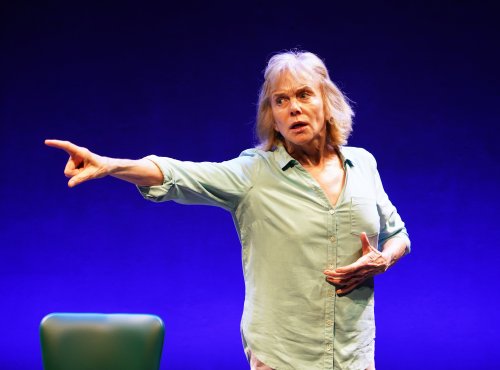
Linda Purl in a scene from Sharon Scott Williams’ “Crazy Mama: A True Story of Love and Madness” at 59E59 Theatres (Photo credit: Carol Rosegg)
There are solo plays that announce their virtuosity as if awaiting a medal, and then there are those in which virtuosity becomes so completely absorbed into storytelling that the technical feat disappears. Crazy Mama: A True Story of Love and Madness, Sharon Scott Williams’ affecting stage adaptation of her memoir featuring Linda Purl, belongs emphatically to the latter category. Now at 59E59 Theaters in a Rubicon Theatre Company production, sensitively directed by Anson Williams, the play recounts a childhood abruptly rearranged by a mother’s paranoid schizophrenia and follows the consequences across nearly half a century. What might have been merely an autobiographical chronicle instead becomes an unusually intimate meditation on the peculiar mathematics of familial love: how a child can spend a lifetime trying to recover the parent who disappeared while still standing in the room.
Playwright Williams begins with an image whose simplicity makes its horror all the more immediate. Sharon, eight years old, hurries home after her birthday, intent on claiming the remaining piece of cake before her older brother, and discovers her mother in the throes of a psychotic episode, armed with a kitchen knife and unreachable by ordinary language. From that rupture, Williams constructs a memory play that moves between the frightened child and the woman who eventually understands what happened to her family. The writing is remarkably alert to the strange coexistence of terror and comedy in a household under siege. Southern idiom, family eccentricity, and a child’s skewed observations supply flashes of wit without ever trivializing the illness at the story’s center. Williams has an ear for the kind of language that can make a recollection feel freshly remembered rather than dutifully recited, and her prose repeatedly achieves a lyrical force without becoming self-consciously literary.
The play’s greatest achievement, however, is that it understands schizophrenia not simply as a medical condition but as a catastrophe that radiates outward through an entire family. The mother’s institutionalizations, the crude psychiatric treatments available in the period, the father’s retreat into bourbon, the brother’s struggle to make religious sense of what is happening, and Sharon’s stubborn conviction that somehow she can restore her mother all become facets of the same emotional disaster. Williams wisely keeps the dramatic center on the child’s experience. Sharon does not possess the vocabulary of psychiatry; she knows only that her mother has been there and then, in some unfathomable fashion, is no longer there. The resulting grief is all the more piercing because it is mixed with the child’s conviction that love, properly applied, ought to be capable of repairing anything.
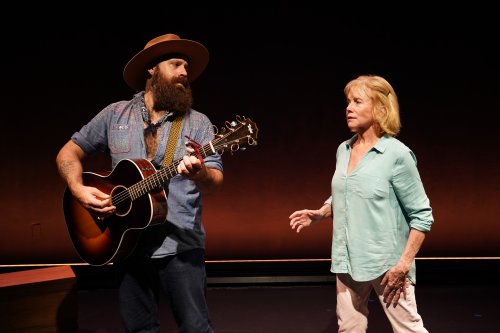
Will Huse and Linda Purl in a scene from Sharon Scott Williams’ “Crazy Mama: A True Story of Love and Madness” at 59E59 Theatres (Photo credit: Carol Rosegg)
Linda Purl turns that predicament into a performance of astonishing elasticity and emotional precision. She inhabits 16 characters, but the number is almost beside the point. This is not a parade of accents or theatrical impersonations; Purl gives each figure a distinct physical logic, allowing a tilt of the head, a shift in vocal placement, a change in muscular tension, or the sudden reorientation of her gaze to transform the person standing before us. Most remarkably, she remains entirely credible as eight-year-old Sharon, catching the peculiar combination of bravado, literal-mindedness, terror and yearning that belongs to a child who has been thrust prematurely into an adult mystery. Her work as Mama is even more extraordinary because Purl resists the temptation to turn madness into theatrical fireworks. The woman remains recognizably human beneath the frightening behavior, which makes the daughter’s attachment to her not merely understandable but inevitable.
Purl’s performance also grows older without announcing each transition. Sharon’s consciousness accumulates experience; her understanding changes; what initially seems like a nightmare gradually becomes a history she must learn to carry. Purl lets those changes register almost invisibly, so that the evening acquires the sensation of watching a life rather than watching an actress demonstrate her range. Her athleticism is considerable—the body itself becomes an instrument of characterization—but the physical virtuosity is always subordinate to feeling. The most powerful passages are often the quietest ones, when the actress allows memory to settle over the face and permits the adult Sharon to coexist, for a moment, with the frightened girl she once was. It is an extraordinary piece of acting, not because it asks how many people one performer can play, but because Purl makes us believe that every one of them has left a mark on the same human being.
Anson Williams directs with a clarity that allows the adaptation’s emotional architecture to emerge without clutter. His handling of a piece this dependent on rapid transformation could easily have become frantic, yet the production generally understands that movement is most effective when motivated by memory rather than spectacle. Williams gives Purl room to establish each character and, crucially, knows when not to decorate a moment that already contains everything it needs. His direction finds the theatricality in economy: with virtually nothing between performer and audience, a gesture can become a room, a voice can summon an absent relative, and a change in posture can redraw the entire family landscape. The production’s spareness therefore feels less like an absence of means than a confidence in the actor and the writing.
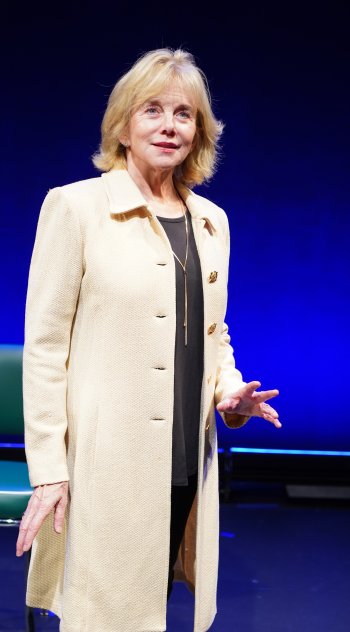
Will Huse and Linda Purl in a scene from Sharon Scott Williams’ “Crazy Mama: A True Story of Love and Madness” at 59E59 Theatres (Photo credit: Carol Rosegg)
Will Huse, appearing as the Blues Man, provides an equally valuable counterweight. His guitar and warmly weathered singing voice introduce brief blues passages that function as musical punctuation, separating memories and giving the narrative a chance to breathe. Huse does more than provide an intermission within the performance: his presence establishes a folk-like atmosphere in which this intensely personal story feels connected to a larger Southern tradition of storytelling through music. There is an appealing looseness to him, a quality of someone who might have wandered in from another story and happened to know the tune that belongs to this one. His musical interludes give the evening texture and tenderness, while his understated charm prevents the material from becoming emotionally monochromatic.
Brian Gale’s lighting and projection design and Lindsay Jones’ sound design complete a production whose aesthetic restraint is one of its considerable strengths. There is no elaborate domestic environment competing with Purl’s transformations; the theatrical world is constructed largely through suggestion, allowing the audience’s imagination to supply whatever furniture, institution, kitchen, street or family gathering the memory requires. That minimalism is especially appropriate to a play about recollection, since memory itself is rarely architectural. It is fragmentary, selective, oddly vivid in one instant and indistinct in the next. The technical design supports that quality rather than attempting to literalize it, keeping the focus where it belongs: on the performer and the remembered people who seem to gather around her.
The playwright ultimately takes her story somewhere more complicated than either tragedy or inspirational uplift. The later chapters, culminating in the relationship between the grown Sharon and her dying mother, do not erase the decades of damage, nor do they pretend that love was an adequate substitute for treatment. Instead, the play discovers the possibility of forgiveness without requiring reconciliation with the past as it actually happened. That distinction gives the final movement its emotional power. Sharon cannot rescue her mother from schizophrenia; she cannot restore the childhood that illness stole; she can only decide what she will carry forward. The resulting sense of release is earned precisely because Williams refuses the sentimental fantasy that everything can be made whole.
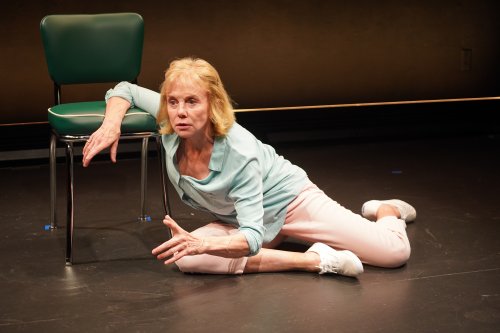
Linda Purl in a scene from Sharon Scott Williams’ “Crazy Mama: A True Story of Love and Madness” at 59E59 Theatres (Photo credit: Carol Rosegg)
At a little over two hours, the piece occasionally feels as though its memoiristic generosity has allowed more episodes into the theater than the dramatic form strictly requires. Yet even that abundance reflects something essential about Williams’ project: this is not merely the story of a breakdown but an attempt to retrieve an entire family from the wreckage surrounding it. The occasional repetition is therefore less a failure of feeling than an excess of it. What lingers is the remarkable union of writer, director, and performer. The playwright has transformed painful personal history into language of unusual warmth and intelligence; the director has given that language a lucid theatrical frame; Huse supplies its musical pulse; and Purl, with an almost preternatural command of transformation, makes 16 lives feel like facets of one. Crazy Mama is, in the best sense, an actor’s theater and a writer’s theater at once: intimate, funny, harrowing, and finally radiant with the stubborn possibility that love can survive even what it cannot cure.
Crazy Mama: A True Story of Love and Madness (through October 18, 2026)
Rubicon Theatre Company
59E59 Theaters, Theater C, 59 East 59th Street, in Manhattan
For tickets, visit http://www.59e59.org
Running time: two hours and five minutes including one intermission


Leave a comment