
Isla
"Isla" dazzles with inventive puppetry, music, and performances, but its beautiful shadows can’t quite disguise a story that needs more substance.
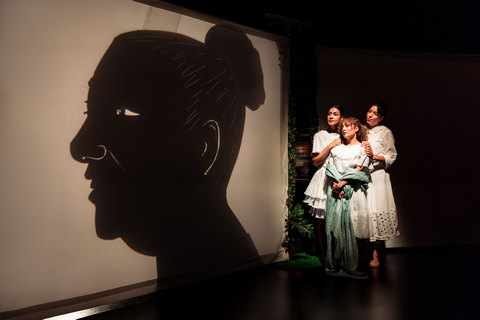
Tiffany Iris, Samantha Blain and Daniela Delahuerta in a scene from HitTheLights! Company’s “Isla” at WP Theater (Photo credit: Rebecca J Michelson)
Isla, the new musical-theater piece from Hit the Lights! Company now at WP Theater, is one of those productions in which the eye is continually rewarded while the mind is left waiting for the story to catch up. It is an act of love, remembrance, and theatrical ingenuity, inspired by the family history of co-artistic director Samantha Blain, whose mother and two aunts fled Cuba in 1969, during the early years of Fidel Castro’s regime, in search of freedom and a new life in the United States. Co-directed by Blain’s colleagues Roman Sanchez and Mikayla Stanley, and assembled collaboratively from family stories, recorded interviews, music, projection, movement, and puppetry, Isla possesses an almost tactile sincerity. Yet sincerity is not the same thing as dramatic necessity. The production has been given an abundance of means for telling its story; what it lacks is a sufficiently compelling story to tell with them.
The premise is inherently moving. Blain initially appears as herself, seated beside a carousel projector and contemplating photographs of her family’s life in Cuba, before gradually becoming her Aunt Lulu, the middle of three sisters. The actual voices of the three women, recorded by Blain in 2018, hover over the production like a form of ancestral testimony. Daniela Delahuerta plays Carmen, the eldest, intellectual and perfectionistic, while Tiffany Iris plays Alina, the youngest, outgoing and fearless; Blain’s Lulu is the combination of the two. The sisters love their mother, tease one another, dream, quarrel, play, and eventually confront the political violence that makes remaining in Cuba impossible. They leave behind friends, lovers, ambitions, and the life they had imagined, undertaking the perilous journey toward Miami and ultimately a new home in America. It is a beautiful family story, and the very fact that it happened gives it an emotional weight that the theater sometimes struggles to match.
The performances are uniformly appealing. Delahuerta, Iris, and Blain establish an easy physical and emotional rapport, and their singing has a sweetness that suits the production’s recollective atmosphere. Blain is particularly effective in the peculiar double role of storyteller and remembered participant, never quite allowing the boundary between memoir and invention to disappear. Claron Hayden, seated to the side with his electric guitar, contributes a score—co-composed with Blain—that is often more successful as atmosphere than as song. His psychedelic riffs and quietly insinuating accompaniment can make the transition from pastoral Cuba to political terror surprisingly visceral: shadow planes drop bombs, landscapes dissolve, crowds gather, and the island seems to tremble beneath the characters. Vittoria Orlando’s lighting helps give these transformations their particular theatrical charge, modulating the space between memory, dream, and historical reality, while L.A. Clevenson’s costumes contribute an appealing handmade specificity to the sisters’ world without competing with the puppetry.
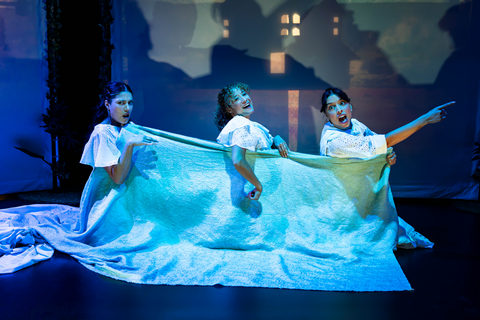
Tiffany Iris, Samantha Blain and Daniela Delahuerta in a scene from HitTheLights! Company’s “Isla” at WP Theater (Photo credit: Rebecca J Michelson)
But it is Casey Scott Leach’s puppetry, manipulated by Leach, Erica Knight, and Jessie March, that repeatedly threatens to become the real protagonist of Isla. Working behind three upstage screens, the puppeteers create an astonishing succession of landscapes, animals, crowds, buildings, boats, and human figures from deceptively simple pieces of cut paper and silhouette. A carrot being chopped becomes an event; a boat crossing the Florida Straits becomes a miniature epic; the silhouettes of Havana nightlife suddenly fill the stage with motion. Leach’s three-dimensional menagerie is equally charming, particularly the chickens with their wonderfully wobbling heads and the odd little solenodons that look like creatures escaped from some particularly eccentric natural-history museum. In the elaborate dream sequence, the solenodons steal Lulu’s notebook, chase her through a jungle, and eventually deliver her into the jaws of a giant crocodile—the crocodilian outline recalling the familiar resemblance between Cuba and a crocodile. These passages are frequently magical, and one occasionally wishes the screens were more transparent, so that we could see the artists’ hands as clearly as we could see the shadows they created.
There is, however, an important distinction between inventive puppetry and revolutionary puppetry. Isla’s shadow work is beautifully executed, but it does not exist in a theatrical vacuum. The comparison that inevitably arises is with Pilobolus’ 2009 work Shadowland, which transformed shadow screens, human bodies, and cutout silhouettes into a full-length surreal narrative, and with Pilobolus’ sister company Momix, whose 2019 work Alice (as in Lewis Carroll’s Alice in Wonderland) similarly turns shadow, bodies, objects, and illusion into a visual vocabulary capable of carrying an entire theatrical world. Those works demonstrate how shadow can become not merely an illustration of narrative but the narrative’s very grammar. Isla is at its most persuasive when approaching that territory, particularly when actors, puppets, projected landscapes, and silhouettes interact so fluidly that one no longer knows where human body ends and image begins. Yet too often the puppetry here illustrates what the characters have already told us rather than discovering something that words alone could not convey.
And this brings us to the central difficulty: the text. Isla began life as a ten-minute piece for the International Human Rights Arts Festival, and that origin helps explain both its virtues and its limitations. Now at 75 minutes, the material has been expanded without being sufficiently deepened. The collaborative writing, music, and lyrics have produced a succession of attractive fragments rather than a dramatic architecture. The sisters remain types more than fully realized individuals; we know their birth order and a handful of descriptive characteristics, but we never acquire the granular sense of who they were in Cuba, what precisely they stood to lose, or how their different temperaments shaped the decision to leave. The recordings of the actual women ought to provide the raw material for precisely that specificity, but they arrive more as evocative snapshots than as dramatic evidence. The songs fare similarly. Their melodies are pleasant, their intentions affectionate, but the lyrics frequently have the generalized simplicity of children’s songs, with refrains that drift toward “la la la” rather than revealing character, conflict, or revelation. The music rarely develops enough individuality to carry the emotional burden assigned to it.
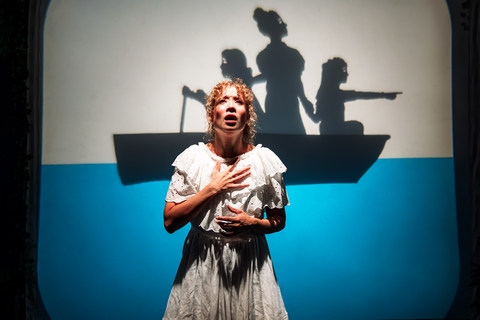
Samantha Blain in a scene from HitTheLights! Company’s “Isla” at WP Theater (Photo credit: Rebecca J Michelson)
The problem becomes especially pronounced whenever the production moves away from its central story. The sisters’ childhood games, the animal chases, the dream imagery, the repeated encounters with the puppet menagerie: each may be delightful in isolation, but cumulatively they consume precious dramatic oxygen. The political material—re-education camps, forced labor, the presence of Castro’s regime, the decision to flee, and the terrifying uncertainty of beginning again elsewhere—ought to generate an increasingly urgent dramatic trajectory. Instead, the show periodically seems to wander away from its own most consequential subject. The artistic surface remains busy, but the narrative engine sputters. One can admire the ingenuity of the machine while wondering why it has not taken us somewhere more surprising.
What makes Isla frustrating, then, is precisely how close it comes to being exceptional. Hit the Lights! demonstrates itself to be a company of genuine theatrical imagination, and Sanchez and Stanley have created a production of considerable beauty, charm, and technical sophistication. The performances are warm, the singing lovely, Hayden’s guitar playing atmospheric, Orlando’s lighting evocative, Clevenson’s costumes quietly effective, and Leach, Knight, and March achieve images that linger long after their sources have vanished into darkness. The final appeal—to preserve family stories because remembering is a way of insisting that “these people were here”—is deeply felt. One leaves understanding the impulse behind Isla completely. What is missing is the rigorous shaping that would transform an inspiring family history into an irresistible piece of drama. With a more sharply constructed book, more distinctive characters, stronger songs, and a greater willingness to let the political and personal stakes accumulate, this could become something genuinely extraordinary. For now, Isla remains a beautiful theatrical vessel whose shadows are more fully alive than the story they have been summoned to illuminate.
Isla (through August 29, 2026)
Hit The Lights! Company
WP Theater, 2162 Broadway, in Manhattan
For tickets, visit www.wptheater.org
Running time: 75 minutes without an intermission


Leave a comment