
Are You Now or Have You Ever Been: An American Docudrama
Powerful docudrama recreating the original testimony of 17 witnesses before the HUAC committee in the 1940s and 50s.
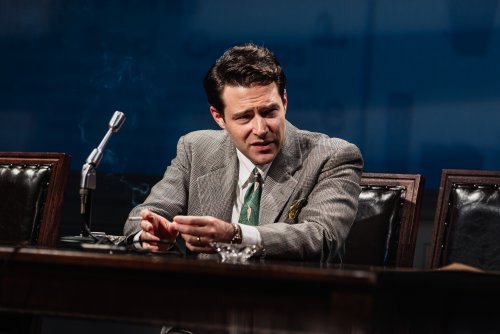
Ben Rappaport as actor Larry Parks in a scene from Eric Bentley’s “Are You Now or Have You Ever Been” at Stage I at New York City Center (Photo credit: Marc J. Franklin)
Eric Bentley’s 1972 docudrama Are You Now or Have You Ever Been is a powerful play based on the original testimony of the artists, writers and performers who were called to testify before the House Committee on Un-American Activities during the Communist scare of the 1940s and 50s. Originally subtitled “The Investigations of Show-Business by the Un-American Activities Committee 1947 – 1958,” the play remains a reminder of repression and fear tactics so like today’s investigation of so-called enemies of the current administration. Although those times are now called the McCarthy Era, Senator Joseph McCarthy had nothing to do with the House of Representatives Committee that the play depicts as he had his own Senate investigation body.
Anna D. Shapiro’s trenchant production now at New York City Center Stage I uses a core group of eight actors led by Michael McKean and has a rotating cast of five guest stars who change every two – three weeks. The one problem with the direction is that all 17 interrogations are staged exactly the same way making for a rather staid, unimaginative production. This may be the fault of Andrew Boyce’s realistic but routine courtroom set, which is occasionally varied by Brittany Bland’s projection design of newspaper headlines and quoted passages. Nevertheless, the testimony and interrogations are still both lively and shocking as we watch famous show business people’s lives disintegrate as they find they have no defense for their previous actions or from those who have named names and destroyed other people’s careers in order to save their own. In some cases, unstated context is needed like the fact that the committee blackmailed choreographer Jerome Robbins with the fact that they would reveal his homosexuality (then unacceptable in American society) if he did not play ball with the committee.

Sally Murphy as playwright Lillian Hellman in a scene from Eric Bentley’s “Are You Now or Have You Ever Been” at Stage I at New York City Center (Photo credit: Marc J. Franklin)
The testimony includes the two most famous lines to come out of the hearings: Sally Murphy reads playwright Lillian Hellman’s statement in her famous letter to the committee: “I cannot and will not cut my conscience to fit this year’s fashions,” and Steven Boyer delivers screenwriter Ring Lardner, Jr.’s response to the question as if he was or ever had been a member of the Communist Party, “I could answer it, but if I did, I would hate myself in the morning.” Some of the people called before the committee are no longer household names (film director Sam G. Wood, actor Elliott Sullivan, Group Theatre actor/director Tony Kraber, screenwriter Martin Berkeley, and actor Marc Lawrence) and could use some biographical identification. Among still world-famous people whose testimony we hear are that of playwright Arthur Miller, director Elia Kazan and actor José Ferrer.
Ironically, or possibly on purpose, the guest stars have the showiest roles. Some of the people called before the committee had been attracted to Communism during the height of the Great Depression when many people thought that Democracy was no longer working. Others were found guilty by association and others had briefly attended meetings to see what they were about and lost interest soon after, forever blackening their record.
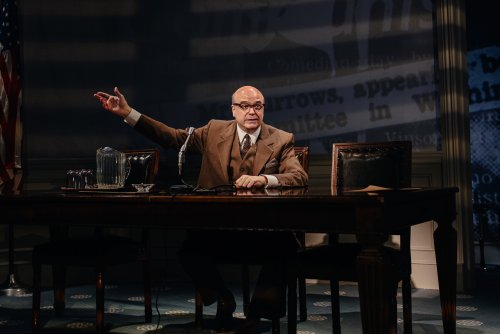
Scott Adsit as writer Abe Burrows in a scene from Eric Bentley’s “Are You Now or Have You Ever Been” at Stage I at New York City Center (Photo credit: Marc J. Franklin)
Ben Rappaport (Good Night, Oscar; Fiddler on the Roof, 2015) plays actor Larry Parks best known for playing legendary entertainer Al Jolson in the hit films The Jolson Story (1946) and Jolson Sings Again (1949). We watch as Parks visually wilts on the witness stand confronted with the fact that he was treasurer of the Actor’s Laboratory Theatre in Los Angles which the committee had already decided was a hotbed of Communism from earlier testimony. He points out that his career has been ruined just by being called before the committee because in the eyes of the public a certain inference or innuendo will be drawn from his appearance, his stardom depending on the public opinion. After being badgered for both a morning and an afternoon session, Parks eventually caves in during the closed-door evening session and names names.
Scott Adsit (Celebrity Autobiography; Chicago’s Second City) plays a hilariously satiric Abe Burrows who uses his wit to skewer the committee who may not even have gotten all of his jokes. When asked if he attended Communist party meetings, Burrows pointed out that he was invited to everything. In reference to various names brought up by the committee, he states that he assumed some of these people were Communists from the views they expressed but he didn’t know if they were or not. He states that he was not trusted because he did “satires on folk songs in a period when the Communist Party had taken the folk song very dearly to its bosom.” In answer to the question whether he was a Communist, he facetiously points out that he never signed a membership card, though some may say they saw one in his name. The immediate consequence of his testimony was that Paramount Pictures dropped the option on his recent hit Broadway musical Guys and Dolls soon after.
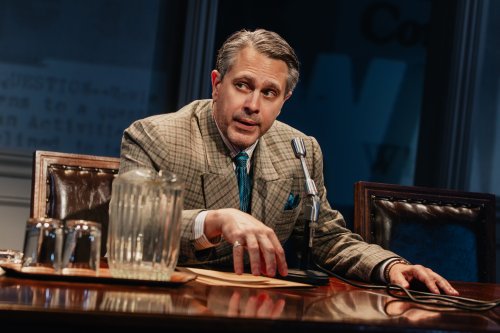
Thomas Sadoski as actor Lionel Stander in a scene from Eric Bentley’s “Are You Now or Have You Ever Been” at Stage I at New York City Center (Photo credit: Marc J. Franklin)
Thomas Sadoski gives a big performance as actor-comedian Lionel Stander who gives the committee as much as they give him after requesting to appear before them as Marc Lawrence had previously named him in his testimony. He points out that merely receiving the subpoena caused him “to be blacklisted in radio, television and motion pictures.” He demands that they turn off the lights and disconnect the television cameras as a professional actor he “only appears for entertainment or for philanthropic organizations.” He claims to “know of a group of fanatics who are trying to undermine the Constitution of the United States by depriving artists of life, liberty and the pursuit of happiness without due process of law!” by which Stander means the committee itself. When pointed out that his wife Lucy Stander was a member of the Communist Party, he insists she was not his wife as they were separated at the time. As the questions become more pointed, Stander invokes the First and Fifth Amendment to the Constitution which resulted in his remaining on the blacklist.
The most powerful of all is the angry, hostile testimony of African American singer-actor Paul Robeson played by Billy Eugene Jones (Our Town, Purlie Victorious, Fat Ham and A Soldier’s Play), one of the few people of color called before the committee. This 1956 interrogation was the second time Robeson appeared as he had previously testified under oath in 1946 that he was not a member of the Communist Party. His later testimony was related to his having applied for a passport in order to travel abroad. He continues to invoke the Fifth Amendment which he points out does not infer criminality according to Chief Justice Warren before lecturing the committee on Black history and particularly his own family story. He points out that opposing the neo-Fascist cause does not make him a Communist. It wasn’t until two years later than Robeson was allowed to have his passport at which time the work of the committee was over.
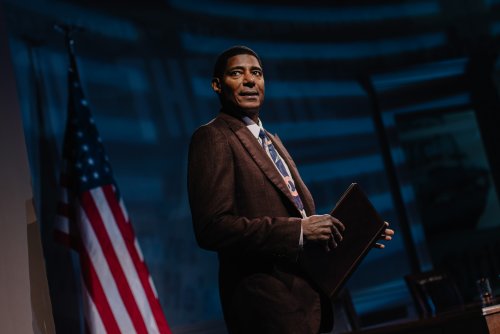
Billy Eugene Jones as singer Paul Robeson in a scene from Eric Bentley’s “Are You Now or Have You Ever Been” at Stage I at New York City Center (Photo credit: Marc J. Franklin)
Actors Frederick Weller, Brooks Ashmanskas and Boyer play between three and five witness each, demonstrating their versatility using different voices and poses to play their characters. While the words of these 17 members of the show business profession may be unfamiliar to contemporary audiences, they are not only all true but also still retain quite a punch when we realize the 100’s of careers that were ruined. It is also a reminder that we still have to fight for democracy in a time when free speech is being eroded almost daily.
Are You Now or Have You Ever Been (through August 2, 2026)
New York City Center Stage I, 131 W. 55th Street, in Manhattan
For tickets, visit http://www.nycitycenter.org/pdps/2026-2027/are-you-now-or-have-you-ever-been/
Running time: one hour and 50 minutes without an intermission


Leave a comment