
King Lear (Compagnia de’ Colombari)
Coonrod's Lear is an astonishing take on the classic tale of vanity gone awry, a condemnation of pretty words that Shakespeare himself made a living crafting.
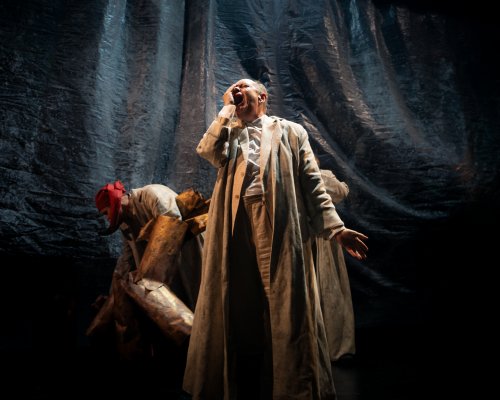
Tony Torn as King Lear and Lukas Papenfusscline in a scene from Compagnia de’ Colombari’s production of “King Lear” at the Ellen Stewart Theatre at La MaMa Experimental Theatre Club (Photo credit: Shin Kurokawa)
Compagnia de’ Colombari’s King Lear does not so much begin as materialize: one moment the audience is rustling programs and adjusting in their seats, and the next the tragedy is already in motion. The actors, dispersed and alternating lines, assemble the premise like a ritual incantation. Lear, the aging monarch of Britain, has resolved to unburden himself of rule and portion out his kingdom among his three daughters—after, of course, they audition their devotion. The premise is familiar, but here it lands with a faintly self-aware irony: a play built from some of the most ravishing language in the canon is, at heart, a warning about the seductions of eloquence.
By loosening the moorings that usually tether one actor to one role, director and adaptor Karin Coonrod peers, with unusual intimacy, into Lear’s psychic weather. The choice to distribute him among ten bodies does not dilute the character; it refracts him. We are invited to watch a consciousness under siege, a man stripped so thoroughly of title, certainty, and familial illusion that what remains is not a king discovering wisdom so much as a human being stumbling toward self-recognition. Lears circulate through the auditorium, each member of the company outfitted by Oana Botez in a palette of muted greige, topped by gilded paper crowns, courtesy of Tine Kindermann, that rise a good foot and a half into the air, their fragile grandeur at once comic and faintly forlorn—a visual joke that curdles into a metaphor. The multiplicity supplies a chorus of selves: monarch and parent, tyrant and child, sovereign and supplicant. At times they seem to echo one another; at others they compete for the same thought, as if Lear’s mind were a crowded room he can no longer govern. The image captures something essential about the play’s cruelty: identity, once propped up by power and praise, proves alarmingly divisible.
Abigail Killeen’s Lear, at least initially, is every inch the ceremonial sovereign, though the production quickly literalizes the fragility of that authority. She removes her paper crown and, with a small shift of bearing, becomes Goneril, who pledges “Sir, I love you more than word can wield the matter, Dearer than eyesight, space and liberty…” Jo Mei’s Regan follows, competitively amplifying the rhetoric, declaring that her sister “comes too short.” Their speeches are delivered from various levels throughout the theatre, a subtle but pointed elevation that frames their love as performance—aspiration masquerading as sincerity.

Jo Mei as Regan and Michael Potts as Gloucester in a scene from Compagnia de’ Colombari’s production of “King Lear” at the Ellen Stewart Theatre at La MaMa Experimental Theatre Club (Photo credit: Shin Kurokawa)
Cordelia, played with luminous restraint by Celeste Sena, refuses the game. Cordelia’s opening gambit in Lear is, of course, the most famous refusal in Shakespeare. Her “Nothing, my lord,” delivered when rhetoric is expected as currency, lands like a moral line drawn in the sand. What follows—“I love your majesty / According to my bond, no more nor less”—is not emotional poverty but ethical precision. She declines the inflationary language her sisters trade in, insisting that love has a rightful measure. To “heave / [her] heart into [her] mouth” would be to convert feeling into performance, and Cordelia will not counterfeit her inner life for material gain. Even her clear-eyed acknowledgment that a husband must claim part of her affection signals not coldness but maturity: she understands love as divisible, relational, and lived, not proclaimed. In a play where words so often distort reality, her plainness is a quiet act of rebellion.
Her “nothing,” arrives without ornament. In a production so attentive to where words are spoken from, this placement matters: Cordelia’s honesty does not need a platform, yet she is at the center of our stage picture. It is, if anything, anti-theatrical. Lear, behind most of the audience, intoxicated by verbal tribute and deaf to moral clarity, banishes her, sending her to France with her husband (Tom Nelis, later a heartbreaking Lear after the storm) and, in doing so with his assault, initiates the long catastrophe.
The company uses the theatre as a total environment. Actors roam the aisles, scale the stadium seating, and occasionally settle among the spectators, dissolving the boundary between watcher and watched. The oft-quoted notion that “all the world’s a stage” becomes less a metaphor than a staging principle. Deceit climbs onto platforms; truth moves at eye level. Coonrod’s production is delivered with a line-by-line lucidity that feels almost pedagogical in the best sense: every clause lands, every turn of thought is shepherded cleanly to the ear. The cast treat the verse not as a museum relic but as a living score, teasing out its stresses, its jokes, its sudden abysses of feeling, until Shakespeare’s language seems to fizz with immediacy. That close to an actor, one hears the poetry think.

Celeste Sena as Cordelia, Tom Nelis as King Lear and Paul Pryce as Kent in a scene from Compagnia de’ Colombari’s production of “King Lear” at the Ellen Stewart Theatre at La MaMa Experimental Theatre Club (Photo credit: Shin Kurokawa)
The subplot receives equally vivid treatment. Paul Pryce’s haunting Kent, expelled for his plainspokenness, returns in disguise with a loyalty that feels stubbornly dutiful. Micheal Potts gives Gloucester a grave, weathered dignity, which makes his gullibility toward his illegitimate son Edmund all the more painful. Elijah Martinez renders Edmund as a virtuoso of self-invention—melancholy and wounded in one breath, impishly conspiratorial in the next. His performance makes explicit what the production suggests throughout: nearly everyone here is acting a part within a part, constructing selves for advantage or survival.
Tony Torn makes a delectably comic Oswald, a creature of elastic limbs and quicksilver reactions, whose demise—complete with a memorably protracted knifing and collapse—becomes a small tragic farce within the larger catastrophe. Torn’s gift for physical and vocal expressivity keeps the character buoyant without reducing him to mere caricature. In bracing counterpoint stands his Lear: regal, inward, and edged with dawning dread, a monarch who seems to feel, almost before the fact, the carpet of authority being tugged from beneath his feet by his ungrateful daughters. His doubling here creates a sly resonance. Abigail C. Onwunali offers a stately, composed Lear, her bearing suggesting authority worn like a well-fitted cloak. Yet it is as Edgar that she most fully unlocks the heart. There, the performance softens and breaks open: she parts from Edmund—a half-sibling she trusts to her peril—with tears that register not merely betrayal but the shock of love misplaced, and later greets the blinded Gloucester with a grief that is filial in its ache. Onwunali charts Edgar’s passage from innocence to sorrow with a transparency of feeling that gives the production some of its most human moments.
The play’s obsession with “nothing” emerges as a thematic spine. Cordelia’s nothing, Lear’s assertion that “nothing will come of nothing,” and the Fool’s sharp “thou art nothing” form a bleak refrain. Lukas Papenfusscline’s Fool, wry without being coy, delivers his barbs like unwanted gifts. The word accrues a psychological weight: Lear’s terror is not merely of losing power but of being unmoored from praise, of discovering that the self he knows is built on others’ flattering fictions.
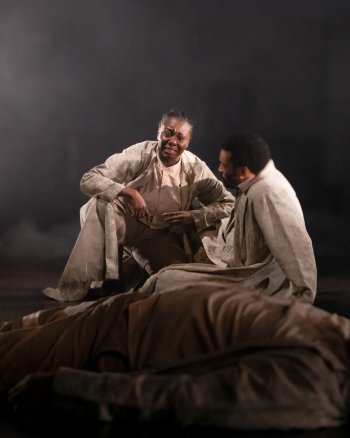
Abigail C. Onwunali as Edgar, Julian Elijah Martinez as Edmund and Michael Pott as Gloucester in a scene from Compagnia de’ Colombari’s production of “King Lar at the Ellen Steward Theatre at La Mama Experimental Theatre Club (Photo credit: Shin Kurokawa)
This anxiety finds a striking theatrical analogue in the choice to divide Lear among multiple performers. As his certainty erodes, voices overlap, lines collide, and sometimes cohere in unison. The effect is not gimmickry but diagnosis—a portrait of a man whose identity, outsourced to the perceptions of others, splinters when those perceptions prove unreliable. King Lear, in this reading, becomes a hall of mirrors in which identity itself is a role one strains to maintain.
By the time the storm arrives, the production has shifted from playful meta-theatricality to something rawer. The earlier permeability between audience and stage gives way to a more traditional focus, as if the stripping of illusion requires a firmer frame. Krista Smith’s lighting, Tye Hunt Fitzgerald’s sound, Frank London’s original music, and carefully composed tableaux remind us that theatre is artifice, yet the emotions they marshal feel unavoidably real. The paradox is pure Shakespeare: the more openly artificial the means, the more piercing the truth.
In the end, this Lear lingers less as a political tragedy than as a study in recognition—of how badly we want to be loved, and how easily that want can be exploited. Lear wagers his kingdom on praise and loses nearly everything, while the daughter who loved him best understood that love is a verb, not a speech. Compagnia de’ Colombari, for their part, trust action over ornament. They do not merely tell us what the play means; they stage the uneasy space between appearance and reality and invite us to find ourselves there. And if the evening also happens to be richly entertaining, that may be the production’s most Shakespearean trick of all.
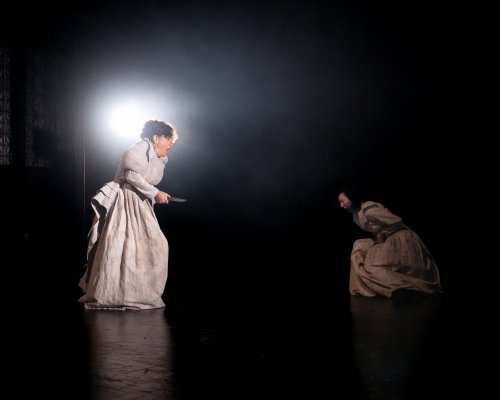
Abigail Kileen as Goneril and Jo Mei as Regin in a scene from Compagnia de’ Colombari’s production of “King Lear” at the Ellen Stewart Theatre at La MaMa Experimental Theatre Club (Photo credit: Shin Kurokawa)
The evening moves with a brisk, almost breathless momentum, aided by a judiciously pruned text that pares away pageantry to expose nerve. What survives the edit is the play’s circulatory system—its questions of love, authority, and self-knowledge. The result is less a museum-piece Lear than a live wire of a production, propelled by urgency and a keen sense of the story’s marrow. Exhilarating is not too strong a word; the tragedy feels discovered in real time, rather than dutifully recited.
King Lear (through February 8, 2026)
Compagnia de’ Colombari
Ellen Stewart Theatre at La MaMa ETC, 66 East 4th Street, in Manhattan
For tickets, visit www.lamama.org
Running time: one hour and 50 minutes without an intermission


Leave a comment