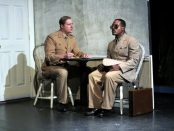
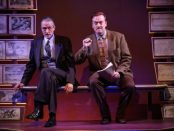
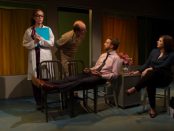
Nicolai Khalezin wrote Burning Doors with dramaturgy by him and Natalia Kaliada. Their aim is to bring attention to currently jailed artists Petr Pavlensky and Oleg Sentsov by weaving in their testimonies. Actors also proclaim from the works of Fyodor Dostoyevsky and Michel Foucault. Fleeting and sometimes sly allusions to Putin are laced in. [more]
hough it’s a one-woman show, Alison Fraser plays a number of characters by speaking in different voices with a certain technical prowess. The principal one is an upper West Side psychotherapist, Sharon, who is ostensibly talking to her own therapist (a “shrink’s shrink,” we’re told) at his apartment late one night. She’s relating the story of her going to her hometown of Lubbock, Texas, for her beloved nephew’s funeral, after he’s committed suicide. But has Eddie really killed himself, like Sharon’s mother did decades ago when Eddie was only three? For that matter, did Sharon’s mother really commit suicide, we’re made to wonder by the end? [more]
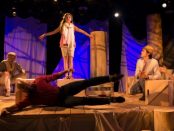
Signaling that we’re in for something different, Bauman has redubbed the play "Arden/Everywhere," a hint that home, and the emotional impact of losing it, is at the heart of her reimagining. Largely through design choices, but also some modest changes to the text, Bauman connects the diasporic struggles of the play’s characters to those experienced by the 65 million refugees the United Nations has identified throughout the world today, effectively arguing that, in both cases, the pain is there for anyone to see. [more]
The audience sitting on three sides of the airy playing area on wooden benches is part of Clifton Chadick’s super, environmental scenic design. The floor is covered with wood chips, logs and tree stumps, there are a several jagged wooden poles and a few red fire buckets strewn about. On one end is a stage area and the other is a screen where Joey Moro’s atmospheric projection design is shown. The crisp imagery includes fires, nature and abstractions. For several distracting instances the actors at the other end of the stage are projected onto the screen for no discernable reason other than as an aesthetic flourish. [more]
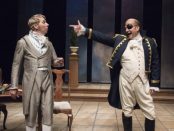
Director Ralph Lewis, apparently not trusting the material – or finding the play too dated – has staged a carnival-esque version (adapted by S.M. Dale in June 2016) which includes 16 songs and musical numbers and making contemporary references to the Trump Administration, as well as current New York City politics. The result, a series of Saturday Night Live political skits, is neither faithful to the original nor witty for a modern audience, more of a confused jumble than a historical rediscovery. [more]
Mr. Njikam offers a witty take on the classic mythology of a hero’s episodic journey with a lively African-American slant. There are a lot of high school and college scenes with wise teachers referring to James Baldwin and W.E.B. Du Bois, combative students, a dying father and an imperious mother. Rhyming battles, love and enlightenment occur along the way. The narrative is so eventful and spread out that it can be difficult taking it all in and its overall impact is diluted. [more]
Marinelli’s performance also contributes to the ennui. Heavy set, possessing a sullen countenance, speaking in a light voice, and lethargically shuffling around, he’s not the most charismatic performer to spend 90 minutes with. In the last portion, when he encounters a lost cat after being stood up on a date, his acting and the play has a jolt of energy and momentum as it reaches its upbeat conclusion. [more]
Although director Kimberly Senior who also piloted the Chicago production has staged the play with elegance, she never really turns up the heat so that there are not many sparks in Carter’s debate. Discord, yes; but no fireworks which might have made the discussion more dramatic. The play uses titles on the back wall to name each of the 14 scenes much in the manner of Brecht’s alienation effect. This breaks up the play but is not very informative. The device of the invisible fourth wall being a mirror in Wilson Chin’s all blue-grey interrogation room seems a gimmick to allow the men to face the audience directly for much of the play. [more]
With only a metal-mesh cage, bed-frame, and a gate--and gobs of black feathers that ultimately litter the stage--Nashman cavorts around the black box set (scenic design is by Marysia Bucholc and Camellia Koo) with abandon. If the challenge of every one-man show is to sustain our attention, Nashman succeeds spectacularly. He has some significant help with evocative lighting by Andrea Lundy, eerie music by Osvald Golijov (performed by the St. Lawrence String Quartet), and Cassidy’s direction, which always keeps him in motion. [more]
Most of the humor is at the expense of the Mesquite City Council and its steely-eyed mayor Linda Hadley (Liz Amberly) who could be accurately described as a Margaret Thatcher wannabe, if she had any idea who Margaret Thatcher was. With rapacious resolve, she has set her sights on doing something no other mayor has ever done in the entire history of Mesquite: win a second term. She is assisted in this quest by her right-hand toady (Jeff Paul), the financial backing of a shady resort magnate (Jed Dickson), and an underwhelming pool of potential challengers, led by Will Brown (the wonderful Joe Burby) whose hapless sincerity is seemingly no match for the mayor’s small-town realpolitik. [more]
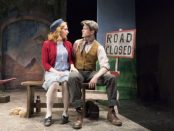
Mr. Hagins has crafted an involving and affective take of a perennial scenario that captures the nostalgic essence of wartime films and plays of the past. There’s the spirit of "Casablanca" and echoes of "The Voice of The Turtle" and "John Loves Mary," combined with the novelty of the interracial angle that’s tenderly realized. [more]
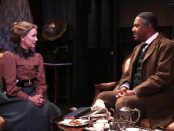
The central character is actually Mrs. Fisher who worries about her children and plots to open Amy’s eyes to her husband’s faults. Unfortunately, Annette O’Toole has been directed to play her as shrill, strident and hysterical, rather than as a wise middle-aged lady who has no illusions about life. Given a great many ethnic prejudices in her dialogue which in 1924 defined her as a suburban provincial, played this way she simply comes across as a bigot. We ought to be rooting for her against the barbarian invasion but O’Toole makes her almost as bad as Aubrey. [more]
In 85 minutes, we really don’t learn much Rebecca, Nolan or Sukey as Mr. Donnelly imparts scant biographical details about them, but strangely does for Padgett. Donnelly takes the perennial premise of a divorced couple’s past romantic feelings for each other being reignited and clumsily tosses in the dramatic, morbid bombshell. His glum and stilted finale at Sukey’s apartment is out of Private Lives. The title refers to Sukey’s wish that when she dies that there be no wake. [more]
The new story concerns Wayne Hopkins, an American boy whose parents die tragically and his Uncle Dave informs him that he is a wizard and must attend a special school in England. Wayne is sorted into The Puffs which he discovers is the house for the losers, rejects and nerds who never win at anything. His one goal is to be a hero at something – eventually – while getting through magic school. There he meets the dashing older student Cedric (Andy Miller) several years ahead, as well as another American, the nerdy math prodigy Oliver Rivers (Langston Belton) who can’t seem to succeed at magic, and Megan Jones (Julie Ann Earls), who wears Goth make-up, all black clothing and resents being there. Megan is particularly angry because her mother is a prisoner and in thrall to the Dark Lord. [more]
The ambiguities in Mary Jane’s character seem to stem more from the writing than the acting: though her behavior remains dubious or questionable, Mary Jane comes to real life as enacted by Carrie Coon, who was such a memorable Honey in the recent Broadway revival of "Who’s Afraid of Virginia Woolf?" She’s a solid Mary Jane as well, but then, the character and her motives prove harder to pin down. The stalwart New York actress Brenda Wehle is a perfectly believable and no-nonsense Ruthie. The always reliable Liza Colón-Zayas is Alex’s caregiver Sherry, and Danaya Esperanza and Susan Pourfar are persuasive as, respectively Sherry’s niece and another mother with similar challenges. [more]
Known as the Shakespeare play with the most song lyrics, the production also includes a deliciously bouncy new score by Stephen Schwartz in different musical styles from the 1920’s – 1950’s, including setting some of Orlando’s mash notes to Rosalind which are usually spoken in verse. The musical numbers are mostly reassigned to the musical theater veterans like de Shields and Stillman who plays an onstage, upright piano, with Leenya Rideout on violin and double bass, and other members of the cast occasionally joining in on guitar and triangle. All of this adds to the festive, light-hearted atmosphere. Originally announced as a Jazz Age interpretation, that concept seems to have gone by the wayside. [more]
Having spent nearly five hours in the company of Ms. Parks’ parade of these beautifully written characters I find myself conflicted about these plays. She is brilliant at generating fire with the source of the heat difficult to pinpoint. It’s her talent to write dramas which sizzle, constructed in her strange vernacular, yet somehow leave too many questions unanswered, the better to prove her one-sided stories. [more]
Director Charles Weldon acted in the 1983, Mark Taper Forum’s Los Angeles production, and besides his meticulous casting he has perfectly rendered this revival. Mr. Weldon’s physical staging inventively, precisely and aesthetically utilizes the large stage to faithfully realize the material. [more]
In terms of the atmospherically detailed writing and Mr. Moad’s enjoyably intense performance that recalls a Sam Shepard hero, “Quittin’ Meth” is the most powerful of the program and its concluding play. It’s a poetically expressed evening’s odyssey of a 27 year-old Iraq War veteran who has returned to his Illinois hometown in 2007. Set in a rundown bar in this depressed steel mill neighborhood, we follow his memories of the war that contrast with his present observations and glimpses of the pitiful bar denizens . He encounters a war buddy who lost a leg and has descended into drug addiction. [more]
Chicago playwright Philip Dawkins makes a memorable New York debut with an involving and engrossing play which at the performance under review you could have heard a pin drop, so rapt was the audience. The play is, indeed, flawed by its avoiding real confrontations time and again, always stopping short of out and out war. Inspired by the true story of Miss Gloria Allen who volunteered to teach a class in etiquette at Chicago’s Center on Halsted, "Charm" is both a fascinating story and it covers unexplored territory on our stages. As Mama Andrews, the elegant Sandra Caldwell is both charismatic and compelling, never fazed by the behavior of the class even when they pay her no mind or reject her teachings. [more]
There are plentiful comic one-liners and also sharp observations in Mr. Giles’ well-crafted dialogue. Giles perfectly renders all four characters with personality details and traits. The tensions, concerns and sensibilities of the long-term gay couple all ring true, but interspersing these with the mildly entertaining hamster story feels like a strategic theatrical device that undercuts the main plot to no great effect. [more]
The only color in the predominantly black-and-white show is orange, which appears as a pair of high heels, a hat and a cape, an apron, books, and various other odd items. There’s also a large bowl of oranges, hanging high up on the black, back wall of the set. (Though Jennifer A. Jacob is credited as “Costume Coordinator” in the program, no one is listed for scenery.) Though it may not add up to much of a story or make much sense, the highly stylized presentation of "A Clockwork Orange" makes it well worth-while as an evening out at the theater. [more]
With her slim physique, flawless diction, melodiously husky voice and imperious bearing, Dunagan is commanding. She conveys the character’s arrogance, selfishness and harrowing mental decline due to dementia with steely flair. She forcefully embodies the archetypal distant mother who damages her children. [more]
Besides harboring a dwindling dream to become a dancer, thanks to a leg injury, Halliday’s dramatic stand-in, Jack (Tyler Jones), an adoptee, also has to contend with the overwhelming repercussions of having tracked down his biological family, which includes an adult half-brother (Andrew Glaszek) with his own substance-abuse demons. That’s a lot for 90 minutes, and Halliday, despite a valiant effort, can’t keep his play from sinking under the weight of it all. [more]
Both as written by Stroppel and portrayed by Stephen D’Ambrose (Stravinsky) and Mark Shanahan (Disney), it also becomes clear that they are equally imperious--at first. Though they’re both monomaniacs, its Disney who proves more like a Trumpian narcissist. While Stravinsky says early on, “Everything I say is entirely true,” Disney, a bit later, claims, “I’m never wrong.” The fireworks begin as soon as they start to interact when Disney describes how the music evokes for him the birth of the universe and “earth--in its infancy,” not to mention dinosaurs, which remain the most memorable part of the "Fantasia" segment or sequence [more]
The play isn’t just about social climbers but those who want to game the system and live beyond their income, and their sense of entitlement rivals that of the 1990’s. However, this is 1901 and there is also a social hierarchy of who is in and who hasn’t made it yet. And these aren’t the robber barons with unlimited incomes, but people further down the economic scale hoping to make a killing by speculating on the market. Like a novel by Henry James or Edith Wharton, this turn of the century social drama encompasses a good many characters and events and includes both comedy and tragedy. The current almost three hour time length would have been longer at the beginning of the last century as there would have been more intermissions in this four act play, but in those days playgoers liked getting their money’s worth. [more]
Neil Pepe’s production of Simon Stephens’ "On the Shore of the Wide World" will not please all. The pace is consciously slow – like the life lived by these characters. However, the wait is worth the effort. By the end when the family reunites for Sunday dinner, the play has become both powerful and poignant. The title, incidentally, comes from the next to the last line of John Keats’ sonnet, “When I have fears that I may cease to be” in which the speaker worries about missing out on love, fulfillment, fame and success, apt summation of Simon Stephens' play. [more]
In fact, Harry Feiner’s marvelous, you-are-there set design for "The Violin" made me think of 'American Buffalo" (set in a shabby pawn shop) before the first words of the play were even uttered or its three cast-members (Robert LuPone, Peter Bradbury and Kevin Isola) even appeared on the stage. But whether or not playwright McCormick had that early Mamet work in mind, the main idea behind "The Violin" was probably inspired by a real event, when celebrated cellist Yo-Yo Ma left his prized cello in the trunk of a New York taxi some years ago, and paid a handsome reward for its return. [more]
Disguised as a snazzy cabaret act, set against constantly projected images from a sleazy Eighties public access talent show—from which the show’s title is derived—the short, intense performance is delivered without a single intake of breath it seems, an energy level that makes it difficult to actually hear—rather than merely listen to—the women’s histories of how they were forced into jobs and professions they found irritating or shallow by pressures applied by loved ones and even themselves. [more]
The affable Gerardo Rodriguez is hilarious as José and brings great dramatic depth to the role. As Joe, the personable Andrew Blair utilizes his geeky but appealing persona to humanize the stock character of the corporate manipulator. Mr. Rodriguez and Mr. Blair have a tremendous and palpable chemistry that’s instrumental to the play’s success. [more]
The awkwardly titled "The Rape of the Sabine Women, by Grace B. Matthias" has problems beyond its nomenclature. What, if anything, is it ultimately about? Though it claims to be a “satirical” look at the subject of rape, any satire is lost in the mixed results of the presentation. If anything, the play seems too subtle and nuanced for its own good. [more]
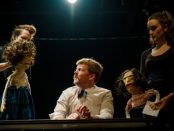
Dazzling hand puppets, stick puppets, marionettes and shadow puppets that are projected onto screens, which were all created by Godwin, depict this gallery of archetypal characters. These are all fantastically employed by him and are on display for the show’s 80 minutes. [more]
In interviews, Ruhl says she intends this play as a gift to her mother who played Peter Pan in Iowa as a teenager. As noble as this goal is, "For Peter Pan on her 70th birthday" never coheres into a compelling experience. The character of Ann is fascinating but is embedded in an uninvolving scenario that is perhaps a mediation on aging, death and disillusionment. [more]
As Blixen, Pelletier is riveting as she wraps her cocoon around the unsuspecting but susceptible young man. Catlike and sinuous as she stalks him and the stage, she is cajoling, seductive, mysterious, wise all at the same time, as they discuss writing, poetry, philosophy, beliefs, memories, desire, and how to live one’s life. Impeccably dressed by Stine Martinsen, she exudes glamour as well as baring her soul. She inhabits the role making us think that we have met the real Karen Blixen. [more]
With his breezy delivery, terrific comic timing and everyman persona, Jeb Kreager is highly engaging as Manning. The animated, wiry and bearded Luis-Daniel Morales is soulful and at times wildly funny as Charlie. Mr. Kreager and Mr. Morales have a marvelous chemistry together which energizes the play. [more]
On a multi-tiered set that takes advantage of every square inch of the tiny Medicine Show Theatre—designed by the authors—Ms. Kostek narrated Dietrich’s life story, from middle class childhood in Berlin to theater and cabaret actress to Hollywood star and on to her virulent anti-Nazi activities and beyond, clearly telescoping some of the events for convenience. (Did Dietrich’s audition for the great director Max Reinhardt really lead to performing at his cabaret the very next day?) [more]
Ms. Zelman-Doring’s cryptic scenario of deeply close twin siblings (Ana offers to masturbate Simon when he is tied up in a chair) is out of Sam Shepard and her dialogue is a pleasing cross between Harold Pinter’s spare eloquence with flourishes of Christopher Durang’s silliness. The abrupt and inconclusive conclusion is in keeping with what went before it. [more]
Performed by The Bats, the resident company of The Flea Theater, the world premiere of "Inanimate" is the inaugural production in their new home on Thomas Street, between Church and Broadway, several blocks south of their original premises. Performed in The Siggy, named after founder and patron Sigourney Weaver, a house with 46 permanent seats, it is the first of the three new theaters to open prior to the complex’s grand opening on September 28. It has been given a sharp, assured staging by director Courtney Ulrich with engrossing performances by its cast of seven. [more]
As in one of Alan Bennett’s "Talking Heads" monologues, Stapleton offers a richly detailed portrait of an ordinary person that revels in the mundane. She also adds the arresting device of having the inner life of the cow depicted in fantasy sequences. [more]
Mr. Klingenstein beautifully and simply renders his fictional account with exquisite detail and emotion. Klingenstein’s dialogue is precise and filled with sharp epigrams. It’s all a genteel and moving exploration of the human condition. A lovely highlight is Ann and Samuel recreating portions of the Lincoln-Douglas Debates of 1858. [more]
Exquisitely produced by the Mint Theater, Jonathan Bank’s direction is leisurely and slow, which undercuts the theatricality of all but the last and the most satisfying one, 'The King of Spain’s Daughter," originally given four separate stage productions at the Abbey from 1935-1939 and two in London in 1939. Using a company of seven, the actors appear in varying combinations while all appear in the third play, "Holiday House. " Two of the plays end too abruptly calling out for a more substantial length, while one of the plays seems to go on too long. [more]
Billed as a “bio-epic,” playwright Zachary Desmond emphasizes the epic in his uneven though compelling approach. Mr. Desmond affectionately imparts biographical details of Einstein’s life from youth to old age. Particularly captivating are the sequences depicting his courtship and marriage to his first wife, mathematician Mileva Marić. [more]
Nora Sørena Casey’s "False Stars," part of this year’s Corkscrew Festival at the Paradise Factory, starts slowly but gradually grows more involving as all the interconnections between the characters slowly reveal themselves. [more]
Much of the play is like an odd synthesis of 1960’s theatrical satires. There are absurdist shades of Murray Schisgal, Elaine May, and particularly of Jules Feiffer's "Little Murders," laced with Paddy Chayefsky’s lacerating tirades. It eventually becomes clear that it’s meant to be overblown and not at all realistic, and at times is hilarious. A zany Reform rabbi’s irreverent diatribe on faith, and a Darth Vader sight gag are hysterical highlights. Then there’s the girlfriend’s unsettling, casual disclosure that she’s had a double mastectomy. It all recalls the provocatively dark humor of Larry David. [more]
Having a background in dance accounts for Gelman’s mesmerizing staging that is filled with finely choreographed sequences. Characters take showers onstage with actual water cascading on their nude bodies and there are stylized, brief simulations of sex that are suggestively erotic. Numerous, arresting tableaus silently emit significance. The actors all give bold, brave and intense performances that transcend stereotypes. [more]
While the three plays in Summer Shorts 2017: Festival of New American Short Plays – Series B have been given proficient productions each seems ultimately unsatisfactory. All seem like first drafts rather than completely fulfilling their potential. The three authors could learn a lesson from the three plays in Series A which all hit their marks. Interesting experiments but failures nevertheless. [more]
Set in a California, Bay Area high school, there we meet the four students who prattle on in contemporary lingo. Gradually, and without any explanation we learn that they are witches. An episode of Bewitched has more background information. After 30 minutes, a semblance of a plot emerges, a run for class office. Eventually it is revealed that the candidate running was raped over the previous summer at an off campus party where alcohol was consumed by her male opponent. This past event becomes the play’s main focus. [more]
Bruce Norris’ "A Parallelogram" endeavors to explore some sobering facts about the effect of the future on the present and responsibility to others. Unfortunately, the play ends up being laborious and tiresome - without being revealing or challenging. Too many of the fantasy elements have not been worked out so that much must be taken on faith or not considered. Norris wants to say something deep but this 2010 play having its belated New York premiere is more confused than meaningful. [more]
Stephen Kaplan’s "A Real Boy" is about a pair of puppets, named Peter and Mary Ann Myers, who adopt the eponymous child named Max, and it proves about as preposterous as such a premise suggests. It isn’t helped by director Audrey Alford’s often awkward staging, or by a muddled and confusing conclusion. [more]
Mark Finley, the director, knew enough to keep the play charmingly low-key with just enough animated physicality to illustrate the story. Finley clearly understood all of Strothmann’s best qualities as a storyteller and how to keep him on his toes as an actor and memoirist. [more]
Although the physical production has been well-thought-out, the script seems to have no interpretation other than a great deal of slapstick comedy which does not much register. The cast varies greatly in having found the core of their roles. Phylicia Rashad’s Titania is romantic and authoritative, while Richard Poe’s Oberon is wryly arch but ineffectual. Their fairy attendants are played by white haired and balding senior citizens but nothing much is made of this unusual casting. As Puck usually played by a youth or a dancer, Kristine Nielsen’s regular mannerisms are kept to a minimum but she seems much more amused by her mischief than the audience does. [more]
Writer and co-creator Chesney Snow is also the performer. Mr. Snow appeared in the Off-Broadway and Broadway productions of the a capella musical "In Transit" as the narrator. Snow is also a prominent beatboxer. That’s an art form that replicates the sound of percussion by using one's mouth, lips, tongue, and voice. In The Unwritten Law, the African-American Snow mines the tragic circumstances of his life and those close to him. [more]
"Acolyte" by Graham Moore, Academy Award winner for his 2013 screenplay for "The Imitation Game," is a more substantial play than the other two. Based on an historical occurrence in 1954, it brings together two couples, Ayn Rand (founder of Objectivism) and her husband Frank O’Connor and her follower, Nathaniel Branden and his wife Barbara, for one of her weekly dinner parties. Rand has asked the Brandens to remain after all the guests have left following a vigorous debate on Aristotelean principles versus Platonic realism. [more]
Aside from the destructive nature of the storm and that the "Pegasus" eventually arrives at a desert shore, there isn’t much to be learned about climate change. We never know if Sleeper lost his ability to speak as a result of his strokes or has chosen not to speak after the death of his wife, which is an entirely different state of affairs. The cast of characters is made up of a great many creative people who are simply labels as we learn nothing about their work or their careers: novelist Merrie, classical scholar Owen, artist Sebastian, poet Ashton, scientist Miss Blake. The thinness of both the characters and the story keeps the play from making any important points. [more]
From Dominique Morisseau, the author of the critically acclaimed Skeleton Crew, Detroit ’67 and Sunset Baby, comes another powerfully provocative and riveting, but overwrought, play which investigates black rage, racial stereotyping, and parental mistakes. Just try to take your eyes off the high octane production by Lileana Blain-Cruz, which has been brilliantly cast with its six actors, all but Karen Pittman (the Pulitzer Prize-winning Disgraced) making their Lincoln Center Theater debuts. Morisseau may not have all the answers but she certainly looks at the questions from all angles. The play’s title is a reference to the metaphor for “the school to prison pipeline” that describes the blighted lives of so many ghetto youths who fail before they finish their education and was the topic of Anna Deavere Smith’s "Notes from the Field" seen Off Broadway last fall. [more]
"I wanted the audience to see 'Places,' not as a ‘museum’ piece, but a piece that was relevant TODAY. Nazimova was fighting the things in the 19th century and early 20th century that we are still fighting…," explains Nordlinger, who also wrote the show, in publicity materials for the production. Her conceit is that Nazimova exists as a ghost and cheekily addresses the audience directly. Her skillful, well-researched and assembled biographical facts are laced with feminist slanted commentary, and knowledge of events that occurred after Nazimova’s death. [more]
Vermillion writes distinctive characters who each have their own language, but fails to make his story believable or emotionally gripping by turning it into something closer to the surreal, expecting the audience to accept the rationalizations rather than science fiction. There are moments that communicate real emotion, particularly the low-key ending, but due to the nature of the story, Vermillion finds himself spending far too much time explicating the pseudoscience behind the title character. [more]
The joy of Stoppard’s writing comes to the fore as the second act characters debate what happened in the first act, too often getting it all wrong, misinterpreting the evidence or jumping to too many conclusions that aren’t justified. These actors are so enjoyable to watch that we can only sit back and enjoy their self-delusions. [more]
"Pity in History" was a teleplay commissioned by the BBC, and was broadcast on July 4, 1985. In the cast were Alan Rickman as the chaplain, Ian McDiarmid as the cook, and Anna Massey as the widow. Significantly, the era depicted was that of when it took place, reflected by period costumes and décor. Clips of it are on YouTube. [more]