News Ticker

Articles by Joel Benjamin

About Joel Benjamin (600 Articles)
JOEL BENJAMIN was a child performer on Broadway and danced with leading modern dance and ballet companies. Joel has been attending theater, ballet and opera performances ever since childhood, becoming quite opinionated over the years. He was the founder and artistic director of the American Chamber Ballet and subsequently was massage therapist to the stars before becoming a reviewer and memoirist. He is a member of the Outer Critics Circle.

The Deborah Zall Project: “In the Company of Women” 2017
May 21, 2017

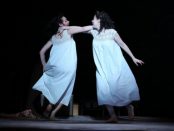
All but one of Zall’s works were solos and all were based on famous literary figures: “George Sand” (ruminating on her lost love, Chopin), “Mary Tyrone” (from "Long Day’s Journey Into Night" fighting her addiction while remembering her childhood), “Sonnet” (to an Edna St. Vincent Millay sonnet about obsessing over a lost love), “Amanda” (the mother in "A Glass Menagerie" sadly musing over her ball gown) and “Shadow of Her Sister” (two sisters from "The House of Bernarda Alba" battle to the death with dark Catholic imagery overlaying the internecine war). [more]

Battery Dance – Spring 2017 Season

May 17, 2017

The final work, “On Foot” was choreographed by Hollander and seven company members. It featured a Middle East-tinged score by Kinan Azmeh and Anouar Brahem and sensational visual art, mostly created on the spot, by Kevork Mourad whose ancestors fled the Armenian genocide. Mourad created both beautiful and horrifying projections on the back screen of the stage and also sat at a computer projector producing fluidly morphing images on a scrim: people floated about; ancient buildings melted; and complex landscapes passed by capturing the mood of the choreography. [more]

Limón Dance Company: Spring 2017 Season

May 16, 2017

“Corvidae,” Colin Connor’s contribution to the program, was staged to the relentless first movement of a Philip Glass Violin Concerto. The title refers to the scientific name of the family of crows and ravens. The six dancers, stylishly dressed in all black outfits by Connor and Keiko Voltaire and moodily lit by DK Kroth, wandered about stylishly, but aimlessly, suddenly bursting into movement, softly leaping, arms held in wing-like positions. The heads of stationary dancers were held high in ornithological awareness as the rest of the cast softly cut through the air in balletic, sweeping steps. The overall mood was dark and sexy. [more]

Happy Days

May 13, 2017

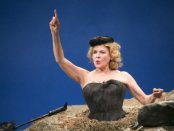
At the end of this "Happy Days," it’s difficult not to be heartbroken by Ms. Wiest’s Winnie, particularly when she gets a rare glance at her significant other, Willie, who manages to crawl over the sand to serenade her with the “Merry Widow Waltz.” Jarlath Conroy playing Willie makes the most of his few scenes both behind and on top of the sandy mound. Somehow he even makes something of his slow crawl towards Winnie at the end. Seeing Ms. Wiest’s face at that moment is worth sitting through Beckett’s theatrical obfuscations. [more]

Bandstand

May 11, 2017

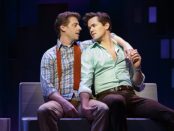
All the actors in the band play their instruments with panache and perfect period style, including Cott whose piano doodling is terrific. James Nathan Hopkins plays the cute, upbeat saxophonist, Jimmy Campbell; Brandon J. Ellis, the joking teddy bear of a guy, Davy Zlatic, the bassist; Alex Bender, the intensely dramatic trumpeter, Wayne Wright; Geoff Packard, the germ phobic trombonist, Wayne Wright; and Joe Carroll as Johnny Simpson, the percussionist who survived a scary accident during the War. [more]

Six Degrees of Separation

May 9, 2017

All the acting is sharp, from the upper-crusters taken in by Paul (Lisa Emery, Michael Countryman and Ned Eisenberg) to their kids (Colby Minifie, Keenan Jolliff, Ned Riseley, and Cody Kostro), Chris Perfetti as Trent who, sexually intoxicated by Paul, fills him in on the ways and means of all the people he will eventually swindle, and finally, to the young lovers (Peter Mark Kendall and Sarah Mezzanotte) whose fate reveals just how psychologically damaging Paul can be. [more]

Titicut Follies

May 3, 2017

The original film is brazen in its guerilla-style filmmaking, a good deal of which was surreptitiously produced right under the noses of the Institution’s officials.  To anyone who knows or watched the original 1967 film, James Sewell’s choreographic rendition would seem tame, certainly lacking the shocking visions of naked men abused and humiliated by sadistic guards, ridiculously backward psychologists and a nutritional staff intent on starving the patients.  (Images abound of skeletal men wandering aimlessly.)  The film begins with the eponymous follies, the men singing and dancing to a bizarre version of “Strike Up the Band” and showing off their other talents, only to quickly descend into a vision of hell on earth. [more]

Ballet Hispanico – Spring 2017

April 27, 2017

The company is in great shape. It’s a difficult task to combine ethnic themes with ballet and modern dance, but somehow Eduardo Vilaro has been succeeding terrifically. His troupe entertains, titillates and even educates (if that isn’t a dirty word). [more]
Indecent

April 25, 2017

"Indecent" is, on the surface, the history of Yiddish writer Sholem Asch’s brave Yiddish play "God of Vengeance" which was—incredibly, considering its wise understanding of the Jewish demimonde—written in 1906 during the height of anti-Jewish pogroms. (Asch actually witnessed a pogrom and its ugliness tainted his life thereafter.) It is far more, though. The play is a look at the sweep of Jewish life in the twentieth century using Asch’s creation as the hook. [more]

Luft Gangster

April 13, 2017

It is fascinating to watch Lowell Byers face his unfounded, country boy optimism as he is confronted with the brutal realities of his situation. That Byers’ Lou never completely succumbs, despite having to perform several vile acts, makes him the moral center of the play that pushes the idea of morality to the extremes. In addition, his exacting research, based on his cousin’s travails, pays off in the complexity of his writing. [more]

Amélie

April 10, 2017

"Amélie" is frustrating. The characters exist as two-dimensional cartoons that a talented cast almost brings to life. The uneven rhythms and poor timing of the show bog it down. An inability to find stage equivalents for the film’s gimmickry also hurts. It does have a game cast who vie with undistinguished songs, choreography and staging. Finally, there is Phillipa Soo who radiates warmth amidst the disarray. [more]
La Campana Sommersa (New York City Opera)

April 8, 2017

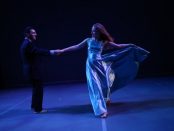
This production was a co-effort with Fondazione Teatro Lirico di Cagliari whose orchestra joined forces with the New York City Opera Orchestra under the baton of Ira Levin who brought out every bit of color in the music. Maestro Levin was sensitive to the needs of the singers, knowing just how to mold the orchestra’s sounds so that their voices soared over the often over-orchestrated score (not helped by the wrong-headed scrim used in the forest scenes). [more]
Diva: Live From Hell

April 4, 2017

"Diva: Live From Hell," an energetic, campy variation on the “All About Eve” theme, is performed with manic glee by Sean Patrick Monahan who also wrote the book and created all the colorful characters. His partner in crime is Alexander Sage Oyen who provided the music and lyrics. Sex (requited and unrequited), ugly violence and dark humor are all thrown into the story which is told by Desmond Channing (Monahan, who also plays virtually a high school’s worth of characters). [more]

Doug Varone and Dancers: Spring 2017 Season

April 2, 2017

Varone employs movements loosely flung out from the body’s core; sudden, inexplicable pauses; (painful looking) drops to the floor (usually onto a knee!); contrasting chaotic activities with stillness, high with low and slow with fast. There is a sense—clearly mistaken—that the choreography is improvised which makes for unfocused and nervous stage pictures. The fact that his dancers, a diverse bunch, wear his movement style like a second skin adds an excitement to his ballets. They seem born to his particular style and give it an offhanded grace, looking more like people moving rather than dancers. [more]
Paul Taylor American Modern Dance: Spring Season 2017

March 31, 2017

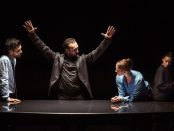
Now named Paul Taylor American Modern Dance, Taylor has included ballets by other choreographers which allows for some healthy comparisons and a hope for the future of this legendary company. The four non-Taylor works, all but one danced by the Taylor dancers, made fascinating comparison with his work: particularly Martha Graham’s “Diversion of Angels,” her ode to romantic and sexual love, choreographed in 1948 to music by Norman Dello Joio, one of the few works in which Graham, herself, did not appear. [more]

The Emperor Jones

March 28, 2017

Directed by Ciarán O’Reilly as a feverish nightmare, this "Emperor," in just over an hour, exposes the inner reaches of the mind of the title character, Brutus Jones (played with a booming voice and a larger-than-life charisma by Obi Abili) leaving tedious reality behind. [more]

Who Would Be King

March 25, 2017

Jason Slavick’s direction keeps the cast rollicking along, taking advantage of every inch of Ars Nova. He is helped by an energetic cast, all on the same wavelength, giving their physical and emotional all. Silly at times, yes; but ultimately dark and meaningful. [more]

Come From Away

March 16, 2017

The songs push the plot along, ranging from numbers about the locals’ dealing with valuable resources (“Blankets and Bedding”) to the quiet awe the visitors express at the local scenery (“Darkness and Trees”). “Somewhere in the Middle of Nowhere” and “Something’s Missing,” eloquently deal with the short-term emotional turbulence that eventually steadied to mutual admiration and many long-term friendships. [more]

Wakey, Wakey

March 14, 2017

"Wakey, Wakey" is Will Eno at his surreal, troubling, beautiful best, a play both challenging and easily absorbed. He truly approaches the unapproachable: the meaning of life. [more]

Deconstruction

March 14, 2017

The acting isn’t detailed or expansive enough to make Leaf’s words come alive or give the slightest notion of the intelligence of these three. Ms. Dobbins’ McCarthy is far too girlish. Yes, the playwright’s point is to show how even an intellectual can be seduced by a good-looking person, but she never boils over. The closest to anger she achieves is petulance. [more]

Nihon Buyo Dance by Geimaruza

March 6, 2017

Three musical pieces displayed the instruments on which the music is made. “Nagare (Flow)” was played on two shamisen (stringed instruments) by Touon Minamidani Mai and Touon Sakata Maiko, completing in ever faster, improvised sounding, themes, all based on traditional melodies (kind of like a gentler version of “Dueling Banjos” from Deliverance). “Toki (Japanese Crested Ibis)” featured a long fue (flute) solo by Tosha Suiho, whose passionate musicianship was overwhelming. The third work, “Shishi (Lion)” combined all the different percussion instruments and the flute to great dramatic effect. [more]

Everybody

March 3, 2017

The original was aimed at an audience that most certainly was illiterate, so that the clever creators used cartoonish, unsubtle characters who spoke in popular jargon, even spouting profanity, which must have tickled the medieval audiences’ sensibilities and kept them following the actors in their juicy parts. Jacobs-Jenkins follows suit, but with his tongue firmly in his cheek, writing his characters, particularly Stuff (played with a no-nonsense, “from the block” insouciance by Lakisha Michelle May), as immediately recognizable twenty-first century caricatures. When cutie pie child Lilyana Tiare Cornell, playing the character Time, spouts the word “shitty,” the audience at the Diamond Stage giggles nervously. [more]

Ring Twice for Miranda

February 19, 2017

Although "Ring Twice" is filled to the brim with socio-political symbolism, it’s not likely that the author was trying for any direct reference to the current maddening political scene since gestation periods for plays are notoriously long. Clearly this play was written well before the 2016 election, so any vague commentary appears to be inadvertent. This is not to say that the metaphors and symbols Hruska uses aren’t intriguing in their own way. [more]

The Dressmaker’s Secret

February 19, 2017

The playwrights have a keen understanding of this place and time, helped by the simple, but telling scenery of Stephen C. Jones, who also lit the small performing space to give the illusion of multiple settings. Molly R. Seidel’s costumes also hit the nail on the head as far as period and character are concerned. The glamorous dress Mária creates for Irma is in direct contrast to her own dreary housedresses, and Robert’s fancy western style suit makes Robi even more eager to leave Romania. [more]

Complexions Contemporary Ballet 2017 at the Joyce

February 15, 2017

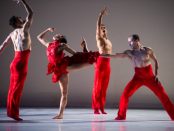
“Star Dust,” Rhoden’s tribute to rock original David Bowie forced Rhoden to study and use each of the nine chosen songs as vignettes to comment on Bowie’s magic, the superb quirkiness of his dancers and display subtlety in his use of steps sometimes missing from his wham-bang, jet engine choreography. Rotating lights and disco balls beamed mood-changing pools of light on the stage (designed by the hard-working Mr. Korsch with psychedelically colorful costumes and makeup by Ms. Darch which exposed a lot of skin.) [more]

Batsheva Dance Company: “Last Work”

February 11, 2017

The centerpiece of “Last Work” was the image of a single dancer, in a blue costume, jogging on a treadmill far upstage while the rest of the troupe, dressed in chic practice outfits by Eri Nakamura went through its paces in a performance area defined by two lines of upright panels lining each side of the stage (designed by Zohar Shoef). The dancers’ outfits changed later on which, for some reason, made it seem as if there were many more dancers on stage than there really were. [more]

Love for Sale

January 26, 2017

The concept of Love for Sale, though not particularly original, is not a bad one, except for one very important factor: Ms. Burke is not up to either the singing or acting demands of Love for Sale, a voyage from innocence to jaded sophistication as told in mostly dark, melodramatic songs, ironically influenced by the American films that flooded Europe in the twenties and thirties. It’s an extraordinarily difficult repertoire that constantly threatens to be silly expressions of impossibly colorful and desperate characters. [more]

Albatross

January 22, 2017

What Evett delivers—using ample quotes from the poem and robust contributions from himself and Spangler—is a terrifying inside look of the Mariner’s experiences, beginning with being hijacked by a friend at a pub. He breathlessly illuminates what the day-to-day life was like with lurid descriptions of illnesses and exciting second-by-second reports of battles with other ships. [more]

Candide (New York City Opera)

January 10, 2017

Linda Lavin, padded and badly bewigged, comes across more like a Jewish yenta than the victim of the vagaries of Eastern European warfare. She has only one song, “Easily Assimilated,” a silly attempt at seduction, which is a shame. This character had several numbers in the original, including one that actually referred to why she is “missing the half of my backside.” Lavin is a star, but is ill-used here. [more]

17th Contemporary Dance Showcase: Japan + East Asia

January 9, 2017

All the choreographers displayed over-intellectualization and overuse of gimmicks, avoiding dealing directly and honestly with their subjects. Homosexuality raised its head in two of the works but was handled superficially. Perhaps, there’s an “Asian sensibility” that eluded me, but the vocabulary used was decidedly Western and has to be assessed in those terms. [more]

Confucius

January 6, 2017

This dance/theater piece is subtitled “Teacher, philosopher, man who shaped a nation,” a rather big theme to dramatize effectively, especially when the mandate is spectacle. Mr. Liu’s barebones, chronological script (consisting of little more than narrative plot advancements and quotes from Confucius) first finds Confucius a defiled presence in the court of the Duke of State (Zhu Yin, zestfully portraying the enervation of over-indulgence) whose evil Minister (Guo Haifeng, zingingly evil) works overtime to frustrate Confucius’ effort. Confucius becomes the love object of and mentor to the Concubine (lovely, floating Tang Shiyi) and, finally becomes the beloved and respected sage. [more]

Alvin Ailey American Dance Theater (Fall 2016 Season)

December 26, 2016

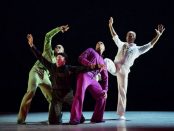
“r-Evolution, Dream.” was a jaunty new ballet by Ailey member Hope Boykin to music by Ali Jackson plus narration spoken by Leslie Odom, Jr. which included a Shakespeare sonnet, “A Negro’s Complaint” by William Cowper, “If I Can Help Somebody as I Pass Along” by Alma Irene Bazel, etc. This delightful romp pitted four groups of dancers against each other, occasionally joining forces, particularly in a fleet finale in which the lines interwove and “interbred.” The dancers—including members of Ailey II—were defined by the color of their chic costumes (black, white, purple and green, designed by Ms. Boykin) all led by Ailey veteran, Matthew Rushing whose Pied-Piper performance gave a center of gravity to what might have been a pleasantly disorganized entertainment. Standing out was Megan Jakel whose whirling, undulating solo evoked spontaneous applause. [more]

The Babylon Line

December 19, 2016

Aaron Port (Josh Radnor), a down on his luck writer, is reduced to teaching Adult Ed classes in middle class/middle brow 1960’s Levittown, Long Island. Richard Greenberg ("Take Me Out," "Our Mother’s Brief Affair") in his new play, "The Babylon Line" at the Mitzi E. Newhouse, has Port frequently speak directly to the audience, doling out information and setting the scene, from the vantage point of 2015. Although it’s an awkward device it does come in handy, particularly at the end when a number of plot strands come together. Port’s frustration with his career is exacerbated by having a successful friend, Jay, confront him en route to his teaching assignment. [more]

A Bronx Tale

December 14, 2016

On Beowulf Boritt’s set of three apartment towers of fire escapes and store fronts, the musical begins with a doo-wop group singing a cappella in close harmony under a Belmont Avenue sign, setting a properly nostalgic mood. The musical follows the plotline of the original. The main character, the Chazz stand-in, is young Calogero, first seen as a youngster (a wonderfully unaffected Hudson Loverro) and then as a young man (handsome and passionate Bobby Conte Thornton), whose father Lorenzo (Richard H. Blake, totally believable) is a hard-working, honest bus driver and whose mother is a housewife Rosina (Lucia Giannetta who makes the most of a small part). [more]

The Mar Vista

December 8, 2016

The title means “sea view,” a metaphor for the fact that his mother’s happiest memories involved being mesmerized by large bodies of water. All the places she felt happiest were by the sea, even—with a stretch of the imagination—the suburb of Mar Vista, L.A., with its wispy view of the Pacific. It was, therefore, dramatically sensible that the final scene should take place on the island off Istanbul where his mother’s family vacationed. [more]

Wonder/Through the Looking Glass Houses

December 8, 2016

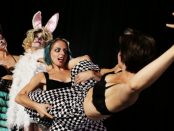
The final sections of this theater/dance work were more effective than the earlier scenes and they included a game show knockoff call “The Price is Right to Be a Queen,” a rigged quiz show which included rather strained audience participation. (Throughout the work the performers zipped into and out of the audience, touching, tweaking and grabbing surprised theatergoers!). The famous “Chess Match” led directly to a totally naked, well choreographed pile-up of bodies reaching for a shiny crown, just out of reach. When Alice grabbed the crown it had a real feeling of triumph. [more]

The Death of the Last Black Man in the Whole Entire World AKA The Negro Book of the Dead

December 5, 2016

There is no plot, just a series of verbal jousts played out on Riccardo Hernandez’ sleek, two-tier set with just the image of trees looming over the actors wearing Montana Blanco’s colorfully exaggerated costumes. From the childlike Prunes and Prisms of Ms. Sithole to the angrily twisted Bigger (a reference to Richard Wright) of Mr. Piniella, the actors recite the difficult lines, goaded to do their finest by director Lileana Blain-Cruz who totally understands the work. [more]

Netherlands Dans Theater

December 4, 2016

Is there a more stunningly beautiful troupe of dancers than the Nederlands Dans Theater? This very international array of performers is not only good looking but dances with thrilling precision and a style that clearly says “company,” thanks to artistic director Paul Lightfoot and general director Janine Dijkmeijer. [more]

Pilobolus Dance Theater (NYU Skirball Center)

December 1, 2016

[esc], staged by Penn & Teller, Mr. Barnett, Ms. Jaworski and Mr. Kent, is a Penn & Teller homage to Harry Houdini. To a musical background of pop songs, the performers—Messrs. Fitzgerald Ahern, Banks-Sullivan, Coalter & Loman and Mlles Krystal Butler & Jordon Kriston—were variously locked in an “escape-proof” box (assembled by two audience volunteers), squeezed into a carry-on bag, handcuffed to a 13-foot pole and duct-taped to a chair. Their escapes, accompanied by Penn’s humorous narration were exciting, energetically performed, but, in the last analysis, a bit long-winded. [more]

“Master Harold” and the boys

November 29, 2016

Watching these three actors is an incredible experience. As Willie, the slower, funnier tea room worker, Sahr Ngaujah, often the butt of the jokes, never loses his humanity. Noah Robbins finds all the complexity in the adolescent Harold, and Leon Addison Brown makes dignity palpable and believable as Sam. [more]

Man in Snow

November 24, 2016

"Man in Snow" begins and ends in tragedy. In between there is an insightful, sometimes banal, study of a middle-aged man, David (an awesomely complex Will Lyman), his bumpy relationship with his wise wife, Franny (Sandra Shipley, whose even-handed façade hides deep emotions), his daughter Emily (lovely, bright Ashley Risteen) who harbors grudges that pore out at the most unfortunate times and his beloved son Joey whose death in a car accident opens the play. [more]

Othello: The Remix

November 20, 2016

In this smart, clever version of the story, Iago, slightly uptight longtime member of Othello’s crew believes that he is not appreciated when newcomer Cassio, a much happier rapper who just enjoys performing gets more notice from Othello. As in the original, Iago plots Othello’s downfall by making him jealous, hinting that Cassio was romancing Desdemona, Othello’s love. Roderigo, the nerdy techie, with a lisp and a heavy heart, also yearns unrequitedly for Desdemona. [more]

The New York Pops: “Concert for Courage”

November 15, 2016

Music director Steven Reineke led a perfectly respectable concert with the help of The Soldiers’ Chorus of The U.S. Army Field Band (First Lieutenant Alexandra Borza, Associate Bandmaster), a robust ensemble that proved itself song after song, including several songs in which soloists emerged to sing as in Barry Manilow’s “Let Freedom Ring” and the Toby Keith/Chuck Cannon “American Soldier.” [more]

Falsettos

November 14, 2016

Throughout it all, Finn’s songs illuminate the joys, loves, hates, passions and complaints of this delightful cast of characters. From the opening “Four Jews in a Room Bitching” to the exquisitely moving final song, “What Would I Do?,” the score is full of melody and witty wordplay. There are songs about Mendel’s sessions (“Marvin at the Psychiatrist, a Three Part Mini-Opera” and “Jason’s Therapy”), a marriage proposal, a nervous breakdown song (“Trina’s Song”), a hilarious song about Jason’s little league (“The Baseball Game”), an ominous song (“Something Bad is Happening”) and several love songs (“I Never Wanted to Love You,” “Making a Home,” “Unlikely Lovers,” “The Games I Play” and the previously mentioned “What Would I Do?”). [more]

Coriolanus (Red Bull Theater)

November 9, 2016

Just as Ulysses S. Grant and Dwight D. Eisenhower did centuries later, Coriolanus, urged on by his powerful mother, Volumnia (a startling, stinging Lisa Harrow), uses his military success as a springboard for a high political office, Consul, which he easily wins with help of two Tribunes of Rome, Sicinius Velutus (a wily Stephen Spinella) and Junius Brutus (Merritt Janson, playing cross gender to perfection) and a friend, Menenius Agrippa (Patrick Page, using his weighty voice and commanding eyes brilliantly). [more]

Love, Love, Love

November 5, 2016

British actor Richard Armitage making his New York stage debut and Tony and Academy Award nominee Amy Ryan work hard to make Kenneth and Sandra three-dimensional, likeable people, but, as written by Mr. Bartlett, their crassness is the fatal flaw in "Love, Love, Love." Why should we enjoy spending so much time with two people who so adroitly care only for themselves? [more]

Heisenberg

October 22, 2016

Simon Stephens, whose Tony Award winning "The Curious Incident of the Dog in the Night-Time" recently amazed audiences with its razor-sharp take on the inner workings of an autistic boy, is back with "Heisenberg," a two-hander that examines the relationship between a forty-something woman and a seventy-something man, written with the same consummate insight into the foibles of human beings, minus that play’s technical wizardry, here replaced by a sharp ear and eye for the nuances of neediness. [more]

Oh, Hello on Broadway

October 20, 2016

In the guise of two old Upper West Side bachelor geezers, Kroll as failed actor, Gil Faizon, and Mulaney as failed writer, George St. Geegland, wander about Pask’s brilliant combination apartment/beauty salon/TV studio/street set, musing out loud about their lives, wearing dreadful wigs (credit Leah Loukas) and speaking in a bizarre accent which, for example, turns “Broadway” into “broodway,” “an” into “en” and “homage” into “home page.” [more]

Inner Voices

October 17, 2016

Paulette Haupt, producing artistic director of Premieres, should be very proud of herself. Her "Inner Voices" program at the TBG Theatre managed to shock, move and entertain. The three short one-act musical monologues, each with a distinctive voice and each performed by an expert singer/actor were sweetly bizarre ("Just One 'Q' "), shattering ("The Pen") and heartwarming ("The Booty Call"). [more]

The Trial of an American President

October 10, 2016

Trial is stacked against Bush from the get-go. The torrent of facts alone convicts him. The director, Stephen Eich, the author and probably the actor, Mr. Carlin, seem to have decided to make Bush weak-voiced, full of twitches, nervous eye movements and religious fervor. Had Bush been portrayed as a stronger man who truly believed in what he did, the play might have had a dramatic spine. The very fact that after being convicted by a jury of audience members Bush’s last word is a tearful outcry (“Laura”) serves to induce not empathy, but pity. [more]

“Misty Copeland” by Gregg Delman

October 6, 2016

"Misty Copeland" is not just the celebration of Misty Copeland the feisty, young classical ballet dancer, but of Misty Copeland the young, nubile, well-proportioned young woman. She looks great wearing next to nothing, her exposed skin gleaming under Mr. Delman’s expertly subtle lighting. She is able to achieve all sorts of hyper-stretched positions on all sorts of furniture, her expressions ranging from distracted to come hither. [more]

The Black Crook

September 25, 2016

The creators of this version combined songs from the period—several probably used in the original production—with a pared-down version of the second-rate melodrama written with by Charles Barras (portrayed as always rattled and put upon by Steven Rattazzi), who tells his side of the story while also playing the romantic lead, Roldolphe, in the actual "Black Crook." [more]

New York Pops Underground (Feinstein’s/54 Below)

September 25, 2016

Hosted by the always charming Steven Reineke, the fundraising event, New York Pops Underground, featured two terrific Broadway stars, Montego Glover and Tony Yazbeck, whose performances clearly loosened the purse strings of a standing-room-only Feinstein’s/54 Below crowd. [more]

A Corona Works: Thorns of the Crown

September 20, 2016

Two queen-like figures, Ms. Corona and Maricarmen Garcia, dressed in a parade of Aviad Arik Herman’s sumptuous costumes, reigned over four young men—Nick Burrage, Alexandre Barranco, Nicholas Montero and Michael Bishop (dressed in Herman’s tight, revealing shorts). The men morphed into the roles of consorts and warriors, manipulated by the two royal ladies into confrontations involving vividly acrobatic ballet steps and quotes from Shakespeare. [more]

Phaedra(s)

September 17, 2016

During the three and a half hours of "Phaedra(s)," Huppert masturbates, menstruates, throws up, fellates several versions of Hippolytus, flails about with masochistic glee, and screams so loudly and continuously as to cause fears for her vocal health, all in the service of getting to the core of the title character as imagined by Sarah Kane, Wajdi Mouawad and J.M. Coetzee (with dramaturgy by Piotr Gruszczynski.) Director Krzysztof Warlikowski did little more than keep the over-the-top emoting and sexuality from exploding out to Fulton Street. [more]

Maestro

September 16, 2016

Felder’s play begins with a video of the actual Leonard Bernstein delivering a colorful, yet entertaining, illustrated lecture on music. When Felder sashays down the aisle, a cigarette in one hand and a drink in the other, the lack of resemblance is, at first, bothersome. But, somehow, sitting at a piano—which he plays impeccably—his monologue pulls you into Bernstein’s tumultuous life story. [more]

BalaSole Dance Company: Mixtus

August 22, 2016

The ten solos proceeded efficiently and smoothly with certain similarities becoming apparent: black was the color of all but one of the costumes and black was the mood of most the works. Crouches were the preferred opening poses, beginning with “Convergent Unease” by Alexis Julian to music by Max Richter, and the movement palettes were not particularly original, even when well danced, as were most of the solos. [more]

Sarasota Ballet: A Knight of the British Ballet

August 15, 2016

A few months ago we saw the sensational Miami troupe featuring the works of George Balanchine. Now we have just had a fascinating week-long season by the Sarasota Ballet troupe, directed by Iain Webb, at the Joyce Theater in Chelsea, in a program called "A Knight of the British Ballet" focusing on the brilliant work of Sir Frederick Ashton. Ashton was for decades synonymous with The Royal Ballet. His ballets were the artistic backbone of that troupe. It’s odd—yet wonderful—that Florida has become a stronghold for the repertories of two of the twentieth century’s most important choreographers. [more]

Cats

August 9, 2016

The debonair resident of posh St. James, and Gus, the theatre cat, are both played with finesse by Christopher Gurr, whose “Gus the Theatre Cat” who nearly steals the show away from the more famous “Memory,” here sung by an underwhelming, but pretty-voiced Leona Lewis, the British three-time Grammy Award nominee, as the bedraggled, superannuated beauty, Grizabella. Mr. Gurr’s wistful singing and great acting movingly communicate his tale of theatrical greatness and all the actors he had known (most completely forgotten by contemporary audiences). [more]

Takarazuka in “Chicago”

July 30, 2016

This Japanese version lacks the passion and darkness necessary to make this morality tale pop. The two leading ladies, Wataru Kozuki as Velma and Hikaru Asami as Roxie looked too wide-eyed and innocent to portray such trampy characters, but they moved and sang well. Keaki Mori as Matron “Mama” Morton, in her high, curly wig, totally missed the seamier sexual ambiguity of the character while Chihiro Isono as the put-upon Amos was a tad too low key. Asato Shizuki was slick, but not seamy or sexually provocative as the lawyer, Billy Flynn. [more]
1 6 7 8 9 10