Archive
The play is a nicely developing mystery fantasy story about the paranormal, but when the teenage boy is revealed as the Spirit Child, the show goes off track. The idea presented is that the Spirit Child is the child who would have been born except for the miscarriage. This idea is a stretch in believability for the dramatic structure of the show. It introduces the idea that a consciousness once attached to a developing embryo continues to be attached to the woman who was carrying that embryo even after the tissue has been expelled through a miscarriage. It turns on its head the whole idea of developmental psychology. How is it possible for the miscarried tissue that was not even old enough to definitively determine sex to become a spirit that ages as if it had been born? [more]

Wonderful Town (New York City Center Encores!)
Fast-forward to 2025, and City Center has once again turned to this dependable crowd-pleaser, reportedly as a last-minute substitute for Michael John LaChiusa’s "The Wild Party." The choice makes logistical sense: "Wonderful Town" offers hummable tunes and a quirky, heartfelt book by Joseph Fields and Jerome Chodorov. But under the direction of Zhailon Levingston—whose past work includes "Table 17" and the vogue-infused "Cats: The Jellicle Ball"—this new iteration stumbles. Lacking Marshall’s instinct for the show’s fine balance between earnestness and irony, Levingston’s staging never quite finds its rhythm, veering too far into knowing kitsch and losing the tender charm that once made Wonderful Town feel, well, wonderful. [more]
Stranger Things: The First Shadow
"Stranger Things: The First Shadow" concludes with a Netflix joke that, besides being pretty funny, also represents a bit of chest-thumping for the play's outsized number of developers who manage to successfully blur the line between theater and television. Whether that's a good thing is a matter of taste, or a lack of it, but there's no denying that "Stranger Things: The First Shadow," which has journeyed from the West End to Broadway, is exactly the type of experience it wants to be: immersive; scary; and, even if you've never seen an episode of the streaming series from whence it comes, familiar. That's because, imaginatively befitting its source material, the play is a storytelling stew of cultural callbacks that owes a debt--presumably unpaid-- to Stephen King, Wes Craven, and other unsettling shapers of Gen-X childhoods. [more]
Ceremonies in Dark Old Men
At this vantage point 55 years after its premiere, like the Wilson plays which intentionally cover the previous 100 years, "Ceremonies in Dark Old Men" feels like an historical play wedded to its own time period. Its story and characters are a combination of a Black version of "Death of a Salesman" and a Harlem version of "A Raisin the Sun." Like the story of Willy Loman and his hapless family, the tale of Russell Parker and his two wastrel sons could only have a tragic ending, as their values are so hollow. And like "A Raisin the Sun," the Parker family is so desperate to succeed as Black people in Pre-Civil Rights Era America that they put their hopes in a man that even a child would not have trusted. [more]

Floyd Collins
Unfortunately, while the carnival atmosphere in the field above the cave increases, the musical is mostly a waiting game: if and when Floyd Collins will be brought up from the deteriorating cave. The emotions that you would expect as time begins to run out as passageways become either waterlogged or impassible are not in evidence except for Floyd’s father who is more concerned with finances that his son’s life. Floyd himself is often depicted as delirious or depressed so that we don’t get much of an arc of his emotions. [more]
Buena Vista Social Club
Wesley Wray (center at microphone) and the company of the Broadway musical “Buena Vista Social [more]
Hold Me in the Water
That balance—between emotional vulnerability and razor-sharp humor—is what elevates "Hold Me in the Water" beyond the sea of solo shows that mine personal experience for applause. Haddad’s artistry lies in his fierce honesty and unsparing introspection. He examines his own longing, joy, and heartache with something approaching clinical precision, yet never loses the pulse of the deeply human. He never asks for pity, and when disappointment inevitably arrives, he extends surprising compassion—even to the one who’s let him down. [more]
Smash
At times the show directed by Stroman seems to be a satire or a parody, while the choreography by Bergasse mostly looks like ersatz Bob Fosse which seems inappropriate for the Marilyn Monroe story. As star Ivy Lynn playing Marilyn, Hurder seems to be doing a Megan Hilty impersonation from the TV series, rather than bringing anything new to the role. (Of course, Hilty is appearing around the corner in Death Becomes Her.) Bowman’s Karen is fine as far as she is allowed to go but the role seems underwritten. Nielsen ass The Actors Studio coach, (compared to Margaret Hamilton as the Wicked Witch of the West) is so unpleasant that you wonder why her character isn’t fired long before it happens in the story line. [more]

Soulmate
Clarke's direction is uneven, giving the show a rehearsal or community theater vibe. The narrative line is unclear as to whether the main characters are real or a hallucination of one of them. The songs, what few there are, are extraneous to the action, adding nothing of importance to understanding the point of the story. The main characters are Cyrene (Shannon Wong) who is the wife of Caleb (Zachery Michael Shook), a construction manager. According to the play notes they are involved in pushing "the boundaries of love, desire, and intimacy." The major problem with this dramatic idea is Cyrene is a memory of Caleb's dead wife, who is directing him to find new and provocative sexual relationships with other women. The character is a constant presence with Caleb but is not seen by any other person. This dramatic element is hinted at but unclear until halfway through this short play. [more]
Class Dismissed
The performers inhabit a shared space that hums with latent connectivity, even in the absence of direct dialogue. Their presence to and for one another—unspoken yet palpable—forms the quiet backbone of the piece. What unfolds is a relentless swirl of Marxist theory and grand philosophical overtures, repeated like mantras against a backdrop of absurdist physicality. Narrative cohesion is eschewed in favor of thematic resonance: a professor marks chalk outlines around a silent woman while students volley fervent monologues; later, those same students offer murmured asides as the professor ascends to a pulpit-like presence. Though no linear thread binds them, their trajectories intersect often and with theatrical charge, forming a constellation of meaning just out of reach. [more]
Grief Camp
Time passes slowly during "Grief Camp" as a bunch of adolescent characters and the audience watching them struggle collectively to figure out the point of being there. Playwright Eliya Smith fails to provide that enlightenment, though director Les Waters does his best to pretend it might be forthcoming, stretching the emptiness of Smith's script until it simply has to be acknowledged. Set in the actual town of Hurt, Virginia, the play's narrative development is mostly in its title and that correspondingly unsubtle location choice, where Smith hazily depicts a sleepaway camp for young people coping with death at an age when life is painful enough. [more]
Glass. Kill. What If If Only. Imp.
The cumulative effect of the four plays is greater than the sum of its parts. The quartet of plays seems to demonstrate Caryl Churchill in a new mode. While the plots are slight, the themes are of major importance and suggest new ways of thinking about them. James Macdonald’s production and the acting of his cast are quite assured even though the plays are mainly non-realistic and require their own kind of suspension of disbelief. [more]
minor•ity
"minor•ity" is a wonder of a play written by francisca da silveira and skillfully directed by Shariffa Ali telling a tale of clashing artistic egos encompassing issues of Black identity, cultural influences, and financial support. The cast of three leaves no question in the viewers’ minds that what is being witnessed are real people telling a story through their actions, not actors playing roles. There is a message in the name of the show presented in the script but not in the show. [more]
John Proctor Is the Villain
While Belflower’s play is clever and insightful, it is also contrived and manipulative attempting to shoehorn almost every feminist hot button topic into one story overlaying "The Crucible": date rape, sexual abuse, sexual harassment on the job, toxic masculinity, patriarch dominance. It makes all of the male characters look like idiots and all of the women victims which is not exactly a reflection of real life. It also overloads the deck while at the same time copping out in the end. While New York teens are probably much more liberated than those in rural Georgia, the language of the play is incredibly devoid of swear or curse words which usually pepper the speech of adolescents. Finally, it borrows from Ivo van Hove’s 2016 staging of "The Crucible" in which a modern classroom also turns into a telling of Miller’s play. [more]
The Picture of Dorian Gray
However, it is not just the remarkable video design which uses sometimes up to six screens to convey the action of the story plus live action, but we get inside of the head of protagonist Dorian Gray in ways not possible before. Also seeing or hearing Snook as all the characters in different voices is quite a remarkable feat. Andrew Scott only plays eight in his Vanya one-man show, but here Snook also changes costumes repeatedly before our eyes and emerges as someone else. Beginning as the narrator, she slowly becomes Dorian Gray who eventually takes over completely. We also see her as Lord Henry Wotton, painter Basil Hallward, actress Sibyl Vane and later her brother James, the Duchess of Harley, and former friend and Oxford classmate Alan Campbell. [more]
Boop! The Musical
But, top-notch as all of that is, the musical's unmitigated highlight is the Broadway newcomer Rogers as Betty Boop. While the character's trademark look and mannerisms certainly contour Rogers's performance, they do not obscure a wealth of touching flesh-and-blood emotions that all come out in an underwhelming eleven o'clock number, "Something to Shout About," that, because of Rogers, manages to overwhelm. It seems that "Boop! The Musical" has a new star rather than an old one. [more]
All the Beauty in the World
Bringley, making his theatrical debut as himself, delivers a performance marked by restraint and quiet intensity. His words, drawn largely from the memoir, reveal a man of thoughtfulness and delicacy—someone who seeks refuge not in action, but in observation, retreating to the hushed galleries of The Metropolitan Museum of Art, where he once worked as a guard. “You lose someone,” he tells us, simply, “and it puts a hole in your life—and for a time you huddle down in that hole.” It’s in that stillness, that huddling, that the piece finds its quiet power. [more]
The Swamp Dwellers
Before he was a Nobel laureate, before his name was canonized in the firmament of world literature, Wole Soyinka was a young playwright—barely in his mid-twenties—when he penned "The Swamp Dwellers" in 1958. And yet, this early work bears the unmistakable gravitas of myth: a compact, hour-long domestic drama that pulses with elemental force. In director Awoye Timpo’s hauntingly grounded revival, the piece reverberates with contemporary resonance. It is at once a family portrait and a parable, steeped in the muddy waters of postcolonial Nigeria and rippling outward into modern-day concerns—climate change, disillusionment with institutions, and the aching silence left by absent gods. [more]
Purpose
The Steppenwolf Theatre Company production of Branden Jacobs-Jenkins’ "Purpose" follows on the heels of their magnificently staged "August: Osage County," but unlike that dysfunctional family drama, this play has a great deal to say as well as major themes. Like the title of the author’s "Appropriate," "Purpose" has many meaning all used here at the same time. And never forget how much fun it is to have a private look in at the private lives of a rich and famous (but fictional) family when they are on their worst behavior. Do not be surprised if this play wins this year’s Tony Award followed by next year’s Pulitzer Prize. You can say you heard it here first. While the play is quite long, it is tremendously rewarding as great plays should be. [more]
Scammed into Love
Although there are humorous moments, the production doesn't work for various reasons, including characterizations and technical issues with sound reproduction. None of the eight songs are memorable, and the characters do not engage the audience, which is a question of direction and acting. While the performers work hard at portraying their characters, the effect is uneven. Some characters appear two-dimensional, and performances feel like a college or community theater production. The vocals are problematic, with some performances being overpowered while others pitchy. Overall, the show doesn't engage the audience in caring about the characters or their stories. [more]
According to Howard
Except for a couple of main characters, the people in his life seem to come and go making it a little bit difficult to follow. While the opening of each act is in the form of a Technicolor musical, the limited budget and the staged reading format does not allow for this. Actor Michael Halling is tall enough to represent the 6’4” Hughes but he does not portray his undoubted charisma to have taken the world by storm. There are also many anachronisms as well as at least one scene which is out of order and facts that are inaccurate. [more]
Glengarry Glen Ross
With one exception, however, Marber's cast of notable wisecrackers treats Mamet's punchy dialogue solely like punchlines, even when they're face down on the canvas. As Shelley "The Machine" Levene, a loser among losers, Bob Odenkirk opens an Act I triptych of two-handers that are all set within a capacious Chinese restaurant, nonsensically designed by Scott Pask to indicate a gigantic establishment apparently getting along just fine serving no more than a couple of liquid-lunchers at a time. On the verge of being fired for bringing up the rear in a sales contest for a shiny new Cadillac--that old-timey signifier of virile American success--Levene tries to sweatily sweet-talk the best leads from Donald Webber, Jr.'s insensate office manager, a pleading effort that quickly devolves into a pathetic attempt at bribery. [more]
Two Sisters Find a Box of Lesbian Erotica in the Woods
Horwitz and Williams perfectly match each others’ energy on stage. Indeed, at times it seems as if each is trying to one-up the other’s exaggerated mannerisms. In one scene, a famous artist might dip into nonsensical French phrase, only for an interviewer to ratchet it up further by over-emphasizing an accent on a word that doesn’t need it. One might not-so-subtly flirt by bringing up a mutual past lover while the other awkwardly deflects, only spurring on further attempts. Throughout each scene, the pair’s back-and-forth is consistently excellent. They have an easygoing chemistry that makes every scenario feel fresh. [more]
Good Night, and Good Luck.
If only film star George Clooney and his co-script writer Grant Heslov had hired an actual playwright to adapt their acclaimed screenplay for the 2005 film "Good Night, and Good Luck." for the Broadway stage. What worked in close up in the film does not have the same effect on the huge stage of the Winter Garden Theatre. And while David Strathairn as Edward R Murrow in the film, the role now played by Clooney on Broadway, also seemed wooden and unemotional, his every flicker of emotion on his face was telegraphed through the extreme close ups of every frame. With its cast of 22 on a huge CBS studio set, most of the characters are undefined or unidentified. At times it is difficult to know who is talking or where their voices are coming from on the multileveled setting. [more]
Humpty Dumpty
Eric Bogosian’s "Humpty Dumpty" was first written 25 years ago and premiered at the McCarter Theatre Center, Princeton, in 2002. At that time the idea of quarantining due to a local or national disaster seemed a fantasy. However, since then, we have all lived through the Covid Pandemic and what was inconceivable became our daily existence. Not only does Bogosian’s play seem tame now, it also seems predictable and dated. Director Ella Jane New does not help the script much by allowing the vapid characters to all seem one dimensional. Possibly with a satiric approach or powerhouse performances, the play might have something new to say to us as its entitled people show their true colors. [more]
Danger and Opportunity
Jack Serio directs a strong cast of seasoned actors whose personal chemistry gives the ensemble a solidly believable portrayal of their characters. Juan Castano is Edwin, a mid-30s man married to Christian, a man ten years older, believably played by Ryan Spahn. The two men are struggling with issues in their marriage when Margaret enters the picture. Julia Chan is Christian's "girlfriend" from high school. They have not communicated with each other in 20 years. [more]
The Cherry Orchard (St. Ann’s Warehouse)
The results of this updating are bold, and Andrews’ intellectual ambition is undeniable. At times, his revisions might seem questionable but when the production clicks, it strikes with a thrilling originality. The production pulses with an urgency often missing from more traditional revivals of "The Cherry Orchard," a play about people running out of time. The central conflict remains: Liubov, the bankrupt widow haunted by the ghosts of her past, returns to her family estate for the inevitable sale of the land that defines her family’s history. Practical solutions are needed, but neither she nor her hapless relatives can take decisive action. [more]
Love Life (New York City Center Encores!)
Brian Stokes Mitchell, Andrea Rosa Guzman, Christopher Jordan and Kate Baldwin in the opening scene [more]
All Nighter
While most of the audience will probably not have graduated in the last ten years (though you never know), the play speaks to all of us about the closeness and personal relationships of our college years. Playwright Natalie Margolin knows how to create tension from hints casually dropped and director Jaki Bradley has created a cohesive cast who could have been together the last four years. "All Nighter" is one of the few plays set at a college that seems to come from the author’s own firsthand experiences. [more]
Operation Mincemeat
The new musical attempts to out Monty Python "Monty Python" by creating a full-length show and story in their style, although its origins also go back to British Music Hall where there is also much cross-dressing (i.e. men playing women and women playing men). Those who love Monty Python will have a great time; those who don’t may find the two hour and 30 minute show heavy going. The show is also Very British and a great many of the jokes and gags don’t land for American audiences. However, the hard working cast is impressive playing many roles each and Robert Hastie’s fast paced direction doesn’t give a lot of time to think about the antics on stage. [more]
Remembrance
"Remembrance" by Patricia GoodSon is a story about her journey, for more than a decade, in dealing with her mother's Alzheimer's disease. As directed by Joan Kane, it is told from the perspective of a woman working with a therapist to unravel the emotional impact of those years of caregiving. It is not about the impact of the disease on the person with it but on the effect on the caregiver. [more]
Amm(i)gone
In "Amm(i)gone," Mansoor masterfully delves into the delicate nuances of cultural and personal differences, exploring the connections that bind us even in our diversity. Co-directed with Lyam B. Gabel, this meta-theatrical production—spanning a compact yet potent 80 minutes—recounts the journey of Mansoor and his mother as they embark on the project of translating "Antigone" into Urdu. Surrounded by designer Xotchil Musser’s evocative set of wooden cutouts and intricate mosaics, and serene candles for effect, Mansoor guides the audience through their creative process, blending dialogue, video and audio recordings, and projected imagery to weave a story that is both intimate and expansive. The production’s clever use of multimedia enhances the emotional weight of their shared task, inviting the audience to reflect on the complexities of language, family, and legacy. [more]
Who is Jimmy Pants?
The second in the York Theatre’s Spring New2NY series is "Who Is Jimmy Pants?," an entertaining spoof of bio-jukebox musical, a genre that could use some taking down. Presented concert-style with book-in-hand, as were the York’s Mufti Series, the high-powered cast of nine directed by Stephen Nachamie (Ken Ludwig’s "Dear Jack, Dear Louise") make the rather clichéd material seem better than it is. [more]
We Had a World
In fact, the play Harmon has written is mainly about the conflict between the grandmother and the mother. While we are never really certain why Ellen and Susan refuse to be in the same room, we come to know all the details of the relationship between Renée and Ellen from three sides. The most entertaining parts of this long one-act delineate the relationship between Joshua and his Auntie Mame-like grandmother who did not believe in age-appropriate events: taking him at age seven to see "Dances With Wolves," attending a Mapplethorpe exhibit (which he did not understand) at age nine, seeing Diana Rigg in "Medea" when he was ten, and a three-movie marathon during a snow day off from school: "Secrets and Lies," "Sling Blade" and "The English Patient." Joshua credits his grandmother with changing his life making him want to be a playwright after seeing "Medea." [more]
The Trojans
"The Trojans" effortlessly blends sharp, often hilarious high-school dialogue with an inventive and evocative score, creating a musical experience that feels both contemporary and nostalgic. The characters’ voices ring true to their age and environment, and their dialogue flows seamlessly into the show’s musical numbers. The soundtrack, crafted from cassette tape loops and vintage analog synths, infuses the production with an infectious energy, while also echoing the show's 1980s-inspired aesthetics. There are exceptional songs throughout the score but "Boys are Bad," a standout solo for Lucas (Daphne Always), not only delivers a memorable melody but also weaves in pointed commentary on masculinity—a theme that reverberates throughout the production. [more]
Maybe Tomorrow
"Maybe Tomorrow," written by Max Mondi and directed by Chad Austin, is a play about such a place and the person who created it. Inspired by a true story, Austin directs a cast of two in an exploration of a person lost in the present and locked within a mental space defined by the four walls of a bathroom, a person mediating the outside world through a computer and contact with one human caregiver but unable to move from a world they have defined as "safe" into the unknown world beyond the walls of a room. [more]
Ghosts
The new version by Irish playwright Mark O’Rowe uses contemporary and spare language but has made several events more literal as if not trusting modern audiences. The director has made the same mistake starting the play as a rehearsal in which we see the opening scene three times ranging from devoid of emotion to accomplished, which is both ineffective and pointless as it does not help us into the world of the play. The thrust stage by set designer John Lee Beatty (a room in unpainted wood, a single dining room table and mismatched chairs and a wall of French doors into a conservatory) is as stripped down and as spare as the language, a fitting place for a drama of tragic proportions, but does not offset the one- dimensional acting. The bland costumes mainly in black or white by Jess Goldstein straddle both the 19th and 21st centuries, seeming to want to have it both ways, but suggesting neither. [more]
Lists of Promise
The scene with Adam and Eve establishes the structure for the show, with each of the ensuing vignettes being conducted in a call-and-response format. The second explores a list of rules established during the Victorian Era. In this set, the aerial performers represent a young girl just coming of age and two older, more established women. The aerial characters make the call with the response coming from different members of the Grounded Women, each expanding on the list of comments being made by the aerialists. The set ends with the Contemporary Woman bringing together some of the ideas presented in the call and response, presenting the state of a woman's status in society as the result of the list of rules. [more]
Last Call
Peter Danish’s "Last Call" is a 90-minute confection of speculative daydreaming, inspired by a brief meeting between two of the most legendary conductors of the last century, Herbert von Karajan and Leonard Bernstein. Set in Vienna in 1988, in the sumptuous Blaue Bar of the Hotel Sacher, just before both men passed away, the play imagines a moment when the two giants of classical music, though not close friends, exchanged words. [more]
The Jonathan Larson Project
Adam Chanler-Berat, Lauren Marcus, Taylor Iman Jones, Jason Tam and Andy Mientus in a scene from [more]
Lilith in Pisces
Kayla Eisenberg’s ("Delta Dawn," "Yiddish Club") script has a flawless grasp of rhythm – the play will rapidly speed up or slow down suddenly yet always feels completely natural. Characters consistently interrupt and speak over each other, then pause for a moment before resuming the frenetic pace. Characters are alone on stage rarely, but just frequently enough to provide necessary moments of calm. It’s a credit to her skill as a writer that 90 minutes of tension-building never feels overwrought. The script is effectively one long, deeply compelling conversation. Throughout it all, Lilith (in the form of a print of 19th-century symbolist Dante Gabriel Rossetti’s famous oil painting Lady Lilith) watches over them. Lilith, the first wife of Adam (before Eve) who defied both him and God only to become a demon, is given great thematic resonance. Eisenberg’s script explores regret, resolve, and defiance through this interesting prism. [more]
As Time Goes By
While the conversation may not always captivate, its premise—one that hinges on the unpredictability of human connection—remains intriguing. However, it’s hard to ignore the tension between the initial promise of a quick fling and the long, drawn-out conversation that ultimately defines their encounter. The result is a work that wrestles with the idea of how we fill the spaces between moments of intimacy—and whether we even have the language to fully express what it means to truly connect. [more]
ON THE TOWN… WITH SWEENEY TODD… AND A SPIRITED SPELLING BEE…
Once or twice a year, I like to recognize exceptional work at the high-school or college level. The students of New York’s Frank Sinatra School of the Arts have outdone themselves with a masterly production of Sondheim’s “Sweeney Todd.” If you can get a ticket, go! It’s brilliant theater. And Connecticut’s Staples Players’ presentation of “Spelling Bee”--with some charming artists-to-watch and one extremely special surprise guest—had me beaming. [more]
Have You Met Jane Goodall and her Mother?
Who knew that a biographical play could be so witty, entertaining and charming? The latest EST/Sloan Project science play, Michael Walek’s "Have You Met Jane Goodall and Her Mother?" is one of the most enjoyable and enlightening comedies of the season. Using the actual facts of Goodall’s first trip to Tanganyika’s Gombe Stream Reserve in 1960 to observe chimpanzees in the wild, Walek creates a play that sticks close to the well documented facts but fills in the missing information with often amusing supposition. The title refers to the fact that the Tanganyika government (then ruled by the British) only allowed Jane to study in their game park as a woman alone if she had a chaperone – so she brought along her mother. Jane Goodall’s trip was arranging by famed palaeoanthropologist Louis Leakey for her to find the missing link between humans and chimps which she finally does just before the end of her four month first trip. [more]
A Streetcar Named Desire (Almeida Theatre)
Even though the director, Rebecca Frecknall, honors most of the play’s dialogue, Blanche’s heartbreaking confession scene with Mitch (Dwane Walcott), her suitor, revealing the sad roots of her dysfunctional life, is truncated by several meaningful words; also, the play as written ends with the men arguing over a poker game as Stella quietly mourns in the arms of her landlady, Eunice (Janet Etuk, excellent). Here it is Stella’s mournful cries that bring the curtain down, distorting Williams’ message. [more]
The Great Privation (How to flip ten cents into a dollar)
While there are plenty of laughs in "The Great Privation," we never lose sight of the fact the subject matter has roots in the history of medical exploitation. Previous mainstream pieces have appeared in recent years: Rebecca Skloot’s #1 New York Times bestseller, "The Immortal Life of Henrietta Lacks," about a black woman whose cells were taken without her consent and unbeknownst to her contributed to numerous medical breakthroughs, and "Behind The Sheet," Charly Evon Simpson’s 2019 play presented by Ensemble Studio Theatre, loosely based on the story of J. Marion Simms, a gynecology pioneer whose progress (and success) was built on the suffering of enslaved women. [more]
Fog and Filthy Air
It is essential for the audience to become fully engaged with the story and to care about the characters. When that does not happen, the show falls flat. While Homeyer and McGrath make an effort as Father and Mother, they are saddled with one-dimensional characters whose interactions lack chemistry. Gamble’s character is more developed but lacks a believable emotional connection with the other two. The dialogue touches on emotional issues within the family but does not effectively build dramatic tension with those issues. In the final analysis, the play lacks a compelling emotional hook. [more]
Dakar 2000
The play moves by unexpected twists and turns which are both amusing and engrossing. We never do find out for certain if Dina is a spy or not. However, she does tell Boubs that she was stationed at the embassy in Dar Es Salaam when al-Quada terrorists blew up both the Kenya and Tanzanian American embassies killing 200 and wounding 4,000. As she lost all of her friends and colleagues, she has vowed to hunt down and bring to justice those responsible. [more]
Wounded
"Wounded," written by Jiggs Burgess, is a story using a cloak of humor to obscure the pain and dark feelings being hidden by the protagonists. Although referred to as a comedy or dark comedy, it should be noted that the simple addition of humor does not make it so. This play is a serious drama, in the full meaning of that form, with some humorous elements. Del Shores skillfully directs an excellent ensemble of three players to expose layers of emotional and physical wounds in the characters. Shores and the cast successfully create a deceptive cover for the story's final destination, with the dramatic tension slowly building to a surprising and unexpected ending. It is a play worth experiencing, even with a few issues concerning the logic in some of the characters' interactions. [more]
Sumo
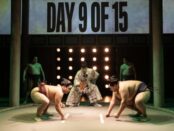
Despite its predictable overarching plot, "Sumo," produced jointly by the Ma-Yi Theater Company and La Jolla Playhouse, is never boring. Partly, that's because, as Mitsuo, Shih is villainously charismatic, portraying the preening bully with the disarming and false sense that there is a method to his sadism. But, even more compellingly, Sumo is an immersive and sumptuous eyeful--no matter your personal predilections for loincloths and bare, overhanging bellies--with a set, props, costumes, projections, and all that glorious sumo hair provided by Wilson Chin, Thomas Jenkeleit, Mariko Ohigashi, Hana S. Kim, and Alberto "Albee" Alvarado respectively. As for the main event, there is certainly loads of cheer-inducing sumo wrestling throughout the play, but it's the sumo karaoke after the intermission that adds much-needed joy to the proceedings. That exhilarating scene, aided by Paul Whitaker's vibrant lighting effects mixed with Fabian Obispo's equally energetic sound design, also offers director Ralph B. Peña the opportunity to let the actors cut loose, at least for a little while. [more]
Talking with Angels: Budapest, 1943
So much of "Talking with Angels" is taken up by the rantings of these otherworldly emenations, which are filled increasingly by cryptic, impenetrable spoutings referencing religious imagery, that the play loses all momentum. Even though these Angels are the eponymous subjects, the really dramatic stretch of the play begins with Gitta’s plan to save not only her Jewish intimates, but scores of Jewish women after these Friday kaffeeklatsch idylls are suddenly interrupted as the Nazis bomb and then enter Budapest with frightening speed. [more]
La Gota Fria: The Cold Sweat
Anna Capunay has attempted to write a family drama in order to influence people to try alternatives to chemo and radiation. Unfortunately, in using her own family story, she has not thought out how to make this a convincing and persuasive play for others. Incidentally, the title comes from the song that singer Carlos Vives made famous in 1993 which literally refers to the weather, and not illness, though it may used metaphorically here as a cold front causing bad weather. [more]
Avalona: A Musical Legend
"Avalona, A Musical Legend," created by Dina Fanai, with music and lyrics, is a concept album with elements of modern opera. While not a musical in the usual sense of that form, it fits in a class of shows with the feel of a musical, such as "Jesus Christ, Superstar," which in its original form was a concept album concert with some notable productions being in the form initially conceived by Sir Andrew Lloyd Webber, but many not. It is a show at the edge of being a spectacle in the best meaning of that word, and one to be experienced as if viewing oneself on an immersive journey of discovery and transformation. [more]
Conversations with Mother
While the characters do not change much, they roll through the years dealing with the various crises with various levels of success. However, the play is peppered with one liners and zingers that make this one of the most entertaining plays this season. Under the polished direction of Noah Himmelstein, Aaron and Doyle get a great deal of mileage from these jokes, not all of them new, but all of them hilarious. [more]
Tango After Dark
"Tango After Dark" came across as more of a slick cabaret act, albeit one that was performed and staged with professional polish. The dramatically focused lighting by original designer Charlie Morgan Jones (Clancy Flynn, assistant lighting designer and USA tour) gave theatrical flair to the choreography which, though a limited vision of this dance form, was entertaining and, at times, quite exciting. There’s nothing wrong with entertainment or excitement even if it isn’t high art. This ensemble provided two hours of fantasy even if it was a glib take on the Tango. It was a good show and a good time. [more]
Georgia and the Butch
The play’s title, "Georgia and the Butch," is fitting. Only O’Keefe is named, while Maria Chabot is simply “the butch,” reflecting both how she devoted herself to O’Keefe completely (to the point of neglecting herself) but also the way she’s often written out of O’Keefe’s biography. Gage brings Chabot to the center of the narrative. By nature of the play’s format, the audience is deliberately not privy to the pair’s private moments. Instead, we are left to ponder their time apart. [more]
On the Evolutionary Function of Shame
The author complicates the issue by bringing in autism (Margot) and Alzheimer’s (the unseen father of Adam 2 and Eve 2.) When asked if she would want her autism cured, Margot answers: “I might. Plenty of people would. I’m fine with who I am, but it’s also undeniable that the world only became truly accessible to me when I entered a specific tax bracket.” Ridding the world of Alzheimer’s wouldn’t help Adam and Eve’s father who is too far gone but might help the next generation. However, Adam feels betrayed by his sister’s research that would “give transphobic parents the option to prevent their kid from being trans before they are born.” He feels he is being elimin [more]
Exiles
"Exiles" has a complicated history: it was published before it was produced, and was rejected by theaters in the UK and Ireland, most notably by W.B. Yeats on behalf on the Abbey Theatre in Dublin. It was first produced in Munich and received mostly negative reviews. The play never really got its due until a 1970 production in the United Kingdom directed by Harold Pinter. [more]
The Audit & The American Dream
Urban Stages conducted a Dynamic Duos playwriting competition for one-act, two-character stories covering any subject during their 2023-24 season. Eight plays out of over three hundred submissions were chosen for staged readings. Two were selected for a full production as part of the current season. Those shows, "The Audit" by Lynda Crawford and 'The American Dream" by Juan Ramirez, Jr., opened on February 27 in a twin bill. They are both interesting stories told well with solid performances. [more]