News Ticker
- December 16, 2025 in Broadway // Marjorie Prime
- December 14, 2025 in Broadway // Oedipus
- December 14, 2025 in Interviews // Conversation with Dominick LaRuffa Jr.
- December 14, 2025 in Off-Broadway // The Surgeon and Her Daughters
- December 14, 2025 in Features // A Seasonal Salon Worth Noting
- December 13, 2025 in Off-Broadway // BUM BUM (or, this farce has Autism)
- December 12, 2025 in Musicals // The Faggots and Their Friends Between Revolutions
- December 12, 2025 in Cabaret // Mary Foster Conklin — Mirrors Revisited (50th Anniversary)
- December 11, 2025 in Cabaret // Kathy Kaefer — Kiss Me Once: Stories from the Homefront
- December 11, 2025 in Off-Broadway // The American Soldier
- December 9, 2025 in Off-Broadway // This World of Tomorrow
- December 9, 2025 in Cabaret // A Noel Coward Celebration — Steve Ross & Friends
- December 7, 2025 in Off-Broadway // Diversion
- December 5, 2025 in Off-Broadway // Meet the Cartozians
- December 5, 2025 in Features // Tom Stoppard: An Appreciation
Archive
As Blixen, Pelletier is riveting as she wraps her cocoon around the unsuspecting but susceptible young man. Catlike and sinuous as she stalks him and the stage, she is cajoling, seductive, mysterious, wise all at the same time, as they discuss writing, poetry, philosophy, beliefs, memories, desire, and how to live one’s life. Impeccably dressed by Stine Martinsen, she exudes glamour as well as baring her soul. She inhabits the role making us think that we have met the real Karen Blixen.
[more]
Sigourney Weaver, who acted in Gurney’s plays Mrs. Farnsworth and Crazy Mary, periodically appeared onstage with her husband Jim Simpson. Mr. Simpson was the former Artistic Director of The Flea Theater which presented 15 of Gurney’s works. Throughout the celebration the couple reminisced about the writer and recited biographical details about him, while illustrative slides depicting his life were projected. At the conclusion of this portion, in white lettering on a black background, were projected the titles of Gurney’s 48 plays. It was a stark testament to his achievements.
[more]
With his breezy delivery, terrific comic timing and everyman persona, Jeb Kreager is highly engaging as Manning. The animated, wiry and bearded Luis-Daniel Morales is soulful and at times wildly funny as Charlie. Mr. Kreager and Mr. Morales have a marvelous chemistry together which energizes the play.
[more]
On a multi-tiered set that takes advantage of every square inch of the tiny Medicine Show Theatre—designed by the authors—Ms. Kostek narrated Dietrich’s life story, from middle class childhood in Berlin to theater and cabaret actress to Hollywood star and on to her virulent anti-Nazi activities and beyond, clearly telescoping some of the events for convenience. (Did Dietrich’s audition for the great director Max Reinhardt really lead to performing at his cabaret the very next day?)
[more]
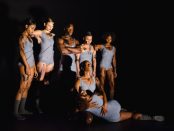
Ms. Grossman tended toward overuse repetition of movements and arm gestures. Emotional states were supported by little else than the titles and her husband’s gemlike scores. “No Words,” to a score composed and played by Mr. Homan, opened the program. His music sounded like an anguished string quartet to which she made an honest stab at using gesture and arrangement of the eight dancers to express the anger and loss in a poem, “Fury: In Praise of Stone,” by Janet R. Kirchheimer and Jaclyn Piudik, which was printed in the program.
[more]
The newly reconstituted New York City Opera opened its second full season with a shared production of Puccini’s rarely performed "La Fanciulla del West" created in collaboration with the Teatro di Giglio di Lucca, Italy; Teatro Lirico di Cagliari, Sardinia; and Opera Carolina of Charlotte, North Carolina. Ivan Stefanutti’s production is solid but old-fashioned and traditional except for huge projections that fill the back wall of the three sets, some which work and some which don’t. Conducted by James Meena, Opera Carolina’s general director and principal conductor, with a cast led by soprano Kristin Sampson in the title role, both the orchestra and cast gave sturdy though only intermittently exciting performances in this unusual Italian opera.
[more]
In the first half of her career, Barbara Cook was a top leading lady in musical theater, famously originating roles in such Broadway shows as “The Music Man” and “She Loves Me.” (Decades later, she could still sing for me at her home lines of “My White Knight” that had been cut from the score of “The Music Man” before it opened on Broadway in 1957.)
[more]
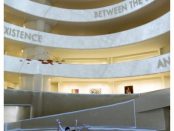
The title comes from T.S. Eliot’s "The Hollow Men," the one that famously includes the line: “This is the way the world ends/Not with a bang but a whimper” - which is exactly how Falls the Shadow ended, the dancers swirling off to the borders of the Rotunda performing space after a series of meetings and partings that too often found them lying in geometric patterns on the floor, their arms spread out in cross forms or moving their limbs in unison to produce a Busby Berkeley effect. (The audience stood above the action on the ramps, looking down.) The two couples rarely mixed and matched, but did occasionally form lineups that wound up dragging the unlucky fourth dancer who was face down on the stage. The actual movement palette was limited to walking, soft arabesques, rolling on the floor and some hip-level lifts, all repeated too many times.
[more]
Ms. Zelman-Doring’s cryptic scenario of deeply close twin siblings (Ana offers to masturbate Simon when he is tied up in a chair) is out of Sam Shepard and her dialogue is a pleasing cross between Harold Pinter’s spare eloquence with flourishes of Christopher Durang’s silliness. The abrupt and inconclusive conclusion is in keeping with what went before it.
[more]
Performed by The Bats, the resident company of The Flea Theater, the world premiere of "Inanimate" is the inaugural production in their new home on Thomas Street, between Church and Broadway, several blocks south of their original premises. Performed in The Siggy, named after founder and patron Sigourney Weaver, a house with 46 permanent seats, it is the first of the three new theaters to open prior to the complex’s grand opening on September 28. It has been given a sharp, assured staging by director Courtney Ulrich with engrossing performances by its cast of seven.
[more]
As in one of Alan Bennett’s "Talking Heads" monologues, Stapleton offers a richly detailed portrait of an ordinary person that revels in the mundane. She also adds the arresting device of having the inner life of the cow depicted in fantasy sequences.
[more]
Mr. Klingenstein beautifully and simply renders his fictional account with exquisite detail and emotion. Klingenstein’s dialogue is precise and filled with sharp epigrams. It’s all a genteel and moving exploration of the human condition. A lovely highlight is Ann and Samuel recreating portions of the Lincoln-Douglas Debates of 1858.
[more]
Exquisitely produced by the Mint Theater, Jonathan Bank’s direction is leisurely and slow, which undercuts the theatricality of all but the last and the most satisfying one, 'The King of Spain’s Daughter," originally given four separate stage productions at the Abbey from 1935-1939 and two in London in 1939. Using a company of seven, the actors appear in varying combinations while all appear in the third play, "Holiday House. " Two of the plays end too abruptly calling out for a more substantial length, while one of the plays seems to go on too long.
[more]
Billed as a “bio-epic,” playwright Zachary Desmond emphasizes the epic in his uneven though compelling approach. Mr. Desmond affectionately imparts biographical details of Einstein’s life from youth to old age. Particularly captivating are the sequences depicting his courtship and marriage to his first wife, mathematician Mileva Marić.
[more]
Nora Sørena Casey’s "False Stars," part of this year’s Corkscrew Festival at the Paradise Factory, starts slowly but gradually grows more involving as all the interconnections between the characters slowly reveal themselves.
[more]
Much of the play is like an odd synthesis of 1960’s theatrical satires. There are absurdist shades of Murray Schisgal, Elaine May, and particularly of Jules Feiffer's "Little Murders," laced with Paddy Chayefsky’s lacerating tirades. It eventually becomes clear that it’s meant to be overblown and not at all realistic, and at times is hilarious. A zany Reform rabbi’s irreverent diatribe on faith, and a Darth Vader sight gag are hysterical highlights. Then there’s the girlfriend’s unsettling, casual disclosure that she’s had a double mastectomy. It all recalls the provocatively dark humor of Larry David.
[more]
Projected titles indicate place and year—beginning with Arles, 1888 and progressing until van Gogh’s suicide—which we hear as an offstage gunshot—in July of 1890. The audience is treated to Vincent’s thoughts on his painting technique, his poverty, his mental health, his fellow artists, stars, sunflowers, all interrupted by chamber music by Debussy, Fauré, Chausson and Franck played—in various combinations—by Henry Wang (violin), Yuval Herz (violin), Chich-Fan Yiu (viola), Timotheos Petrin (cello), Max Barros (piano) and Renana Gutman (piano).
[more]
But Cohen the composer is another matter entirely--his jazz-inflected songs make "Come Light My Cigarette" a gem of a chamber musical. As more and more of the songs are revealed, time and again one is reminded of "Trouble in Tahiti." And like that classic Leonard Bernstein opera, "Come Light My Cigarette" appears to be set in the 1950’s, which the music evokes. So do the busy but impressive set and costumes, both designed by Craig Napoliello.
[more]
The songs never come up to the title song made famous by Marlene Dietrich who’s mentioned several times during the play. Antin’s attempt at playful seduction, “Take Me Home Tonight,” sung by the half-dressed cabaret girls and his German-style drinking song, “Fill My Stein with Beer” are pleasant pastiche, but “How Can Germany Survive?” (sung by the beleaguered Willi) and “Time to Stand Up” (sung by Josef) are heavy-handed and obvious. The lyrics throughout, even in the love songs are of the “moon-June” variety, but, as mentioned, are sung with great feeling.
[more]
Watching Evans being bossed around by the tall beanpole Russel Norris, whether in an office job, cleaning a park or waiting on tables, was to watch classic comedy performed with brilliant, but invisible timing. (Credit choreographer Tyler Holobaski for his seamless contributions.)
[more]
Having a background in dance accounts for Gelman’s mesmerizing staging that is filled with finely choreographed sequences. Characters take showers onstage with actual water cascading on their nude bodies and there are stylized, brief simulations of sex that are suggestively erotic. Numerous, arresting tableaus silently emit significance. The actors all give bold, brave and intense performances that transcend stereotypes.
[more]
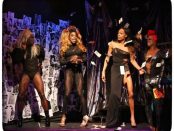
Antyon LeMonte, Honey Davenport, Jay Knowles and Kevin Aviance in a scene from “Trinkets”
[more]
While the three plays in Summer Shorts 2017: Festival of New American Short Plays – Series B have been given proficient productions each seems ultimately unsatisfactory. All seem like first drafts rather than completely fulfilling their potential. The three authors could learn a lesson from the three plays in Series A which all hit their marks. Interesting experiments but failures nevertheless.
[more]
Set in a California, Bay Area high school, there we meet the four students who prattle on in contemporary lingo. Gradually, and without any explanation we learn that they are witches. An episode of Bewitched has more background information. After 30 minutes, a semblance of a plot emerges, a run for class office. Eventually it is revealed that the candidate running was raped over the previous summer at an off campus party where alcohol was consumed by her male opponent. This past event becomes the play’s main focus.
[more]
Bruce Norris’ "A Parallelogram" endeavors to explore some sobering facts about the effect of the future on the present and responsibility to others. Unfortunately, the play ends up being laborious and tiresome - without being revealing or challenging. Too many of the fantasy elements have not been worked out so that much must be taken on faith or not considered. Norris wants to say something deep but this 2010 play having its belated New York premiere is more confused than meaningful.
[more]
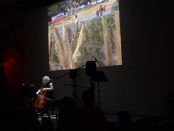
Interestingly, some of the most raucously explicit material of protest came not from the Peace and Social Justice Concert 24 but from the Wil(helms/liams)burg Concert 26, a collaboration of musicians and performing artists from Brooklyn and Hamburg, Germany. In the opening work, "Trumpen," for clarinet, piano, cello and laptop performers, Georg Hajdu created a piece based on the destructive and fracturing words of Donald J. Trump. This piece introduced the Unheard-of//Ensemble – Ford Fourqurean/clarinet, Daniel Anastasio/piano and Thea Mesirow/cello – who played throughout the concert, demonstrating remarkable technical control and versatility; this group “is a contemporary chamber ensemble dedicated to the development and performance of new music by living composers.” In "Trumpen," Trump’s words are altered and devolved into an ever-increasing intensity of chaos; the audience is witness to the mess – and is part of it as well – as this replicates political protest at its best, at once ancient and contemporary.
[more]
n light-hearted Rationalize (concert 27), composer Cody Brookshire combined found and manipulated sounds created by the audience with live music on bass clarinet and marimba. Brookshire created SynkroTakt, an audio streaming technology. Before the piece began, the composer instructed the audience on the seven-step procedure required to enable their devices to create sounds streamed into synchronous audio tracks; the audience, in this way, became the collective ‘artist/musician’ and provided one half of the ‘duet’ of electronic sounds and live instruments. The result was an unexpectedly sweet and pretty piece, a bauble in which sounds produced by an unusually concocted combination of chance and intention became a contemporaneous agent of creativity.
[more]
In spite of the Festival’s lengthy booklet and daily concert updates, the rich creative vitality of the electroacoustic musical community remains only tangentially documented: composers and performers clearly work in close collaboration. Internationally recognized cellist Madeleine Shapiro, for instance, director of the important NewMusicMannes ensemble at the New School’s Mannes College of Music, is on the NYCEMF 2017 Steering Committee, and performed in several of the 2017 Festival’s concerts. She is clearly the sort of artist who can turn her instrument into both the composers’ muse and their servant. Shaprio’s ability to incorporate the cello’s entire history into its creative use in contemporary classical and experimental music suggests expanded incorporations of cello sounds in new music to contemporary composers.
[more]
Stephen Kaplan’s "A Real Boy" is about a pair of puppets, named Peter and Mary Ann Myers, who adopt the eponymous child named Max, and it proves about as preposterous as such a premise suggests. It isn’t helped by director Audrey Alford’s often awkward staging, or by a muddled and confusing conclusion.
[more]
Mark Finley, the director, knew enough to keep the play charmingly low-key with just enough animated physicality to illustrate the story. Finley clearly understood all of Strothmann’s best qualities as a storyteller and how to keep him on his toes as an actor and memoirist.
[more]
The revival at the York is being seen in yet a new version of the show that began as a cabaret in 1981 and went to Broadway in 1985. Created by director Larry Alford, choreographer Wayne Alford and composer Herman, the original show included new songs written especially for the show, only one of which remains in the revival. However, as directed by Pamela Hunt ("The Musical of Musicals"), this version of "Jerry’s Girls" organizes the songs more faithfully by around each show and includes the greatest hits from "Hello, Dolly!," "Mack and Mabel," "Milk and Honey," "Mame," two numbers from "Dear World," and ending with a medley from "La Cage aux Folles." Along the way are also two unfamiliar numbers from Herman’s 1960’s revue "Parade."
[more]
In the seven concerts of the second half of the 2017 New York City Electroacoustic Music Festival held this month at National Sawdust in Brooklyn, New York, the full diversity and eclectic versatility of electroacoustic music was on vibrant, energetic display; the densely packed weekend of music was exciting, sometimes disconcerting and sometimes thrilling, and always fascinating. Sixty-six works by sixty-six composers were performed … a dizzying array of instruments, equipment, performers, sensibilities and effects!
[more]
While the dialogue offers some stabs at humor and Opel--a first-rate comedienne of the old school--usually excels at comic timing, much of it falls flat here. Most of the 90-minute, intermission-less piece focuses, naturally enough, on Bobby’s attempts to create a new life for herself, ultimately meaning a new relationship. It’s during her second visit with the shrink that he says, “I’m making getting laid a medical directive”-- to which Bobby replies, “Can you do that?” effectively ending the scene.
[more]
«
1
…
70
71
72
73
74
…
114
»
Copyright Jack Quinn, 2001-2023