News Ticker
- December 14, 2025 in Broadway // Oedipus
- December 14, 2025 in Interviews // Conversation with Dominick LaRuffa Jr.
- December 14, 2025 in Off-Broadway // The Surgeon and Her Daughters
- December 14, 2025 in Features // A Seasonal Salon Worth Noting
- December 13, 2025 in Off-Broadway // BUM BUM (or, this farce has Autism)
- December 12, 2025 in Musicals // The Faggots and Their Friends Between Revolutions
- December 12, 2025 in Cabaret // Mary Foster Conklin — Mirrors Revisited (50th Anniversary)
- December 11, 2025 in Cabaret // Kathy Kaefer — Kiss Me Once: Stories from the Homefront
- December 11, 2025 in Off-Broadway // The American Soldier
- December 9, 2025 in Off-Broadway // This World of Tomorrow
- December 9, 2025 in Cabaret // A Noel Coward Celebration — Steve Ross & Friends
- December 7, 2025 in Off-Broadway // Diversion
- December 5, 2025 in Off-Broadway // Meet the Cartozians
- December 5, 2025 in Features // Tom Stoppard: An Appreciation
- December 4, 2025 in Off-Broadway // Practice
Archive
Well-meaning and sincere," Occupied Territories" is both generic and stereotyped, offering a story television and the movies have been offering for years: the traumatic effect of a father’s Vietnam experience on his family years later. Co-written by Nancy Bannon who appears in the play and Mollye Maxner who directed it, it offers no surprises or new enlightenment. Set in two locales and time frames, the play alternates between scenes in a suburban basement on the day of Stephen Collins’ funeral and scenes from the life of the same man 45 years earlier as a rookie in the jungles of Vietnam. Ironically, the actors playing the soldiers are more convincing than the actresses playing the family members at home in America in the present.
[more]
The score is comprised of Jerry Garcia & Robert Hunter’s Grateful Dead music and lyrics with additional music and lyrics by Phil Lesh, Mickey Hart, Bob Weir, and Bill Kreutzmann. It’s all an engaging patchwork well-realized by Jeff Chimenti’s polished musical supervision and arrangements. Though it’s wonderful experiencing such spirited renditions of Grateful Dead classics such as “Truckin,” “Casey Jones,” “Alabama Getaway” and “A Touch of Grey” by the talented ensemble, "Red Roses, Green Gold" doesn’t really cohere into a satisfying work of musical theater.
[more]
During the jam-packed ninety minutes of "This One’s For the Girls," the foursome run through a batch of songs that show the ups and downs of the last one hundred or so years through the eyes of women. Ms. Marcic puts her characters through the romantic, social and professional wringer. Their individual tales are illuminated by songs and clever dialogue, helped by the set design of Josh Iacovelli which includes walls painted with artful pictures of famous ladies and a continuous slide show of portraits and scenes of historic and social importance such as fashions, sheet music, popular literature and family portraits. Mr. Iacovelli also designed the subtle lighting which makes the most of the tiny stage.
[more]
While superficially poignant, "Torch Song" remains what it always was: a fierce play about the need for respect as a gay person, when it was painfully more difficult to come by acceptance, let alone respect. And to that extent, it may seem like a dated work, wedded to when it premiered as three one-act plays that were then put together as one, more than three decades ago. It’s still just as moving and tear-provoking as it comes to focus on a gay man whose mother (“the Sylvia Sydney of Brighton Beach”) has to cope with his adopting a young son. With the marvelous Urie and the always-superb Mercedes Ruehl as the mother, how could anything go wrong? Nothing does.
[more]
King’s "Dolores Claiborne" would seem a strange choice for dramatization as the book is a monologue told entirely by its protagonist at a police interrogation over a murder on Little Tall Island off the coast of Maine. Though J.D. McClatchy’s streamlined libretto is very faithful to the book (while eliminating some characters and complications), it never approximates the compelling and wry narrative voice in Dolores’ first-person tale which makes her sympathetic and gives a sense of urgency to her story. Mezzo-soprano Lisa Chavez creates a believably passive character as a maid/companion to a selfish, rich woman whom she is accused of killing and an abused wife saddled with an alcoholic and brutal husband who died 30 years earlier but she brings no sympathy to the role. She just seems a tired, traumatized woman, not very interesting for the leading character in an opera.
[more]
Martha Graham called her dancers “athletes of God.” Watching David Greenspan perform all the roles in a six-hour marathon performance of Eugene O’Neill’s 1928 melodrama, Strange Interlude, caused me to wonder what I might call David Greenspan. Would “Son of Thalia” (the Greek goddess of theater) do? “Olympian of O’Neill”?
[more]
Boycott gets to sing a bounty of scintillating songs including “It’s A Perfect Relationship,” “Is It A Crime?,” “I’m Goin’ Back” and her duets with Heuser in “Better Than a Dream” (written for the film version) and “Long Before I Knew You.” Colgan’s choreography includes witty dance numbers to “Independent,” “I Met a Girl”, “Mu-Cha-Cha,” and “The Midas Touch.” Sue and Otto have a hilarious parody of the operetta aria in “Salzburg (By the Sea),” and the singer and girls of the Pyramid Club do a clever take on a cut-rate Busby Berkeley number to “The Midas Touch.”
[more]
In Jonathan Silverstein’s production, Arnie Burton and Matt McGrath as two friends who handle their fears of an unnamed epidemic in opposite ways do not seem to connect as real friends would. Ironically, while they are both known for their outrageous over-the-top comic performances, here they remain low-key and rather flat. The play may have been more involving if they had been allowed to give the kind of performances which they are most famous for. The play ultimately has a poignant denouement but it takes a long time getting there.
[more]
Elizabeth McGovern, Charlotte Parry and Anna Baryshnikov in a scene from J.B.Priestley’s
[more]
The highlight of the program was watching the world-renowned premier danseur David Hallberg perform a work specially commissioned for him by Fall for Dance. Mark Morris, the equally famous and respected choreographer, chose Benjamin Britten’s “Twelve Variations for Piano” as his score for the coyly humorous “Twelve of ‘Em.” The tone was set by Isaac Mizrahi’s wry costumes for both Mr. Hallberg and the adroit pianist Colin Fowler who was totally in synch with Morris’ tongue-in-cheek sense of humor. Both wore ancient Greek-like flowing tunics over t-shirts and jeans.
[more]
Director John Collins, founder of ERS, has set the play in an office or conference room with three long tables (in Jim Findlay’s design which eventually grows tiresome) and a great many stick telephones by which the characters often call each other to relay Shakespeare’s lines as if they are working from their offices. The walls of the set become screens for the text to scroll upwards through most of the play; at time we even see it five ways including the ceiling and with four panels in the back as well as on the back wall. Whether this is to remind us that this is a play of language, it is usually distracting and not very revealing. Often the actors speak so fast that it impossible to follow them and then in a brilliant coup de theatre one scene (that between brother and sister Claudio and Isabella) is spoken so slowly that it seems to reveal hidden meanings not noticeable before.
[more]
Set designer Charlie Corcoran ingeniously has the small stage’s walls adorned with sections of a yellow cab. Off to the side is a piece containing the steering wheel from where McDonagh periodically speaks. Above this, is a screen bordered by vintage billboard pictures. This showcases Chris Kateff’s dazzling projection design that illustratively displays imagery of New York City from various eras, video clips and slides such as the 1975 New York Daily News headline, “Ford To City: Drop Dead.”
[more]
It is possible to enjoy Brian Friel’s "The Home Place" without knowing the background to this historical play set in rural Ireland in 1878 as a Chekhovian representation of a world about to come to an end. However, the play will be much more meaningful if one knows the historical events that have led up to this turn of events. Charlotte Moore’s handsome and genteel production will be enjoyed most by those who understand the play’s undercurrents and implications. The low-key staging of this subtle play which does not spell everything out requires the audience to be adept at reading between the lines.
[more]
While the acting is compelling, the threesome does not reveal many layers to their characters; they establish a persona and stick to it, without divulging any further information. As Mae, Nicole Villamil is both stoical and passive, a rather flat reading of this ambitious though down-trodden young woman. Julian Elijah Martinez’s Lloyd definitely comes from the lower depths with his vulgar language, his self-pity and his inability to help himself. However, there is little variety in his performance and we have no idea what his relationship with Mae has been up to this time. He does get noticeable stronger after he begins taking the pills the clinic has prescribed. Unaccountably dressed in a sport jacket and a tie in Sarita Fellows’ costume design, Nelson Avidon’s Henry is the biggest enigma of the three. At first reticent and later lascivious, he tells us little about his attraction to Mae - or where he comes from.
[more]
Nicolai Khalezin wrote Burning Doors with dramaturgy by him and Natalia Kaliada. Their aim is to bring attention to currently jailed artists Petr Pavlensky and Oleg Sentsov by weaving in their testimonies. Actors also proclaim from the works of Fyodor Dostoyevsky and Michel Foucault. Fleeting and sometimes sly allusions to Putin are laced in.
[more]
Ruth Sullivan, Allison Threadgold and Patrick Hamilton in a scene from “Tomorrow in the
[more]
hough it’s a one-woman show, Alison Fraser plays a number of characters by speaking in different voices with a certain technical prowess. The principal one is an upper West Side psychotherapist, Sharon, who is ostensibly talking to her own therapist (a “shrink’s shrink,” we’re told) at his apartment late one night. She’s relating the story of her going to her hometown of Lubbock, Texas, for her beloved nephew’s funeral, after he’s committed suicide. But has Eddie really killed himself, like Sharon’s mother did decades ago when Eddie was only three? For that matter, did Sharon’s mother really commit suicide, we’re made to wonder by the end?
[more]
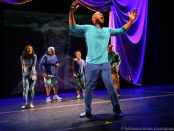
I’ve been playing soccer and have been exposed to soccer longer than I have been exposed to dance. Both of these things are part of my kinesthetic and the biography of my body. I can’t really recall a time where I didn’t play soccer and I’ve been dancing since I was at least ten years old. It’s actually not super far-fetched when I watch a soccer game, it looks like choreography to me. I trained for dance in some ways as an athlete would train for sport, I really connect to the similarities more than the dissimilarities. In terms of the literal transfer, our choreographer Stacey Printz did a great job of identifying some tropes that are consistent in both soccer and the kind of cultural universe that we traverse. There are elements of hip-hop, samba, South African gumboot dancing, Haitian folkloric movement – all of these inform the choreography. Moving forward, without being hyper-literal, I think that’s proven to be a really transformative experience for us and also makes it very clear and legible for audiences watching the piece. If our written and spoken language is literal, dance gives us allegory and metaphor and the synthesis of the two - - spoken language and body language -- helps to communicate the ideas in a very powerful way.
[more]
Signaling that we’re in for something different, Bauman has redubbed the play "Arden/Everywhere," a hint that home, and the emotional impact of losing it, is at the heart of her reimagining. Largely through design choices, but also some modest changes to the text, Bauman connects the diasporic struggles of the play’s characters to those experienced by the 65 million refugees the United Nations has identified throughout the world today, effectively arguing that, in both cases, the pain is there for anyone to see.
[more]
As the show progresses with intermittent songs, the other musicians/singers (Ryan McCurdy, Matt Park, and Rocky Vega) also strip down to their underwear/lingerie. The sounds they all make are, at times, infectious. And Oh is a natural-born performer, who instantly has us in her thrall. Though the show has been co-directed by Orion Stephanie Johnstone and Oh, it’s hard to imagine anyone reining in its star. And if the “first installation” of Oh’s latest show occurred when she stood on a soap-box in Times Square pontificating in 2014, it’s hard to say how it’s progressed since then. Unless you were there, you just wouldn’t know.
[more]
The audience sitting on three sides of the airy playing area on wooden benches is part of Clifton Chadick’s super, environmental scenic design. The floor is covered with wood chips, logs and tree stumps, there are a several jagged wooden poles and a few red fire buckets strewn about. On one end is a stage area and the other is a screen where Joey Moro’s atmospheric projection design is shown. The crisp imagery includes fires, nature and abstractions. For several distracting instances the actors at the other end of the stage are projected onto the screen for no discernable reason other than as an aesthetic flourish.
[more]
While not all musicals from Shakespeare have worked and updates are particularly risky, "Desperate Measures" avoids all of the pitfalls and is a refreshing and satisfying work in its own right. The catchy score has superb songs in the vein of the Broadway western musical. It is hoped the show has a long life beyond this production, like its young hero, in years to come.
[more]
Director Ralph Lewis, apparently not trusting the material – or finding the play too dated – has staged a carnival-esque version (adapted by S.M. Dale in June 2016) which includes 16 songs and musical numbers and making contemporary references to the Trump Administration, as well as current New York City politics. The result, a series of Saturday Night Live political skits, is neither faithful to the original nor witty for a modern audience, more of a confused jumble than a historical rediscovery.
[more]
Mr. Njikam offers a witty take on the classic mythology of a hero’s episodic journey with a lively African-American slant. There are a lot of high school and college scenes with wise teachers referring to James Baldwin and W.E.B. Du Bois, combative students, a dying father and an imperious mother. Rhyming battles, love and enlightenment occur along the way. The narrative is so eventful and spread out that it can be difficult taking it all in and its overall impact is diluted.
[more]
Part of the problem is the lack of innovation in Ray Roderick’s staging in this show which calls out for invention and clever handling of sets and props. Devin Vogel’s colorless stage design (making use mainly of a ladder in the first and third stories) and Hope Salvan’s equally colorless costumes for most of the show (pale grey and blue tee-shirts and jeans for the first one-act) do not help bring any atmosphere to the three separate stories which span the time scheme from Biblical days up to the present. All three stories are narrated or introduced by The Balladeer who also plays the Snake in the first story. While such songs as the catchy “Forbidden Fruit,” the lovely “What Makes Me Love Him?,” the sultry “I’ve Got What You Want,” and the folk-rock ballad, “You Are Not Real” still impress, the musical staging is lacking in showmanship and pizzazz.
[more]
Marinelli’s performance also contributes to the ennui. Heavy set, possessing a sullen countenance, speaking in a light voice, and lethargically shuffling around, he’s not the most charismatic performer to spend 90 minutes with. In the last portion, when he encounters a lost cat after being stood up on a date, his acting and the play has a jolt of energy and momentum as it reaches its upbeat conclusion.
[more]
Michelle Dorrance, this troupe’s director, has become a force in tap dance because she understands both its legacy and its future. She played Pied Piper to a large troupe of very talented dancers who were all given opportunities to shine and create moods that varied from sexy to flirtatious to hilarious and sad. With additional choreographic contributions by Ephrat “Bounce” Asherie and Matthew “Megawatt” West—fine soloists—“Myelination” ebbed and flowed as soloists floated out of groupings of the twelve dancers to express themselves in brilliant bits that combined tap with modern dance, jazz, break dancing and even a touch of ballet.
[more]
Possessed of a soaring tenor baritone voice that forcefully hits every note, an immensely likeable persona and boundless energy as he dances with brio, Moss commands the stage for 70 minutes. Periodically overcome with emotion, he gracefully collects himself and moves on. It’s a moving display of therapeutic showmanship.
[more]
Although director Kimberly Senior who also piloted the Chicago production has staged the play with elegance, she never really turns up the heat so that there are not many sparks in Carter’s debate. Discord, yes; but no fireworks which might have made the discussion more dramatic. The play uses titles on the back wall to name each of the 14 scenes much in the manner of Brecht’s alienation effect. This breaks up the play but is not very informative. The device of the invisible fourth wall being a mirror in Wilson Chin’s all blue-grey interrogation room seems a gimmick to allow the men to face the audience directly for much of the play.
[more]
With only a metal-mesh cage, bed-frame, and a gate--and gobs of black feathers that ultimately litter the stage--Nashman cavorts around the black box set (scenic design is by Marysia Bucholc and Camellia Koo) with abandon. If the challenge of every one-man show is to sustain our attention, Nashman succeeds spectacularly. He has some significant help with evocative lighting by Andrea Lundy, eerie music by Osvald Golijov (performed by the St. Lawrence String Quartet), and Cassidy’s direction, which always keeps him in motion.
[more]
Because the first three pieces of the program had established an intellectual across-time dialogue between Bach and Glass and an examination of Glass’ Bach ‘ancestry,’ the unabashedly Romantic quality of Glass’ new piece came as a surprise: in spite of the presence of familiar Glass rhythmic and harmonic motifs, the concerto contained new cadences and directions. In both piano-strings simultaneities and in the four piano cadenzas, explorations of uncertainty and of distances from longed-for resolutions felt like new territory for Glass. The piece as a whole moved from monumentality through moments of increasing quiet to Dinnerstein’s final poignant movement into silence.
[more]
Most of the humor is at the expense of the Mesquite City Council and its steely-eyed mayor Linda Hadley (Liz Amberly) who could be accurately described as a Margaret Thatcher wannabe, if she had any idea who Margaret Thatcher was. With rapacious resolve, she has set her sights on doing something no other mayor has ever done in the entire history of Mesquite: win a second term. She is assisted in this quest by her right-hand toady (Jeff Paul), the financial backing of a shady resort magnate (Jed Dickson), and an underwhelming pool of potential challengers, led by Will Brown (the wonderful Joe Burby) whose hapless sincerity is seemingly no match for the mayor’s small-town realpolitik.
[more]
Each was asked about their first audition. Marilyn D’Honau couldn’t remember, although she clearly made an impression on Robbins who subsequently used her in "Gypsy." Tony Mordente, just an acting hopeful, was working in a Times Square Howard Johnson’s when he heard that WSS was being assembled and he showed up with no professional experience and managed to impress the powers-that-be. Some flew in from the Coast or Las Vegas or were known by Robbins before hand, like Ronnie Lee who was in "Peter Pan." All were reminded by Robbins before the opening night that they were “handpicked.”
[more]
«
1
…
68
69
70
71
72
…
114
»
Copyright Jack Quinn, 2001-2023