News Ticker
- December 13, 2025 in Off-Broadway // BUM BUM (or, this farce has Autism)
- December 12, 2025 in Musicals // The Faggots and Their Friends Between Revolutions
- December 12, 2025 in Cabaret // Mary Foster Conklin — Mirrors Revisited (50th Anniversary)
- December 11, 2025 in Cabaret // Kathy Kaefer — Kiss Me Once: Stories from the Homefront
- December 11, 2025 in Off-Broadway // The American Soldier
- December 9, 2025 in Off-Broadway // This World of Tomorrow
- December 9, 2025 in Cabaret // A Noel Coward Celebration — Steve Ross & Friends
- December 7, 2025 in Off-Broadway // Diversion
- December 5, 2025 in Off-Broadway // Meet the Cartozians
- December 5, 2025 in Features // Tom Stoppard: An Appreciation
- December 4, 2025 in Off-Broadway // Practice
- December 4, 2025 in Cabaret // Eddie Bruce — The Magic & Music of Tony Bennett
- December 3, 2025 in Interviews // Interview with Ty Jones, Classical Theater of Harlem
- December 2, 2025 in Features // Gingold Theatrical Group’s 20th Anniversary Gala at The Players
- December 2, 2025 in Interviews // The American Soldier – An Interview with Douglas Taurel
Archive
Some books and movies and poems do not lend themselves to theatricalization, and that’s certainly the case with "Incantata," which is currently being given its American premiere at the Irish Repertory Theatre. Though it’s only 80 minutes long, it felt like an eternity--and not only because of the story--but also the telling. What’s even more annoying is that it tells the same poem, again and again, and seemingly again.
[more]
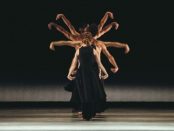
Ballet Vlaanderen was founded in 1969 by dancer/choreographer Jeanne Brabants, and the present artistic director since 2015 is Sidi Larbi Cherkaoui, who is known for his own award-winning choreography. Under his direction, the Flemish company, based in two places, Antwerp and Ghent, is dedicated to creating innovative new pieces and bringing important works to the stage. Stylistically, the company bridges the gap between ballet and modern dance. For their presentation at The Joyce Theater (March 3-7, 2020), Ballet Vlaanderen danced three pieces: "Kaash," "Faun," and "Ten Duets on a Theme of Rescue. "
[more]
One of the most interesting attributes of this play (apart from the clever title being a less common and unharmful definition of the word “faggot”) is playwright J. Julian Christopher’s insistence that none of the characters be portrayed by cisgendered men. The most significant effect of this casting is demonstrated in scenes when the men are supposed to be naked and interacting with each other in sexual ways. Where true male nudity and sexual touching would have simply been gratuitous and distracting, clever costuming (presumably) provided by production designer Meghan E. Healey has the characters wearing body suits, onto which sequined phalluses and scrotums of different colors and sizes have been sewn. Each suit sports a large nipple and a heart as well. The depiction of sex and sexuality thus become representational and symbolic, allowing the play and its language to proceed unimpeded by gawking.
[more]
“Spicy. Cajun. Alfredo. With Bourbon Infused. Crumbled. Bacon” is the hoped-for path to victory for the pivotal Memphis cooking competition in award-winning playwright Katori Hall’s uplifting "The Hot Wing King," where comedy and drama deftly converge. Strained relationships, personal despair and camaraderie among gay and straight black men are all dramatized in this rewarding contemporary work that has echoes of the wit and pathos of Mart Crowley’s "The Boys in the Band."
[more]
This illustrates the biggest problem with "Suicide Forest": it takes on too many issues, jumping from social to sexual to mythological to intimate family subjects. Making the play even more difficult to understand is that it is performed in both Japanese and English. In addition there is some confusing cross-ressing. "Suicide Forest" is alternately funny, disgusting and moving, making it too often a tiring show to sit through despite its wealth of social commentary. The director Aya Ogawa kept the show rolling along but couldn’t make all the parts gel.
[more]
To review dramatist/lyricist/composer Ethan Lipton's "Tumacho" almost feels like missing the point of this endearingly oddball "play with songs," a comic pastiche of Western and horror tropes that is essentially the theatrical equivalent of an old Hollywood B-movie. Its major goal is to shamelessly please the audience, something it largely achieves through top-notch performances and an abiding strangeness, if not necessarily a consistent quality of jokes or characterizations or plotting. Obviously, all of the latter should matter, but the fact that it doesn't only attests to the show's bizarre charm.
[more]
Following its opening production of Cy Coleman’s equally rarely seen "Seesaw," J2 Spotlight Musical Theater Company is presenting a fully staged version of "No Strings" as the second production of its inaugural season. While No Strings, set in the Paris world of high fashion and the French watering holes of the very rich, would need a much more lavish staging to do it justice, Deidre Goodwin’s production does have its charms though the show’s book by playwright Samuel Taylor seems particularly thin by today's standards. The songs are melodic and hummable though there is no breakout winner among the 14 musical numbers.
[more]
MCC Theater’s New York premiere of C.A. Johnson’s new play "All the Natalie Portmans" is a lovely work which resembles other such modern coming of age plays from Carson McCullers’ "The Member of the Wedding" to Lynn Nottage’s "Crumbs from the Table of Joy" as well as moments from Tennessee Williams’ "The Glass Menagerie" in its depiction of a dysfunctional family struggling to survive. While the play is not entirely fresh, the characters are so honestly drawn that director Kate Whoriskey’s cast not only holds our interest but makes us worry about their futures. The play does not contain many surprises as the family is obviously on a downward spiral but we hope against hope that Keyonna and Samuel will survive the battle.
[more]
I'm very glad that a friend and I were able to enjoy the high-spirited, fast-moving revue "Five Guys Named Moe," which is currently playing at Westchester Broadway Theatre. A lot of talent on that stage. Director/choreographer Richard Stafford has found six performers – Tyler Johnson-Campion, Tony Perry, Napoleon M. Douglas, Quentin Avery Brown, Douglas Lyons, Isaiah Reynolds --who do justice to the hits of Louis Jordan. Each has his own personality. Each gets moments to shine individually. Tony Perry, as I noted in these pages a year ago, was one of my favorites in WBT’s 2018 production of Ain’t Misbehavin’. And it was good to see him again. The others in the cast are all new to me. But they all got well into the spirit of this music. And their zest was contagious.
[more]
Music director Andy Einhorn who conceived the show was a genial, informed host. Having worked as the music supervisor and music director for the most recent revival of "Hello, Dolly!," he was at times overcome with emotion as the show, directed by Cady Huffman, revealed all of Herman’s richness and, yes, sophistication. Listening to and quoting Herman really got to Einhorn whose beautiful arrangements buoyed all the songs.
[more]
If the show seems at times to be a bit of a mess, it’s an often entertaining and always lively one, thanks in good part to members of the acting ensemble, most of whom play multiple roles. Palacios is warm and winning as Rocky. Formica and Ross are engaging, especially when LaBarerra and Kayster have a falling out late in the play, which turns them from robust sparring partners into true foes. Colón and Wise also have plenty to do, and they seem game for all of it.
[more]
Pearl Cleage’s "Blues for an Alabama Sky" gets a belated New York premiere courtesy of Keen Company in its 20th season. Although seen in many regional theaters since its 1995 premiere at the Alliance Theatre Company in Atlanta with Phyllicia Rashad in the leading role, it has long been overdue in New York even though Cleage is also a successful and acclaimed novelist. Framed as a domestic drama, the play manages to take in the topics of racism, sexism, homophobia, birth control and abortion, poverty, alcoholism, and extreme religious points of view among the bohemians of Harlem, circa 1930.
[more]
Wearing costume designer Janice Pytel’s arresting black and red ensemble, Ms. O’Connell mostly sits in a chair on scenic designer Andrew Boyce’s authentically detailed drab and ominous motel room set. With her haunting eyes, flowing hair and magnetic countenance, O’Connell vividly channels Higginbotham’s presence. Her lip-synching, gestures and facial expressions are all flawless. The presentation’s conceit is realized by O’Connell’s supreme artistry.
[more]
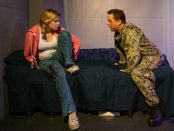
"Extremities" on a ship best sums up its playwright William Mastrosimone’s adept, if off-kilter, new psychological thriller "Rules of Desire," that’s been given a tidy production. In it, a dim 22-year-old U.S. Navy enlistee smuggles his troubled 18-year-old girlfriend in a duffel bag onto the aircraft carrier on which he is stationed. The couple surreptitiously sets up house in an airlock, but their connubial bliss is threatened by the licentious Chief Petty Officer discovering their love nest. Psychosexual hijinks ensue.
[more]
As the centerpiece of its spring season, Classic Stage Company is presenting a repertory of adaptations of two legendary Gothic horror stories: Bram Stoker’s "Dracula" and Mary Shelley’s "Frankenstein" in new stage versions. Kate Hamill, go-to playwright for adaptations of 19th century literature, has given her take on "Dracula" a delightful comic slant. The sexism in the novel has been diluted by making this a feminist revenge fantasy. Turning Doctor Van Helsing, vampire hunter, and Renfield (under the sway of the vampire) into women changes the dynamic quite a bit giving the play a modern viewpoint. Director Sarna Lapine, who has worked with Hamill before on her "Little Women" and "The Scarlet Letter" adaptations, keeps the pace brisk and the humor buoyant as the women are given the best of the story.
[more]
"Anatomy of a Suicide"’s title is more than accurate as two suicides are depicted. Dramatizing such subject matter would usually be intrinsically harrowing. However, acclaimed British playwright Alice Birch is concerned with hollow technique rather than rendering fleshed out characters straightforwardly grappling with life’s travails. Instead, we get three women’s cryptic underdeveloped stories mashed together, enacted simultaneously, structured as short scenes in this 90 minutes play. It’s an unsatisfying minor exercise with flashes of emotional resonance.
[more]
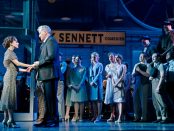
The latest offering in New York City Center Encores! concert series was the Jerry Herman musical, "Mack & Mabel." Originally on Broadway during the 1974 season, it received disappointing reviews and had a mere 66 performances before it closed after nine weeks. This production also has its problems, but it was enormously entertaining and worth seeing, mostly because of the Herman score and the delicious musical numbers. Herman has written the music for some of Broadway’s most iconic shows, like "Hello, Dolly!," "Mame" and "La Cage Aux Folles." Because of his recent death this past December, the show was a tribute to him, with huge, framed photos of him displayed during the entr’acte.
[more]
Now that The Public Theater’s 2019 revival of the late Nzotake Shange’s "for colored girls who have considered suicide/ when the rainbow is enuf" has been critically acclaimed once again, The Negro Ensemble Company is reviving her only dialogue play, "a photograph / lovers in motion," in a new version. Originally produced at The Public Theater in 1977 as "a photograph / lovers in cruelty," the play was later revised and renamed for a 1982 production at the Houston Ensemble Theatre. The new version adapted and directed by Ifa Bayeza, the playwright’s sister, makes the play more of a choreopoem like Shange’s other plays and shifts the focus from the photographer Sean David to Michael, a female poet and dancer, adding poems for her to recite. The two titles of the play are still applicable as according to the director the relationship between Sean and Michael is both a duel and a duet.
[more]
It might be about 90 years too late, but writer/director Ciarán O'Reilly is throwing a good old-fashioned Irish wake, with poems, songs, and a slice of barmbrack (Irish sweet bread) or each of the lucky attendees. And he's also summoned the dearly departed herself, Lady Isabella Augusta Gregory, and a few of her more notable friends (some guys named Yeats, O'Casey, and Synge) to join in the celebration, stitching together her words with some of theirs to create the waggishly titled "Lady G: Plays and Whisperings of Lady Gregory." It's a charming and touching tribute to a woman whose literary efforts are usually far less appreciated, unfortunately, than her advocacy.
[more]
The inestimable Charles Busch has come up with something of a dud, as well as redundant, with his latest play, "The Confession of Lily Dare." Even its title leaves a lot to be desired. Based on a seemingly endless parade of Hollywood movies of the pre-code era (from the late 1920’s to the mid 1930’s), Busch has pulled out all of his old tricks--cross-dressing, an homage and parody of old movies, long pink arm gloves--and produced something stale and feeble.
[more]
Although J2 Spotlight’s artistic director Robert W. Schneider who staged this show has given it a vigorous production and cast a delightful Gittel in Stephanie Israelson, he is unable to disguise the show’s flaws. He is not helped by the trite, derivative choreography by Caitlin Belcik for a show that is mainly dance and has eight dancers out of a cast of nine. The many production numbers are both busy and familiar, and keep the ensemble composed of Kyle Caress, Chaz Alexander Coffin, Katie Griffith, Caleb Grochalski, Morgan Hecker and Halle Mastroberardino spinning throughout the show.
[more]

This current New York City revival, directed by Aimée Fortier, shifts the focus largely away from Jimmy and onto Alison (Elizabeth Scopel). Critics have described this character as passive, and there is evidence in the script that this is so. For instance, Alison can’t find the nerve or the right moment to tell Jimmy that she is pregnant. In this production, though, she seems to have a reserve of strength at her core. We identify with her in her struggle to cope with the insufferable verbal abuse she takes from Jimmy (Ryan Welsh). As the action proceeds, she seems to emerge as the play’s central character. This production even gives Osborne’s denouement a feminist twist. (We may again be reminded of Eliza Doolittle—specifically, her liberated final scene in director Bartlett Sher’s 2018 Broadway revival of "My Fair Lady.") It helps Fortier’s approach that, of the four leading players, Scopel delivers the smoothest, strongest and most believable performance in the production.
[more]
Could there be five more self-involved, selfish, self-deceptive characters than those who populate Lily Akerman’s "The Commons" at the 59E59 Theaters? No, these five roommates aren’t evil, just depressingly of the here and now, young people who have lost the ability to communicate honestly with each other. There’s a problem with a 90-minute play about people who do not connect: it is an unrewarding slog for an audience to sit through.
[more]
If it sounds challenging to do a two-performer version of "Frankenstein," it proves just that in the current production at the CSC, being performed in repertory with a new stage version of "Dracula." As adapted by Tristan Bernays from the novel by Mary Shelley, the first half-hour of the 80-minute show is more like performance art than a play, as very few words are spoken. During the first part of the play, there are more grunts and groans than there is anything resembling a script.
[more]
Even before the playwright pays homage to William S. Burrough’s "Naked Lunch" through this last line, one is already drawing comparisons to the psychotic, structureless existence of that novel, and wondering whether there is anything more to "The Sickness" than the eventual demise of two wasted lives of X and Y. Later that evening my theater companion admitted to thinking, “die already” at some point during the play, because there seemed to be nothing else happening. The audience is given no reason to like the characters, no reason to think they’re ever going to change and no reason to root for their survival; all that they’re left with is the desire for the play to end.
[more]
The trite set-up makes all of the characters one-dimensional, with the Jewish Seth a “knish maker” and shop owner on “Hester Street, Angie groping to find herself--not to mention a partner--and Sophia, a loving and understanding “Nonna.” Blake, of course, is a leather-clad roué, who also wears sunglasses throughout--until he loses them. What is somewhat surprising is to learn that Seth, an orthodox Jew, was in an “arranged” marriage before, and divorced his wife two years ago. But the play suffers from an inordinate lack of surprise.
[more]
"Goy Friendly" is clearly meant as a light entertainment with lecture-demonstration components and succeeds as such. It’s delightful spending time with this superb raconteur, even if he cleverly sidesteps the deeper implications of his subject matter.
[more]
In making her professional stage debut courtesy of Page 73, Zora Howard has written a powerful kitchen sink drama in 'Stew," as much about making a literal stew as about the emotional stew the four women in the Tucker family of Mt. Vernon find themselves in. While many of the elements are family, Howard combines them in new ways so that the play seems both new and true. With a terrific cast headed by Portia ("The Rose Tattoo," "Ruined," "Rinse Repeat," "Our Lady of 121st Street") as the family matriarch, director Colette Robert keeps the temperature continually simmering on a low boil until all of the secrets and events have been revealed. This is an American tragedy as well as a study in how we live in this era.
[more]
Mr. Droege’s sharp and well-observed writing renders each of these familiar figures with biting depth, achieving grand mini-portraiture. Though preoccupied with comedy, an undercurrent of proportioned sentiment elevates the work above mere caricature. Promiscuity, aging, drugs, alcohol, loneliness and the past are among the issues eloquently explored in relation to the gay male lifestyle. Droege’s shrewd structure has each of the participants alternatively popping up to chatter while imparting pertinent personal details, fueling the semblance of a narrative.
[more]
Amidst the hubbub that includes coerced audience clapping and singalongs, we attempt to discern what the point is. It appears to be the story of an outsider who takes up residence in a rural locality and is accused of a crime; the audience votes whether to convict or acquit him. Several audience members have been given pages of lofty speeches to recite. “The words your fellow Townspeople quoted come from Dr. Cornell West and Coretta Scott King,” states the program. Where We Stand’s 70 minutes are mildly engaging if often baffling and do make some impact.
[more]
The Mint Theater Company has rediscovered and championed British actor/playwright Miles Malleson with Conflict and Yours Unfaithfully. Now they have combined two of his one acts adapted from great short story writers in an evening called "Chekhov/Tolstoy: Love Stories" in their premiere pairing. While the production directed by Jonathan Bank and Jane Shaw (each directing one play) is able to be performed on basically the same set, the two plays have little to do with each other and represent love in two different ways. Anton Chekhov and Leo Tolstoy are major writers, but the adaptations appear to be minor and do not show off their authors at their best. Although the Chekhov story is basically an anecdote, the Tolstoy tale is a fable with a message.
[more]
The subject matter of "Chasing the River" is, of course, viable, but the play is not as nuanced and insightful as one would hope—nor is it particularly gripping. Sometimes the action feels stagey, and at other times it seems undercooked. Particularly problematic is the role of Nathaniel who is written and acted quite one-dimensionally. True, Giebel offers at least one surprising aspect of the character: We learn that he wanted a sports-playing boy-child, not daughters, and that he treated the tomboyish Kat (then called “Katie”) as a substitute for a son. We learn that he was able to gain Katie’s trust, which he then insidiously betrayed. We never wonder, however, whether he is anything other than an unrelenting nightmare of a person. There are scenes in which we see him being pleasant to Katie, but his bullying monstrousness seems always apparent. Most creeps—even the alcoholic ones—manage to hide their ugly sides now and then.
[more]
ICE raids, harrowing border crossing journeys and transferring money home are depicted in the rousing and moving play "Fandango For Butterflies (and Coyotes)." It’s derived from undocumented Latin American immigrants’ stories of why they left their countries and of their lives in the United States. Reminiscences and dramatic complications are interwoven with terrific dance sequences and lovely songs.
[more]
«
1
…
37
38
39
40
41
…
114
»
Copyright Jack Quinn, 2001-2023