News Ticker
- December 13, 2025 in Off-Broadway // BUM BUM (or, this farce has Autism)
- December 12, 2025 in Musicals // The Faggots and Their Friends Between Revolutions
- December 12, 2025 in Cabaret // Mary Foster Conklin — Mirrors Revisited (50th Anniversary)
- December 11, 2025 in Cabaret // Kathy Kaefer — Kiss Me Once: Stories from the Homefront
- December 11, 2025 in Off-Broadway // The American Soldier
- December 9, 2025 in Off-Broadway // This World of Tomorrow
- December 9, 2025 in Cabaret // A Noel Coward Celebration — Steve Ross & Friends
- December 7, 2025 in Off-Broadway // Diversion
- December 5, 2025 in Off-Broadway // Meet the Cartozians
- December 5, 2025 in Features // Tom Stoppard: An Appreciation
- December 4, 2025 in Off-Broadway // Practice
- December 4, 2025 in Cabaret // Eddie Bruce — The Magic & Music of Tony Bennett
- December 3, 2025 in Interviews // Interview with Ty Jones, Classical Theater of Harlem
- December 2, 2025 in Features // Gingold Theatrical Group’s 20th Anniversary Gala at The Players
- December 2, 2025 in Interviews // The American Soldier – An Interview with Douglas Taurel
Archive
Bookwriter Jonathan Marc Sherman has wisely kept the story in its period. However, his dialogue is almost word for word lifted from the screenplay which is rather old hat for those of us have heard it in the movie. The score with music by Sheik and lyrics by Sheik and Amanda Green makes all the songs sound the same in Sheik’s orchestration played by a combo of four. The lyrics are both pedestrian and trite, telling us only what we already know. The songs which are not listed in the program include a great many reprises. Many of the tableaux and setups recreate exact visual moments from the film.
[more]
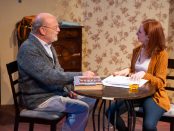
Bess Wohl's "Grand Horizons" opens with a pas de deux of marital inertia as Nancy (Jane Alexander) and Bill (James Cromwell), two near-octogenarians wasting their twilight days in a so-called independent living community, wordlessly go through the motions of sitting down to dinner. Their silence, and apparently 50-year marriage, are finally both broken when Nancy dispassionately declares that she "would like a divorce" and with equal nonchalance Bill responds, "All right." Confidently staged, or rather choreographed, by director Leigh Silverman, it's an extraordinary scene that, in truth, could stand alone as its own very brief play with the audience, possibly to its experiential chagrin, imaginatively filling in everything that came before.
[more]
While Simon Stone’s adaptation is engrossing for its surprising updates, it never captures the emotions, seeming more like a gimmick that a reworking of the Greek tragedy. With most of the actors underplaying their roles, the emotional temperature never really heats up even when the audience is confronted with various horrors. The use of the video screen and the all-white set somewhat distances the audience from the events on stage which undercuts the tragedy unfolding. Don’t blame Rose Byrne and Bobby Cannavale, who have given much more impassioned performances elsewhere, as they seem to be pawns of Stone’s concept.
[more]
Hosted by the Graham Company’s elegant director Janet Eilber, the program began with some historical comments after which two groups of dancers, one representing the Graham technique from Graham 2 and the other the Cunningham technique from the Merce Cunningham Trust entered the large studio/theater. They performed parallel exercise routines, the Graham side guided by Virginie Mécène, Graham 2’s director and former Graham star and the Cunningham contingent guided by two former Cunningham members Jennifer Goggans and the aforementioned filmmaker Madoff.
[more]
An author can be too close to his or her material so that the real story fails to be revealed. Inspired by his own family events, Buzz McLaughlin’s Sister Calling My Name has a fascinating premise but that is not enough. In relating a faith-based story of Michael, a man who has avoided for 18 years his mentally disabled sister Lindsey, a ward of the state since being a teenager, McLaughlin repeats lines and plot points endlessly while failing to give us enough details to bring the characters to life. The play seems to go round and round in a circle. The script note that Lindsay’s disability manifests itself in simply locking into an idea and going with it until another takes its place does not help an audience who must listen to the same dialogue over and over. Peter Dobbins’ production for Blackfriars Repertory Theatre and The Storm Theatre does little to make the characters more than labels.
[more]
Hoyle has brought his most recent play, "Border People," to New York City in a production directed by Nicole A. Watson. It’s a work dedicated to people who dwell along borders of various sorts—“geographical or cultural”—and it suggests that no matter how clearly lines of demarcation may be drawn, they can seem arbitrary and sometimes strangely porous. Hoyle presents nearly a dozen characters in this show: diverse in age, gender, race, nationality, religion, sexuality and temperament. He includes people from one side or another of actual U.S. borders, both to the north and to the south. We also meet characters from the Bronx who live along the borders that separate the borough’s “projects” from the outside world.
[more]
“The legend returns” claimed the fliers and posters for "Matthew Bourne’s Swan Lake"’s short season at the New York City Center. That proclamation wasn’t far from the truth. "Swan Lake" is definitely Bourne’s most famous and prolifically performed work from a repertory that includes "Edward Scissorhands," "Sleeping Beauty" and "The Red Shoes," all having made touchdowns in New York City with varying success. Only his "Swan Lake" has caught the imagination of audiences throughout the world despite its daring take on a beloved classic.
[more]
David Alan Grier, Blair Underwood and Billy Eugene Jones in a scene from Charles Fuller’s “A
[more]
Additional credit can be given to Simon and Wolkowitz’s performances by the excellent supporting cast and Einhorn’s writing. The script's one weakness appears to be an insistence on providing an overabundance of mind-numbing facts about blood-type science, details which ultimately don’t lend themselves to the overarching tale of one man’s search for value and importance in his dreams, those of his family that came before him, and the question of whether he will leave anything other than a legacy of his children’s memories.
[more]
“Producing theatrical works that feature compelling stories created by emerging theater artists” is from the New Light Theater Project’s self-description. Their vastly and thoughtfully entertaining presentation, "Brecht: Call and Respond (an evening of three one-acts)" achieves that aim. Bertolt Brecht may not be an emerging theater artist, but the other two playwrights certainly are.
[more]
Writer and director Renee Philippi’s appealing scenario is simple, heartfelt and dramatic. It’s realized by Ms. Philippi’s supreme command of stagecraft that revels in theatricality. Designer Carlo Adinolfi’s awesome cutouts, handheld and shadow puppet creations individualize the animals with striking expressive details. Mr. Adinolfi’s stylized set pieces thoroughly convey the look of a rustic environment and his arresting projections visualize varying locales and the animals’ dreams. The production is enhanced by the perfection of Eric Nightengale’s atmospheric lighting and sound design. Composer Lewis Flinn’s energizing original music veers from jaunty to appropriately moody as it complements the piece’s actions and emotions.
[more]
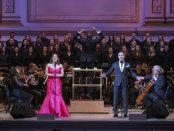
The New York Pops’ latest concert, Find Your Dream, was a glorious tribute to nostalgia. Not only was it an evening of the beloved songs of Rodgers and Hammerstein with selectionsfrom all 11 of their collaborations, it also recreated a performance first presented five years ago by The Pops. The guests artists on the evening of January 24 were British musical theater star Laura Michelle Kelly (Broadway’s "Mary Poppins" and "Finding Neverland") first seen in a flaming red, off the shoulders gown and American musical theater star Max Von Essen (Broadway’s "An American in Paris" and "Anastasia") in a midnight blue jacket. Joining The Pops as usual was Judith Clurman’s Essential Voices USA who were an integral part of the show with the famous choral numbers.
[more]
"Really Really Gorgeous" has an often-amusing absurdist and surrealistic sensibility. Plot turns take on the illogical quality that exists in dreams or in kids’ games of “Let’s pretend.” For instance, at one point, Pen discovers that by curling her hand in a certain way, she can transform it into a magical ammo-firing “finger gun” that can be used as an instrument of destruction. This may seem like goofy stuff, but Mecikalski the allegorist has serious points to make here: about celebrity and despotism and about the swiftness with which the sentiments of a desperate, fickle populace can change.
[more]
The 92nd St. Y’s Lyrics & Lyricists, one of New York’s leading propagators of the Great American Songbook, featured the witty and sardonic songs of E.Y. “Yip” Harburg in its most recent edition: "E.Y. 'Yip' Harburg: Follow the Fellow Who Follows a Dream." Harburg, famous for writing the lyrics for "The Wizard of Oz" and "Finian’s Rainbow," wrote over 600 songs with many collaborators. The show gracefully explored his oeuvre and his life using the extraordinary talents of five fine singers and a superb band led by Paul Masse who supplied the often surprising orchestrations. They were helped by vivid projections by Dan Scully that showed New York City street scenes, theater marquees, historic programs and posters as well as photos of a genial looking Harburg who tried all his life to defy all the prejudices and inequities of his time and replace them with his complex and colorful lyrics that featured witty rhymes and references.
[more]
Smiling Faces, Skull, Princess, Pile of Poo and other notable emojis cavorting around might have made for a peppy contained sophisticated children’s show. The creators of "Emojiland: The Musical" however, have opted for a full-length treatment that sputters out by intermission as not much has happened and then we come back for more anemic hijinks. The meager plot involves a software update, a firewall, a virus, betrayals and some romantic complications all taking place in a smartphone fantasyland.
[more]
Laura Linney is never one to avoid a challenge. When she last appeared at Manhattan Theatre Club’s Samuel J. Friedman Theatre she was alternating in the roles of “Regina” and “Birdie” in the revival of Lillian Hellman’s "The Little Foxes" and won a Tony Award for Best Actress for her efforts. Now she is back in an adaptation of Elizabeth Strout’s novel "My Name is Lucy Barton" where she plays both the title character and her mother and is the only performer on stage. Directed as she was in the London production by Richard Eyre, she beautifully captures the tone and voice of Strout’s heroine.
[more]
The show was conceived, directed and designed by Theodora Skipitares. Her treatment of these biographical details is that of a fanciful saga with the awestruck tone of a children’s book. There’s a neat bit involving Lt. Uhura from the original Star Trek in her red uniform on a miniature Enterprise starship, recounting meeting Dr. Martin Luther King. Skipitares’ thrilling staging is in concert with the witty elements of presentation. Many whimsical scenery pieces are suspended from the ceiling and are lowered and raised.
[more]
When a playwright adapts a famous, well-known story for the stage the problem becomes how to tell it in a new way that makes it seem unfamiliar and fresh. Otherwise, why bother retelling it once again? Unfortunately, Tom Dulack’s "Paradise Lost," “inspired by the poem by John Milton,” retells the story of Lucifer’s fall from Heaven into Hell, and the eventual banishment of Adam and Eve from the Garden of Eden without any surprises. Using only contemporary language, Dulack’s play lifts the skeletal plot of Milton but lacks the poetry, as well as those elements which made this epic controversial in the 17th century (rejection of the divine right of kings, embracing divorce and marriage equality, etc.) It resembles a Sunday Bible sermon or dramatization meant for youth.
[more]
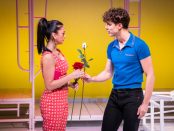
"Romeo & Bernadette," a fresh take on Shakespeare’s oft-adapted tale of love, is an unabashed valentine to inter-era romance. Shakespeare’s Romeo (cutie-pie Nikita Burshteyn, perfectly cast) is magically time-travelled to 1960’s Brooklyn to seek Bernadette (beautiful Anna Kostakis who plays both the foul-mouthed Bernadette and the demure Juliet), a striking doppelganger of his beloved sixteenth century Juliet. There he meets members of two rival Italian mobs who substitute, 1960-style, for the Capulets and Montagues.
[more]
An essay more than a play, with players as opposed to characters, "How to Load a Musket" is a racist diatribe that fails to make its points coherently. The costumes and appointments on the walls of a black box space say all that there is to say in a play that ultimately leaves one wanting for more. The scenic design by Lawrence E. Moten III is the show’s best asset.
[more]
Fog wafting, an empty rocking chair moving by itself, blackouts, ghostly apparitions and crashing music are all part of the spooky fun in "The Woman In Black." Scary moments, intriguing hokum and laughter abound as this inventively presented British theatrical thriller plays out.
[more]
On paper the concept should not work: scenes and characters have been cut, a Shakespeare sonnet has been added set to music, as well as a Greek song, and four characters originally written for men are played by women. Nevertheless, the streamlining of this modern dress production in the edition prepared by Emily Burns and Godwin makes this tragedy very accessible and eliminating subplots makes the play quite linear. The addition of women gives the play an almost contemporary feeling. The scenic and costume design by Soutra Gilmour for the first half of the play is simply dazzling, while the second half has its own visual display.
[more]
The play succeeds in large part because it begins in the aftermath of a school shooting. There are a few bits of dialogue describing the terror of the incident itself, but there is no onstage representation of the violence, nor any long, involved retelling of it. None of that is really needed, because the chaotic, nightmarish imagery of such episodes has become engrained in our imaginations over the years. Nor does the play aim to offer a solution to the mass-shooting scourge. Instead, it tells a simple—yet decidedly powerful—human story about a figure who is, paradoxically, both on the periphery of the incident and at its heart.
[more]
It is not difficult to see what attracted Metropolitan Playhouse to Ardrey’s drama: its message that one cannot shut one’s self off from the problems of the world as the America First movement wants to do is very timely once again as in the 1930’s, and the refugees who appear in the play’s second act and speak of their hopes and dreams in the new land are a stinging rebuke to those who would shut the golden doors to foreigners seeking asylum in the United States in our own time.
[more]
Employing an impressive array of voices and mannerisms, and only sometimes augmented with a wig or article of clothing, Miller as “Narrator” impersonates numerous performers, personalities, and politicians of the era, voicing every commercial and even dubs his own parents in short video clips at the very beginning of the piece. “100 voices. 25 years. 1 man,” the publicity statement declares, and Miller doesn’t disappoint.
[more]
A recent iteration of the classic ballet "Swan Lake" was staged by Derek Deane and danced by the Shanghai Ballet and presented by the Shanghai Ballet with China Arts and Entertainment Group Ltd. at the David H. Koch Theater at Lincoln Center. The company called their version "Grand Swan Lake" because it promised to be bigger than any other, at least in the number of dancers on the stage. But was bigger any better? Actually, yes. I assumed that using 48 swans was just a gimmick to get attention, but it was a very effective dramatic device. Forty-eight white tutus in moving formation was impressive, and in the last act, all those swans magically rising up through the fog was really breathtaking, a memorably dramatic visual.
[more]
With her richly expressive character voice, alternating between appealing deepness and wonderfully hitting high notes, she beautifully does justice to each song. We see every hallowed surrealistic image contained in “Life On Mars” due to her precise phrasing and crisp enunciation. Written in 1995, with its incendiary title, harsh lyrics and considering the state of the nation today, “I’m Afraid of Americans” becomes a prophetic terrifying showstopper as performed by the dynamic Cion.
[more]
More in the spirit of Carrie Fisher than Christina Crawford, performer Barra Grant chronicles her life and that of her famous mother in her engaging and smartly presented self-written solo show, "Miss America's Ugly Daughter: Bess Myerson & Me." Nostalgic New Yorkers will have their memories refreshed while others might be delightfully informed. It’s a harrowing, insightful and often very funny 90 minutes.
[more]
Created and first performed during the run-up to the 2018 national referendum that eventually led to the amendment's repeal, Maz and Bricks, a part of the Origin Theater Company’s 1st Irish Festival, hasn't suffered any loss of social relevance, because O'Connor is not a single-issue polemicist. Her play brims with many pointed ideas about modern Ireland, which, with greater and lesser success, are woven into a beguiling tale that follows its two titular characters on a Joycean ramble through the streets of Dublin, tripping up most significantly at the end when O'Connor shoehorns in a needlessly melodramatic coda intended to tie together a few loose plot threads that really shouldn't have been there at all.
[more]
Rennie Harris Puremovement American Street Dance Theater exploded onto the stage with raw vitality. Harris, who choreographed most of the works, combined various styles of street dancing (mostly hip hop). His dancers were diverse, athletic, very, very energetic, full of personality and thoroughly entertaining.
[more]
The production is unapologetically irreverent. At the beginning, we see a masked Greek chorus wearing long robes, shuffling ever-so-slowly around the stage of the Center at West Park (the sanctuary of a Presbyterian church). The leader of the chorus eventually speaks to us in staid, stentorian tones from behind his gold mask. But soon the actors (all male) strip off the robes. They’re bare-chested, save for leather harnesses that look as though they could have been purchased from a local kink boutique. Costume designer Yuanyuan Liang obscures the men’s faces with black head coverings, giving them the look of hostage takers or executioners.
[more]
Wataru Kitao in Suguru Yamamoto’s “The Unknown Dancer in the Neighborhood” at The Japan
[more]
The festival has given birth to musicals that have gone on to Broadway ("Next to Normal," "Chaplin," "[title of show]," "In Transit") and Off-Broadway ("Altar Boyz," "The Other Josh Cohen," "My Vaudeville Man," "Yank!," "Cyclops," "Bedbugs," etc.) Its shows have been produced in all 50 states and in 27 countries.Productions launched at the festival have won one Pulitzer Prize, three Tony Awards, three Obie Awards, and seven Drama Desk Awards. That’s a terrific track record.
[more]
«
1
…
38
39
40
41
42
…
114
»
Copyright Jack Quinn, 2001-2023