News Ticker
- December 19, 2025 in Off-Broadway // If We Kiss
- December 19, 2025 in Dance // Rashid Johnson’s “The Hikers”
- December 18, 2025 in Off-Broadway // Predictor
- December 17, 2025 in Musicals // The Baker’s Wife
- December 16, 2025 in Broadway // Marjorie Prime
- December 14, 2025 in Broadway // Oedipus
- December 14, 2025 in Interviews // Conversation with Dominick LaRuffa Jr.
- December 14, 2025 in Off-Broadway // The Surgeon and Her Daughters
- December 14, 2025 in Features // A Seasonal Salon Worth Noting
- December 13, 2025 in Off-Broadway // BUM BUM (or, this farce has Autism)
- December 12, 2025 in Musicals // The Faggots and Their Friends Between Revolutions
- December 12, 2025 in Cabaret // Mary Foster Conklin — Mirrors Revisited (50th Anniversary)
- December 11, 2025 in Cabaret // Kathy Kaefer — Kiss Me Once: Stories from the Homefront
- December 11, 2025 in Off-Broadway // The American Soldier
- December 9, 2025 in Off-Broadway // This World of Tomorrow
- December 9, 2025 in Cabaret // A Noel Coward Celebration — Steve Ross & Friends
- December 7, 2025 in Off-Broadway // Diversion
- December 5, 2025 in Off-Broadway // Meet the Cartozians
- December 5, 2025 in Features // Tom Stoppard: An Appreciation
- December 4, 2025 in Off-Broadway // Practice
- December 4, 2025 in Cabaret // Eddie Bruce — The Magic & Music of Tony Bennett
- December 3, 2025 in Interviews // Interview with Ty Jones, Classical Theater of Harlem
- December 2, 2025 in Features // Gingold Theatrical Group’s 20th Anniversary Gala at The Players
- December 2, 2025 in Interviews // The American Soldier – An Interview with Douglas Taurel
- December 2, 2025 in Off-Broadway // A Bodega Princess Remembers La Fiesta de los Reyes Magos, 1998
- December 1, 2025 in Off-Broadway // Full Contact
- November 30, 2025 in Concerts // Sweet Smell of Success
- November 26, 2025 in Off-Broadway // Kyoto
- November 26, 2025 in Musicals // The Seat of Our Pants
- November 25, 2025 in Off-Broadway // Richard II (Red Bull Theatre)
- November 24, 2025 in Off-Broadway // Archduke
- November 24, 2025 in Choral // GLORIA! — Canterbury Choral Society
- November 24, 2025 in Off-Broadway // Gruesome Playground Injuries
- November 23, 2025 in Concerts // The New York Pops: Everything I Know: Mandy Gonzalez Sings Lin-Manuel Miranda
Archive
Will Arbery’s Evanston "Salt Costs Climbing" (set in the city in which the author received his Master of Fine Arts Degree in 2015) is a perplexing experience as it shifts from realism to absurdism to surrealism. Its worthy topics of ecology and climate change notwithstanding, the play’s repetitiousness and unprepared-for events are frustrating as well as the missing backstories. While it begins interestingly enough , it very quickly turns tedious and inexplicable. A noble experiment, "Evanston Salt Costs Climbing" is either for the select few or needs a rewrite or second draft.
[more]
Director Kotryna Gesait’s direction does not have the necessary distance from the material to realize that actors speaking simultaneously will blur content and intentions for the audience. Scenic design of Chantal Marks provides the obligatory cocoon-like fabrics draped from the ceiling as well as on the walls. Heather Crocker’s lighting design is supportive of the many changing moods of the piece from scene to scene. The sound design of Nadav Rayman underlines key shifts beautifully.
[more]
"Camp Siegfried" is a new departure for the author of "Small Mouth Sounds," "Continuity," "Make Believe" and "Grand Horizons." Depicting an important piece of history in an age when hate speech is on the rise, the play seems to be attempting something it doesn’t quite achieve. However, it is certainly a worthy effort and an engrossing piece in the theater though it leaves us hungry for more.
[more]
Noel Coward’s "The Rat Trap" is not only entertaining but seems to have been ahead of its time. Discounted by critics and the author alike when it had its only production until now in 1926, the play turns out to be a cogent exploration of a creative woman’s search for her place in society, one which has no niche for her talents once she is a married woman. The Mint Theater Company does the play justice, restoring its reputation as an Edwardian period piece on the topic of the New Woman who is also a gifted artist. In Sarin Monae West and Elisabeth Gray we see the work of talented performers who we want to see more of in the future.
[more]
He saw seemingly everything, and championed plays and productions he found meaningful, even if they were at the smallest of theaters. He chose what he wished to cover, and would sometimes expound at great length about a drama Off-Broadway or Off-Off-Broadway that he felt was worthwhile and might otherwise be neglected, and then dispatch in the shortest, most terse review imaginable a big, glossy commercial Broadway musical that he was sure would find an audience but—in his eyes—was devoid of much artistic value.
[more]
"Kimberly Akimbo," David Lindsay-Abaire’s oddball take on the title character’s dishearteningly sad disease, began life as a play back in 2001, reaching New York via the Manhattan Theatre Club in 2003. In 2021 Lindsay-Abaire (libretto and lyrics) combined resources with the eloquent composer, Jeanine Tesori, to restyle the play as an award-winning musical produced at the Atlantic Theater Company in November 2021. This is the production that has moved to the Booth Theatre where it now resides featuring the glowing performance of Victoria Clark as the troubled title character. Jessica Stone repeats her directorial duties, managing the move to a larger venue with skill and subtlety.
[more]
"George Kaplan" is a beautifully realized drama with comedic elements by Frédéric Sonntag, translated into North American English by Samuel Buggeln. The viewer will laugh but will also be brought to gently encounter deeper and possibly disturbing questions about our political and cultural perceptions. Questions such as What is the nature of a surveillance culture? How do fiction and disinformation relate to the perception of reality? Does myth lead to conspiracy theories? Who is manipulating us, and for what purpose? Does any of it matter in the whole scheme of things?
[more]
Still, rest assured, most of what Birbiglia says is funny, even for any fans well aware that Birbiglia is leading us somewhere that is not. Given the eponymous Hemingway allusion, the show's mortal endpoint is obvious, but the journey to it is full of surprising, and sometimes touching, laughs. They begin with an annual health checkup that includes a worrisomely poor performance on a spirometer, the ball-and-hose machine that measures lung function. The results baffle Birbiglia's doctor, since they seem to indicate he was having a heart attack while taking the test.
[more]
A touching portrait of a father and his alienated son unfolds in the Manhattan Theatre Club’s "Where the Mountain Meets the Sea" by Jeff Augustin, directed by Joshua Kahan Brody. ... "When the Mountain Meets the Sea" is not only about two different people, but two different time periods. Jean exists in memory while Jonah’s journey is to cross the country, retrieve Jean’s ashes and spread them over Haiti.
[more]
Writer/ director/actress Madeline Sayet is an engaging performer. Directed by Mei Ann Teo, her one-woman show “Where We Belong” is an autobiographical tale of her Mohegan roots and her seeking her place in the world as she travels to London to pursue a PhD in Shakespeare. While much of the play contains information and stories that will come as a revelation to most New Yorkers, the play often feels like a lecture with an agenda. The most interesting parts are her own discoveries about her roots and her encounters with other people in which she plays both characters.
[more]
I think this is great news. I’m happy the show will finally be getting a full theatrical production in New York. I saw the original festival-production tryout of "Without You" about a dozen years ago and found it to be the most affecting and meaningful solo show that I'd seen in years. I’d previously felt the same way about Rapp's book, "Without You"—it was the most absorbing showbiz memoir I'd come across in years; I bought copies of that book to give friends as presents.
[more]
Norris’ smart and effective script is packed with controversy; its characters are stained by the trauma in which their lives have been steeped, and it’s uncertain they will ever feel clean again. So many questions come to mind as this play unfolds. ... "Downstate" is a stirring, thought-provoking play about a deeply painful topic that plagues societies around the world. It’s an extremely tight piece of writing; every word and action is relevant. I can’t wait to see it again.
[more]
What Crowe has done in writing his own book for the new show is recreate almost exactly every scene in the movie starting from the time when 15-year-old hero William Miller meets rock critic Lester Bangs, including the bus and plane sequences. The best lines in the stage version are recognizable from the film and nothing of equal stature has been added to the version now on stage at the Bernard J. Jacobs Theatre. The new songs credited to composer Tom Kitt with lyrics by Crowe and Kitt add little to the work as they do not forward the story. A good many of the iconic songs from the film make their appearance but as staged by director Jeremy Herrin and choreographer Sarah O’Gleby they are the least effective numbers in the show.
[more]
Hudes has directed her own play in a delightful vaudeville/musical comedy style with dancing between the scenes to choreography by Ebony Williams to live music played by pianist Ariacne Trujillo-Durand, supervised by Alex Lacamoire. Of the five actresses who perform each in their own inimitable style, three of them have appeared in Hudes’ plays before: Daphne Rubin-Vega and Zabryna Guevara (who play the Author twice each) have appeared in two New York productions and Marilyn Torres has appeared regionally in the Pulitzer Prize-winning, "Water by the Spoonful" at The Old Globe, San Diego. By the end of the evening we feel we have met all of the Perez women as well as know what makes the Author tick.
[more]
He had his first album out by age nine, the same year he began opening for the Backstreet Boys. (His older brother, Nick Carter, was of course one of the Backstreet Boys.) And he enjoyed a good run, with hit records, concerts, videos, TV guest shots. He even got to star in a now-forgotten movie, Popstar, in which my friend David Cassidy had a supporting role, playing his manager.
[more]
LaTanya Richardson Jackson (Samuel L. Jackson’s wife) has directed in a desultory fashion. Long, revealing monologues, the backbone of this particular play, are delivered directly to the audience rather than to the other characters, making them more speeches than important character revelations. She also chose to overdo the ending, which includes an ill-advised exorcism and won’t be ruined here.
[more]
Jay Rogers, who's lost his battle with cancer, was a wonderfully impish cabaret star, with impeccable comic timing. Totally likeable fellow, on stage and off stage. I was so happy to be able to include him on an album I produced this year, "Chip Deffaa's My Man.” He's a total delight, singing an original song by Barry Kleinbort, "Leading Lady Valentine." I'm so glad he was able to record it for me. No one else could have put over that special material with such great charm. I would not have recorded that song had he been unavailable. And I'd hoped to record him again. I first saw him, several decades ago, in a witty cabaret show at Eighty-Eights, singing songs of George Winters.
[more]
In October, he opened in an autobiographical Off-Broadway play that he wrote, 'Everything's Fine"—a good-natured remembrance of his youth, and of a school teacher who fell for him. He performed the show, as usual, on the night of November 2nd, and everything did, indeed, seem to be fine. He was expecting to continue the run into 2023, and then focus on the film adaptation of "Beautiful." But on November 3rd, 2022, he died at his Manhattan office, unexpectedly, of a heart attack.
[more]
Director Lorraine Serabian is faithful to the spirit of when these plays were written. She delves into the spirited dreamers and chance takers that Tennessee Williams so faithfully showed us in very poetic theatre of the rawest psychological insight. The scenic design of JR Carter is economical for fast changes between plays, yet evocative of the period it is asked to enhance. Adrian Yuen’s lighting design captures the dinginess and the squalor, yet always craving that sliver of brightness. Williams wrote more one-act treasures than we see here, and this production definitely makes an audience want to experience more of his minor masterpieces.
[more]
The first Off Broadway revival of Edward Albee’s " A elicate Balance," his first Pulitzer Prize-winning play (of three), is also the first to feature an all Asian American cast as well as being the first New York production of an Albee play to be performed by a non-white cast. A coproduction of Transport Group and the National Asian American Theatre Company (NAATCO), it is has been directed by Jack Cummings III, Transport Group’s artistic director. The production is elegant and polished, if a bit leisurely. However, at two hours and 45 minutes the running time is the same length as the 2014 Broadway revival. The six character cast is led by Mia Katigbak, actor-manager and co-founder of NAATCO.
[more]
Chung has the six characters played by three actors, each playing a parent/child duo switching from one to the other in confusing frequency. In addition, each actor plays a parent of the opposite gender. To muddy things even further, all the characters are played by Asian-Americans who make honest, but failing, attempts to adopt working class Italian and Irish Catholic accents and attitudes. Lon/Daniela are played by Cindy Cheung; Roberta/Robbie by Jon Norman Schneider; and Theresa/Tim by Rob Yang.
[more]
Ostensibly a comedy, or a tragi-comedy, or a dystopic mashup of "The Wizard of Oz" and "Field of Dreams," Diaz's play could possibly be enjoyed as a befuddling trifle if not for its serious pretensions about morbidity and mortality. Both aspects of this double downer involve a young man (the hopelessly adrift Daniel K. Isaac) recently diagnosed with a terminal disease that Diaz, desperately straining for universality, never identifies. He also doesn't note any character names in the program's cast list, referring to each of the actors only by the numbers 1 through 5, even though character names are used in the script. This concealment likely is a way of protecting the play's huge final reveal, or it could have another point that exists in Diaz's noggin but not in mine.
[more]
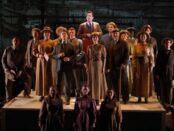
World events have inadvertently raised the significance of the New York City Center’s Annual Gala presentation of the brilliant new staging of the Jason Robert Brown/Alfred Uhry musical Parade which debuted over two decades ago. Anti-Semitism and xenophobia have risen to epidemic levels. This moving dramatization of actual events drives home the inevitable results of such unreasonable hatred. "Parade" is the gripping story of Leo Frank (Ben Platt), a Brooklyn Jew, who moved to Atlanta, Georgia for a better job. He married a Southern Jew, Lucille (Micaela Diamond), whose southern version of Judaism confuses him. Frank was the manager of a pencil factory and was accused of raping and murdering a 14-year-old white employee, Mary Phegan (Erin Rose Doyle), on Confederate Day, 1915. This almost operatic musical drama impeccably depicts how Phegan’s death led to a flowering of the anti-Semitism (twisted to the prosecution's benefit, horribly during Frank’s trial) and the KKK.
[more]
Ensemble Studio Theatre’s "38th Marathon of One-Act Plays," their first since 2019, is split up into two programs of five plays each, with an eleventh play, Vera Starbard’s “Yan Tután,” streaming free on-demand, in collaboration with Perseverance Theatre. Each of the plays in Program B is successful in telling us enough about the characters to make the audience care for them and empathize for what they experience in their short time on stage. ... The Marathon is a great venue for up-and-coming writers to hone their characterization skills. Some of these writers have already had full productions of other plays in their resumés, so for some their success is in full swing. Program B is a definite tease towards coming back to experience Program A.
[more]
You won’t find Vatican Falls on any map about picturesque raging waters. No, Frank J. Avella’s new play, "Vatican Falls," is, instead, a passionate, sometimes humorous, indictment of the Catholic Church and its long history of concealing the sexual abuse suffered by hundreds of young men at the hands of priests. Tony DiBernardo’s vivid, yet simple set—red platforms that were eventually arranged into the form of a cross—help Avella—who co-directed with Carlotta Brentan—make his sometimes confusing storytelling clearer by dividing the stage into two playing areas.
[more]
The 20th anniversary revival of Suzan-Lori Parks’ Pulitzer Prize-winning play, "Topdog/Underdog," is just as powerful and absorbing as before with its story of two African American brothers Booth and Lincoln who are searching for the American Dream in opposite ways. Under the astute but leisurely direction of Kenny Leon (Tony Award Best Revivals of "A Soldier’s Play," "A Raisin in the Sun" and "Fences"), rising stars Corey Hawkins (Tony nominated for "Six Degrees of Separation," and appearances in the film versions of "In the Heights" and "The Tragedy of Macbeth") and Yahya Abdul-Mateen II (Emmy Award winner for HBO’s "Watchmen" as well as ensemble awards for the cast of "The Trial of the Chicago 7") give riveted performances in this two-hander.
[more]
Ralph Fiennes’ towering performance as a megalomaniac who changes the face of New York as we know it is worth the price of admission. With his puffed out chest and nose in the air remaking himself physically, he creates a biographical portrait which will go down in the theater annals. Co-directors Nicholas Hytner and Jamie Armitage keep all the data and speechifying fascinating despite what could be the dryness of the material. And let’s not forget David Hare’s achievement to place the 30 year career of builder Robert Moses front and center on stage without overwhelming us with facts and figures but creating drama out of real life confrontations. "Straight Line Crazy" may just prove to be the dramatic high point of this theater season.
[more]
"Walking with Ghosts" is a decidedly intimate experience, one that seems tailor-made for an off-Broadway theater like the Irish Rep. Price and his production team try to expand the show to Broadway proportions through McKenna's lighting and aforementioned set and Sinéad Diskin's vivid sound design. But its true scale is human, which means all that's required is Byrne and his bravery.
[more]
The venerable, historic Negro Ensemble Company is presenting an intriguing program at the equally venerable, historic Cherry Lane Theatre: "Our Voices, Our Time: One-Act Play Festival." The three short plays, all insightful in very individual ways, reveal the ins and outs of relationships while also dealing with contemporary issues.
[more]
G.D. Kimble’s "What Passes for Comedy" depicts the fascinating era of early live television talk shows and the racism and anti-Semitism which was acceptable in those days. However, it also hints at hilarious comic interludes which it does not deliver. A much better play is hiding in this material and a rewrite could make it a much more successful evening. Its lack of focus camouflages its real intentions which are quite admirable. The play is also hampered by its conventional structure which requires a good many unnecessary exchanges. Nevertheless, this is an admirable attempt at something a little different from the usual run of historical plays on the stage, an absorbing evening even when it is not clear exactly where it is going.
[more]
Director Machel Ross does little to guide this play to any semblance of cohesion. Scenes 1 and 13, between Hound Dog and Ayse, her childhood best friend, begin with the exact same lines and stage blocking up to a point…so, did one scene happen and the other one not happen? Which is the real scene? Scene 6, between Hound Dog and Yusuf, the neighborhood trash collector and best friend to Hound Dog’s father Baba, happened three days after their meeting in Scene 4, or is it, as Hound Dog perceives, only yesterday?
[more]
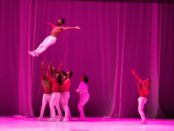
A scene from Twyla Tharp’s “In the Upper Room” at New York City Center (Photo credit:
[more]
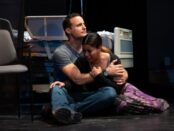
Mandi Masden, Tonya Pinkins and Toussaint Battiste in a scene from Robert O’Hara’s production
[more]
While director Dustin Wills has given 'Montag" a superb production, the meaning and message of Kate Tarker’s play remains obscure. Demonstrating female empowerment alone is not enough if the details remain murky and confusing. If the play has any geopolitical message about American-German-Turkish relations, it is entirely lost in the proceedings. The fact that both women are now single parents is not given much significance in the play. One gets the feeling that much of the play has a private meaning for the author who grew up in Germany on the outskirts of a U.S. military community. For those who do not know German, “Montag” is the word for Monday, the day when Clifford Andrews went missing and the women barricaded themselves in the apartment.
[more]
It’s not clear what Amaterasu Za’s mission is. If, as Dachs’ program comments indicate, it is to bring Japanese culture to modern audiences, the company needs to be less stodgy and more contemporary in its approach to such vivid dramas as "Chushingura - 47 Ronin." If this production is representative of their efforts, Amaterasu Za is dedicated to first rate representations of high Japanese art. Their standards are high. Perhaps, Dachs and her company can figure out how to combine a reverence for traditional Japanese theater with appealing to a wider audience without sacrificing authenticity.
[more]

Belgian actor Ronald Guttman gives a subtle, yet wrenching performance in "The Fall," expounding the philosophies of Albert Camus trapped in the sad and now resigned character of the exiled Parisian lawyer Jean-Baptiste Clamence. Fellow bar mates, we the audience, are his confessors in a sailors’ dive bar in Amsterdam’s red-light district circa 1956. In adapting Camus’ last completed novel for the stage, Alexis Lloyd, has created a role of controlled emotions that belie the seething honesty struggling to rear its ugly head. Director Didier Flamand encourages the full use of the space to make constant contact with members of the audience. Turning around from ordering his drink at the bar, he is in the best position to orate at will. As the performance takes place (and fits very neatly) in the entirety of the Huron Bar (the lower level of the SoHo Playhouse), the original architect of the building should be entitled to a scenic design credit. The best seat in the house is occupied by the bartender.
[more]
Many of Bedlam’s productions have used small casts with most of the actors playing more than one role. In the case of "The Winter’s Tale," not one of Shakespeare’s more often produced plays, the casting uses so few actors that the play becomes confusing and difficult to follow, and a great many characters and much dialogue has necessarily been cut. In one head-scratching scene, Elan Zafir is required to play King Polixenes and his son Prince Florizel at the same time. While the sets and costumes are modern, with the Shakespeare poetry sacrificed to sound like contemporary speech, the characters are still referred to as “King Leontes” and his wife “Queen Hermione.” As the setting by John McDermott looks like three rooms in a frat house, one wonders why the Royal Family of Sicilia would be living in such shabby quarters and continually guzzling beer in the palace.
[more]
Etheridge may be 61, but she sounds just as she did when she first came on the American rock scene in 1988: full-throated emotion and raspy vocals that bring honesty and pathos to intensely personal and confessional lyrics. The accomplishment in "Melissa Etheridge Off Broadway: My Window – A Journey Through Life" is not in the many scenes of heartache and a dense song list, but in the strength and the resilience that carries her to artistry that she shares so unselfishly and unselfconsciously to speak to and heal a legion of fans.
[more]
To be clear, the casting isn't colorblind; it's just casting, with director Miranda Cromwell delicately drawing out a different set of lived experiences from Miller's almost untouched words. The play's West-End co-director Marianne Elliott has not made the journey across the pond with its ongoing contributors, all of whom deserve kudos for the revelatory production, especially Wendell Pierce ("Broke-ology," "The Wire," "Treme") as Willy and Sharon D. Clarke ("Caroline, or Change") as Linda, his long-suffering wife. Though Pierce devastatingly pulls Willy apart in front of our eyes until all that's left is his sense of failure, it's Clarke who gives Willy's downfall its saddest dimension, convincing the audience, beyond any doubt, that the very-flawed Willy is loved. If seeing previous productions of "Death of a Salesman" has inured you to Willy's ultimate fate, this one should bring back the tears, and Clarke deserves a lot of credit for that difficult gift.
[more]
Directed by Jeffrey L. Page (who also did the simplistic choreography) and Diane Paulus, this production’s well-meaning gimmick is to have all the historic characters played by a “cast that includes multiple representations of race, ethnicity and gender [who] identify as female, transgender and nonbinary,” to quote the exacting language of the production’s press release. This casting coup works most notably as a political statement, hopefully forcing the audience take a fresh look at the original all-male contingent, however brilliant they may have been, and their flaws. The word “woman” never appears in the Declaration of Independence (nor the Constitution) and the millions of Black slaves were quite purposely and expediently left out of the Declaration. This multi-racial cast is a not-so-subtle slap in their faces.
[more]
Tom Stoppard’s "Leopoldstadt" is a powerful achievement, a history of our time as well as a cautionary tale. In depicting Jewish life in Vienna from 1899 - 1955, It also reveals a way of life and a culture rarely seen on our stage. Patrick Marber’s superb production keeps the story progressing at just the right tempo both to follow the plot as well as reflect family life as it is really lived. There is not a weak link among the 36 actors in which all of the children’s roles are double cast. The excellent design team puts four generations of Vienna on stage of Broadway’s Longacre Theatre.
[more]
Actor/writer/director Douglas McGrath is a charming storyteller and his one-man show "Everything’s Fine" is a total delight. He tells the entertaining and poignant story of his eventful 14th year when he was in ninth grade but also describes life in his family of five growing up in Midland, Texas. His tale of darkest adolescence is also nostalgic and reminiscent of the problems of life as a teen. The title turns out to be ironic as it was an expression his father used before announcing there was a new problem.
[more]
"Baldwin & Buckley at Cambridge" should stir up controversy as their 1965 topic is still relevant. Such a debate today would have a great deal more ammunition than either of these men had at the time. However, one can still hear both points of view today given by liberals and conservatives, respectively. The fact that the Baldwin/Buckley debate is still relevant can be witnessed from the rise of the Black Lives Matter Movement in 2013 as well as the 2019 publication of "The Fire Is Upon Us: James Baldwin, William F. Buckley, Jr., and the Debate over Race in America" by Nicholas Buccola. This is a question which has not been resolved in the intervening 57 years.
[more]
Harms’ play never lets up in its homage to corporate intrigue laced with humor. The audience’s caring for how Regan and Guy end up is a given, so that we can forgive his “poetic license” in that all legal personnel involved would be fully aware that the illegal recording of someone without their knowledge is a Class E felony in the state of New York, but nevermind. Director Ken Wolf keeps the story moving at a great clip and gently supports all five of the thoroughly believable characterizations, to the point we hope even Meena will be okay after her hysterical breakdown akin to professional suicide.
[more]
Perhaps because of its prestigious accolade, or just undeniable merit, "Cost of Living" is the first of Majok's heartfelt efforts to make the journey from off-Broadway to on-Broadway in the Manhattan Theatre Club’s production, a transition that, thanks to director Jo Bonney's returning and unflinching guidance, hasn't diminished any of the play's intimacy or daring. If anything, on Wilson Chin's Bergman-meets-Bayonne turntable set, gloomily lit in unrelenting twilight by Jeff Croiter, "Cost of Living" has become even more persuasive and poetic. Invaluably serving that dramatic growth are actors Gregg Mozgala and Katy Sullivan, repeating their roles from the play's 2017 New York City Center premiere by MTC.
[more]
Neith Boyce’s "The Sea Lady," a Broadway-bound play in 1935, only now having its world premiere at Metropolitan Playhouse is an attempt at a Shavian play of ideas. Based on a 1901 novel by socialist H.G. Wells, this very Edwardian story resembles Shaw’s "Misalliance" but without the wit or the scope of ideas. Extremely tentative in how far it dares to go, "The Sea Lady" seems like a relic of an earlier age. It has charm but it lacks depth; its message may have been new in 1901 when the novel came out or 1935 when the play was finished, but today it seems extremely old hat.
[more]
On what is either a shoestring budget or a conscious effort to strip Henry James’ novel down to its essentials, Randy Sharp’s new adaptation of "Washington Square" is both exciting theater and entirely true to its source material. The quartet of fine actors make this story of 1840’s New York entirely credible and engrossing at all times. While it avoids the beautiful trappings usually associated with the period, it is so gripping that they are not missed for a moment.
[more]
Krevolin is a clever writer, turning Wilder’s American folk tale into a modern comedy/drama with relevance to today’s audiences. Although he often makes his points a bit too obviously with the rantings of the bigots veering too close to cliché, he nimbly juggles the complex inter-relationships. His staging is simple, helped by Aurora Winger’s lighting. Characters often enter down the aisle as they approach the stage tossing off their lines, cheerfully lit by Winger. While waiting for the next inevitable production of Wilder’s Our Town, whet your appetite with its modern cousin, "Our Town…but Wilder."
[more]
On paper, Diane Davis’ play "Complicity" offers a stark, yet refreshing take on the now familiar Harvey Weinstein-tainted Hollywood story of women being victimized by a male-run, male-driven industry. On stage what we have instead are sometimes too-clipped scenes where an audience is left the chore of filling in the many blanks. The actors sometimes attempt to do just that with histrionics that are unfortunately not reined in by director Illana Stein.
[more]
There are two truisms in life in addition to the one about death and taxes: it takes all kinds of people to make a world and something will get everyone in the end. The world premiere of Gracie Gardner’s "I’m Revolting" beautifully proves both points. A sensitive and perceptive play set in the waiting room of a private New York City skin cancer clinic, the play introduces us to all walks of people and many reactions to medical reports. The ensemble cast includes several veteran actors (Laura Esterman, Glenn Fitzgerald, Peter Gerety and Patrice Johnson Chevannes) and several not so well known faces. Knud Adams’ direction is subtle and unobtrusive allowing life to pass on the Linda Gross stage of the Atlantic Theater Company.
[more]

"Weightless" is an engaging little indie rock musical, little in the sense that it has only three characters plus a narrator and runs only 75 minutes of playing time. The show features the Bay Area rock band The Kilbanes (married songwriting and performing duo bassist Kate Kilbane and keyboard player Dan Moses) who also wrote the show, and the cast that also filmed the show in 2021 during the pandemic. Like "Hadestown," "Weightless" is based on a story in Greek mythology and includes the gods on Mount Olympus; in this case the source material is from Ovid’s "Metamorphoses," a work written in Latin. "Weightless" is performed as if it were a concept album staged as a concert with the characters all played by the six member band who sit or stand on the stage placed on various platforms. Peiyi Wong’s set design does not allow for much stage movement and Tamilla Woodard’s direction does not give the actors much to do in the way of stage business. However, the storytelling is clear and the characters well defined.
[more]
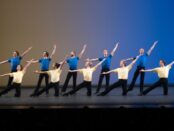
"Men of Kyiv," choreographed to high-spirited traditional folk music by Pavlo Virsky, pitted two groups of men—one wearing blue T-shirts, the other yellow, the colors of the Ukrainian national flag—against each other in a friendly, boisterous competition which began with a high-kicking entrance mazurka. This was followed by one exhibition of prowess after another: barrel turns, high cheerleader jumps, kazatskis, split leaps and unison chain dances. It was almost as exhausting to watch as it was to dance and it left the audience totally in love with this good-natured dance troupe.
[more]
As conceived, directed and choreographed by Randy Skinner, who was also part of the creative team that brought the stage version of the 1954 classic Irving Berlin’s "White Christmas" to Broadway, "Cheek to Cheek" is a welcome addition to The York Theatre’s homages to Broadway and film composers. They strike gold again with this charming revue that focuses on the lesser known classic songs from the decades of Berlin moving seamlessly from movie lot to movie lot. The very talented Jeremy Benton and Kaitlyn Davidson, returning from the original run of this show, are joined by the radiant Darien Crago, Danny Gardner, Darrell T. Joe and Melinda Porto. The entire cast is made up of consummate singer-dancers, each featured in dance numbers and/or their own solo songs.
[more]
Perhaps the supreme dance festival in New York City, maybe even in the world, New York City Center’s Fall for Dance 2022 is celebrating its 19th year of presenting a panoply of domestic and international troupes. Initiated by outgoing City Center President Arlene Shuler, this celebration of the many facets of dance has brought some of the best and some of the mediocre representatives of world dance to many thousands of people who have been notoriously uncritical of what has been set before them. And, rightly so. This is an audience that has come to enjoy whatever entertainment is presented—and, at an affordable price. Program 1 of this year’s five-program edition was typical, presenting one local troupe, a Portuguese classical ballet couple and an all-male French/Algerian company which opened the program with in-your-face energy tempered by woefully mawkish “daddy was mean to me” back stories.
[more]
If you like your W.W. II history unadulterated, you may object to a love story between a French teenage girl and a Nazi soldier even if they are inexperienced and innocent and unaware of what is to come. The fact that they are both hopeful of life in the future in the middle of war and devastation notwithstanding, were people ever this naïve and unworldly? While "This Beautiful Future" is tastefully presented, it does not deal with the moral issues that the play hints at but refuses to recognize.
[more]
Is it possible to be completely truthful in attempting to tell the life of a famous author in a biofilm? That is the premise of Argentinian novelist and playwright Romina Paula’s "Fauna" now having its English language premiere at New York’s Torn Page Theater. As the play is philosophical, poetic, cerebral, and literary with quotes from many authors including Argentinian writers unfamiliar to Americans, it may be too erudite and esoteric for most theatergoers. However, April Sweeney’s production at the vest pocket Torn Page Theater is so intense that it carries its audience with it. With the actors only feet from the viewers so that you feel you are in the room with them, the play is a powerful experience that few productions ever achieve.
[more]

Although Alan Cumming is a charismatic performer, the distracting video design, the often overpowering music, and the often flashing lighting by Tim Lutkin, gets in the way of viewing the show. Much of the effect is created by the atmospheric lighting which periodically changes color (blue, green, red) yet at times it turns the evening into a multimedia event. Since none of the poems are clear enough to be understood, we learn little of Burns’ output as a poet though we do hear about his triumphs that lead to being lionized in Edinburgh. The contemporary music only rarely suggests the period. The dance elements also seem an eccentric way to portray this 18th century man who attempted to live life to the fullest. Cumming charmingly depicts this Scottish icon though he does come off as a lovable rogue. It is all an example of too much being too much. The rather coy ending has Cumming sitting on the edge of the stage declaiming Burns’ now famous poem, “Auld Lang Syne,” after the final curtain has already descended.
[more]
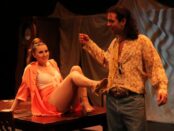
Maurice Ravel’s delightful 'L’heure espagnole," usually paired with his other opera, "L’enfant et les sortilèges," is here paired with "Faust et Hélène," an obscure cantata by Lili Boulanger, one of Ravel’s contemporaries. Hearing her exquisite Faust et Hélène is comparable to discovering a diamond you didn’t know you had. New Camerata Opera opens its seventh season with this very engaging double-bill. Director John de los Santos has envisioned a world where the passage of time is the focus of both of these operas. While the set for the Boulanger is spare, Mr. de los Santos is aided in this concept for the Ravel with projections of striking clockwork photography and a set filled with a collection of stylized grandfather clocks from NYC-based artist Atom Moore. Ashley Soliman’s costumes are timeless for the Boulanger work – the men are shirtless and barefoot in a variation on dhotis or male harem pants while Hélène is in an orange gown with a virtually endless train.
[more]
Greenspan isn’t always totally clear when switching points of view, but made up for this by turning the entire, long script into a wonderland of gestures, vocalizations, postures and movements. His eyes and his hands are masterful communicators. His lean body’s dancelike movements add dimension to the onslaught of words. This is a performance that must be seen to appreciate how mindboggling his accomplishment is.
[more]
Most poignantly, when Drew starts to wonder if maybe their son's survival has been the opposite of a blessing, Andrea expresses horror for a thought that, thanks to Pimentel's touchingly subtle performance, we know she's had herself. To its strongest credit, MacDermott's play affords all three of its actors the opportunity to find meaning beyond their characters' words. Though, of course, with a less capable trio, this sort of dramatic freedom could have been a disaster.
[more]
«
1
…
14
15
16
17
18
…
63
»
Copyright Jack Quinn, 2001-2026