Plays
In "Entangled:12 Scenes in a Circle K off the I-40 in New Mexico," the beguiling and philosophically mischievous collaboration between Mona Mansour and Emily Zemba, the American desert becomes less a landscape than a condition of thought—a place where the ordinary laws governing time, consequence, and human attachment appear to have loosened their grip. Set in the fluorescent limbo of a Circle K somewhere in the New Mexico expanse—30 miles from the nearest outpost of civilization, and perilously close to both an atomic testing site and a nuclear laboratory—the play hums with a low-grade metaphysical dread that it wears, with admirable restraint, as comedy. [more]

Trash
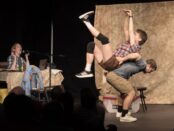
James Caverly and Andew Morrill’s Trash is a provocative play about two late 20s deaf roommates who have nothing in common except sharing an apartment. However, what is most intriguing about Trash is that it told in multiple ways. As the main characters are both deaf, they use American Sign Language to communicate. As a concession to hearing audiences, some of the dialogue is projected on three walls facing the audience. Still more unusual, there is a jukebox on stage (played by Chris Ogren) which, when fed with dollar bills, translates the ASL into spoken speech. When the lead characters really want us to know what is being said they use this method. However, this is only used partially. Much of the play is told only in ASL but Caverly and Morrill are so adept (and so dramatic) at it that we often feel like we know exactly what they are saying. They also use white boards which they hold up for all to see for simple statements or questions to the audience which sometimes require answers.
[more]
Spare Parts
What begins as a satirical clash between corporate swagger and academic idealism gradually deepens into a more unsettling inquiry. The play’s true subject, it turns out, is not merely the arrogance of billionaires but the universal temptation to trespass upon the limits of the body. Humanity, after all, has always been drawn toward transgression—whether through cosmetic surgery, pharmaceutical enhancement, or the relentless drive to improve the species one experiment at a time. [more]
Zack
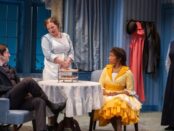
While not the classic that "Hobson’s Choice" has become, Harold Brighouse’s follow-up play "Zack" proves to be a charming Edwardian comedy drama in the Mint Theater Company’s production which may be the first full New York production since 1916. Ironically, Zack has a great many things in common with "Hobson’s Choice" probably best known from the awarding-winning 1954 Sir David Lean film with Charles Laughton, John Mills, Brenda da Banzie and Prunella Scales. Britt Berke’s production glosses over the play’s deficiencies by keeping this middle-class comedy of manners going at quite a clip. While "Zack" shares many elements with "Hobson’s Choice," the two plays are very different, variations on a theme: a strong woman who saves the hero from his weaknesses, siblings who are against seeing the strength of an unambitious person, a parent who is both dominating and dogmatic, and a happy ending for the leading characters. However, both are based on the theme of the “worm turning.” [more]
Dear John
Elliott’s staging is often quite clever, making use of the space in interesting ways. The use of actual letters Lin received adds a degree of authenticity to an already very personal piece, but having audience members come on stage to pick up the letters themselves is a strong choice of direction. It keeps the letters feeling fresh every time – and also provides an opportunity for Lin to change costumes. The projections onscreen (handled by designer Ein Kim) and roving spotlights (lighting designer Yang Yu) evokes images of a game show, making each letter-picking section feel like a miniature intermission – something that breaks up the play quite nicely. [more]
Our House
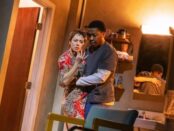
Billed as a “comedy in two acts” on its title page, it is not funny nor does it deal with comic material, though the direction tries to emphasize its bitchier moments. Its plot involves homophobia, gay bashing and racism which goes a long way to explain why The Other Side of Silence (TOSOS), the oldest and longest producing LGBTQ+ theater company, would be interested in staging it. However, half of the actors emote shamefully and the other three give too restrained performances to make much impression, both of which damage the credibility of the play. [more]

Body Count
If the show’s point of view occasionally feels one-sided, that imbalance ultimately serves its chief purpose: entertainment. 'Body Count' may not function as a comprehensive treatise on contemporary sexual politics, but it is undeniably electric as a performance vehicle. Knowles’ Pollie is charismatic to the point of hypnosis—funny, sharp, wounded, and persuasive enough to feel utterly real. Her barbs may sometimes be a shade too neat, a shade too gleefully cruel, but they land with a sting that lingers. Long after the laughter subsides, one finds oneself turning the lines over again, wondering what uncomfortable truths might be hidden inside the joke. [more]
Chinese Republicans
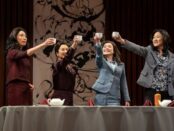
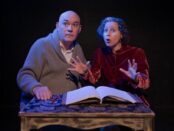
Unlike "Glengarry Glen Ross" which also begins at luncheon meetings in a Chinese restaurant but then took us to the office in its second act, "Chinese Republicans" is mostly set at the monthly luncheons with one flashback to Ellen’s first interview with Phyllis years before and a dream sequence. Each scene reveals new pieces of information but the play seems too schematic finding no other way to reveal what we need to know. The title needs to be taken on faith as very little is made of their all being Republicans (probably to fit in at the office.) Nevertheless, the language of the play is raw, the insults cutting and the humor biting. The play covers many women’s issues found in other fields: sexual harassment, corporate culture, prejudice and racism against Asians, generation gap, social justice, and the treatment of women in the business world. "Chinese Republicans" is a tight expose of how women particularly Asian American women are treated in the work place in the 21st century. [more]
The Mall The Mall The Mall
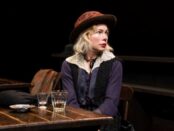
"The Mall The Mall The Mall" is a magical realist comedy about three teenagers traversing a suburban mall in search of stolen fandom merchandise. Along the way, they encounter a coterie of increasingly strange antagonists and have some surprisingly sincere moments of self-discovery. The script, from writer Philip Kenner ("BOYSTUFF," "Stand & Repent"), is quite sharp. The directing from James Wyrwicz ("Is This a Theater Of Love?," "I Love You Jesus Christ!") is wickedly funny, with blocking that brings out the humor of the script while letting the emotional beats still land as they should. Kurt Cruz’ sound design adds quite a lot of comedy as well. [more]
The Reservoir
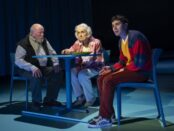
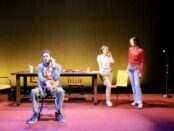
Alcoholism and Alzheimer’s wouldn’t seem to have much in common. However, Jake Brasch cleverly links the two in his comedy drama "The Reservoir," the story of a recovering drunk on leave from college who goes home to discover his grandparents are sinking into old age, which he never noticed before. Rising star Noah Galvin who replaced Ben Platt in "Dear Evan Hansen" and then co-wrote and starred in the film "Theater Camp" has the role of a lifetime as Josh who never leaves the stage throughout the play and who experiences the year after he dropped out of NYU. Surrounded by some of the most well-known and experienced theater pros around (Heidi Armbruster, Peter Maloney, Mary Beth Peil, Matthew Saldívar and Chip Zien) he holds the stage even as his character relapses and regresses at the worse possible moment. [more]
Marcel on the Train
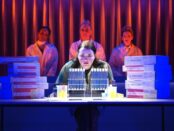
Slater’s performance is a revelation of synthesis. Known for his buoyant athleticism in Broadway’s "SpongeBob SquarePants" and his chilling portrayal of the Balladeer and Lee Harvey Oswald in Classic Stage’s brilliant "Assassins," he here channels that dexterity into something at once lighter yet more harrowing. His Marceau moves with balletic precision: fingers unfurl like petals; wrists trace invisible architecture; the torso leans into unseen walls. Butterflies tremble from his cupped hands, a flower blossoms and droops along the line of his arm. Guided by movement consultant Lorenzo Pisoni, Slater achieves an embodiment so exacting it appears to suspend the laws of bone and gravity. [more]
Hold on to Your Butts
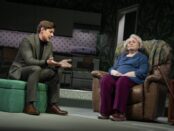
Actors Kerry Ipema and Natalie Rich, joined by the live Foley artist Kelly Robinson, proceed to conjure Spielberg’s dinosaur epic. They marshal an arsenal of materials so defiantly homespun it borders on subversive: cardboard cutouts standing in for apex predators, skeletal wooden frames sketching out jeeps and laboratories, pocket flashlights pressed into service as cinematic chiaroscuro, and a scattering of objects manipulated with priestly concentration, shot for shot—all deployed with an almost ascetic economy of means that make the absence of machinery feel not like deprivation but like principle. [more]
Mother Russia
In Lauren Yee’s exuberant and stealthily devastating new comedy, "Mother Russia," history arrives not with a bang but with an order of fast food. Two young men, perched at the lip of a new world order, cradle their first-ever Filet-O-Fish sandwich from McDonald's as though it were a sacred relic. They tear into it with the devotional hunger of converts, pausing only to roll their eyes heavenward and lick tartar sauce from their fingers with an abandon that feels both comic and liturgical. Capitalism, Yee suggests, is best introduced as a condiment. [more]

The Waterfall
Not only does Phanésia Pharel’s "The Waterfall" have a great deal to say, it is also very revealing of immigrant views on the American Dream. A tour de force for two actresses, Taylor Reynolds’ production takes hold of you and never lets up for a moment. This captivating play says much about mother-daughter relationships as well as Haitian-American values. See it for Patrice Johnson Chevannes and Natalie Paul’s thrilling performances which fill the stage. [more]
The Monsters
Written and directed by Ngozi Anyanwu, author of "The Last of the Love Letters" (Atlantic Theater Company) and "Good Grief" (Vineyard Theatre), 'The Monsters" is a tour de force for two actors who have the chops for this very physical outing both emotionally and literally and luckily Aigner Mizzelle and Okieriete Onaodowan have what it takes. Aided by the choreography of Rickey Tripp, the fight direction of Gerry Rodriguez, and the work of MMA consultant Sijara Eubanks, the realistic fights mainly pantomimed with only one participant (except for Lil’s training sessions which include Big) make us believe we are seeing two people fighting. [more]
Hate Radio
The premise—a radio broadcast—might seem theatrically inert, yet Rau ingeniously implicates the audience by issuing each spectator a set of headphones. We are not merely watching propaganda; we are tuning in. If we need to gauge our own humanity while we watch the hideous display, all we need to do is look straight ahead - on the other side of where the actors play sits the other half of the St. Ann’s Warehouse audience. The isolation produced by the earphones intensifies the intimacy of the rhetoric. One hears the laughter, the rhythm, the coded exhortations as if they were meant for one’s own ear. The imaginative leap—who would listen to this? who would believe it?—collapses. The seduction of format, the familiarity of tone, do much of the ideological work. [more]
The Dinosaurs
Like Beth Wohl’s Liberation, Jacob Perkins’ "The Dinosaurs" follows a group of women who meet weekly to discuss a problem that interests them, in this case alcoholic addiction. Covering many years, the play gives six women with different stories a chance to talk candidly about their lives and travails. Beautifully written, the play, however, feels thin and repetitious and doesn’t seem to get anywhere. Directed by Les Waters, the six actresses led by Off Broadway stalwarts Kathleen Chalfant and Elizabeth Marvel create very different portraits, though at a brief 70 minutes we don’t learn that much about each one. [more]
The Tragedy of Coriolanus (Theatre for a New Audience)
Tata’s staging is also problematic making almost every scene look like every other. The mob scenes have been reduced to five actors (other than the lead characters) which does not suggest any threat whatever. Afsoon Pajoufar’s unit set is an attempt to create a Roman building and then put scaffolding around it to suggest modern renovations. However, using it for almost every scene which is just under three hours becomes monotonous and uninspired. The acting doesn’t help much with each actor seemingly having chosen one single character trait so that all are one-note in this blank-verse drama. Only Roslyn Ruff as Volumnia, the title character’s mother, shows any variety or range. (Volumnia has always been the best role in the play.) [more]
The Other Place
Going along with leaving much unsaid, Zeldin in his direction has kept things rather slow and leisurely so that the play’s 80 minutes seems much longer. Also much of the backstory is missing: what does Chris do for a living as we are told he is very rich? As his friend Terry is described as his contractor, does that make him a builder or has Terry only been hired to do the renovation on the house? The house incidentally has been made unrecognizable with walls removed to let in the light - though the view outside is still in darkness until the trees are torn down, including the tree from which Adam hanged himself. How has Annie been living since leaving the hospital? She has refused to take Chris’ money so that is not an explanation. And is his offer of money an expiation for some unnamed guilt? [more]
Ai Yah Goy Vey! – Adventures of a Dim Sun in Search of His Wanton Father
Chang is an agile performer, and his quick shifts among characters recall the early solo work of urban shapeshifters who built entire neighborhoods out of voice and posture. Yet here the gallery of types is unevenly realized. Too often, figures arrive as the sketch of a stereotype rather than the surprise of a person. When Chang draws on the stylization of Chinese opera—particularly in the rendering of Jackie’s diva-like mother—the show briefly discovers a richer theatrical language, one in which Eastern and Western performance traditions spar and flirt on equal terms. Such moments hint at a more adventurous piece than the one that predominates. [more]
The First Line of Dante’s Inferno
The opening gesture of Dante Alighieri’s "Inferno"—that immortal confession of midlife disorientation in which a wanderer finds himself astray from the “straight road” and deposited in a “dark wood”—has rarely felt as theatrically apt as it does in "The First Line of Dante’s Inferno," Kirk Lynn’s sly, searching, and disarmingly funny new experiment in staged storytelling. Lynn, a polymath of the American theater—playwright, novelist, screenwriter, educator, and guiding spirit of the Austin collective Rude Mechs—treats Dante’s premise less as a theological map than as a psychological condition. His forest is not an allegorical afterlife but a contemporary wilderness in which several souls, one quite literally at midlife, appear to have misplaced the coordinates of their former selves. [more]
Hans Litten: The Jew Who Cross-Examined Hitler
Despite the admirable commitment to historical accuracy, Lackey’s script is littered with flimsy side characters, muddled messages, and awkward dialogue. The result is a thematically incoherent mess that feels unaware of its own central tragedy. Hans says in Act 1 that he wants to force Hitler onto the witness stand in order to stop the Nazis from coming to power. The play seems unwilling to address that this did not work – that no amount of clever rhetoric would have been enough to stop the tide of Fascism. It would be wildly unfair to blame Hans Litten for failing to stop the Nazis, but it is a grievous omission for a play about him to explicitly frame the story that way and then refuse to grapple with the implications of him failing to do so, both for him as a character and for the ideas he is meant to represent and martyr himself for. Indeed, the play revels in the grace of Hans’ martyrdom. [more]
An Ideal Husband
After a several year hiatus, The Storm Theatre, one of the last classical theater companies left in New York, is back with an elegant and polished production of Oscar Wilde’s rarely seen comedy-drama "An Ideal Husband" staged by artistic director Peter Dobbins. While Wilde’s "The Importance of Being Earnest" is well known to theatergoers, "An Ideal Husband," last since on Broadway in 1985, is not but ought to be better known. This play of political corruption and moral turpitude seems more relevant than ever with the number of government scandals in our news daily. As witty as Wilde’s most famous play, An Ideal Husband also has an involving plot and colorful characters. [more]
Anonymous
Spit & Vigor Theatre Company has an interesting approach to stagecraft at least with its return engagement of Nick Thomas’ Anonymous, now at their new home at the Tiny Baby Black Box Theatre. The play which takes place at a weekly meeting of an addiction support group has the audience sit in a circle and then embeds the actors in the circle without acknowledging the rest of us. This gives the play an immediacy it might not have had otherwise. The audience feels like they are part of the monthly group even though we are not seen by the actors. On the other hand, Sara Fellini’s direction is so broad that the actors all seem like they are overacting considering that the audience is only feet away. The play would be much more convincing if they all took it down a few notches. Some of the actors seem to be hamming it up – unless it is simply that we are sitting next to them or across from them that their performances seem to be too big for the tiny venue. [more]
Blackout Songs
Joe White’s "Blackout Songs" direct from London with its original cast is a tour de force for two actors. It is also a challenge for the audience both because its single topic is addiction and as intentionally written by the author we never know what is real and what is imagined. Rising film stars American actor Owen Teague ("Unspeakable: The Murder of JonBenet Ramsey," Stephen King’s "The Stand') and Australian actress Abbey Lee ("Mad Max: Fury Road," "Black Rabbit") both making their New York stage debuts give bravura performances, though Lee’s English accent is often difficult to understand as is the British slang that they often toss off. However, director Rory McGregor’s use of a single set to present a turbulent relationship over ten years and many locales is quite remarkable. [more]
King Lear (Compagnia de’ Colombari)
By loosening the moorings that usually tether one actor to one role, director and adaptor Karin Coonrod peers, with unusual intimacy, into Lear’s psychic weather. The choice to distribute him among ten bodies does not dilute the character; it refracts him. We are invited to watch a consciousness under siege, a man stripped so thoroughly of title, certainty, and familial illusion that what remains is not a king discovering wisdom so much as a human being stumbling toward self-recognition. Lears circulate through the auditorium, each member of the company outfitted by Oana Botez in a palette of muted greige, topped by gilded paper crowns, courtesy of Tine Kindermann, that rise a good foot and a half into the air, their fragile grandeur at once comic and faintly forlorn—a visual joke that curdles into a metaphor. The multiplicity supplies a chorus of selves: monarch and parent, tyrant and child, sovereign and supplicant. At times they seem to echo one another; at others they compete for the same thought, as if Lear’s mind were a crowded room he can no longer govern. The image captures something essential about the play’s cruelty: identity, once propped up by power and praise, proves alarmingly divisible. [more]
DATA
Mathew Libby’s riveting "DATA" is drawn from tomorrow’s headlines – or is this frightening story depicting events that are already happening? As directed by Tyne Rafaeli, this techno-thriller become more and more scary as we begin to realize the dangers of AI and computer algorithms to be used for immigration and citizenship rules as the story moves to its inevitable conclusion. Silicon Valley has a lot to answer for and this play demonstrates what may be in store for us very soon. [more]
Watch Me Walk
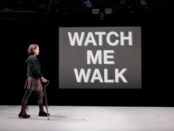
Anne Gridley begins "Watch Me Walk" by taking its title at punishingly literal face value. She introduces herself, grips her walking stick—never a cane, a semantic correction that quickly reveals its philosophical weight—and proceeds to walk the length of the stage again and again, in near silence, for so long that the initial charge of provocation slowly discharges. What remains is not suspense but facticity. In another theatrical ecosystem, this might register as endurance art or a sly conceptual prank; here, in a Soho Rep production presented in association with the recently concluded 2026 Under the Radar Festival, it operates as a recalibration of spectatorship itself. We arrive alert, waiting for the performance to “start,” only to discover that it already has—and that the only thing lagging behind is our attention. [more]
The Disappear
Watching these creative people misbehave is part of the fun though a great deal must be taken on faith: Julie’s tremendous talent, Raf’s inordinate fame and highly emotional depth, Ben’s genius as a filmmaker though Raf has never seen one of his movies, and that Mira’s novels earn more money than Ben’s films. However, nothing Schmidt has written for these characters demonstrates these qualities. Julie is portrayed as pretentious and overacting. Raf is so low-key it is hard to see him as having a great deal of depth on screen. With Ben's self-dramatizing and egotistical nature, it is hard to imagine him finding time to focus on his work, while the items we hear about from Mira’s novels hardly seem like the material for best sellers. Possibly Schmidt who has directed her own play needed a second pair of eyes and ears to get her play whipped into shape. [more]
Cimino’s Defeat
Eric Faris’ "Cimino’s Defeat" seems under researched while attempting to make a play from a few salient facts. At times the play seems endless, at others repetitious with all the arguments that never reach any conclusions. A good deal of the play seems amateurish though this may be the fault of co-directors Sam Cini and Ryan Czerwonko who allow for much ranting and raving from the actors. There may well be a play in the "Heaven’s Gate" debacle but this isn’t it. [more]
Bug
Seen first Off Broadway in 2004, Tracy Lett’s "Bug" has now reached Broadway via the Steppenwolf Theatre Company production being presented by Manhattan Theatre Club. While "Bug" has the reputation as a thriller (and has all the elements.) David Cromer’s leisurely direction turns this into a character study instead. Michael Shannon’s electrifyingly crazed protagonist in the Off Broadway staging has given way to Namir Smallwood’s low-key insidious portrayal of Peter Evans, an Iraqi vet who has escaped from four years in an army hospital facility. The play which deals in conspiracy theories does seem more relevant now than two decades ago as there are so many more such theories swirling around us on a daily basis. [more]
and her Children
Hailey McAfee in a scene from Rosie Glen-Lambert and McAfee’s “and her Children” at SoHo [more]
Night Stories
"Night Stories" is, first and foremost, about Jewish life. The show’s characters are mainly Holocaust survivors, yet they are never reduced to simply being symbols of suffering. They go on tangents, they make jokes, they express unimaginable pathos before quickly moving on, and they navigate life as best they can. There are so many moments in this play that are deeply human, and deeply Jewish. The production imbues Sutzkever’s poetry with a magnificent resonance. His words are as strikingly beautiful as when he first wrote them, and this modern production is a heartrendingly beautiful affirmation of life. [more]
Anna Christie
Michelle Williams and Tom Sturridge in a scene from Eugene O’Neill’s “Anna Christie” at St. [more]
If We Kiss
What "If We Kiss" captures, with rare delicacy, is the way young people experience such convergences as both comic and catastrophic. The play treats adolescent feeling with respect, refusing to condescend to its intensity while still allowing space for humor and grace. In doing so, it reminds us that first love is never merely personal: it is social, moral, and—when the generations begin to rhyme—quietly political. [more]
Predictor
Jennifer Blackmer’s "Predictor" expands a single moment of insight into a sharp examination of authorship and agency. Anchored by Caitlin Kinnunen’s quietly compelling performance as Meg Crane, the production traces the birth of a home pregnancy test with clarity, momentum, and discipline—most persuasive when it trusts process over proclamation. [more]
Marjorie Prime
Director Anne Kauffman, who impressively guided the play's Off Broadway premiere a decade ago, returns to do the same for its Broadway debut. With Michael Almereyda's cinematic adaptation having been released between these productions, the new challenge for Kauffman is navigating a wave of narrative familiarities she first fostered. Not only has Harrison's once intentionally disorienting plot become straightforward on a second or third pass, his formerly fanciful depiction of artificial intelligence now carries an impending sense of mundanity, too. [more]
Oedipus
Icke’s version avoids the religious and ethical themes of the original but instead makes it a riveting thriller as the tension rises to almost unbearable heights – even if you know the outcome of this classic tale. In rearranging the story and telling it differently, Icke gives us the hope against hope that this time it will turn out differently. Set on the night of a political election in an unnamed country, Oedipus is first seen on video making a speech to reporters and the populace. He is not yet the ruler but a shoo-in to be elected on this night. However, he makes two promises that will lead to his downfall but he doesn’t know it yet; he will release his birth certificate and he will investigate the death of Laius, a previous leader and the previous husband of his wife Jocasta. [more]
The Surgeon and Her Daughters
According to the author’s note, he wrote the play to acquaint theatergoers with the “forgotten war” in Sudan. Unfortunately, as there is no backstory for the leading character the Sudanese Mohammed-Ahmed, we learn nothing about this war or how it has affected him. Eventually we learn that he was a surgeon there and lost his wife and daughter. We assume that he was not able to become qualified as a doctor in New York as he has been working as a sign holder for a midtown Irish bar. However, the circumstances of the deaths of his wife and daughter are never explained nor why and how he came to New York (one assumes he was seeking asylum but this is never stated either.) Not surprisingly, no one he meets in New York believes he has been a surgeon as he never tells his life story. [more]
BUM BUM (or, this farce has Autism)
In "BUM BUM (or, this farce has Autism)," EPIC Players—New York’s indefatigable standard-bearer for neuroinclusive performance—unfurls a world premiere that feels less like a conventional new play and more like a controlled theatrical detonation. Written by autistic playwright Dave Osmundsen, the play arrives disguised as farce, yet beneath its slapstick velocity lies an exacting critique of how neurodivergent lives are shaped, softened, and rendered consumable for mainstream audiences. It is a work that understands comedy not as an escape from politics but as one of its most effective instruments. Under the brisk, clear-sighted direction of Meggan Dodd, EPIC Players has assembled a company of actors on the spectrum to bring to life the buoyantly subversive text of award-winning Osmundsen—a writer whose instinct for farce is matched only by his ear for the humiliations, large and small, that so often attend the rhetoric of “inclusivity.” [more]
The American Soldier
The American Soldier, written and performed by Douglas Taurel, is a solid evening of theater with important messages about war and the soldiers who fight them. Taurel is an excellent actor and he has done a nice job adapting the show from actual soldier's letters and their accounts of their time in battle. [more]
This World of Tomorrow
This World of Tomorrow resembles the films "Back to the Future" (Bert cannot risk changing anything), "Groundhog Day" for its repetition of the same events, and "You’ve Got Mail" in which two undeclared lovers run the risk of missing each other. Both the message and the structure resemble those time travel movies of the 1940s like René Clair’s "It Happened Tomorrow" where the characters get to view a glimpse of the future only to end up back where they started. The problem with "This World of Tomorrow" is that the play attempts to do something that the movies do much better. While Derek McLane’s clever scenery making much use of projections on a series of square pillars which rearrange themselves for each scene as the projections change is appealing as well as eye-catching, it can only do so much to suggest the extensive and imposing World’s Fair, as well as other parts of New York City. All this will be more successful in a future film version in which CGI will allow us to really see the bygone fair and NYC in 1939. [more]
Diversion
I come from a family of nurses, and apparently so does playwright Scott Organ whose play "Diversion" is set entirely in an ICU nurse’s breakroom. Organ has clearly done his homework, because he’s written an honest, intense, and yet often funny piece centering on a few days in the work life of six nurses under the pressure of a “diversion” investigation. For those unfamiliar with the word in a medical setting, “diversion” is the delicate term given to the illegal practice of diverting drugs away from their intended use, on patients, and instead toward personal use or sale. [more]
Meet the Cartozians
Talene Yeghisabet Monahon’s new play "Meet the Cartozians," being presented by The Second Stage at The Pershing Square Signature Center, is simply the best new American play in New York this fall. This riveting two-part play set in two time frames 100 years apart asks the questions what does it mean to be an American, what does it mean to be white in America, and what does it mean to be an Armenian American. The timeliness of these questions will not be lost on audiences well aware of the current administration’s views on immigration particularly of non-white applicants for asylum. The Armenian American playwright’s last three plays ("How to Load a Musket," "Jane Anger" and "The Good John Proctor") have all had historical backgrounds but this one is personal to Monahon as it deals with her own heritage. Director David Cromer who has proven himself to be a wizard with new plays as well as his brilliant reinvention of Thornton Wilder’s Our Town has chosen a superb cast led by two-time Tony Award-winner Andrea Martin and 2024 Tony Award-winner Will Brill who are all excellent playing two roles each. [more]
Practice
With a three-hour running time (the first act runs two hours straight without an intermission) the play is too long for its repetitiousness having the actors go over the same theater games and monologues over and over again. Of course, the play becomes an endurance test for the actors as well as viewers, whether it was intended to or not. Actors who have undergone this kind of training may be amused; those of us who have not may be bored or lose interest. Although the actors who make up the ten-member cast of "Practice" play very different personalities, we see so little of them individually that it is hard to keep them separate and they become a big blur. [more]
A Bodega Princess Remembers La Fiesta de los Reyes Magos, 1998
Iraisa Ann Reilly in her one-woman show “A Bodega Princess Remembers La Fiesta de los Reyes [more]
Full Contact
In its final form, the piece stands as both elegy and proclamation: a testament to a heritage reclaimed, and to the fierce, necessary act of making contact—full, unguarded, and profoundly human—with oneself. Estrada exists here in a purgatorial tension, suspended between the gravitational pull of guilt and the stark instinct toward survival. The play chronicles not simply his attempt to move forward but the Herculean labor of taking even the first tremulous step toward healing—an act rendered as perilous as any physical combat he has ever undertaken. At times it seems his own mind, a treacherous and labyrinthine opponent, threatens to drag him beneath its tide. And yet, in the fragile space between collapse and catharsis, the work finds its most haunting register: a portrait of a man grappling to reclaim his narrative before the darkness that shaped him claims him once more. [more]
Kyoto
Unlike J.T. Rogers’ Tony Award-winning "Oslo" which handled similar material about the secret Oslo Peace Accord conference, "Kyoto" by Joe Murphy and Joe Robertson makes little concession to its audience giving almost too much information and depicting too many characters, while being patently undramatic much of the time. However, the topic is so explosive that it carries its audience through its 11 conferences. (One hardly notices Natalie Pryce’s costumes so closely does one have to listen to follow the flow of the arguments.) One does come away with the knowledge these sorts of conferences are almost futile with each nation having its own agenda and limits to how far it will go even at the expense of other nations. It is almost remarkable that the Kyoto conference reached any consensus at all. The question now is how much of that was actually enforced by the signatories to the protocol. [more]
Richard II (Red Bull Theatre)
If you know the play, you many have trouble following it as several actors double: Ron Canada plays both John of Gaunt, Duke of Lancaster (Richard’s uncle and Henry Bolingbroke’s father) and later the Bishop of Carlisle. Daniel Stewart Sherman doubles as both Sir Thomas Mowbray, Duke of Norfork and later as courtier Sir Stephen Scroop. Ryan Spahn is seen as Richard’s favorite Bagot, a Welsh Captain, and as a companion to the Queen. The ending has been changed as there is no Sir Piers Exton: another character comes to murder Richard in his cell, giving a different import to the scene. As there is no Duke and Duchess of York, the Duchess’ defense of her traitorous son after Bolingbroke becomes King Henry IV is given to the Queen instead. [more]
Gruesome Playground Injuries
In Neil Pepe’s stark revival of Rajiv Joseph’s "Gruesome Playground Injuries," Nicholas Braun and Kara Young trace three decades of bruised connection. Childhood scars, teenage volatility, and a late-night reckoning unfold in jagged time jumps that reveal how two people can orbit each other without ever landing in the same emotional place. [more]
HardLove
By the time the play reaches its understated yet piercing climax, the question is no longer whether ChiChi and Theodore are “right” for one another—though that question lingers—but rather what it means for any of us to seek connection in a world where desire is both compass and mirage. "HardLove" distills the fragile thrill of two strangers attempting to divine each other’s contours—emotional, physical, moral—and uses that single night’s encounter as a prism through which larger anxieties of belonging, expectation, and becoming refract. In the end, this bold, darkly funny, and unexpectedly tender work stands as a testament to the theater’s capacity to anatomize intimacy without anesthetizing it: a funny, poignant hour that leaves its audience pondering not only these two characters but the mysterious machinery of desire itself. [more]
The Burning Cauldron of Fiery Fire
Tom Pecinka and Marianne Rendón in a scene from Anne Washburn’s “The Burning Cauldron of Fiery [more]
Little Bear Ridge Road
However, like its characters in their narrow world, the play itself—which premiered last year at Chicago’s dynamic Steppenwolf Theatre—seems small and isolated on a Broadway stage, even at the relatively intimate Booth. Despite a typically sterling performance by Laurie Metcalf, whose presence in a part that fits her like a glove is the principal reason to make a visit worthwhile, Hunter’s dramatic tropes seem too familiar to generate the kind of breakthrough excitement warranted by the price of a Broadway ticket. [more]
Ready for Company and Other Family Tales
"Ready for Company and Other Family Tales" is at times quite heartwarming. Amidst jokes and cakes, Kim Ima explores her family history across a century of change in the United States. The tone is light, Ima is quite fun as a performer, and the show never wears out its welcome. While the show is charming for what it is, yet leaves much material unexplored. Instead, there are long digressions about aunts and grandfathers that tend to blend together, making it difficult to keep track of who’s who in the winding family tree the show seeks to present. Ima herself is at ease onstage, with a definite charisma. However, the show’s subject matter often renders the entire production perfectly pleasant though somewhat forgettable. [more]
The Harvest
In a Montana farmhouse worn thin by grief and memory, "The Harvest" exposes the fractures beneath a family’s final crop. What begins as a quiet drama of duty erupts into a raw reckoning—where a mother’s long-silenced truth rewrites everything her children thought they knew. [more]
Rob Lake Magic With Special Guests The Muppets
If the Muppets are deployed as window dressing, the illusions themselves are a museum of inherited gestures. Lake presents the familiar canon of contemporary stage magic: the bifurcated assistant, the levitating woman afloat above a bed of water (which, in its defense, has the best stage accoutrements of the evening), the interlocking wedding rings that actually make it back to their owners, the transmogrified paper rose born of a Kleenex, the sealed-box prediction trick. These are the old reliables, charming chestnuts of the craft. And to be fair, if it is your first encounter with such wonders in the flesh, they retain an undeniable potency. Something impossible happens before your eyes, and for a moment one senses the naïve astonishment that once greeted Houdini or Blackstone. But the long shadow of 20th-century spectacle looms large. When David Copperfield made a woman vanish, he seemed to risk something existential—his illusions were staged with the gravitas of a metaphysical wager. Doug Henning, all fringe and mystical glow, imbued the form with a countercultural buoyancy. Lake’s versions, by comparison, feel perfunctory, the delivery mechanical rather than miraculous. To deploy the same tricks as one’s predecessors is no sin, but to do so without reimagining them—or without doing them better—is a kind of aesthetic resignation. [more]
Pygmalion
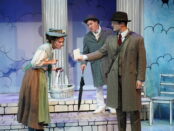
In their latest, Shaw’s ever-popular "Pygmalion," Staller has staged Shaw’s never-used prologue created for the 1938 film version which has the gods and goddesses on Mt. Olympus recount to the modern audience the myth of Pygmalion and Galatea which inspired Shaw’s Edwardian comedy. The set by Lindsay G. Fuori creates an Al Hirschfeld-inspired Greek temple used for all of the play’s five scenes. Four of the actors dressed in white Grecian robes (courtesy of designer Tracy Christensen) greet us and tell us the myth that we will see in Shaw’s updated 20th century comedy in which the sculptor becomes a professor of language and linguistics and the statue becomes a flower girl who wants to improve her speech well enough to get a job in a flower shop. However, Staller does not stop there but has created narrative introductions for each act which is rather intrusive though it may help some first-time viewers to understand the play. (Is there any theatergoer who has not seen the play’s musical version My Fair Lady on stage or screen?) [more]
Liberation
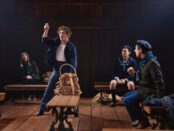
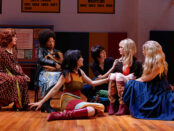
Kristolyn Lloyd, Adina Verson, Betsy Aidem and Audrey Corsa in a scene from the Roundabout Theatre [more]