Multimedia
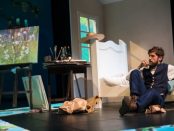
Do we want to be led to a utopia full of shiny objects or can we find abundance at home, in friendship and family? Symbolically, and at times explicitly, Concrete Temple Theatre explores this ever-timely question in "Packrat: The Quest por la Abundancia," an inventive parable written and directed by Renee Philippi with puppetry, projections, and sets designed by Carlo Adinolfi. By offering well-paced visual and auditory surprises, it keeps viewers' attention for over an hour, which is no small feat. [more]
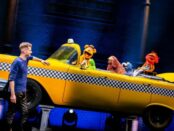
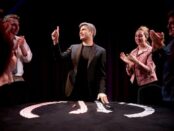
Rob Lake Magic With Special Guests The Muppets
If the Muppets are deployed as window dressing, the illusions themselves are a museum of inherited gestures. Lake presents the familiar canon of contemporary stage magic: the bifurcated assistant, the levitating woman afloat above a bed of water (which, in its defense, has the best stage accoutrements of the evening), the interlocking wedding rings that actually make it back to their owners, the transmogrified paper rose born of a Kleenex, the sealed-box prediction trick. These are the old reliables, charming chestnuts of the craft. And to be fair, if it is your first encounter with such wonders in the flesh, they retain an undeniable potency. Something impossible happens before your eyes, and for a moment one senses the naïve astonishment that once greeted Houdini or Blackstone. But the long shadow of 20th-century spectacle looms large. When David Copperfield made a woman vanish, he seemed to risk something existential—his illusions were staged with the gravitas of a metaphysical wager. Doug Henning, all fringe and mystical glow, imbued the form with a countercultural buoyancy. Lake’s versions, by comparison, feel perfunctory, the delivery mechanical rather than miraculous. To deploy the same tricks as one’s predecessors is no sin, but to do so without reimagining them—or without doing them better—is a kind of aesthetic resignation. [more]

Amaze
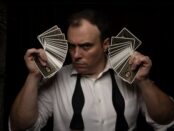
British illusionist Jamie Allan has brought his aptly named magic show "Amaze" to New World Stages and it is truly awesome. His act is so low key that one doesn’t at first realize how remarkable his tricks are taking many familiar and famous magic acts one step further – like the card trick with a deck of blank cards. He also uses his show to build the theory that children are more susceptible to magic and illusion and that we all need to return to our childhood memories and imaginations. [more]
Passengers
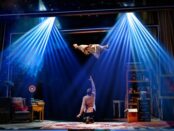
Montréal’s physical theater troupe The 7 Fingers has made their third visit to New York with Passengers and the wait has been worth it. Using circus events, music, dance and monologues, "Passengers" follows nine travelers who perform as their train travels across the country. Like Cirque du Soleil, the varied acts are all unified by a theme, but The 7 Fingers is more intimate in scale and eschews clowns, giving the nine acrobats, gymnasts and circus artistes more and more daring acts to do. As the journey continues, the performances become more breathtaking and demonstrate the versatility of the cast. [more]
Dead as a Dodo
While they credit the eight puppeteers textually, “with help from the ensemble,” Warnock and Waage are also credited as executive producers along with set and costume design. Mr. Waage is given solo credit for the sublime puppet design and construction. All in all, the parts make for a rather resplendent whole. Starting with the puppeteers dressed in sparkly black fabric that bring a deserved attention to the constant manipulation of the puppets and a set that constantly morphs between scenes. The initial “lights-up” has a large chunk of sparkly “glitter basalt” that dissolves into the individual puppeteers. The look is reminiscent of Adrian’s classic sequined pantsuits for Judy Garland in concert. Kudos to lighting designer Daphne Agosin for capturing every sparkle in those costumes as well as to the projection designer Erato Tzavara for creating surreal space within the confines of the Baruch’s venue. Thor Gunnar Thorvaldsson’s original music and sound design underscore the fantastical display on stage. [more]
The Beastiary
This stunning theatrical work is a creation of the two-member On The Rocks Theatre Co. (Christopher Ford and Dakota Rose), two ingenious artists who have been at work on "The Beastiary" since they were selected as Ars Nova’s fifth Company in Residence in 2019. Commissioned to create a new show from scratch, a first Ars Nova-produced reading came to fruition in 2021. Adding composer Dorit Chrysler to the team, later 2022 workshops added the theremin score and the puppets to the play. More behind the scenes development, a puppet build residency, and a two-week production workshop built the show that is now at Greenwich House. Ford and Rose have co-written and co-designed the scenic elements. Ford designed the glorious costumes and hand-made puppets and Rose directed the entire production. [more]
The Spirits’ Speakeasy
There is no program for the event nor a press script, which makes sense, since "The Spirits’ Speakeasy" is less theater and more experience. There are missed opportunities for the actors to move the attendees around so they experience more of what is going on in both rooms. My companion and I thoroughly enjoy catching up with each other, so much so that when Margery finally arrives in the lounge to give a few lackluster readings (based on the billets dropped into the box but presumably not seen by her, and half of the guests names she calls out do not answer anyway) we are unfazed. Finally, Houdini bursts into the room, challenges Margery’s authenticity by calling her a fraud, and insists she participate in a mysterious magic box trick, which was dramatic and fun. All told, although the activities of the evening are infrequent, we do not feel the evening is a disappointment at all. [more]
Bill’s 44th
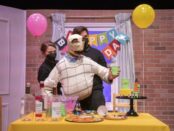
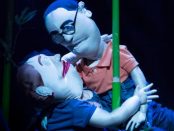
"Bill’s 44th" is a story of loneliness told within the context of a birthday celebration. It is a wordless puppet show for grown-ups created and presented by Dorothy James and Andy Manjuck. James and Manjuck combine to inhabit Bill, a middle-aged man with a belly paunch and a paper-maché bald head with bushy eyebrows, a mustache, and deep, empty eye sockets. His legs are those of Manjuck, and his arms are those of James and Manjuck. It is a remarkable display of puppetry. Their collaboration brings emotional heft to the puppet with actions that are choreographed to perfection. Jon Riddleberger plays a supporting role as a pizza delivery man and later as the puppeteer of a human-sized dancing carrot stick. [more]
Small Acts of Daring Invention
If the play's goal is to pay homage to Wright, it misses the mark for most audiences. If one is unfamiliar with Wright, most of the symbols revealed in the play will not be understood in terms of her life story. This fact is not necessarily a distraction from the action since the play provides a suitable level of mystery, imagination, and surprise, resulting in an entertaining but possibly unsettling experience, starting with the opening and carrying through to a satisfactory ending, all without spoken dialogue. [more]
Travels
"Travels" at Ars Nova isn’t just a story of the many places James Harrison Monaco has been. That’s part of it, the most superficial part. "Travels" is far more: a deep look at the people in his life, two in particular, whose fascinating and moving stories emerge from a torrent of music, videos, lights and words. In eight songs/scenes a very personal saga unravels until a chilling coda. On the tiny Ars Nova stage, a console contains the control center of the production. Constantly moving images give the illusion of flying into a vortex, soon replaced by more informative images that illustrate the stories told by Monaco and his very talented compatriots: El Beh, Ashley De La Rosa, Mehry Eslaminia and John Murchison. [more]
The Order of the Golden Scribe: Initiation Tea
"The Order of the Golden Scribe: Initiation Tea" is an immersive and interactive theater experience co-created by Shuai Chen and Arlo Howard, who also directed. It combines a story about a secret society of historian scribes with a series of creatively challenging cryptographic puzzles. It is all wrapped up in an elaborate initiation "tea" for new members of the Order. The initiation ceremony requires the initiates to prove themselves worthy of joining the Order by solving the puzzles. Each successful solution is rewarded with first tea, then finger sandwiches, followed by scones with jam and butter, and finally, a dessert. The puzzles are cleverly conceived and presented. The audience is divided into teams of four or five seated at café style tables. [more]
The Good Soldier Švejk and His Fortunes in the First World War
The Czechoslovak-American Marionette Theatre (CAMT) is presenting “an innovative re-interpretation of a classic, combining live performances with puppets” at the resourceful Theater for the New City in the East Village. "The Good Soldier Švejk and His Fortunes in the First World War" is a classic journey into a satirical, picaresque anti-war message first revealed in the novel by Jaroslav Hašek published in several volumes in the early twenties. It is one of the most translated books by a Czech writer. Hašek served in World War I and his experiences fueled his sardonically funny novel.
Švejk was adapted for stage productions soon after by such theater luminaries as Erwin Piscator and Bertolt Brecht. The new, loose-legged adaptation at TNC is by Vít Hořejš who also directed this production. [more]
Ernie’s Secret Life
The show is well presented but lacks a clear narrative, leaving viewers with more questions than answers. Is it about a man's journey to self-discovery or an exploration into a confusing haze of fantasy and hallucination brought on by a mental breakdown? The added storylines used to illustrate narrative points do not clarify the overall thematic structure of the production but add layers to the mystery of Ernie’s mental state. If you like theater, even with the limitations in exposition, it is worth the effort to experience a production outside of what people typically consider dramatic staging. [more]
Asi Wind’s Inner Circle
"Ari Wind’s Inner Circle" is so incredible that it defies the imagination. Can these be called sleights of hand when we see everything that happens at all times? It is the sort of show that you just have to see for yourself and experience firsthand to believe. Not even magicians have been able to explain many - or all - of the tricks. It would be unfair to describe the tricks more completely – though how they are handled will completely amaze and dazzle you. [more]
The Rise and Fall of Jean Claude Van Damme
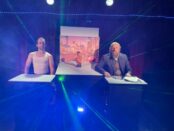
"The Rise and Fall, then Brief and Modest Rise Followed by a Relative Fall of…Jean Claude Van Damme as Gleaned by a Single Reading of His Wikipedia Page Months Earlier" is the brobdinagian title of a tongue-in-cheek, hour-long comic riff on the life of a faded movie star. The title is almost as long as the play. Timothy Haskell has written what is actually an extended elaborate skit brought to life by Joe Cordaro (perfect as a clueless Van Damme and other characters) and John Harlacher (hilarious as the all-knowing narrator) using puppets designed by co-director Aaron Haskell. The other director is Paul Smithyman who also designed the efficient conglomeration of a set which includes two podiums for the actors and a screen for the snippets of films and slides used to illustrate the story. In front of the screen is a slotted board into which the actors insert funny two-dimensional stick puppets. [more]
André & Dorine
This charming show comes from the acclaimed Spanish troupe, Kulunka Teatro. The ensemble of Jose Dault, Garbiñe Insausti and Edu Cárcamo all offer awesome physically commanding silent portrayals of a variety of types while encased in Ms. Insausti’s stupendously created caricaturist masks. Their handling of props is majestic. During the exhilarating curtain call, the cast appears without masks, and their magnetism is even more visible. André & Dorine’s engaging wry scenario was devised by Insausti, Mr. Dault, Iñaki Rikarte, Mr. Cárcamo and Rolando San Martín. [more]
Audience (The Czechoslovak-American Marionette Theatre)
Havel’s Audience represents CAMT’s first foray into modern Czech literature having previously staged imaginative productions of folk material. This visit to contemporary theater, unfortunately, wasn’t as successful as most of CAMT’s fairytale presentations. The combination of whimsical marionettes and psychologically sophisticated drama didn’t gel. The autobiographical Audience pits Havel’s alter-ego, Ferdinand Vanĕk (played by Vít Hořejš who also translated and directed the play), against The Brewmaster (Theresa Linnihan) in what initially seemed to be casual, directionless banter during a workday at a beer brewing company. Preceding the actual play were a series of historic newsreels—prepared by Suzanna Halsey—showing how Czechoslovakia (when it was still called Czechoslovakia) descended from the high hopes of 1968—euphemistically called the Prague Spring—to the depths of despair following the Soviet Union’s crushing invasion to put down what they perceived as a pro-West revolution. The newsreel images were far more frightening than Havel’s two hander which is clearly meant to reveal in everyday terms just how nefariously the communist, totalistic credo infiltrated daily life in Prague. [more]
Sloppy Bonnie: A Roadkill Musical for the Modern Chick
Written by Krista Knight and Brinegar, Sloppy Bonnie follows its title character (played with irresistible zest by Amanda Disney) as she lays waste to everything and everyone in her path, leaving car wrecks and bodies spread across the South. Two exuberant actors, Curtis Reed and James Rudolph II, portray all the other characters—male and female—beginning with zippy “cosmic” FM radio hosts, Chauncey and Dr. Rob, who deliver homey philosophy and songs. They introduce Bonnie, clad in a slightly slutty outfit—revealing blouse, ridiculously short skirt and white patent leather boots (by Alex Sargent Capps, Megan Haase and Gabrielle Saliba)—straight out of Li’l Abner which is an apt reference as the entire physical production is presented as a brightly colored cartoon with elaborate framings, abstract designs and hilarious manipulations of the actual performers’ appearances. [more]
The Jackson C. Frank Listening Party w/Special Guest
Aguirre manages to have written a play that doesn’t feel like a play thanks to his interpretation of the main character. He doesn’t overdo the emotions, letting the songs carry that weight for him. Sarah Norris’ direction—aided by Hallie Griffin’s skillful film and sound editing—is unobtrusive except for allowing the two women characters to veer towards stereotype, particularly when Aguirre’s Allen is so natural. [more]
X the Experience
The music by Manuel Pelayo, Giancarlo Bonfanti and Katz sets an eerie, futuristic tone that, combined with numerous dance and visual elements, presents X the Experience like a long MTV video with some thoughtful concepts acted out in between. X the Experience posits the interesting question as to whether human beings can ever truly give up their “personal provocative narrative” in favor of any greater good, and writer Veasey’s script successfully puts this notion forward, when the script is in progress. If you’ve got the time and especially the patience, check out X the Experience. [more]
PackRat
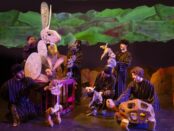
Writer and director Renee Philippi’s appealing scenario is simple, heartfelt and dramatic. It’s realized by Ms. Philippi’s supreme command of stagecraft that revels in theatricality. Designer Carlo Adinolfi’s awesome cutouts, handheld and shadow puppet creations individualize the animals with striking expressive details. Mr. Adinolfi’s stylized set pieces thoroughly convey the look of a rustic environment and his arresting projections visualize varying locales and the animals’ dreams. The production is enhanced by the perfection of Eric Nightengale’s atmospheric lighting and sound design. Composer Lewis Flinn’s energizing original music veers from jaunty to appropriately moody as it complements the piece’s actions and emotions. [more]
The Transfiguration of Benjamin Banneker
The show was conceived, directed and designed by Theodora Skipitares. Her treatment of these biographical details is that of a fanciful saga with the awestruck tone of a children’s book. There’s a neat bit involving Lt. Uhura from the original Star Trek in her red uniform on a miniature Enterprise starship, recounting meeting Dr. Martin Luther King. Skipitares’ thrilling staging is in concert with the witty elements of presentation. Many whimsical scenery pieces are suspended from the ceiling and are lowered and raised. [more]
BOOM
Employing an impressive array of voices and mannerisms, and only sometimes augmented with a wig or article of clothing, Miller as “Narrator” impersonates numerous performers, personalities, and politicians of the era, voicing every commercial and even dubs his own parents in short video clips at the very beginning of the piece. “100 voices. 25 years. 1 man,” the publicity statement declares, and Miller doesn’t disappoint. [more]
Virgo Star
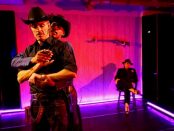
Following a comically exaggerated shootout, the two men make out. A cowgirl and a Mexican woman get together. At one point performers blindfold audience members for a brief bit. There’s a hula-hoop dance number. Monologues detailing homophobia, racism and gay bashing are enacted. It’s all cryptic, edgy and well-executed entertainment for devotees of non-traditional theater. [more]
Slava’s Snowshow
"Slava’s Snowshow" is a unique experience. It is clowning of a sophisticated sort with its wordless skits which takes it beyond language. Its set pieces are outrageous enough to transcend anything other clown shows are doing at present. At 110 minutes, it is just long enough to not overstay its welcome. The audience participation sequences will make you feel that you are part of the show and the clowns play off of audience reactions throughout. However, as the clowns are more somber than playful it may not be for people easily depressed or very young children who have not seen the magic of theater before. [more]
The Black History Museum…According to the United States of America
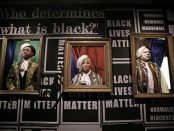
Revolutionary War patriots Thomas Jefferson, John Adams, Richard Henry Lee, John Hancock and Benjamin Franklin are eerily represented by male and female black performers wearing tweaked 18th century garb, half-white wigs and garish makeup. They’re on a raised platform sitting on period furniture and cynically thrashing out The Declaration of Independence with the aim of enforcing white male hegemony. This is the satirical wild opening of "The Black History Museum...According to the United States of America." It’s an immersive two-hour performance art piece performed all over the two floors of New York City’s HERE theater complex. [more]
Derren Brown: Secret on Broadway
The shaven-headed, athletic and charismatic Derren Brown is a well-known personality in the United Kingdom due to his award-winning theatrical and television presentations. With his resounding accented voice, engaging showmanship and mystical talents, he commands the stage while appearing in a sleek dark suit, a flowing mystical robe and evening clothes. Mr. Brown discloses that he struggled with his homosexuality before coming out at the age of 31. This revelation enhances his witty persona, along with other personal data imparted along the way. [more]
The Ringdove
What raised "The Ringdove" above mere creative story-time theater was the exquisite artwork and detailed performances. The perfect, colorful costumes (by Casey Compton) that evoked everything from Greek myths to desert Bedouins were topped by Lee’s brilliant mask heads. Lee also supplied the scenery which included ephemerally leaved trees and a turtle pond that was a witty work of high art, a microcosmic version of a tiny ecosystem. Lee and his colleagues created an oasis pleasant to the eyes and ears, all the while teaching a moral about the interconnectedness of all living things. [more]
Da Vinci & Michelangelo: The Titans Experience
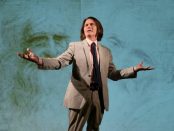
Described as a multimedia production, "Da Vinci & Michelangelo: The Titans Experience" is actually a lecture by art historian Mark Rodgers to slides of the masterpieces of these two geniuses. Both enlightening and dense, the performance by this animated and exuberant lecturer tells you a bit more than you can take in in one sitting. It is a little like two art classes back to back. However, one comes out of the show with an even higher respect for these two Renaissance men who were far ahead of their time and are still at the top of their professions after 500 years. [more]
Luzia: A Waking Dream of Mexico (Cirque du Soleil)
"Luzia: A Waking Dream of Mexico" is Cirque du Soleil’s 38th original production and its 18th performed under The Big Top. The name is a combination of the Spanish word for light (luz) and the word rain (illuvia). Written and directed by Daniele Finzi Pasca (co-authored by Julie Hamelin Finzi) with Patricia Ruel as Director of Creation, the colorful show is a surrealistic journey through the various landscapes and arts of the country. Using the frame of a traveler parachuting into a land of memories, the show moves from a movie set to the ocean to a smoky dance hall to the desert. It touches on the music, design, sports, entertainments, animals and mythology of Mexico. [more]
Feral
All of this is brought to life via digital camera, which captures the movement of the figures on a quickly assembled “set” that is, in effect, a whole miniature seaside town, with businesses and homes through which the various human, animal and automotive figures navigate. At one very “meta” point, we even see a Punch and Judy show at a town festival: puppets putting on a puppet show! [more]
Hans Christian Andersen: Tales Real & Imagined
Eve Wolf’s new play for the Ensemble for the Romantic Century, titled "Hans Christian Andersen: Tales Real & Imagined," suggests that the real-life Andersen might actually have appreciated whitewashed depictions of his life, maybe even the Kaye movie. The Andersen that Wolf gives us is an unattractive and unhappy misfit. We hear, though, more than once, his mantra of self-assuring optimism—which, it seems, fooled no one, including the storyteller himself: [more]
SKIN
Broken Box Mime Theater’s SKIN is a collection of short plays loosely centered around its one-word title. The pieces run the gamut in terms of subject matter, approach and tone. Or course, many theatergoers may have an implicit bias against the very idea of mime. This is understandable if unfair. Mime has long been viewed by many, in the U.S. anyway, as little more than pretentious preening and outsized gesturing by grimacing folks in clown makeup. More often than not, it’s seen as a joke. But this show has a fun, cool, buoyant vibe that reminds audiences that the genre needn’t be just a punchline, but something that can actually pack a punch. [more]
The Female Role Model Project
Kim Kardashian West, Melania Trump and Chinese popstar Bingbing Fan appear as wacky contestants on a philosophical gameshow hosted by Oprah Winfrey in the lighthearted, thoughtful and souped-up multimedia performance piece "The Female Role Model Project." It’s a breezy 90-minute exploration of existence from a woman’s perspective with audience participation. [more]
beep boop
"beep boop," Richard Saudek’s hour-long sad-sack romp through modern man’s constant love/hate bout with technology, is at HERE, the avant-garde arts center in SoHo. Its deft combination of mime, music, audio-visual effects and—yes—modern technology is worth a visit to this very active performance space, if for nothing else than to see Saudek disappear into his laptop. [more]
Vitaly: An Evening of Wonders
The audience is frequently called upon to participate onstage and from their seats with one elaborate portion involving their driver’s licenses. London vacation photos of Mr. Beckman, a guard at Buckingham Palace, and Queen Elizabeth II becomes a hilarious and mystifying routine. Plastic bottles are fodder for visual conjuring. While blindfolded Beckman guesses things that audience members have selected. A Van Gogh-inspired painting exercise is performed to the booming sound of Beethoven. Less successful is a large-scale, convoluted and confusing card trick. [more]
Manufacturing Mischief
Noam Chomsky, Karl Marx, Ayn Rand, Elon Musk, Steve Jobs and a “Tiny” Trump all on stage at the same time, verbally jousting with each other? Pedro Reyes’ "Manufacturing Mischief" at the Tank does, indeed, throw these historic figures together in a play that is intellectually stimulating and quite witty as these giants tear each other apart. [more]
Tchaikovsky: None but the Lonely Heart
The letters alternate with the musical portions played by Ji on piano, Ari Evan on cello and Stephanie Zyzak on violin in various combinations which are beautiful but it is never clear in what way the selections relate to Madame von Meck except for the Piano Trio in A minor, op. 50, which Tchaikovsky reveals at the beginning of the second act that he is writing for her. It is not stated whether the two excerpts from The Nutcracker, for violin and piano, and for solo piano were created for her. [more]
There’s Blood at the Wedding
Packed into Theodora Skipitares’ "There’s Blood at the Wedding" are multiple takes on how authorities have abused their powers, too often killing innocent people. By theatricalizing and stylizing their stories, Skipitares zooms past the political and digs deeply into the emotional debris left over after a series of brilliantly staged traumatic scenes. [more]
Symphonie Fantastique
Twist’s “Creator’s Note” in the program alludes to Wassily Kandinsky’s musical metaphorical paintings and Twist’s youthful attraction to the possibility of using abstract puppetry in combination with music. The five-part Symphonie, subtitled “Episode in the life of an Artist,” called to him for its color and storyline which vaguely guide his creation although only the changing moods, rhythms and colors of the score seem be the inspiration for the series of moving abstract images that were mostly treats for the eyes, if not the mind—seductive, clever, dreamy, sensually involving, but more a vacation for conscious thought than an intellectual challenge. [more]
The Undertaking
Dull, smug and interminable," The Undertaking" is a multimedia play written by Steve Cosson that explores the meaning of death. Jean Cocteau, Marcel Duchamp and Greek mythology are trotted out during this 80-minute hodgepodge. Mr. Cosson is also the director and his physical staging ranges from sedate to overdrive, with the actors incited to be manic. The ending, however, does have an affirmative simplicity. [more]
Mary Shelley’s Frankenstein
Fairchild speaks well and communicates much with his physique, but his choreography is repetitive and uninventive. Here was a chance to breathe new life into a too familiar character. All Fairchild could come up with is lurching movements and awkward falls to the floor. He takes the obvious path to create his character with movement when he had a chance to illuminate the Monster’s inner emotions. [more]
It’s a Wonderful Life: The 1946 Live Radio Play
As adapted for the stage by Anthony E. Palermo, it’s roughly half the length of the film. But it still tells the same story about George Bailey, who on Christmas Eve in 1946 intends to take his life, only to be saved by an angel named Clarence. While saying there’s “a Tom Sawyer quality to you, George,” Clarence still turns George around by showing him what “a different world” it is without him, as if he had never been born. And it seems to be amazingly complete--even while the focus of the presentation is on the live radio version, including a banner that says, W.I.R.T. (duh, for Irish Repertory Theatre) and several different “words from our sponsors,” such as “Lucky Strike” (“clears your lungs”) and “Carter’s Liver Pills.” [more]
Jason Bishop: Believe in Magic
He grew up in rural Pennsylvania, was raised by foster families, and learned about magic by reading books at the public library. These biographical details add depth to his shaded yet sunny persona and inform his terrific rapport with children. At the start of the show’s second act, there’s a commotion in the mezzanine with the sound of excited kids because he’s upstairs chatting with audience members before beginning his latest demonstration. [more]
Big Apple Circus 2017
The Wallenda family’s act is the climax of a show that is held together by Ringmaster Ty McFarlan and the ongoing antics of Grandma the Clown and Joel Jeske aka Mr. Joel. The big-voiced and charismatic Ringmaster Ty prowls about introducing acts, touting tidbits about Big Apple Circus and generating excitement while Grandma and Mr. Joel involve audience members in good-natured slapstick shtick involving water, balloons and costumes. [more]
Marcel + The Art of Laughter
Like the great comedy teams, Jos Houben and Marcello Magni are a study in contrasts. The Belgian Mr. Houben is tall, animated and relies on breezy patter. The Italian Mr. Magni is short, often dour and mostly silent. They have collaborated with Peter Brook at his Théâtre des Bouffes du Nord in Paris, and have performed together around the world. [more]
Burning Doors
Nicolai Khalezin wrote Burning Doors with dramaturgy by him and Natalia Kaliada. Their aim is to bring attention to currently jailed artists Petr Pavlensky and Oleg Sentsov by weaving in their testimonies. Actors also proclaim from the works of Fyodor Dostoyevsky and Michel Foucault. Fleeting and sometimes sly allusions to Putin are laced in. [more]
The Flatiron Hex
Dazzling hand puppets, stick puppets, marionettes and shadow puppets that are projected onto screens, which were all created by Godwin, depict this gallery of archetypal characters. These are all fantastically employed by him and are on display for the show’s 80 minutes. [more]
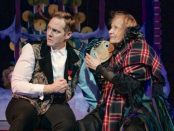
Friends Call Me Albert
Billed as a “bio-epic,” playwright Zachary Desmond emphasizes the epic in his uneven though compelling approach. Mr. Desmond affectionately imparts biographical details of Einstein’s life from youth to old age. Particularly captivating are the sequences depicting his courtship and marriage to his first wife, mathematician Mileva Marić. [more]
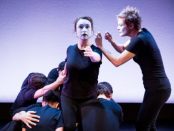
Van Gogh’s Ear
Projected titles indicate place and year—beginning with Arles, 1888 and progressing until van Gogh’s suicide—which we hear as an offstage gunshot—in July of 1890. The audience is treated to Vincent’s thoughts on his painting technique, his poverty, his mental health, his fellow artists, stars, sunflowers, all interrupted by chamber music by Debussy, Fauré, Chausson and Franck played—in various combinations—by Henry Wang (violin), Yuval Herz (violin), Chich-Fan Yiu (viola), Timotheos Petrin (cello), Max Barros (piano) and Renana Gutman (piano). [more]

Lucky (Atlas Circus Company)
Watching Evans being bossed around by the tall beanpole Russel Norris, whether in an office job, cleaning a park or waiting on tables, was to watch classic comedy performed with brilliant, but invisible timing. (Credit choreographer Tyler Holobaski for his seamless contributions.) [more]
Ovo (Cirque du Soleil)
The Wall is also used by the performers who climb on it, disappear into it, and use it as both a platform and a launching pad. The most remarkable act is the finale – the “Trampo Wall” performed by the ten Crickets in green. A colony of Crickets run, jump, and travel straight up the four story vertical wall without artificial support. They also use air track and trampolines to take flight from the back of the stage to the very apron. One watches with bated breath in absolute disbelief. [more]
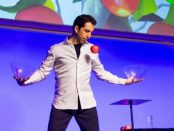
The Reception
Soon little rends in the fabric of normalcy became apparent. Bits of dialogue are repeated senselessly and the five revelers keep returning to the same positions (three on a couch, one alone at the border of the space and one behind the bar). Attempts at dancing get more and more inelegant, even leading to a bit of physical sparring. Even worse, there is an intermittent ominous, crackling sound emanating from deep in the floor, as if the house were about to collapse. [more]
Derren Brown: Secret
It quickly becomes apparent that Brown is a master at reading body language--no less than facial and vocal expressions--to manipulate the many audience-members who participate and to read their inner thoughts. Brown’s patter is also built on an almost glib sort of false modesty, such as his saying, near the end, “This only works because we are story-focusing creatures.” Any given interaction doesn’t “work” because we’re focusing on the “story,” but because he knows just exactly how to get us all to see only what he wants us to. [more]
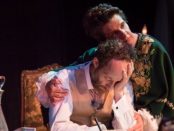
Beneath the Gavel
Bated Breath Theatre Company specializes in original works inspired by and in partnership with museum collections and exhibitions. However, this show about the fate of the “Haddie Weisenberg Collection” painted by artist Daniel Zeigler appears to be entirely fictional. Written and directed by Mara Lieberman, executive artistic director of the company since 2012, the play uses six actors in 43 different roles from artists both famous and imaginary, to auction house sales personnel and staff, to collectors to dancers, as well as having actors impersonate free standing sculptures. Ironically, 59E59 Theaters was at one time part of Christie’s Auction House and Theatre B was actually one of the firm’s galleries. [more]
See Reverse
Presented by the acclaimed Broken Box Mime Theater, "See Reverse" consists of ten short pieces with some even shorter vignettes sometimes in between. Lasting close to two hours with an intermission, it’s a lot of mime. [more]
Hi-Fi | Wi-Fi | Sci-Fi: Predictions Past Present and Future
The only real high-tech exchanges take place only three times during the run of the show. At the performances of February 6, 9 and 17, one of the roles in "Camera Obscura" will be performed telematically from Seoul Institute for the Arts in Korea and directed by Il Kyu Park. "Hi-Fi | Wi-Fi | Sci-Fi" which uses a great many sound specialists for little effect is an interesting idea but doesn’t go far enough either dramatically or in terms of modern technology to have much impact. As a cautionary tale, time has caught up with these plays and passed them by. [more]
Made in China
The ensuing journey is a bizarre and sometimes hilarious exploration of China and the culture within, even if it doesn’t always make the most sense. "Made in China" makes the most of the liberties that puppetry allows, and features some very impressive techniques and performances from the actors behind the scenes. Though the two main characters are both interesting, they are both made all the more entertaining by their canine companions. The two dogs, Lily and Yo-Yo (Dorothy James and Andy Manjuck among others) are completely lovable, and every single scene they are a part of is instantly heartwarming. [more]
Phantasmagoria; or, Let Us Seek Death!
Benjamin Stuber’s puppetry designs are a disappointment and should be more thoughtful and complementary to the play. Ghoulish puppets that are meant to disturb seem make-shift and thrown together. There is only one disturbing and appropriately quirky puppet effect – the appearance of a huge eye, set into a collage background of assorted textiles. [more]
Paris (Company XIV)
Company XIV has applied its inimitable Baroque-Burlesque style to the Greek myth of the Judgement of Paris for the second time and come up with Paris, an exotic and erotic adults-only entertainment that is like nothing else you will see this year. Conceived, directed and choreographed from the fevered imagination of Austin McCormick, Paris combines the arts of dance, opera, circus, theater, storytelling and high fashion to tell its story of the competition between the goddesses Athena, Juno and Venus for the Golden Apple. As you may know, the future outcome was eventually The Trojan War. [more]