Articles by Victor Gluck, Editor-in-Chief
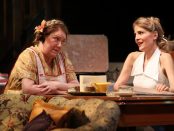
Ostensibly about domestic abuse, the evidence is all offstage and we must surmise this from the defeated condition of the heroine Irene played by Ms. Daly. Her husband Gerry (John Procaccino) is involved in some shocking, nefarious business revealed to the characters on stage but never revealed to the audience, nor is the confidential project her brother Teddy (Mr. Daly) claims to be working on which will make his fortune. As such, the thrills are all a matter of guesswork, rather than actual events. [more]
Wild Goose Dreams
In offering a window on a world most New York theatergoers know little about, Hansol Jung’s Wild Goose Dreams is a fascinating look at Korean culture. On the other hand, what appears to be a Korean obsession with the Internet and smartphones often becomes tedious as it goes on so long without bringing us much that is new. Leigh Siverman’s busy production creates a world of its own but is often overwhelming rather than enveloping. The Public Theater staging, a co-production with La Jolla Playhouse, may be of more interest to Millennials addicted to their electronic devices than the rest of the theatergoing public. However, this may be the trend of the future and older theatergoers may just have to get used to it. [more]
Eve’s Song
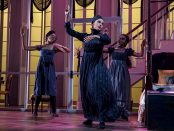
Both a theatrical surprise and a very accomplished dramatic work, Patricia Ione Lloyd’s "Eve’s Song" is one of the best theatrical experiences to be had in New York at this time. With a cast led by De’Adre Aziza who is well known to Public Theater audiences, director Jo Bonney, totally attuned to the author’s unique style, delivers an exquisite and provocative evening in the theater. It is always a pleasure to herald the arrival of a new and talented writer, particularly one as masterly and sophisticated as newcomer Lloyd. [more]
Days of Rage
As proven elsewhere, Steven Levenson is expert at depicting young people in crisis on stage. "Days of Rage" is very real in its handling of a group of people of similar beliefs living together who have forces that are driving them apart, and as such it is engrossing and intriguing. However, the play’s theme seems to be rather opaque or at least vague in its depiction of college-age radicals at the height of the Vietnam War. While some of the characters are thinly drawn, most problematic is that the catalyst to all the action is a character that we want least to hear from. [more]
Natural Shocks
Played by Pascale Armand, known for her Tony nominated Best Performance by an Actress in a Featured Role in "Eclipsed," Angela is the heroine of Lauren Gunderson’s new one-woman play, "Natural Shocks," being given its world premiere by the Women’s Project at the WP Theater. The play has previously been given over 100 staged readings in 45 states over a period of two months. As much as one wants to admire this tour de force for an accomplished actress, in its current form the play has several problems. [more]
Daniel’s Husband
What begins as light comedy in Michael McKeever’s well-made play "Daniel’s Husband" becomes deadly serious in this cautionary tale. If the plot seems familiar, this is a return engagement of a successful play that appeared at the Cherry Lane Theatre in April 2017. The same engaging and proficient cast returns and while designer Brian Prather remains the same, the costume and lighting designers are now different. The play has been tweaked a bit but you will probably not notice if you have seen it before. It still packs an emotional wallop in the way events turn out. [more]
India Pale Ale
Playwright Jaclyn Backhaus made an auspicious splash with her adventurous and inventive 2016 play Men on Boats about Major John Wesley Powell’s 1868 Colorado and Grand Canyon expedition which was played by all women as a satire of the machismo of this all-male trip. In her new play, India Pale Ale, Backhaus, who is part Punjabi, writes of something must closer to home: the Punjabi community in Raymond, Wisconsin. While the play’s authenticity is palpable in both its writing and acting, the play in its four acts seems to be pulling in four different directions. It is not so much that the play does not have much of a plot, but that is inconsistent in its theme and message. [more]
The Book of Merman
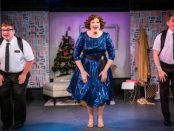
The witty score with music and lyrics by Schwartz is a collection of both pastiche songs based on numbers Merman made famous and new ones that fit her style that suggest other famous songs. Directed and choreographed by Joe Langworth in a brisk and breezy fashion, "The Book of Merman" is a diverting, entertaining show that will be best enjoyed by musical comedy aficionados who know their Merman from their Mary Martin as there are a great many in-jokes. [more]
Mother of the Maid
Jane Anderson’s "Mother of the Maid" would probably not be very compelling without Glenn Close’s Isabelle Arc as the play itself is following the dots in filling in the little that is known with mostly common historic and unsurprising details. (One exception is after Isabelle has seen the unicorn tapestries at the palace, she naively asks if there were any of the animals to be seen.) However, with Close who gives a constrained and moving performance the play becomes something else: a persuasive portrait of a mother and wife who has an awakening to the ways of the world based on what happens to her daughter. [more]
Renascence
In her own time, poet Edna St. Vincent Millay (1892 – 1950) was a rock star and a best-selling author until illness and postwar culture dimmed her luster. Still she fascinates with her bohemian lifestyle, beauty, love affairs with both men and women, feminist views, and effortless sounding poetry. In recent years, her life has again obsessed biographers and playwrights in such works as "Savage Beauty: The Life of Edna St. Vincent Millay" (2001), "Becoming Vincent" (2013) and "What Lips My Lips Have Kissed: The Loves and Love Poems of Edna St. Vincent Millay" (2014). Add to this list the adventurous Transport Group’s world premiere musical "Renascence," with book by Dick Scanlan and lyrics from Millay’s own poems set to music by Carmel Dean. Unfortunately, the new show is often arch and pretentious and the musical settings are entirely in the wrong style for Millay’s lyrics from the 1920’s. [more]
Fireflies
Although Donja R. Love describes his new play "Fireflies," his second world premiere in New York in 2018, as a “surrealistic voyage through Queer love during pivotal moments in Black History,” this riveting play is about a great deal more than that: racism, faith, homophobia, domestic abuse, women’s roles, alcohol addiction, infidelity, women’s right to choose, and sexuality. As sharply directed by Saheem Ali, the problem is that until the very end it is difficult to know where the play is going and what its real message is. [more]
Ordinary Days
Adam Gwon’s song cycle, "Ordinary Days," became a cult hit when it opened the Roundabout’s Black Box Theatre in 2009 for a run of ten weeks. So successful was the show that it is one of the few Off Broadway musicals of its era to have an original cast album. As so few people were able to see the show, there has been a need for a major revival which Keen Company is now presenting at The Clurman Theatre at Theatre Row. While creating a show about commonplace moments offers its own problems, director Jonathan Silverstein’s choices have created new ones. [more]
Emma and Max
Solondz’s mordant wit makes this the darkness of tragicomedies. Brooke and Jay’s delusions so typical of white entitlement are entire their own. When we finally hear from Brittany, she turns out to be a keen observer of entitled white behavior and middle-class liberal hypocrisy. Though we never meet Emma and Max except on Brooke’s baby cam, their off-stage presence is felt throughout the play. As Solondz’s movies contain brilliantly written dialogue, he is a natural for the theater. While his movies are made up of mostly two character scenes, this technique transfers beautifully to the stage. The only flaw here is that the monologues which become rants go on a bit too long, long after we get the gist and the characters given their many prejudices away. A bit of skillful trim – or the invention of more ideas would make this an even more powerful play. [more]
Popcorn Falls
However, the play’s humor is very mild. The jokes are on the level of “My steeple is drooping! I swear this never happened to me before,” from Pastor Peters, and “George Washington dined on that very land,” “Well, it was a picnic lunch.” Among the gags are that the cord for the mike in the Town Hall has been eaten through as they “can’t afford squirrel traps.” The play is farce but it is not played fast enough to keep all its bubbles in the air. Tim Mackabee’s set is very redolent of small town halls, but does not suggest the other locales. Jeff Croiter’s lighting attempts to add to the atmosphere as the play moves all over town. Heller and Souhrada remain in Joseph La Corte’s single costumes all evening, ones that are suitable for a major and a janitor. [more]
Girl From the North Country
Set in a dark time, "Girl From the North Country" creates a community on stage as do the best plays and musicals. Its tale of lost souls attempting to keep their heads above water is universal in both its message and its approach. Conor McPherson has never written so accessible a play before for Americans, and Bob Dylan’s songs have never sounded so poignant. "Girl From the North Country" is both unforgettable and not to be missed. [more]
The Winning Side
In dramatizing the story of Wernher von Braun, James Wallert’s "The Winning Side" makes compelling the concept of ethics in science: should we admire a mathematical genius who has had antithetical political ideas or are his scientific achievements too valuable to hold his former political beliefs against him? Though the program notes indicate that the play “is a work of dramatic fiction and liberties have been taken,” The Winning Side does show us a genius at work who was also an opportunist and changed his stories depending on what suited the occasion. As such it has become relevant all over again in an era when truth counts for so little and men of morality are all the more valuable. [more]
Final Follies
It would be a pleasure to report that A.R. Gurney’s last play entitled “Final Follies” performed with two early works, is one of his best, but that is not the case. As directed by David Saint on a triple bill celebrating the work of this major satirist who died in 2017, this comedy is minor Gurney. In fact, part of the problem with this evening produced by Primary Stages is that Saint has used three separate acting styles, one for each of the plays, all of which are wrong for the material. Surprising considering that Saint’s 2002 direction of Gurney’s full length, "The Fourth Wall," was quite delicious. However, his touch seems to have deserted him here. [more]
Bernhardt/Hamlet
"Bernhardt/Hamlet" is structured as a backstage comedy. Sarah rehearses with French stage star Constant Coquelin playing both The Ghost and Polonius, worries that she is losing 29-year-old lover, playwright Rostand to his wife – or to his new play "Cyrano de Bergerac," and frets over her son Maurice, at 29 years old still a college student who in need of money. Added to her troubles her illustrator Alphonse Mucha whose posters of her productions have added to her fame and glory is unable to make a sketch of her as Hamlet which suits them both. Worse still all the men in her life – including the Parisian critical establishment – plus the women of Paris are saying that it is not appropriate for her to play Hamlet in breeches as it is a man’s domain. Although the new play is not entirely about women in a man’s world, Rebeck does give this theme major importance. Ultimately, Sarah receives a visit from Rostand’s clever wife Rosamund which leads to the play’s denouement. [more]
A Lovely Sunday for Creve Coeur
What gives "A Lovely Sunday for Creve Coeur" its special cachet in the Williams canon is that its storyline and heroine called Dorothea very much suggest a prequel to A Streetcar Named Desire set ten years earlier, when Blanche was still teaching and coping with life, though already needing liquor and pills to get her over her anxieties. Some enterprising theater group ought to schedule these two plays in repertory with the same actress in the leading role in each. [more]
Uncle Romeo Vanya Juliet
Previous experiments from this adventurous theater group helmed by artistic director Eric Tucker include two versions of Twelfth Night performed in repertory, Hamlet and Saint Joan performed with casts of only four actors, and an updated Pygmalion which was double cast in its smaller roles. In "Uncle Romeo Vanya Juliet," Tucker has tried something new: a mashup of both Anton Chekhov’s "Uncle Vanya" and Williams Shakespeare’s "Romeo and Juliet," with scenes from the two alternating. The result is not confusing, but irritating and irrelevant, with neither play gaining from the combination. The advertisement for this show reads “5 actors, 2 plays, 1 performance,” but to what point? [more]
Because I Could Not Stop: An Encounter with Emily Dickinson
Stranger still is the choice of Angelica Page to play Dickinson who looks rather too healthy to be the famously thin and sallow-faced writer known from the one famous photograph. She makes Dickinson sarcastic, arrogant, cynical, self-important and haughty which goes against the voice of the woman in the poems. At times she has been given arty stage directions like posing by a mantelpiece or sleeping on the ground next to what we assume is alongside of her father’s grave. [more]
The True
If these characters sound familiar, they are based on real people who populated Albany politics four decades ago. "The True," a world premiere play by Sharr White ("The Other Place," "The Snow Goose") gives four-time Emmy and two-time Golden Globe Award winner Edie Falco another bigger-than-life role and she is magnificent. The cast also includes television stars Michael McKean (Mayor Corning) and Peter Scolari (Peter Noonan) as well as Glenn Fitzgerald (Howard C. Nolan) and John Pankow (Charlie Ryan) who under the direction of The New Group’s artistic director Scott Elliott create a true ensemble, making us feel that these people have lived their roles. [more]
Spin Off
Considering the repetitiveness of the material and the fancifulness of the play, Megan McQueen as Rosie Ramirez and Kevin Rico Angulo as Det. Jimmy Marks make a great deal more of their characters than is in the writing, while the rest of the actors in underwritten roles do quite a bit less. Both attractive performers, they make us care about their characters though not much is happening. It is to be hoped that they find more substantial roles soon that will showcase their talents. [more]
Collective Rage: A Play in 5 Betties
The actual subtitle of Silverman’s play gives one pause: “In Essence, A Queer and Occasionally Hazardous Exploration; Do You Remember When You Were in Middle School and You Read About Shackleton and How He Explored the Antarctic?; Imagine the Antarctic as Pussy and It’s Sort of Like That.” While this might suggest that the play is overwritten and self-indulgent, it belies the concise, tight writing and structure of Silverman’s comic/angry play which is always surprising, always inventive, always inducing laughter. The play does use Brechtian supertitles to announce the scenes but these are comic and informative, rather than didactic or preachy. [more]
You and I
While Barry was to become famous writing plays about the very rich, the Whites are of the middle class and live on earned money. In the play’s second act, eight months have passed, and money, not so surprisingly, has become tight for both Maitland and Ricky. However, this would be fine if the artificial style of the play and the dated twenties slang did not seem arch and affected. And while director Michael Hardart’s production is always stylish and graceful, he has not helped greatly with his casting or his mannered and theatrical approach to the material. The characters talk in an elevated, literate language but they are basically very simple people, not the kind who sit around tossing off bon mots. Here they speak Barry’s realistic lines as though they do. [more]
Heartbreak House
Gingold Theatrical Group’s "Heartbreak House" is an interesting but misguided attempt to update Shaw’s Edwardian masterpiece and make it seem more relevant to our times. Despite the stellar cast, the unfocused production by the usually reliable David Staller undermines much of the play’s humor and message. While the adept cast is stylish, they never gel into a true ensemble. This new version adapted from Shaw’s earlier 1914 script rather than the more famous 1919 published text will be of interest to Shaw devotees who will have never seen this rendering before. [more]
Hershey Felder as Irving Berlin
Using a format that has worked for him before in his George Gershwin and Leonard Bernstein evenings, Hershey Felder has returned to 59E59 Theaters in a charming biographical musical as legendary songwriter Irving Berlin. As Felder narrates his story becoming Berlin, he also sings and plays over 30 of his most famous songs, as well as some not so familiar today, including “Blue Skies,” “White Christmas” and the iconic, “God Bless America’. [more]
Smokey’s Joe’s Café: The Songs of Leiber & Stoller
Although "Smokey Joe’s Café" has been seen in New York before, the new production now at Stage 42 is an entirely different incarnation of the show that still holds the record for Broadway musical revues having racked up 2,036 performances. The new version which again uses nine talented and dynamic singers and dancers, five men and four women, has deleted five songs and added five, rearranged the song list for a new total of 40, and eliminated the intermission. It is now a more streamlined version of the 1995 show. [more]
1969: The Second Man
The mellow sound of Brandt’s score proves to be easy listening, but the individual musical numbers do not build to any dramatic climaxes so that the show seems tamer than material concerning depression and alcoholism suggests it should be. However, the ballad forms and guitar/violin instrumentation are pleasant to the ear. Some of Giles’ dialogue which is not part of Aldrin’s story seems extraneous and the show takes a while to get started. "1969: The Second Man" is entertaining enough in this concert form, but needs some work before going to the next level. Jacob Brandt, however, proves to be a talented new musical voice. [more]
Days to Come
"Days to Come" fills in the gap in Hellman’s career between her first play, the controversial "The Children’s Hour," and the immediate successors, the hugely commercial hit and often revived, "The Little Foxes" and the New York Drama Critics Circle Award-winning "Watch on the Rhine." Completists will want to see this play which has not been seen in New York for over 40 years. The Mint Theater Company’s revival of "Days to Come" is an example of a worthy, lost play whose problems haven’t yet been solved – if they ever will. See it now as there probably will not be another chance anytime soon. The Mint is to be applauded for taking a chance on this rarely seen, but estimable failure. You will not be bored but you may not be convinced. [more]
Be More Chill
"Be More Chill" is an impressive musical version of Ned Vizzini’s cult novel. Not only does it reproduce the plot on stage, it also gives it a high tech look that dramatizes the story where the novel left it to the imagination. Joe Iconis, long thought to be one of the most promising new theater composers, makes good on that promise, and Joe Tracz demonstrates for a second time that he can put difficult material on the stage. While Ryan Rumery’s overly loud sound design will turn off older theatergoers who are not more chill, those in the swing of things will have a memorable evening in the musical theater. [more]
Neurosis
The clever invention is that each of them has a best friend who only they can see and hear: Neurosis (Brennan Caldwell) is Frank’s best buddy, a more cautious, nervous version of Frank, and Neurosalina (Morgan Weed) is Abby’s neurosis, a mean girl who Abby can’t get out of her head. Both of them need help but are not getting it from their neuroses who are always giving them bad advice and are stopping them from moving on. The show is bookended by musical advice from Samantha (Lacretta), a therapist, who takes on the task of freeing Frank from his problems: his overbearing Jewish mother Geri (Susan J. Jacks), his “underbearing” father Kenny (Joel Blum), his low self-esteem, and his lack of poise around women. [more]
Gettin’ the Band Back Together
If the show plays like it was written by a committee, in fact, it has been. The book is by producer/ writer Ken Davenport and The Grundleshotz who turn out to be a group of performers and writers who originally workshopped the show in a series of improvised rehearsals. For the record, they are Sebastian Arcelus, Fred Berman, Michael Hirstreet, Jenna Coker Jones, Craig Jorczak, Nathan Kaufman, Emily McNamara, Jennifer Miller, Bhavesh Patel, Sarah Saltzberg (who is credited with additional material), Michael Tester, as well as Jay Kaitz who plays the second male lead in the show, Bart Vickers as though he were auditioning for Dewey, the laid-back music teacher in "School of Rock." [more]
The New One
Comedian/monologist Mike Birbiglia, best known for "Sleepwalk with Me," has the remarkable knack of finding humor in autobiographical crises that shouldn’t be funny but in his hands are uproarious. His latest show, "The New One," is just as hilarious as the previous ones. When Mike and his wife, the poet Jennifer Hope Stein, got married he pointedly told her that he did not ever want to have children, and she agreed. Ten years later Jen has changed her mind and tells him, “A baby wouldn’t have to change the way we live our lives,” probably the understatement of the century. [more]
Twelfth Night 2018 (Free Shakespeare in the Park & Public Works)
Shaina Taub’s joyful and sunny updated musical version of Shakespeare’s comedy, "Twelfth Night," is back in a full production courtesy of Free Shakespeare in the Park and Public Works which premiered an earlier production for four performances during Labor Day Weekend 2016. This slightly trimmed and tightened version is even more entertaining and the witty contemporary lyrics make this fun for young and old, as well as Shakespeare veterans and novices. [more]
Head Over Heels
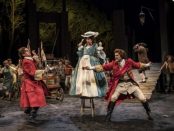
Under Michael Mayer’s fast-paced direction, "Head Over Heels" starts badly and busily but eventually slows down to a delightful Elizabethan parody on love and gender. While not all of The Go-Go’s songs are suitable for the storyline and the period, enough of them fit perfectly to make this a superior light entertainment. The cast is first rate and may make stars of the ingenious Andrew Durand and the classy and stylish Peppermint. Aside from introducing The Go-Go’s song catalog to Broadway, "Head Over Heels" covers a great many firsts of all kinds. [more]
Summer Shorts 2018 – Festival of New American Plays: Series A
Along with its twists and turns, Bohjalian’s "Grounded" is so fully explored that it is hard to believe that it is a first play. On the long wait on the runway at Kennedy Airport for a flight bound for London, stewardess Karen discovers that her co-worker, 24-year-old Emily who has been in this line of work for two years, has a fear of flying and has never flown over the ocean. When Emily begins her story she reveals that her life coach thought she was too grounded and dared her to become a stewardess. [more]
The House That Will Not Stand
Gardley makes use of a little known piece of American history: while Louisiana was under Spanish and later French rule, it had a three-tiered racial system. Aside from white settlers and black slaves, there was a third class: free women of color (mostly Creoles) could enter into a relationship with white men as common-law wives. Their children could inherit part of their estates. Some of these so-called “colored” women became extremely rich. This system was called plaçage and such women were known as placeés. The lighter the woman’s skin color the higher her social caste. However, when Louisiana was sold to the new United States in 1803, this system was frowned upon and eventually went out of style around 1813 due to legal challenges. [more]
Summer Shorts 2018 – Festival of New American Short Plays: Series B
The plays in Summer Shorts 2018 - Festival of New American Short Plays have often had a theme running through all the offerings in one evening, however they were concealed or obscured. This year’s Series B is about two-character relationships at a tense moment in their developments, sort of sparring partners as one of the plays calls it. Unfortunately, the plays in this series by Neil LaBute, Claire Zajdel, and Eric Lane all need further work as they are premises rather than finished plays. [more]
American Players Theatre: Midwest Summer Theater Destination 2018
Having added the 200-seat indoor Touchstone Theatre in 2009 to the outdoor Hill Theater with a capacity of 1,089, the season which began on June 14 now runs until November 18. It currently serves 110,000 patrons annually, one of the largest audiences for classical outdoor theater in the United States. Another perk of visiting the neighborhood is to tour Taliesin East, Frank Lloyd Wright’s fascinating private home as well as his school for architects, both of which are only one mile away from the theater. [more]
The Possibilities & The After-Dinner Joke
If "The After-Dinner Joke"’s 66 scenes seem cinematic, that is due to the fact that it originally was a teleplay commissioned by BBC for the series "Plays for Today" examining public issues. Churchill chose to deal with the politics of charitable institutions. Selby, personal secretary to the sales manager, decides that she gets no fulfillment from her work and tells her boss Mr. Price that she is resigning to be a do-gooder. Price offers her a job at the same salary working as a campaign organizer raising funds in towns throughout Britain for one of the charities that he has founded. [more]
The Originalist
n what easily could have become a one-man show, playwright Strand has cleverly created dramatic tension by first introducing us to a second character and later a third. Set during the 2012-2013 term of the Supreme Court, the play begins with a lecture by Scalia to a law class where he explains his philosophy of being an “originalist,” that is, someone who interprets the Constitution as it was originally written and understood by its drafters in 1789. This presupposes that it is not a living document that should reflect each era, but something carved in stone which does not change but may need interpretation. [more]
Teenage Dick
Add to this list Mike Lew’s new witty and clever "Teenage Dick" (being given its world premiere by Ma-Yi Theater Company in association with the Public Theater), both an update and a parody of Richard III now set in Roseland High School. However, while most of these other adaptations just want to demonstrate the contemporary relevance of Shakespeare’s Elizabethan stories, "Teenage Dick" has an additional agenda: does society’s bullying lead to defining the personalities of those with disabilities? [more]
Cyprus Avenue
Sixtyish Eric Miller is an angry white man, hating Catholics, Blacks, homosexuals, women, and other groups. He has also become very nationalistic. He not only wants to tell the world, he thinks he should act on it. Middle America in the age of Trump? Actually, the same problem appears to be happening in Northern Ireland according to David Ireland’s dark play, "Cyprus Avenue," having its American premiere at the Public Theater courtesy of a co-production by The Abbey Theatre (Dublin) and Royal Court Theatre (London). Problem is for all the sound and fury, Cyprus Avenue, which is a brilliant character study, outlives its welcome long before it is over in this 100 minute play. [more]
Little Rock
Using a tremendously talented and versatile cast of nine actors (three black male actors, three black female actors, as well as three white performers) playing from three roles to 12, the story of the year these heroic teenagers spent integrating the previously segregated high school becomes high drama. Rasean Davonte Johnson’s unit setting with its banks of stairs makes copious use of Wendall K. Harrington’s projection design for the many locations in the city of Little Rock, inside and outside of the school and the homes of the participants, as well as historical footage of the events and the people. "Little Rock" also includes snatches of 14 songs, some sung as choruses and others as solos including “Eyes on the Prize” and “We Shall Overcome,” which add a human dimension to the often startling events depicted. [more]
Carmen Jones
Unlike the musicals "Rent" (an update on Puccini’s "La Boheme"), and "Miss Saigon' (inspired by Puccini’s "Madame Butterfly") both of which had all new music by other composers for their contemporary stories, "Carmen Jones" uses the original Bizet score. However, it is not simply an English translation. Hammerstein has written all new lyrics to place the story in a W.W. II Southern community (possibly North Carolina) and with the characters ending up in Chicago for the denouement. While "Carmen Jones" was a smash hit originally running for 503 performances at the Broadway Theatre during the war years, some like then critic James Baldwin found the dialect that Hammerstein had used for his African-American characters both embarrassing and demeaning, and the show has not had a New York revival until now. Notwithstanding, the first London production in 1991-92 was also a tremendous success at the Old Vic Theatre with a mix of both opera and theater stars in the cast. [more]
Conflict
With Miles Malleson’s 1925 "Conflict," being given its New York premiere, the Mint has uncovered a brilliant political and social drama which has tremendous relevance for today with its dissection of conservative and liberal points of view. It resembles Shaw and Tom Stoppard in its debate of ideas and Galsworthy and Arthur Miller in its moral integrity. Superbly directed by Jenn Thompson ("Women Without Men") with a crackerjack cast, this is not only one of the Mint’s best offerings, it is also the most satisfying play in town. Framed as both a thriller and a romantic comedy, Conflict is absorbing and exciting theater throughout, the sort of play that has you hanging on every word to see which way it will go. [more]
Skintight
Harmon’s new play resembles "Admissions," his last New York offering seen at Lincoln Center this March, in that it debates a topic from many sides but then fails to give us the author’s point of view on it at the end. Like all of his four plays so far it offers a strong character who has a very big gripe with the way things are and who attempts to change people accordingly. And like the others, "Skintight" is very funny while it deals with a serious topic but ultimately seems rather superficial, though here that maybe because of the extremely wealthy milieu in which money is no object and things magically appear via live-in servants. As is Harmon’s wont, the acerbic repartee is tossed about plentifully and as directed by Daniel Aukin, the six actors get the most out of their snappy lines. [more]
Fairview
Jackie Sibblies Drury is a unique new voice in the American theater. Her use of metatheater is all her own. "Fairview" has a great deal to say about race in America and the angle you see things from and she is able to cleverly shift it from scene to scene. However, this new play is a bit too long for its content, with scenes overstaying their welcome. Nevertheless, Drury is a playwright well worth watching. [more]
The Property
Although the advance publicity for Ben Josephson’s "The Property" refers to it as a comedy, there is nothing funny about it, neither jokes nor comic situations. In fact, the heroine’s desperate need for security ends up destroying five people. The themes are relevant in an era when people are downsized after many years of work and have trouble paying their mortgages but the stilted artificial dialogue and the melodramatic events damage the serious issues at stake. While veteran director Robert Kalfin has staged the play as though it were a drawing room comedy, its content presupposed that it is a tragedy on the lines of such better plays as George Kelley’s Pulitzer Prize winning "Craig’s Wife" and William Inge’s "The Dark at the Top of the Stairs." [more]
Othello (Shakespeare in the Park)
In the recent Metropolitan Opera production of Verdi’s "Otello," Otello was white which left no reason for his jealousy if he was identical to all the Venetians around him. In the current Shakespeare in the Park production, using color blind casting, Santiago-Hudson chooses to make at least five of the leading characters people of color so that Othello is no longer an outsider, nor are they. The meaning of the theme is diluted in such a reading. It may be politically correct, but in this play about race there is no getting away from its original meaning. Even The Public Theater’s artistic director Oskar Eustis’ program notes remark that Othello is only one of two explicitly black characters in all of Shakespeare, the other appearing in "Titus Andronicus." Other than this casting choice, the production offers no new interpretation of the play or characters, making it more like a staged reading than a full production. [more]
The Maid’s Tragedy
Director Lucy Gram uses six actors to play 11 roles which has worked for such companies as Bedlam and Fiasco. However, here the four actresses play both men and women, three of them never change their costume, voice or look when they return as their other characters so it is very difficult to keep the roles straight. Aleca Piper playing the roles of Calianax (an elderly man), Lysippus (a younger man) and Dula, a lady-in-waiting, first takes off her white sweater, then puts up her hair, but if you are not following this very carefully, the changes are lost on you. Her use of a loud, booming voice does not help in differentiating her roles or in understanding her lines. Erin Roché and (Ms.) Sydney Battle play men and women alternately with no changes of any kind. [more]
Ivanov (State Theatre of Nations)
The chance to see Anton Chekhov’s first produced play, "Ivanov," not only in the original Russian (with English surtitles) but in modern dress proves to be a revelation. Staged by Russia’s State Theatre of Nations and as presented by the Cherry Orchard Festival, this is a rare opportunity to see this usually neglected Chekhov classic, seen in New York in English on only three occasions since it was first written: 1966 on Broadway with Sir John Gielgud, 1998 at Lincoln Center with Kevin Kline, and in 2012 at the Classic Stage Company with Ethan Hawke. Like the recent Australian version of Chekhov’s first written play, "Platonov" (renamed "The Present" in Andrew Upton’s update), Timofey Kulyabin’s production is not only in modern dress but updated to a drama set in our time. [more]
Fruit Trilogy
Her newest work, "Fruit Trilogy," an evening of three one acts, “Pomegranate,” “Avocado” and “Coconut,” has all of the strengths and weaknesses of her previous stage plays which include going on at too great length when the audience has already gotten the point. Directed by Mark Rosenblatt who staged the world premiere at the United Kingdom’s West Yorkshire Playhouse, the play features Kiersey Clemons and Liz Mikel who are frightening in their intensity and realism. Although the three settings are unstated, the fact that both actresses are black suggests that the plays may have been inspired by Ensler’s humanitarian work in Africa. Although it will not be immediately obvious to theatergoers, the plays move from two women enslaved, to a woman traveling to freedom, to finally a woman finding liberation through her own body. [more]
Secret Life of Humans
Though it wouldn’t be fair to reveal it here for audiences about to see the play, the “secret” actually turns out to be one that has been widely known for some time as it is all over the Internet. The play’s assertion that Bronowski died immediately after his November 1973 television appearance is inaccurate as he died the following summer while visiting friends on Long Island. Nor is there evidence that there was ever a locked room. As Bronowski had four daughters, it is unlikely that one of them was a grandson named “Jamie Bronowski.” The frequent use of technology in the play like having actors walk on the wall as if traversing photographs has been done much more effectively by Cirque du Soleil and others. The quality of the black and white video clips leaves much to be desired. [more]
Tchaikovsky: None but the Lonely Heart
The letters alternate with the musical portions played by Ji on piano, Ari Evan on cello and Stephanie Zyzak on violin in various combinations which are beautiful but it is never clear in what way the selections relate to Madame von Meck except for the Piano Trio in A minor, op. 50, which Tchaikovsky reveals at the beginning of the second act that he is writing for her. It is not stated whether the two excerpts from The Nutcracker, for violin and piano, and for solo piano were created for her. [more]
Brokeback Mountain
While "Brokeback Mountain" impresses in its sincerity, it does not move which is a serious problem considering the romantic and tragic plot. Director Jacopo Spirei’s cast is in fine form as singers though the music and its libretto fail to fulfill this story’s potential. Daniel Okulitch and Glenn Seven Allen as the two doomed lovers make indelible impressions of men in a repressed society which does not allow them freedom of expression - even though they are not given the kind of music that can move the heart to tears. Brokeback Mountain which is fine as far as it goes offers the same disappointment of many new modern operas in that its writing falls short of its high-reaching intentions. [more]
The Beast in the Jungle
While "The Beast in the Jungle" is a musical for our time it contains a message that was dear to the heart of writer Henry James, that of the unlived life. Ultimately very moving when the story reaches its conclusion, the exquisite Vineyard Theatre production is for elite tastes but all dedicated theatergoers, not the casual entertainment seekers, should see it. It may well start a new trend in theatre musicals, one in which the emotional sections are danced rather than sung. [more]

Molasses in January
Standing in the way of the show’s success is the workshop-like production. Some of Pellegrino’s melodies are pleasant but musical director Michael Wittenberg’s piano playing drowns out many of the weak voices. The lyrics tend to be very thin and extremely repetitious. The uncredited set is actually that of another show with unnecessary portions covered over in brown cloth, giving the look of the show no atmosphere whatever. The uncredited costumes are mainly coordinated in bland brown and white which does not help recall the period one bit. Stone’s choreography is extremely basic and not very decorative. If you sit on the left side of the theater, you are likely to be blinded periodically by designer Christina Verde’s two spotlights aimed right into the eyes of the viewers. [more]
Peace for Mary Frances
We learn a great deal about hospice, possibly more than one might want to know in a play. While most death watch plays like Edward Albee’s "All Over" and Scott McPherson's "Marvin’s Room," take place in another room from where the elderly person is dying, Mary Frances alternates between the downstairs living room/dining room and the upstairs bedroom of her split-level house. Unfortunately, this 21-scened play with at least a dozen more scenes which switch between Mary Frances’ bedroom and the living room where the rest of the family eat or watch television requires endless jump cuts like a film and endless lighting cues from designer Tyler Micoleau. [more]