
Livia
A gifted Baize Buzan animates an ambitious Roman-American political allegory whose warnings about tyranny are sharper than its dramatic revelations.
Posted on November 5, 2026 by  Tony Marinelli in Off-Broadway Plays, Plays, Solo Shows, Still Open
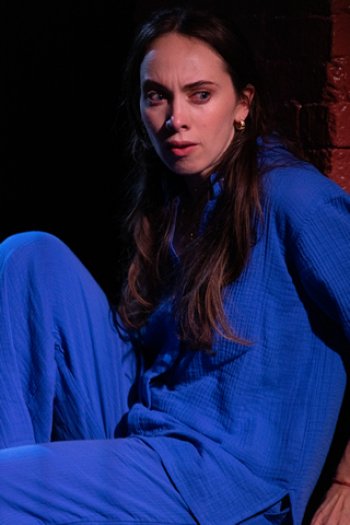
Baize Buzan in a scene from Paul David Young’s “Livia: A Roman Tragedy” at the Flea Theater (Photo credit: Bronwen Sharp)

Tony Marinelli, Critic
Paul David Young’s Livia: A Roman Tragedy, now receiving its world premiere at The Flea Theater, approaches the political present by way of an increasingly endangered past, imagining the final convulsions of the Roman Republic as an unsettling reflection of contemporary American democracy. In this fictional portrait of Livia Drusilla, the formidable historical figure associated with Augustus and the consolidation of imperial power, Young substitutes a woman of conscience for the politically calculating survivor history has generally made her out to be.
His Livia is stranded in Rome while her lover has departed to join an armed rebellion against an increasingly erratic, venal emperor, whose administration of the state involves banishment, imprisonment, executions and the systematic intimidation of anyone foolish enough to challenge him. Left to contemplate the disintegration of the society around her, she attempts to understand how a once-functioning republic surrendered itself to authoritarian rule, and whether an individual, however isolated, can still make a difference. The premise is compelling, and the contemporary correspondences are hardly difficult to recognize. Yet the production, directed by Danilo Gambini, is considerably more successful at conveying the urgency of its political anxieties than at transforming them into sustained theatrical drama.
Young has undertaken an impressive amount of historical and literary excavation. His text draws upon Shakespeare’s Julius Caesar, Antony and Cleopatra and Coriolanus, the tragedies of Seneca, the dramatic writings of Corneille and Ibsen, and the philosophical observations of Cicero and Epictetus, with additional contributions from the German sociologist Norbert Elias, Hannah Arendt and even the unlikely theatrical repository of Burt Shevelove and Larry Gelbart’s A Funny Thing Happened on the Way to the Forum providing a densely populated intellectual conversation. The result is a monologue that frequently seems to have been assembled from the accumulated wisdom of several centuries, as though Young has invited the Western literary canon to testify against the present administration. There is evident seriousness of purpose behind the enterprise, and the classical references occasionally lend Livia’s indignation a welcome historical dimension. But the sheer volume of borrowed authority can become oppressive. Rather than allowing these ideas to emerge organically through a character’s experience, Young frequently presents them in substantial thematic installments, each announcing another variation on the same political emergency. The scholarship is considerable; the dramatic architecture is less so.
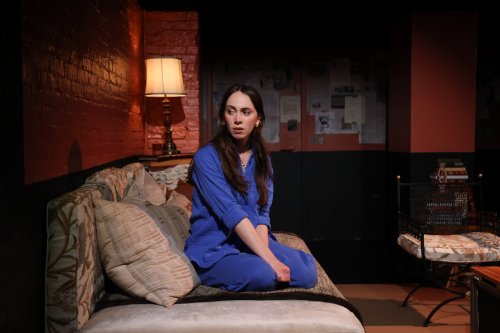
Baize Buzan in a scene from Paul David Young’s “Livia: A Roman Tragedy” at the Flea Theater (Photo credit: Bronwen Sharp)
The parallels between ancient Rome and contemporary America are unmistakably the play’s principal attraction, as well as its most obvious limitation. Young’s emperor is a grotesque combination of vanity, incompetence, appetite and self-preservation, sustained by a population of followers willing to excuse practically anything in exchange for proximity to power. Livia’s descriptions of a ruler who possesses neither wisdom nor military accomplishment, whose authority rests upon the enthusiasm of an unruly collection of admirers, are pointed enough to require little interpretive assistance. Her denunciations, frequently reinforced by Shakespearean and classical language, acquire an unmistakable contemporary resonance. Yet recognition is not the same thing as revelation. The audience is hardly arriving without its own accumulated knowledge of political corruption, institutional degradation, democratic backsliding and the daily spectacle of public life reduced to an exercise in disbelief. There is something curiously redundant about having a character spend the better part of an evening explaining what the audience has already spent years reading, watching and arguing about. The play’s insistence gradually becomes less persuasive than exhausting, particularly when its various observations circle back to familiar conclusions without substantially advancing Livia’s circumstances or understanding.
The more troubling omission is Young’s apparent unwillingness to examine the conditions that make authoritarianism possible in the first place. Tyranny here seems to descend upon an otherwise virtuous civilization like some inexplicable contagion, leaving the decent bewildered and the wicked conveniently identifiable. Livia asks how her society arrived at this catastrophe, but the play offers comparatively little investigation of the compromises, resentments, class divisions, political failures and failures of imagination that might have prepared the ground for it. There is no particularly searching consideration of how supposedly enlightened citizens can become insulated from the anxieties of ordinary people, or how the complacency of those who regard themselves as morally superior can contribute to the very political disasters they subsequently deplore. The invocation of Shakespeare’s observation that the fault lies within ourselves rather than in the stars consequently feels less like an invitation to self-examination than another opportunity to condemn the opposition. A more penetrating Roman-American analogy might have made room for the uncomfortable possibility that the republic’s defenders have some explaining of their own to do. Instead, the play is largely content to reassure an already sympathetic audience that its alarm is justified.
Baize Buzan, fortunately, brings a degree of theatrical vitality to material that might otherwise remain suspended in an extended exercise in political commentary. Following her memorable appearance at the Cell Theater this spring as Leni Riefenstahl in Beauty Freak, she demonstrates once again an unusually commanding ability to inhabit a character whose convictions are inseparable from her physical presence. Her Livia is neither a detached lecturer nor a simple vessel for the playwright’s opinions. Buzan gives her an increasingly volatile emotional life, moving from barely contained resentment to outright fury, from caustic disbelief to moments of genuine vulnerability in which the loss of her lover and the possibility of her country’s destruction become painfully immediate.
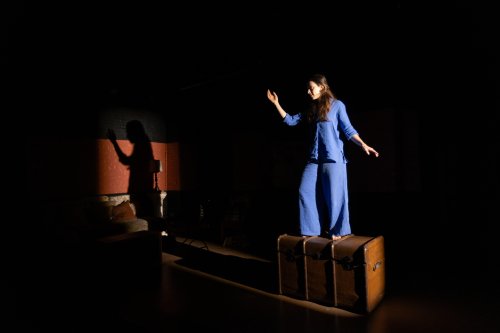
Baize Buzan in a scene from Paul David Young’s “Livia: A Roman Tragedy” at the Flea Theater (Photo credit: Bronwen Sharp)
Her penetrating gaze, richly textured voice and extraordinarily expressive face provide a vocabulary of their own, while her restless movement around the playing area prevents the lengthy monologue from becoming entirely static. She can make a sentence sound like an indictment, a warning or an exhausted confession, sometimes within the same passage. There is also a gradual accumulation to her performance: what initially registers as intellectual agitation eventually acquires the temperature of personal desperation. Buzan commits herself so completely to the character’s predicament that even when the writing becomes repetitive, her efforts to find fresh emotional territory remain compelling. She cannot supply the dramatic developments the script withholds, but she makes the absence considerably easier to endure.
Gambini’s direction is resourceful in its handling of a demanding solo performance, finding movement, visual variety, and shifts of emphasis within a text that provides relatively few conventional opportunities for theatrical progression. The opening, in which Buzan initially addresses the audience with her back turned, creates an intriguing delay before the character’s face becomes available to us, although it also contributes to an opening stretch in which the circumstances of her speech remain frustratingly indistinct. It takes some time to establish not simply what Livia is saying but to whom she is saying it, and why we are being invited into this particular moment of private distress. Is she addressing an absent lover, an imagined political assembly, the citizens she hopes to persuade, or an audience that exists principally to receive the playwright’s contemporary warnings? The uncertainty might have been productive had it been developed into a meaningful dramatic question.
Instead, the production occasionally seems as uncertain about its central character’s immediate objective as the audience is. This becomes particularly conspicuous when Livia climbs onto the trunk and stands atop it, an emphatic physical gesture whose theatrical justification remains elusive. The image is certainly designed to register as a moment of elevation, but elevation for whose benefit? Who is she addressing from this makeshift platform, and what does the act of climbing accomplish that the words and the performance have not already established? Without a discernible audience within the fiction, or a persuasive change in the character’s circumstances, the gesture risks looking like grandstanding for its own sake. Gambini otherwise maintains an energetic visual rhythm, but occasional stage business cannot entirely compensate for the lack of a clearly defined dramatic relationship.
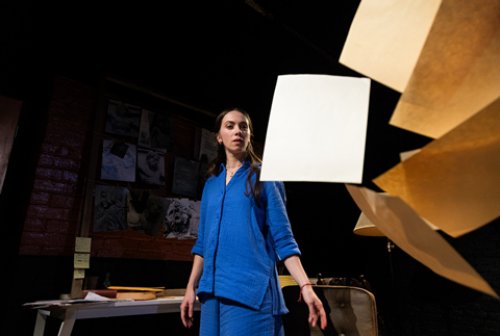
Baize Buzan in a scene from Paul David Young’s “Livia: A Roman Tragedy” at the Flea Theater (Photo credit: Bronwen Sharp)
The designers provide the production with a more substantial visual and atmospheric framework. Jimmy Stubbs’ scenic environment suggests a private interior that has gradually become an extension of Livia’s political and intellectual preoccupations, combining a sitting area and book-filled workspace with walls crowded by photographs, documents, and other accumulated evidence of a life increasingly consumed by public events. The arrangement offers Gambini several distinct areas in which to position his performer, while Nicole Lang McDonald’s lighting gives the space a shifting character, drawing attention to different corners and allowing lamps and pools of illumination to suggest the passage between thought, recollection, and confrontation. Stubbs also contributes the costumes, which sit comfortably within the production’s deliberately elastic relationship to historical and contemporary references. Liam Bellman-Sharpe’s sound design adds an unsettling dimension to the proceedings, filling the theater with carefully deployed effects that enlarge the world beyond the confines of the solitary figure onstage without overwhelming her voice. Together, these contributions give the production a welcome sense of atmosphere and spatial complexity, helping to sustain the eye and ear when the writing itself threatens to become monotonous.
There is, finally, a worthwhile theatrical proposition buried within Livia: A Roman Tragedy: the possibility of using the collapse of an ancient political order to interrogate the fragility of institutions that contemporary citizens have too often assumed to be permanent. Young’s material is intelligent, occasionally eloquent, and plainly animated by a genuine fear about the direction in which democratic societies can travel. But the accumulation of historical quotations and contemporary analogies eventually becomes a substitute for the dramatic exploration that might have made those concerns more unsettling.
The play offers abundant reasons to be alarmed, fewer opportunities to discover something unexpected about the people responsible for the alarm, and almost no meaningful change in the predicament of its central character. Its extended lament might have gained considerably from a ruthless reduction in length and a more complicated understanding of the forces that have brought Rome, and its American counterpart, to the edge. Buzan’s performance and Gambini’s staging provide ample evidence of what the material can accomplish theatrically, even as they expose what it cannot. The result is a thoughtful, handsomely realized, and intermittently absorbing production whose political convictions are considerably more persuasive than its dramatic means of expressing them.
Livia: A Roman Tragedy (through November 15, 2026)
The Siggy Theater at The Flea Theater, 20 Thomas Street, in Manhattan
For tickets, visit https://www.eventbrite.com/e/livia-a-roman-tragedy-by-paul-david-young-tickets-1995159651225
Running time: 75 minutes without an intermission



Leave a comment