
John Proctor Is the Villain
Adds to the growing list of attempts to update and improve Arthur Miller's "The Crucible" with the Netflix series "Stranger Things"'s Sadie Sink as star.
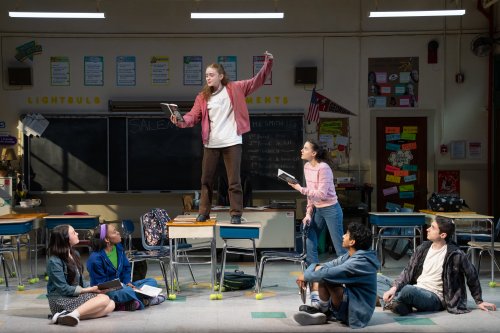
Sadie Sink and the cast of Kimberly Belflower’s “John Proctor Is the Villain” at the Booth Theatre (Photo credit: Julieta Cervantes)
Kimberly Belflower’s John Proctor Is the Villain is the latest in a series of feminist plays and musicals to grace the New York stage like Liberation, POTUS, Legal Blonde and Boop! The Musical which ultimately empower its female characters in a male dominated world. It is also representative of a subgenre which reevaluates the plays of Arthur Miller from a feminist point of view which now includes Crucible rewrites (The Good John Proctor, Becky Nurse of Salem, A Discourse on the Wonders of the Invisible World), Death of a Salesman plays (Mrs. Loman, Wife of a Salesman) and an All My Sons gloss (A Woman Among Women). As is obvious from its title, Belflower’s new play, seen regionally since 2022, joins the growing list of feminist attempts to update or improve on The Crucible which was always open for criticism for playing fast and loose with the ages of the real people as seducer Proctor was 60 and victim Abigail Williams was 11 or 12. Of course, Miller was writing an allegory of the McCarthy Era and not writing an accurate history of the Salem Witch Trials of 1692-3.
While Belflower’s play is clever and insightful, it is also contrived and manipulative, attempting to shoehorn almost every feminist hot button topic into one story overlaying The Crucible: date rape, sexual abuse, sexual harassment on the job, toxic masculinity, patriarch dominance. It makes all of the male characters look like idiots and all of the women victims which is not exactly a reflection of real life. It also overloads the deck while at the same time copping out in the end. While New York teens are probably much more liberated than those in rural Georgia, the language of the play is incredibly devoid of swear or curse words which usually pepper the speech of adolescents. Finally, it borrows from Ivo van Hove’s 2016 staging of The Crucible in which a modern classroom also turns into a telling of Miller’s play.

Gabriel Ebert and Molly Griggs (extreme right) and the cast of Kimberly Belflower’s “John Proctor Is the Villain” at the Booth Theatre (Photo credit: Julieta Cervantes)
Belflower’s story, set in the only high school in a small town in northeastern Georgia, begins when a group of female junior classmates are turned down for starting a Feminism Club which has been rejected on the grounds of alienating the male students and due to tensions running high in the community. (We later find out that the mayor had been accused of sexual impropriety or harassment, which is never made specifically clear.) In their English class led by the popular teacher Mr. Carter Smith on whom most of the girls have a crush, they begin to study Miller’s The Crucible as part of their literature unit.
Then a series of parallel events occur similar to the events in the Miller drama: rich girl Ivy Watkins’ father is accused of sexual harassment by his former secretary, and student Raelynn Nix is confronted by her ex-boyfriend and classmate Lee Turner who attempts to kiss her in a locked classroom in order to win her back even though he cheated on her with her best friend. Then loose cannon Shelby Holcomb who has been out of school for four months returns. No one knows exactly why she left to live in Atlanta with her aunt, but it is assumed to have been something inappropriate of a sexual nature. The Feminism Club is finally allowed to meet as a literature club under the mentorship of English teacher Mr. Smith.

Maggie Kuntz, Morgan Scott, Fina Strazza and Amalia Yoo in a scene from Kimberly Belflower’s “John Proctor Is the Villain” at the Booth Theatre (Photo credit: Julieta Cervantes)
All of this happens while the class digs deeper into The Crucible. Shelby, always a provocateur, insists that John Proctor is the villain of the play as he never apologizes for having seduced his servant Abigail Adams. But she also finds out that most of the girls in Salem at that time would have been assaulted in their young lives by one of the men or boys in the community. And then Shelby makes an accusation that someone they know took advantage of her. Of course, Shelby has always been unstable so it is difficult to know how much of what she says is true. However, she and study partner Raelynn get their own revenge in the play’s finale with their interpretative dance project for The Crucible which finally includes all of the girls in a scene right out of Miller’s play. (For those who have forgotten the Miller play, this is reminiscent of the girls in Salem and what led to the Witch Trial.)
Just as in Miller’s play, the accusations are innuendo and undocumented evidence. We never know for certain what to believe is true. As John Proctor Is the Villain moves towards its conclusion, it becomes more and more like The Crucible. The ending is at the same time ironic, cynical and ambiguous. Young women theatergoers who are seeking to find their place in a male dominated world will love the play, which does not, of course, keep the Belflower’s play from being untidy and overloaded with issues. What are the chances that all of these things would happen in a small town at the same time?

Sadie Sink and Amalia Yoo in a scene from Kimberly Belflower’s “John Proctor Is the Villain” at the Booth Theatre (Photo credit: Julieta Cervantes)
Danya Taymor who recently established herself on Broadway with another modern classic, S.E. Hinton’s The Outsiders, has directed with surety and speed. Her casting is perfection for these archetypal roles. As the unstable and charismatic Shelby, TV star Sadie Sink (Netflix’s series Stranger Things) lights up the stage whenever she appears, but also takes that light with her whenever she leaves. As the teacher on whom most of the girls have a crush Gabriel Ebert adds another offbeat character to his resumé. Molly Griggs as the young new guidance counselor Miss Gallagher has chosen to be rather bland as she makes her way in her career as the school’s youngest staff member.
Among the female classmates, Fina Strazza is notable as the neurotic, compulsive and obsessive Beth. Amalia Yoo is excellent as the conflicted Raelynn who is discovering she needs to become her own woman apart from the men in her life including her preacher father and her ex-boyfriend. As the emotional Ivy whose father confesses to impropriety, Maggie Kuntz is ambiguous as to her feelings about what is happening to her family, while Morgan Scott as Nell, the African American student newly transferred from Atlanta, is a voice of reason and stability. Among the two male students, Hagan Oliveras is amusing as the toxic Lee who is willing to change in order to win Raelynn back, while Nihar Duvvuri is droll as the nerdy and dim Mason who often doesn’t get what is staring him in the face.

Hagan Oliveras and Amalia Yoo in a scene from Kimberly Belflower’s “John Proctor Is the Villain” at the Booth Theatre (Photo credit: Julieta Cervantes)
The set design by Teresa L. Williams for the collective AMP FT is a completely detailed classroom leaving nothing out. Sarah Laux’s costumes for both teachers and students are suitably appropriate without being fussy or outrageous. The lighting by Natasha Katz subtly suggests various times of day in Mr. Smith’s classroom and one other location. John Proctor Is the Villain is certain to be controversial though to some extent it does a disservice to Arthur Miller’s historic tragedy. In any case, the production should make Sadie Sink into a major stage star.
John Proctor Is the Villain (extended through September 7, 2025)
Booth Theatre, 222 W. 45th Street, in Manhattan
For tickets, call Telecharge at 212-239-6210 or visit
http://www.johnproctoristhevillain.com
Running time: one hour and 45 minutes without an intermission


Leave a comment