Theater for the New City
Although Cobb makes references to Iago, Othello’s, second-in-command, and Barbary, the maid to Desdemona’s late mother who brought her up, Nine Moons does not tell us anything we don’t already know from Shakespeare’s play. Since the one thing we are waiting for is Othello’s wooing of Desdemona which will result in their elopement, this does not begin until one hour and five minutes into this 115 minute play. What transpires before that is chit chat about the state of Venice and Cyprus, Othello’s unease in this new city, and Cassio’s army ambitions at odds with his drinking problem, all of which is covered in Shakespeare’s later tragedy. [more]
Scammed into Love
Although there are humorous moments, the production doesn't work for various reasons, including characterizations and technical issues with sound reproduction. None of the eight songs are memorable, and the characters do not engage the audience, which is a question of direction and acting. While the performers work hard at portraying their characters, the effect is uneven. Some characters appear two-dimensional, and performances feel like a college or community theater production. The vocals are problematic, with some performances being overpowered while others pitchy. Overall, the show doesn't engage the audience in caring about the characters or their stories. [more]
Remembrance
"Remembrance" by Patricia GoodSon is a story about her journey, for more than a decade, in dealing with her mother's Alzheimer's disease. As directed by Joan Kane, it is told from the perspective of a woman working with a therapist to unravel the emotional impact of those years of caregiving. It is not about the impact of the disease on the person with it but on the effect on the caregiver. [more]
Lists of Promise
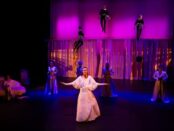
The scene with Adam and Eve establishes the structure for the show, with each of the ensuing vignettes being conducted in a call-and-response format. The second explores a list of rules established during the Victorian Era. In this set, the aerial performers represent a young girl just coming of age and two older, more established women. The aerial characters make the call with the response coming from different members of the Grounded Women, each expanding on the list of comments being made by the aerialists. The set ends with the Contemporary Woman bringing together some of the ideas presented in the call and response, presenting the state of a woman's status in society as the result of the list of rules. [more]
Fog and Filthy Air
It is essential for the audience to become fully engaged with the story and to care about the characters. When that does not happen, the show falls flat. While Homeyer and McGrath make an effort as Father and Mother, they are saddled with one-dimensional characters whose interactions lack chemistry. Gamble’s character is more developed but lacks a believable emotional connection with the other two. The dialogue touches on emotional issues within the family but does not effectively build dramatic tension with those issues. In the final analysis, the play lacks a compelling emotional hook. [more]
A Shift of Opinion
There are a number of problems with these vignettes, ranging from the individual characterizations of the men involved to the superficial nature of the historical details of the events being discussed. Sheppard overacts in portraying O. Henry as a barely coherent alcoholic. It is not credible that a person as "drunk" as O. Henry would be engaged in any serious discussion with the likes of Mark Twain and William Hearst, let alone Teddy Roosevelt or even Schiff. The performances don’t engage the viewer to care about who the character is and what he has to say. In a number of the scenes, the dialogue seems contrived to present a particular socio-political viewpoint without any explication or depth. [more]
Woman on a Ledge
"Woman on a Ledge" is an adaptation by Hershey Felder of harpist Rita Costanzi’s writings about her life. Ms. Costanzi is a world-renowned harpist whose life experiences have been woven into a fascinating and highly engaging theater piece. As directed by Lissa Moira, this one-woman production beautifully integrates Ms. Costanzi’s superlative playing with her solid storytelling. One does not have to be a harpist or classical music fan to enjoy this production. Her storytelling alone is worth the time spent, and it becomes exceptional when coupled with her exquisite playing, used to underscore elements of her story. [more]
Soup in the Second Act
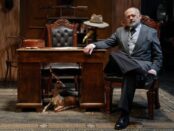
Barry Primus’ "Soup in the Second Act" is described in press materials as a "dramatic comedy" but it's more drama than comedy. The humor comes from old-fashioned actor jokes such as this one: "Two actors bump into each other on Times Square. 'God, where have you been? I haven't seen you in such a long time.' 'I'm doing a one man play all over the country.' So the other says, 'That's great. That's great. Anything in it for me?'" If you like that sort of thing, you'll enjoy "Soup in the Second Act" (which is itself the punchline for another actor joke). [more]
Dickhead
"Dickhead," written by Gil Kofman and directed by Richard Caliban, is a story about the patriarch of a dysfunctional family in the midst of a near-total disintegration. The action is centered on Richard (Ezra Barnes), an abrasive, abusive lawyer who is rightly called “a dick” by his wife and just about everyone who interacts with him. He is also called Dick, as a nickname for Richard. The only time he is called "Dickhead" is midway through the action, in a maybe friendly comment by his oldest friend Howard who is given a solid portrayal by Chuck Montgomery. In the opening scene, Richard is in the office of his therapist Dr. Adams (Frank Licato) on a cell phone call with a tech support person at the internet company. This action provides a portrait of Richard’s personality: nasty, abrasive, ego-centric; a real dick. It also indicates that things are not going well in Richard's home life and job. Barnes' performance is well-tuned to the character, although, at times, getting close to being too much of a dick. Licato effectively embodies the therapist who is not as balanced as he appears to be in the opening. Licato gives a good performance of another character late in the play, the doctor’s wife. [more]
The Goldberg-Variations
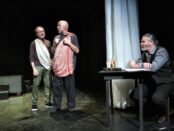
"The Goldberg-Variations" by George Tabori (written in 1991, now having its belated new York premiere) is a confused and confusing conflation of Bible stories and backstage bickering amongst a playwright, his director, designer and actors. Now at the Theater for the New City, the overlong production, directed by Manfred Bormann keeps the audience scratching their heads as each part of the Good Book is explored. [more]
Ella the Ungovernable
David McDonald has discovered onto an obscure and interesting story: 15-year-old Ella Fitzgerald’s incarceration in the New York Training School for Girls in Hudson, New York, after her mother was killed crossing the street, and her miraculous escape from it. While little is known of her life during this period, McDonald calls his play "Ella the Ungovernable" “speculative fiction.” As co-directed by actress Michele Baldwin (who plays Ella’s mother Tempie, short for Temperance) and the playwright, the play feels a bit long without an intermission. [more]
Party Clown of the Rich and Famous & The Hungry Mind Buffet
There’s so much fascinating material in "Party Clown of the Rich and Famous" and its companion compendium of four short works, "The Hungry Mind Buffet" that it pains me that the works aren’t presented with classier production values, unfortunately a reality in cash-strapped Off-Broadway presentations. Even so, the evening offers much to savor. [more]
The Frybread Queen
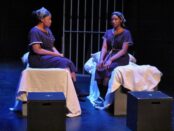
"The Frybread Queen," a unique narrative penned by Carolyn Dunn and brought to life under the direction of Vickie Ramirez, delves into an intergenerational conflict sparked by the death of a man who held significant roles in the lives of four Native American women. While the making of frybread serves as a tool to highlight the characters' diverse attitudes and emotions, it is not the central theme of the play. The primary focus is on the fate of the deceased man's daughter and the mystery surrounding his death. [more]
Orson’s Shadow
For those interested in both theatrical history and the lives of our former artistic heroes, Pendleton doesn’t disappoint, even if he exaggerates and manipulates the facts a bit. He does better with Welles and Olivier, both played smartly and quirkily, than he does with Taff’s almost invisible Plowright and Menna’s ghostly, but glamorous Leigh. Hamilton’s Tynan is more didactic than dramatic, but he looks terrific and keeps the show rolling along. Listening to these giants kvetch and spew is fascinating and strangely satisfying. [more]
Pharaoh
This show, as conceived by Shulman, creates a unique theatrical experience combining narrative text with Kathakali, a form of traditional Indian dance exquisitely performed by Kalamandalam John. Shulman gives voice to all the characters, principally the Pharaoh. At the same time, John acts out the 54 different characters in an elaborate costume, colorful make-up (costumes and make-up by Dr. Kalatharangini Mary John), intricate gestures, expressive facial movements, and traditional dance moves of Kathakali. [more]
Fair Winds and Winds of War
Kahn has a good ear for the subtleties of each character and the period. However, "Fair Winds" doesn’t handle all the major themes smoothly and the use of the narrator sometimes feels like a way to make up for her storytelling shortcomings, although Maisonett is an accomplished enough actor to make it work. [more]
The Good Soldier Švejk and His Fortunes in the First World War
The Czechoslovak-American Marionette Theatre (CAMT) is presenting “an innovative re-interpretation of a classic, combining live performances with puppets” at the resourceful Theater for the New City in the East Village. "The Good Soldier Švejk and His Fortunes in the First World War" is a classic journey into a satirical, picaresque anti-war message first revealed in the novel by Jaroslav Hašek published in several volumes in the early twenties. It is one of the most translated books by a Czech writer. Hašek served in World War I and his experiences fueled his sardonically funny novel.
Švejk was adapted for stage productions soon after by such theater luminaries as Erwin Piscator and Bertolt Brecht. The new, loose-legged adaptation at TNC is by Vít Hořejš who also directed this production. [more]
The Boy Who Listened to Paintings
Alyson Reim Friedman, Thom Brown III, Niko Zylik as young Nicky, Donovan Counts, Alisa Ermolaev and [more]
The Gospel According to Chaim
There are few issues that raise the ire of the religious as a member changing religions. Apostate is the mildest term used for such a person. Mikhl Yashinsky’s "The Gospel According to Chaim" at Theater for the New City tells of such a person, the eponymous Chaim Einspruch, played with beatific authority by the author, himself. This is a true story and a rarity: a contemporary play written in Yiddish. (Supertitle translation is provided.) Chaim Einspruch wrote the first Yiddish translation of the New Testament, a shanda of the highest order since this acknowledges the existence of Jesus as “the Savior.” [more]
Becoming Chavela
Ranchera is a style of traditional Mexican folk music with origins in the ranchos of rural Mexico. The songs are about love, patriotism, or nature and are usually sung by men. The vocals have a rough, raw quality in contrast to the more refined vocalizations of the urban singers. In Mexico City, Chavela defied the norms and sang rancheras with her style and interpretations while staying true to the rawness of delivery and the ideas expressed by the lyrics. Trudeau transforms herself into Chavela with an on-stage costume change and then provides solid interpretations of some of Vargas’ classic rancheras as she takes the audience on an exploration of Vargas' life in Mexico City, a brief time in Cuba and to the mid-1970’s when she stopped performing as a result of all the tequila she had consumed over the years. Although Trudeau's voice is more refined, she still delivers the songs with all the passion and fire needed in some and the introspection and sadness in others. Her embodiment of Vargas is complete. [more]
Killin’ Republicans
"Killin’ Republicans," concept and libretto by Dick D. Zigun and music by Arturo Rodriquez, directed by vagabond, is billed as a rock opera about violence towards certain Republican Party leaders since the mid-nineteenth century. It deals with a series of assassinations and attempted assassinations of Republican leaders from the 1850s to President Reagan in 1981. It is supposed to be a discussion about the reasons for the attacks and not a call for violence against Republicans. The entire show is sung or performed in spoken form in various styles as more of a concept concert than an opera. The libretto covers a wide range of events attempting to give context to the multiple incidents but fails to clarify the point of the show. It is a mistake in its present form. [more]
Twisted
It takes considerable skill for competent actors to play at being bad actors, and many of the cast members succeed. It is not a bad play, but the overarching problem with the show is that it is playing to a niche audience. If you do not know anything about the B-movies of the 50’s and 60’s, you will react as I did in thinking it is a terrible play. If you are familiar with the work of Roger Corman, William Castle, or any other B-film directors, or any of the films, such as "Galaxy of Terror," "The Little Shop of Horrors," "The Tingler," "The Curse of the Werewolf," or any of the dozen movies of that period, you may enjoy this production [more]
Bliss Street
The main issue with this show is the lack of clarity in the book. Who is the play about, the father or the son? Act I is primarily a story about Paul Sub and his business ventures leading up to the creation of The Coventry. Act II is more about Charlie Sub and how his father's business decisions impacted Charlie's life. In both cases, the story's elements need to be restructured to make it more compelling. Does it matter what type of romantic relationship Charlie develops in LA? Did Paul's liquor store fail after the robbery? The book needs to be edited to define clearly which story is being told and to eliminate the scenes that do not advance the story. [more]
The Conductor
"The Conductor," by novelist Ishmael Reed and directed by Carla Blank, is a play that uses the revival of the Underground Railroad system as a device to address several contemporary socio-political issues related to race and ethnicity. It is a show that directly addresses extremist conservative groups and their movements that seek to restrict and limit governmental and social actions used to address institutional inequality. Reed utilizes the result of a school board recall election in San Francisco as the basis for illustrating the insidious nature of these reactionary groups. [more]
Who Murdered Love?
What is a mystery inside a riddle wrapped in an enigma? A Winston Churchill question from 1939 aptly fits a play with music set in 1924 that toys at being a murder mystery. As a play with music "Who Murdered Love?" doesn't work. As a play without music, it doesn't work as well. It is Dadaism with Surrealist overtones, and Surrealism with Dadaist overtones, if anyone in the audience knows what Dada or Surreal means. [more]
Not About Me
Eduardo Machado’s 11th play to premiere at Theater for the New City is called "Not About Me" which is a complete misnomer as it is about his life for the last 40 years with his alter ego at its center. Marketed as a “memory play that takes audiences on a haunting journey through the mind of a playwright during Covid-19 lockdown,” in fact, it is about his friends who died during the last pandemic, the mysterious “gay disease” that came to be called AIDS. Other than as a tribute to those lost friends, it is difficult to see the message of the play as it depicts a great deal of risky behavior. [more]
Darkness After Night: Ukraine
"Darkness: unfolds in many very short scenes with some confusing transitions. Dubashin, the traitor to Russia, finally gets to confront Number One in a knock-down personal battle. The only thing that can be said for this denouement is that it is wishful thinking of the highest order. There is more than a whiff of a vanity production here, leavened by Morrow’s “good intentions.” Morrow is, perhaps, a tad self-indulgent to have put himself in the action hero part of a military do-gooder and he could use a dramaturg who could shape the disparate scenes into a well-oiled whole. [more]
A Healthy House
Diriwachter is particularly skilled in writing working class vernacular. The Father and Tim speak the same language and he catches all the subtleties of decades of ups and downs. He also is wonderful with the two salesmen, cleverly finding the rhythm of their spiels that build up to the final pitches. His salespeople are written as clever but not unfeeling so that the audience never totally believes that the Father and son are being betrayed and cheated. [more]
The Oracle
This premiere five-performance Off-Off-Broadway showcase run of "The Oracle" is best viewed as a tryout, and the production’s presentational flaws are cited with that belief. Co-author Elliott also directed; while he’s assembled, well-positioned and guided the industrious cast to lively performances, his physical staging is variable. The play is structured as 34 brief scenes over two acts. Instead of rapid transitions, there’s a pause between each scene while recorded music plays as the actors get in place. This intrusive strategy slackens the pacing and adds to the running time. [more]
The Unamerican
So rages legendary Right Wing Hollywood gossip columnist Hedda Hopper in playwright Claude Solnik’s well-observed historical fantasia about the 1950’s anti-Communist Blacklist, "The Unamerican." Besides a comically accurate Hopper, Mr. Solnick offers rich portraits of Marilyn Monroe, Arthur Miller and Elia Kazan. The romance of Miller and Monroe and the clash between those male friends and colleagues over their disagreements of how to deal with testifying before the House Un-American Activities Committee (HUAC) are perceptively rendered by Solnick’s erudite research and keen writing. A highlight is the background of "The Crucible," with Monroe reciting a speech from it. When "The Unamerican" focuses on the interplay between its four main characters it soars. [more]
Di Froyen (The Women)
The New Yiddish Rep’s (David Mandelbaum, artistic director) production of the Yiddish language "Di Froyen (The Women)" is a bittersweet, anger-inducing portrait of modern day Chasid women caught between orthodox Jewish ideology and the rush of modern society’s laws and attitudes into their lives. Adapted by Malky Goldman and Melissa Weisz from Naomi Regan’s "Women’s Minyan," "Di Froyen," in one compact, tense hour, opens up a previously secret world to the public. Here are six women, all wearing sheitels (wigs that orthodox Jewish women must wear because showing their own hair is proscribed by religious law) and all under immense pressure from within and without their enclave. [more]
I Just Want to Tell Somebody
He used the gimmick of preparing to perform the very show he was performing for his audience in the Cabaret Theater of the Theater for the New City; but by the end of his fascinating and grueling life story he was on fire with his tale of his life in the theater and film. He grew up in the Sixties when the U.S. was in turmoil and it seemed that everyone was getting high. Smokey’s career began with a first prize in his Washington, D.C., high school talent show and some performances at the Arena Stage. He quit school to try his luck in California but failed and returned to D.C. where he joined an all-Black repertory theater and appeared in his first commercial which he showed on a large screen. Much later he appeared in Francis Ford Coppola’s "The Cotton Club" as a featured musical performer. His number in the film was shown proving he was an impressive dancer and singer partnered by Jackée Harry. [more]
A Christmas Carol, Oy! Hanukkah, Merry Kwanzaa, Happy Ramadan
Not only is this a puppet show but it is also an extended concert. This year’s vocalists are Valois Mickens, of West African, Celtic, and Native American origin, and Katarina Vizina, a transplant from Slovakia, who sing pieces of about 20 carols and songs including “We Wish You a Merry Christmas,” “Feliz Navidad,” “Silent Night,” and “The Dreidel Song” in the original languages. Occasionally they participate in the action, as well as in the prologue that sets up the show. [more]
The Dark Outside
The Off-Off-Broadway world premiere of "The Dark Outside," nonagenarian English playwright Bernard Kops’ poetic, archetypal and fantastical family secrets drama is problematic. Directorial excess combined with intrusive conceptual design clash with authorial vision. The play was originally performed as a reading at London’s National Portrait Gallery on January 17, 2020. It’s likely that its potential was more realized and faithful to Mr. Kops’ text during that simple event. [more]
1-2-3 Manhunt
DiMurro writes with an acute sense of the rhythm of New York speech and its old-school jargon, helped by director William Roudebush’s complementary sense of timing, not to mention four expert actors who know how to embody these characters. Herrick Goldman’s atmospheric lighting and Andy Evan Cohen’s brilliant urban soundscape immeasurably added to the overall impact of "1-2-3 Manhunt." [more]
The Wayward Daughter of Judah the Prince
It is to the credit of the entire cast—dressed in Anthony Paul-Cavaretta’s period tunics and flowing robes—that Lackey’s sometimes over-the-top dialogue lands credibly. Two other elements elevate the play: Michael Sirotta’s lovely, mood-enhancing score and Jon DeGaetano’s imaginative scenery which includes large, stage-spanning curtains that cleverly serve as entranceways, sails and even ancient columns. Michael Redman’s moody projections enhance Sirotta’s contributions. [more]
Tomorrow We Love
There is plenty of over-the-top acting, physical antics and far-fetched story lines, all perfectly acceptable ingredients for a zany gender-bending farce. The only thing missing are the laughs. Even the high school-quality set design by Ryan Goff and delightful costumes by Jimmy Moon are on par for this campy send up of a 1950’s rom-com. Ultimately, Vause’s script reads funnier than it plays, so there is more amiss than the smoking gun in this screwball comedy. [more]
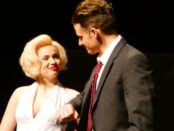
Hooked on Happiness
Although the show is 80 minutes without an intermission, it just breezes right by and one is never bored. The music, played by Peter Dizozza (on piano), Ralph Hamperian (on bass) and Art Lilliard (on drums), keeps the show moving at perfect tempo. From ballads to disco tune, from rap to group numbers, the music is spot on. Sound designer Alex Santullo delivers a pitch-perfect musical. [more]
A Life in the Rye
A seated actor dressed all in black wearing a beret beats a conga drum on a confined playing area. Other actors in period costumes sit at small cabaret tables and chairs as thick wafts of smoke envelop the stage. On the back wall is a white screen and from behind it is the shadow of a woman dancing. Such is the arresting 1950’s classic beat coffee house imagery director Joe John Battista conjures up for playwright Claude Solnik’s fascinating fantasia derived from the life of J.D. Salinger (1919-2010), "A Life in the Rye." [more]
Ludwig and Bertie
"Ludwig and Bertie," written by Douglas Lackey, gives us insight into the relationship of two of our greatest twentieth century philosophers, the younger Jewish Ludwig Wittgenstein and the 20-year-older atheist Bertrand Russell. Bertie, played smartly by Stan Buturla, is the wise old professor at Cambridge when he meets the almost half his age young student Ludwig, poignant, headstrong and hungry for more knowledge, insight and truth, played passionately by Connor Bond. [more]
Dining with Ploetz
"Dining with Ploetz" at Theater for the New City consists of three short plays by writer, director and teacher Richard Ploetz. The program adds up to slightly under two hours’ running time (with one intermission). The plays are all billed as comedies, and—as the title implies—they all, to one degree or another, involve “dining.” They are, however, quite diverse in terms of style and tone. The first and last of them (both of which the playwright directed) hold the audience’s attention fairly well. The middle piece, directed by Steven Hauck (who acts in the other two), is riveting. [more]
Barabbas
While Will T.F. Carter’s "Barabbas" is very outspoken on the topic of political corruption in Peru, the play is dramatically weak as so much of it is exposition. In each scene we learn a little bit more about the men’s lives, but little that is new happens in the play’s 90 minutes. The tepid direction by Eduardo Machado gives us too much time to consider the play’s deficiencies and makes the play seem longer than it is. Carter’s anger at what is going on in Peru is commendable, but Barabbas does not utilize that indignation except on an intellectual basis. [more]
Shareholder Value
Attea’s point concerns business models that are overly focused on the needs of shareholders, rather than on those of management and employees. But the play is curiously bloodless. Strong plays about the ferocity of capitalism—from Arthur Miller’s "Death of a Salesman" to David Mamet’s "Glengarry Glen Ross"—take interest in the human equation. They focus on the personal anguish that the system can induce. Attea doesn’t delve that deeply here. [more]
Thelonious!
Welch and the play’s director, Jonathan Weber, seem to be going for a sort of Ionesco-esque ambience here. The story unfolds in a broadly played, cartoonish way. Occasionally, a satirical jab at ivory-tower academics will land, thanks to Welch’s depiction of the shallow and creepy professor, who—as played by the bearded Slone—looks like he just stepped out of a daguerrotype. But, generally speaking, this comedy is rambling, unwieldy and not especially funny. (Few audience laughs were audible during the performance under review.) In the last stretches of the play, a meta element is introduced, with the characters talking about having entered “the epilogue” stage of the story. Once we’ve stumbled into this self-referential territory, it becomes even harder to engage in any real way with the play. [more]
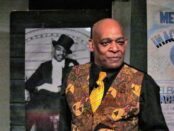
Betty and The Belrays
The creator of "Betty & The Belrays," now at the Theater for the New City, pretty much dares you to compare his well-meaning, but cartoony, new musical to Hairspray, a comparison in which the new musical fare poorly. Written—book and lyrics—and directed by William Electric Black, with music by Black, Valerie Ghent and Gary Schreiner, "Betty," like "Hairspray," tells the story of a white high school-aged girl, the eponymous Betty (Paulina Breeze), living in a racially divided city, here 1963 Detroit, where Motown and its distinctive style are being forged. [more]
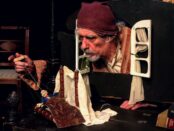
Lured
Frank J. Avella’s "Lured" at the Theater for the New City practices a bit of theatrical legerdemain. Ostensibly about the perils of being gay in today’s Russia, Avella takes an unexpected turn into revenge melodrama that almost defeats his main political/social theme. Considering that Lured is based on real events, at the very least he dulls the important political and social points he is making by having the victims and perpetrators behave equally abhorrently. [more]
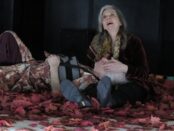
Subway Story (A Shooting)
"Subway Story (A Shooting" is the fifth and final installment of William Electric Black’s Gunplay Series, a sequence of plays “dedicated to all who have lost their lives to the senseless gun violence plague.” In this concluding chapter, ongoing gun violence, particularly its link to urban youths, is the prevailing theme. Black is a seven-time Emmy award-winning writer. His work often broaches societal-conscious issues. [more]
America’s Favorite Newscaster
Another irony is that while Fury is kind of a bore, another character is not. Yeah, you guessed it. Him. When the president (David O. Friedman) appears in Fury’s bedroom like the Ghost of Christmas Present, Attea’s writing finally comes to life. His take on you-know-who isn’t unique, but the situation is wonderfully silly, and Friedman’s impression is a funny profile in petulance. [more]
BrouHaHa
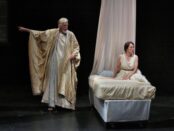
Washington, D.C.’s acclaimed Happenstance Theater is making is New York debut with its 2015 show "BrouHaHa," which has been seen previously in Baltimore, Maine and New Haven. Taking for its theme what would you do if the world were about to end, this “clownesque escapade collaboratively devised and performed by the ensemble” follows the company of six through a series of skits and journeys almost all of which lead to death but from which the actors bounce back. While the company members are extremely talented, the material lacks impact and structure and cries out for both a playwright and a director. Although intended to be comic, there are no laughs in this show though it may provoke smiles. [more]
Prague, 1912 (The Savoy Café Yiddish Theatre)
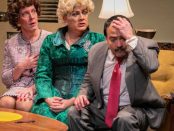
There is a fascinating story to be told in Franz Kafka’s involvement with the Yiddish theater in Prague during 1912 but Lu Hauser’s play isn’t it. "Prague, 1912 (The Savoy Café Yiddish Theatre)" is both episodic and repetitious without being clear as to the point that it is making. It simply seems to be a collection of scenes on the same themes that endlessly repeats itself. As Paula Vogel’s "Indecent" has demonstrated, there is a renewed interest in the Yiddish theater but "Prague, 1912" has not brought to life this world that is now gone with the wind. [more]
Up the Rabbit Hole
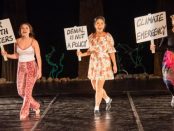
Besides harboring a dwindling dream to become a dancer, thanks to a leg injury, Halliday’s dramatic stand-in, Jack (Tyler Jones), an adoptee, also has to contend with the overwhelming repercussions of having tracked down his biological family, which includes an adult half-brother (Andrew Glaszek) with his own substance-abuse demons. That’s a lot for 90 minutes, and Halliday, despite a valiant effort, can’t keep his play from sinking under the weight of it all. [more]
Diva: Live From Hell
"Diva: Live From Hell," an energetic, campy variation on the “All About Eve” theme, is performed with manic glee by Sean Patrick Monahan who also wrote the book and created all the colorful characters. His partner in crime is Alexander Sage Oyen who provided the music and lyrics. Sex (requited and unrequited), ugly violence and dark humor are all thrown into the story which is told by Desmond Channing (Monahan, who also plays virtually a high school’s worth of characters). [more]
About Clarence and Me
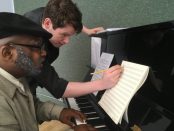
To call "About Clarence and Me" simply a play is misleading, as the project features an entirely original score by co-writer Scott Hiltzik. A classical musician, Hiltzik’s music is technically striking but carries a modern flare. In additional to their finely tuned performances, both DeMone and Roll impress as musicians as well. Roll proves himself to be quite the accomplished classical pianist, demonstrating mastery of the keys by way of precision and constraint. DeMone, ever his opposite, produces from the piano a sound descendent of a ragtime piano roll, at times accompanied by the veteran singer’s sonorous growl. Directed by Hiltzik’s co-writer Jones, the duo’s intimacy with the material is plain to see in the final product. Full of nuanced moments both thematically and in performance, the writing team’s hands-on approach is responsible for this well-rounded and solid production. [more]
The Beekeeper’s Daughter
Najla Said and P.J. Brennan in a scene from Karen Malpede’s “The Beekeeper’s Daughter” [more]
Cabaret journalist/actor Andrew Martin found dead in his home on June 7, 2016
A chatty, openly gay bon vivant over the years, Andrew Martin had his feet in many waters; all of them related to show business. He was proud of his long-winded stories and exceptional knowledge of trivia about the famous and infamous. He had many followers on Facebook where he shared sometimes painful stories of his family and personal angst. He wrote openly about being troubled by strained relations within a divided family at times. [more]
Midnight Kill
As the actors interact with each other and work to share this story, the spirit and tenacity in which they do so is something remarkable. Their presence and focus in bringing a significant time in history to life leaves the audience with chills. While it is so important to pay attention to the subtitles in this production, as it signifies when time and seasons pass, it is hard to tear your eyes away from the living story taking place on stage. With a set design also by K.K. Wong that uses simple props to illustrate the basic lifestyle of the residents, audience members get a feel for the day-to-day life in this community. At times, it is challenging to keep up with processing the subtitles and watching the action on stage, and intense concentration is essential in understanding the continued series of events. [more]
Allen Wilder 2.0
Joe Casey is a charming actor. He exudes a “playboy” vibe which goes hand-in-hand with the character of Michael whose vices range from women to booze and back again. Casey shows an understanding of a man who is largely misunderstood and actually well-intentioned. Steph Van Vlack plays the role of Donna. Nearing 50 and a divorcée with a child, Donna is conflicted in light of the fact that she—a woman of her age—is engaging in an apparent “one night stand.” Among other things, this is also a character deeply disturbed that she’s actually considering sleeping with the child she used to babysit for all those years ago. Van Vlack brings a necessary uncertainty to the character. Playing a woman of certain age, Van Vlack’s performance indicates that Donna still has deep insecurities and still has quite a bit to learn about relationships. [more]
BIKE SHOP, The Musical
Barkan doesn’t hold back as she expresses herself through song and dance to share her personal journey. The opening number “Streetwise” is a burst of exhilaration and adventure and pumps the audience up for what’s to come. In addition to the hilarious and entertaining moments, the climax is a literal bump in the road that causes her story to turn somber and results in Barkan hanging up her helmet and retreating to her family’s bike shop as she works on healing emotionally after a tragic accident. The audience is left with one question on their minds: Will she ride again? [more]
Casterbridge
In recent years, there have been many Off Broadway attempts to musicalize the works of Thomas Hardy. The latest is composer Christopher Beste and writer David Willinger’s ambitious, "Casterbridge," a very engrossing version of Hardy’s novel "The Mayor of Casterbridge." While some of the lovely music proves to be too difficult for some of the singers, under the direction of Willinger with musical director Bob Goldstone at the piano, the almost all sung-through stage version is an impressive and faithful retelling of the Hardy story. [more]
Martyrs Street
Shulman is a skilled story teller, creating characters that are real and complex: honorable people that make mistakes, some misguided, some well-intentioned or ruthless. People we all know, maybe even in our own families. Shulman makes the head of each household, two women, the focal point of the play. Noor, which means light in Arabic, is a widowed professor at the university with a 16-year-old daughter, Aisha, and a son, Nimer. She doesn’t wear a headscarf, and spends time alone with her late husband’s friend Salim (Alok Tewari), which is frowned upon in the community. Noor received an order from the Israeli government that her house is going to be taken down in 30 days. [more]