
well, i’ll let you go
Weiler’s drama delves into resilience, mercy, and the quest for serenity amid the disorder and mystery of life’s final, unknowable passages.

Quincy Tyler Bernstine and Will Dagger in a scene from Bubba Weiler’s “well, I’ll let you go” at The Space at Irondale (Photo credit: Emilio Madrid)
well, i’ll let you go, Bubba Weiler’s exquisitely devastating new work, staged with unpretentious yet profound grace by director Jack Serio leading a magnificent cast at the Space at Irondale in Brooklyn is, in a word, haunting. The play unfolds as a poignant, slow-burning elegy to ordinary lives and the extraordinary grief that can shatter them. It is a tender meditation on loss, memory, and the fragile architecture of community—one that both embraces and exposes the complex, often contradictory, human heart.
For a quarter-century, Maggie and Marv inhabited an aging farmhouse on the outskirts of a Midwestern suburb—an archetype of dependable, unassuming solidity. They were the kind of couple whose presence reassures a neighborhood: a touchstone in times of hardship, a quiet beacon of hope simply by virtue of their constancy. But then, as the story’s inciting tragedy, Marv dies—though “dies” feels woefully insufficient to capture the abrupt violence and mystery surrounding his passing. In fact, it is a murder shrouded in ambiguity, a death that shatters the fragile equilibrium of Maggie’s world and thrusts her suddenly into the isolating living nightmare of grief.
The remarkable Quincy Tyler Bernstine embodies Maggie with such deft subtlety and emotional precision that every nuance of heartbreak, weariness, and quiet resilience is rendered palpable. Bernstine’s Maggie is the gravitational center around which the play’s constellation of characters orbits—an anchor who may or may not hold as the play delicately examines the fissures in a life once thought simple and known.
Marv’s death has left Maggie suspended between obligation and shock, between the physical heaviness of sorrow and the mental labyrinth of uncertainty. The countless floral tributes and casseroles that appear at her doorstep are simultaneously comforts and burdens, gestures of kindness that underscore her solitary plight. The question of whether to hold a funeral—an event both communal and intensely personal—becomes a potent symbol of her internal struggle. Do we ritualize grief to assuage it, or is such ceremony merely a hollow performance in the face of irreparable loss?

Constance Shulman and Quincy Tyler Bernstine in a scene from Bubba Weiler’s “well, I’ll let you go” at The Space at Irondale (Photo credit: Emilio Madrid)
Standing somewhat apart yet intimately connected is a narrator, portrayed with calm, ironic warmth by Michael Chernus, whose presence evokes the venerable Stage Manager from Thornton Wilder’s Our Town. This is no mere homage; Weiler’s text and Frank J. Oliva’s sparse, evocative set design deliberately conjure Wilder’s spirit—a shared sensibility toward the small-town Americana that carries universality in its particularity. The difference here is that as more of the truth is revealed the simple rehearsal ware – a card table for a glass top dining table and metal folding chairs for the dinner table chairs – are eventually replaced by the real furniture. A bare platform is replaced by the piano that no one in the house knew how to play.
With the narrator telling us it is very much a lived-in home that a husband and wife shared for 25 years, it is a particularly telling aspect of the playwright’s meticulous scaffolding: his vivid and deliberate description of the family room—a domestic setting nestled within the couple’s home is central to revelations later. It is no idle digression. Rather, this descriptive passage functions as a kind of theatrical overture, an authorial gesture that frames the physical and emotional terrain upon which the drama will unfold. Notably, the playwright makes this choice even as he signals, with deft intention, that the eventual staging of the piece is to occur on a nearly barren stage.
Why, one may ask, does he conjure the contours of a lived-in space only to strip it away in performance? The answer lies in the deeper dramaturgical architecture of the piece. This apparent contradiction—this choice to root us in the tangible before lifting us into abstraction—is not a lapse in cohesion but a harbinger of thematic resonance. The author plants these domestic details not to dictate scenic design, but to haunt the empty stage with their absence, allowing the actors’ movements and the audience’s imagination to bear the weight of memory, intimacy and loss. It is a theatrical sleight of hand—economical, yes, but emotionally extravagant.

Quincy Tyler Bernstine and Emily Davis in a scene from Bubba Weiler’s “well, I’ll let you go” at The Space at Irondale (Photo credit: Emilio Madrid)
Around Maggie gather a gallery of troubled, vivid souls—friends, family, and strangers each marked by their own hidden burdens and fractured loyalties. Wally (Will Dagger), Marv’s cousin, is a disheveled, anxious presence, painfully aware of his own dependence on Maggie and Marv. Joanie (Constance Shulman), an ill-suited funeral director with faux compassion, chose that grim profession for reasons that are slowly revealed, threading a quietly devastating backstory into the narrative. Julie (Amelia Workman), a childhood friend who arrives late to Maggie’s side, is haunted by the cost of a lifetime of favors owed, her delayed presence a testament to the fragile economics of friendship and guilt.
Then there’s Jeff (Danny McCarthy), Marv’s brother and Julie’s husband, whose manipulative impulses emerge in the midst of Maggie’s mourning; Angela (Emily Davis), who surfaces from Maggie’s shadowed past, an acquaintance from town she can only half-remember how she knows arrives to make a serious, respectful impression now; and Ashley (Cricket Brown), the young community college student whose life Marv saved in his final moments—a living enigma for Maggie, another human connection to Marv that is apparently nebulous at best.
The cast’s collective talent is nothing short of extraordinary, with each performer delivering meticulously calibrated portrayals that never slip into caricature. True to the tradition of actor-playwrights, Weiler’s script offers these performers moments to shine—Bernstine, apart from Chernus, shares the stage with each actor in intimate, often heartrending duets. This design magnifies the emotional stakes and showcases a rare discipline in ensemble storytelling. Bernstine listens intently, as she did in her Tony-nominated portrayal of Mrs. Muller in Roundabout’s revival last year of John Patrick Shanley’s Doubt, responding to what amounts as a constant verbal and emotional assault with a silence loud enough to shake the stage.
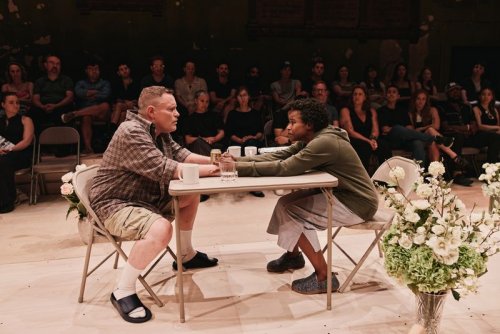
Danny McCarthy and Quincy Tyler Bernstine in a scene from Bubba Weiler’s “well, I’ll let you go” at The Space at Irondale (Photo credit: Emilio Madrid)
Director Serio brings a sure-handed subtlety here, allowing space for quiet moments to breathe and accumulate meaning. Stacey Derosier’s lighting further sculpts the mood with an unshowy yet evocative touch, while Avery Reed’s costume design grounds the play’s Midwestern setting in authentic detail.
At its core, well, i’ll let you go is a profoundly American exploration of grief’s intricacies—the messiness of distinguishing between duty and right and wrong conduct, the strangeness of how people behave around death, and the often-elusive nature of love with happiness. It wrestles with how we make meaning in the wake of loss, how the act of mourning might momentarily clear to reveal what was genuine and what must be relinquished. In the brief less than two hours, Weiler’s play offers a profound reckoning with what it means to endure, to forgive, and to ultimately find peace in the chaos of life’s final, unfathomable acts.
well, i’ll let you go (extended through September 12, 2025)
The Space at Irondale, 85 S. Oxford Street, in Brooklyn
For tickets, visit www.https://tickets.letyougonyc.com/
Running time: one hour and 40 minutes without an intermission


Leave a comment