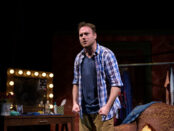
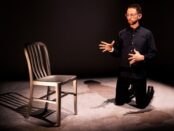
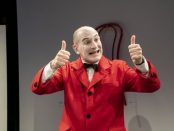
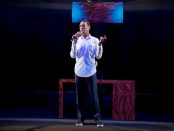
As directed by the astute Josh Sharp, Kayne begins his show as a stand-up act, but warns us “This is a comedy show. BUT it is also sad. There will be long stretches where you will not be laughing. I don’t want to feel like I tricked you, so I’m telling you in advance.” However, Kayne is able to find the absurdity in things that are inherently sad so that there is much humor in his one-man show. After his stand-up comedy routine, he gives a short math lesson using a white board and a black board (set design by Brett Banakis) to demonstrate that things are often not what they seem. [more]
All of this is told by Baer in Twain’s humorous and inimitable style filled with anecdotes both true and untrue. As we are told from the author himself, “I have never been a man to allow the truth to stand in the way of a good lie.” The presentation also includes sections from travel letters in Twain’s own words besides a large section of Huckleberry Finn’s adventures down the Mississippi. The presentation also sets Twain’s life in the context of the growing America of those days, events like the Gold Rush, the transcontinental railroad, the election of Abraham Lincoln, the burgeoning of literacy and the press, etc. Even if you know a good deal about the life of Samuel Clemens a.k.a. Mark Twain, Joe Baer’s one-man show fills in a great many gaps with fascinating adventures of a world traveler who had a keen eye for the ridiculous and the satiric. In "Samuel Clemens: Tales of Mark Twain," he remains good company throughout the evening. [more]
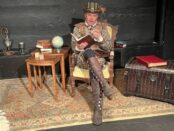
Under the direction of Chad Austin, Droxler uncannily becomes not only Williams (and all of Williams cinematic characters who each serve up different helpful advice), but also his father Ed; mother Mary; and other characters, all, of course, just facets of his own persona. He even conjures the comic actor Jim Carrey who, for a short time replaces Robin Williams as an ad hoc advisor. Even Jack Nicholson makes a guest appearance. [more]
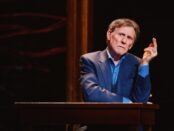
From the moment he walks out with a stuffed “Disneyfied” dragon to tell us a fairy tale his mother told him when he was little, we are enraptured by Pinky, an 11-year-old Chinese boy growing up in San Francisco’s Tenderloin. Written and performed by Wesley Du, "Hong Kong Mississippi" is a coming-of-age tale that speaks innocently, yet often in frank terms, of racism. And providing the real dose of irony, the only other character to experience a seismic shift in the play is the man who resents Pinky the most, a man who against his better judgment unknowingly becomes Pinky’s mentor and father figure he never had. [more]
Fortunately for us, “Magisian” Drance is quite the storyteller. Under the reasonably succinct direction of Jackie Lucid, he spryly moves around the space, emphasizing parables with chalk drawings and applying subtle changes to his inflection, body language, and eye contact to make the various characters distinct. Intense and playful, somber and jubilant, he makes this story engaging yet simple, without the help of costumes, scores, and songs which allow shows like "Godspell" and "Jesus Christ Superstar" to thrive in the contemporary theater canon. The Magis Theater Company endeavors to share this gospel as it might have been done in older times, from start to finish and on the backs of its storytellers alone. [more]
For the audience, there is an ease of losing sight of the fact that what we are watching is a piece of theatre. Campbell is direct and warm and instructing and sensitive in this piece that he has written. He has the right amount of connection to the material, obviously, as this is a scene from his life, yet he creates the minimal distance from the piece so the audience doesn’t obsess over how maudlin the subject matter is. Instead, the audience can be enlightened by his path. [more]
Some critics would say Eric Bogosian’s "Drinking in America" is dated, but that’s very much up for argument. The script given to critics for the new production at the Minetta Lane Theatre is marked “Tweaked Drinking In America Script For Audible,” all in caps actually. In all fairness, some of the “current references” particularly with regard to in-demand actor names bandied about in the scene entitled “Wired” are names clearly from another age. That could have easily been “tweaked,” if they really wanted to do that. References to Quaaludes in the scene “Our Gang” reek of history rather than current usage, but then again, is there an easy 2023 replacement for Quaaludes, a drug that was taken off the market around the time the play was first produced? Aside from those references, the twelve scenes that comprise the play remain shockingly topical for our era. [more]
Garner is a wonderful actor, shifting easily and subtly from one character to another, her voice, posture and gestures are just right. She avoids being maudlin and thereby makes her narrative even more heartbreaking. Even when Eleanor is reunited with her favorite apple tree back in New Jersey, she hits just the right note of sweetness and hope. [more]
David Greenspan, the shape-shifting thespian, has taken on yet another multi-character play, as if his one-man "Strange Interlude" and his more recent "Four Saints in Three Acts" whet his appetite for Joey Merlo’s "On Set with Theda Bara," a mysterious take on the life of the silent picture era vamp and her intrusion into a family whose lives become a film noir. Directed smartly by Jack Serio, the surreal play, just one hour long, took the audience on a colorful journey that included a truly spooky séance. [more]
Sam Morrison’s poignant "Sugar Daddy" has been “on the boards” for just under a year, but first coming to prominence at last year’s East to Edinburgh presentations at 59 East 59th Street Theatres as the Brits say “with a proper sendoff” before he struck gold at the Edinburgh Festival in August. It was only a matter of time before this jewel of a show received a longer run here in New York. It is truly a comfortable fit at SoHo Playhouse, with the only pity being it doesn’t have an open-ended run. "Sugar Daddy" is so many things. It is an off-beat love story; it is an expression of love as much as it is an expression of grief. Most importantly, it is an intensely personal story that he has chosen to share with total strangers, yet we don’t feel like strangers when he’s done. [more]
"Ari Wind’s Inner Circle" is so incredible that it defies the imagination. Can these be called sleights of hand when we see everything that happens at all times? It is the sort of show that you just have to see for yourself and experience firsthand to believe. Not even magicians have been able to explain many - or all - of the tricks. It would be unfair to describe the tricks more completely – though how they are handled will completely amaze and dazzle you. [more]
And that's the agonizing tension in "Without You;" in his lyrical responses to Larson, Rapp is well aware that it's not a back-and-forth, that Larson can't say anything more than he has already. But, just as with "Rent," there is still solace, because I'm sure Rapp, the show's impressive five-member band cozily tucked into Southern's set, and the production crew could hear what I did in the audience: lots of crying. It came with a palpable feeling of not being alone in your thoughts for the dearly departed, especially those taken much too soon. A generation or two removed from having attended "Rent," it was an unspoken bond not only worth revisiting but, if I'm being honest with myself, desperately needed. [more]
"Small Talk," like its title suggests, is less unified than Quinn’s earlier shows. He also uses its format to wander from topic to topic, seemingly randomly without much structure. It allows him to focus on his pet peeves which seem to be the real topic of the show. While some of his earlier shows were big on humor, this one is more interested in provoking thoughts than laughs. [more]
Under the direction of Karl Janes and Andy Smith, Tim Crouch is a very commanding performer, using his resonant baritone to paint pictures with words, holding our attention at all times. Narrating alone he makes us see all he describes from the theater, to the audience, to the landscape on stage and the other unseen actors. However, the play is not for all theatergoers simply because the format is complex and hard to follow and knowledge of the plot of "King Lear" is mandatory. On the other hand, for those who are into experimental theater, this is an exemplary model of the genre boldly pushing the envelope to what is possible. [more]
"Christmas Magic in the Big Apple" continues Richard Holbrook's many years of presenting Christmas season shows. What sets his productions apart from many other performers is his view that this time of year is a time for celebrating family and friends. It is not simply a time of religious holidays but more of an all-encompassing recognition of the joyous spirit that moves people to engage with one another in a celebration of life. His shows are a creative mix of holiday songs with a universal theme. Holbrook commented, “Not everyone celebrates Christmas, and I don't want people coming to my show being made to feel uncomfortable." His playlists over the years have exemplified that view, with the current show being the latest in the series. [more]
Sommerville gives an exquisite reading of Betsy's emotional highs and lows, embracing the difficult range of expression so that the audience can experience the intensity of the feelings being shown. She also provides vivid characterizations of the people who populate her story, bringing them to life as it unfolds. Sommerville seduces the audience into empathizing and sympathizing with Betsy. She uses certain physical mannerisms in her presentation that may go overboard at times, but they do add truthfulness to the depth of emotions being shown. However, please make no mistake: this is ultimately a tragic story. [more]
While Arthur Greenleaf Holmes is the creation of a talented comedian Gordon Boudreau as is Holmes poetry, the presentation is very much true to the era being presented. It is funny. It is bawdy, in the broadest sense of that word. Nevertheless, it is thought-provoking for those who are interested in the skillful use of language. It is not for those who may be offended by ribald, and some may call filthy imagery and poetic descriptions of bodily functions, but it is an immensely entertaining time in the theater. [more]
Cale’s story uses many film noir devices from the 1940’s: exotic locale, strange encounters, searching down unknown streets, disappearing characters, a sexy stranger, danger signals avoided, clues that don’t add up, information that turns out to be fallacious, a damsel in distress, stolen objects, moments of high passion, etc. Yet all seem to be used as if for the first time. The elements are time tested, but the story is new. Cale is an excellent storyteller pulling us in with enough hints and clues to keep us interested until the very end. There are moments that sag but he always pulls out us into something new and unexpected. [more]
Writer/ director/actress Madeline Sayet is an engaging performer. Directed by Mei Ann Teo, her one-woman show “Where We Belong” is an autobiographical tale of her Mohegan roots and her seeking her place in the world as she travels to London to pursue a PhD in Shakespeare. While much of the play contains information and stories that will come as a revelation to most New Yorkers, the play often feels like a lecture with an agenda. The most interesting parts are her own discoveries about her roots and her encounters with other people in which she plays both characters. [more]
"Walking with Ghosts" is a decidedly intimate experience, one that seems tailor-made for an off-Broadway theater like the Irish Rep. Price and his production team try to expand the show to Broadway proportions through McKenna's lighting and aforementioned set and Sinéad Diskin's vivid sound design. But its true scale is human, which means all that's required is Byrne and his bravery. [more]
Belgian actor Ronald Guttman gives a subtle, yet wrenching performance in "The Fall," expounding the philosophies of Albert Camus trapped in the sad and now resigned character of the exiled Parisian lawyer Jean-Baptiste Clamence. Fellow bar mates, we the audience, are his confessors in a sailors’ dive bar in Amsterdam’s red-light district circa 1956. In adapting Camus’ last completed novel for the stage, Alexis Lloyd, has created a role of controlled emotions that belie the seething honesty struggling to rear its ugly head. Director Didier Flamand encourages the full use of the space to make constant contact with members of the audience. Turning around from ordering his drink at the bar, he is in the best position to orate at will. As the performance takes place (and fits very neatly) in the entirety of the Huron Bar (the lower level of the SoHo Playhouse), the original architect of the building should be entitled to a scenic design credit. The best seat in the house is occupied by the bartender. [more]
Etheridge may be 61, but she sounds just as she did when she first came on the American rock scene in 1988: full-throated emotion and raspy vocals that bring honesty and pathos to intensely personal and confessional lyrics. The accomplishment in "Melissa Etheridge Off Broadway: My Window – A Journey Through Life" is not in the many scenes of heartache and a dense song list, but in the strength and the resilience that carries her to artistry that she shares so unselfishly and unselfconsciously to speak to and heal a legion of fans. [more]
Actor/writer/director Douglas McGrath is a charming storyteller and his one-man show "Everything’s Fine" is a total delight. He tells the entertaining and poignant story of his eventful 14th year when he was in ninth grade but also describes life in his family of five growing up in Midland, Texas. His tale of darkest adolescence is also nostalgic and reminiscent of the problems of life as a teen. The title turns out to be ironic as it was an expression his father used before announcing there was a new problem. [more]
Although Alan Cumming is a charismatic performer, the distracting video design, the often overpowering music, and the often flashing lighting by Tim Lutkin, gets in the way of viewing the show. Much of the effect is created by the atmospheric lighting which periodically changes color (blue, green, red) yet at times it turns the evening into a multimedia event. Since none of the poems are clear enough to be understood, we learn little of Burns’ output as a poet though we do hear about his triumphs that lead to being lionized in Edinburgh. The contemporary music only rarely suggests the period. The dance elements also seem an eccentric way to portray this 18th century man who attempted to live life to the fullest. Cumming charmingly depicts this Scottish icon though he does come off as a lovable rogue. It is all an example of too much being too much. The rather coy ending has Cumming sitting on the edge of the stage declaiming Burns’ now famous poem, “Auld Lang Syne,” after the final curtain has already descended. [more]
Greenspan isn’t always totally clear when switching points of view, but made up for this by turning the entire, long script into a wonderland of gestures, vocalizations, postures and movements. His eyes and his hands are masterful communicators. His lean body’s dancelike movements add dimension to the onslaught of words. This is a performance that must be seen to appreciate how mindboggling his accomplishment is. [more]
As a piece of writing, "The Near Disaster of Jasper & Casper" is whacky and creative, and except for a couple of out-of-place bits of humor, one involving a middle finger and another a candle called “Blow Me,” it is charmingly humorous. The story even becomes lightly touching when Jasper’s love for his brother Casper is tested, and Jasper learns the real meaning of family and what it is to be responsible for others besides himself. "The Near Disaster of Jasper & Casper" is a thoroughly enjoyable, quirky fairy tale told by an expert storyteller, Jason Woods. By the end of this foray into the woods, it was time to go, I hated to leave, I had to, though. Worth a second viewing. [more]
D'Astolfo (that’s duh-STAHL-fo, mkay?), who also wrote the piece, sends Taylor off like a firecracker from the moment he comes onto the stage, speeding through Taylor’s wry and witty dialect so fast, why Mother of Jefferson Davis, he’s passing the fox! D’Astolfo’s dialogue is chock full of delightful West Virginian-isms, gay and regional. Taylor is described in the script as “wide-eyed and winning,” and this definitely describes D'Astolfo in the role. He also adds to the play’s humor in a totally different capacity as the voice of the wry, off-stage announcer and master of ceremonies. [more]
If you ever lived through the angst of an unrequited love, a romance impossible for one reason or another, then Billy Hipkins’ "Prince Charming, You’re Late" will hit the spot. Directed by Perry Dell’Aquila, the monologue flows smoothly and movingly. Hipkins, a forty-something gay man with a gentle, softly sardonic nature, fell for a much younger actor in a Broadway show where he was employed as a dresser. Unfortunately, this was a job that put him up close and personal with the object of his frustrated affections. Hipkins’ description of this unattainable young man is both heartbreaking and heartwarming, a vision of unattainable perfection in every way. [more]
Romy Nordlinger has written and is performing the monodrama, "Garden of Alla: The Alla Nazimova Story," at the TheaterLab. Directed by Lorca Peress, "Garden of Alla" gives us this eccentrically talented artist up close and personal. Nordlinger has a history of portraying Nazimova and has honed her interpretation to the point that it fits her like a second skin, helped by Peress’ sense of pacing and stagecraft. [more]
Takiff is a skilled performer who never loses the audience no matter how angry or sardonic he gets. He is helped by the mood setting lighting of Elizabeth M. Stewart and the sound and video contributions of Matthew Chilton. Mark Mindek provides some minor, but effective, dance bits. Brian Lane Green’s direction made all of pieces fit together into a cogent whole. As difficult as the subject matter is, "Jews, God, and History (Not Necessarily in That Order)" should be seen as a fresh, in depth consideration of the subject matter. [more]
Alison Leiby’s "Oh God, A Show About Abortion" is probably the most level-headed work about that much debated subject, perhaps too level-headed. While the United States is going through social and political paroxysms over a leaked Supreme Court argument that portends the overturn of Roe v. Wade, Leiby’s matter-of-fact attitude toward the subject is a balm. [more]
Greenspan, a six-time Obie Award winner, whirls at breakneck speed through this three-act play in just over an hour, transforming from one character to the next with expert fluidity. He transitions between the highly dramatic and entitled Grace, the histrionic and prideful Mrs. Harrington, the simple but lovable Mr. Harrington, the gentle and sweet Patricia, and the gangly, dopey gentleman callers Tom Anderson and Billy Caldwell, drawing on every gender-bending limb, muscle, hand, voice, look or facial gesture he can muster. Even the brusque Tip Busty and party girl Sadie Buchanan get their own unique treatment. [more]
Whether frenetically dancing, rhapsodizing over Nancy Drew, fretting about when she’ll wear a bra or reacting horrified upon learning about sex, Ms. Curry performs with the verve of Lily Tomlin in her prime. Curry’s rich portrayal of Jaqueline Marie Butler captures the wonderment of childhood amidst harsh realities and the physical and emotional upheavals of adolescence. A matter-of-fact confession that Jaqueline has been molested is a chilling highlight. With her wide-eyes, expressive facial features, limber physicality and vocal prowess, Curry often rapidly achieves distinctive characterizations of the dozen other figures in the play. The wizardry of Mika Eubanks’ costume, hair and makeup design all visually enhance Curry’s performance. [more]
Despite the familiar visual trappings--mic stand, performer-blinding stage lights, and a dull curtain backdrop--Edelman's deceptively free-flowing talents hew more towards the monologist Spalding Gray than those of Williams. Like Gray, Edelman is an entrancing storyteller capable of stitching together personal anecdotes into a rich thematic tapestry. In Just for Us his canvas includes mental pictures of growing up Orthodox Jewish in a Boston where white privilege is starkly stratified; his brother's 2018 Winter Olympics participation as a member of the Israeli team in possibly the least athletic competition; witnessing the actions of a predictably conceited Jared Kushner at synagogue; and the touching time his family celebrated Christmas in order to console a bereaved non-Jewish friend. [more]
Her nine years on SNL would seem excellent preparation for "Search" which requires her to portray ten different characters alternately. However, although Strong has tremendous stage presence, she has not yet grown into all of the roles or given all of the characters (nine women and one man) distinct, separate voices. While still a tour de force for one performer, the play seems dated after 37 years with one scene using a coin pay phone and several references to the Equal Right Amendment (ERA), neither of which are in common parlance anymore. On some level, a good deal of the play takes place in the past (Betty Friedan, LSD, Rupert Murdoch, “I mean the Women’s Movement isn’t that old,” etc.) but as no years or dates are mentioned, it feels like it is taking place now which seems like a mistake. Without the intermission, the show presents too many stories to take in all at one sitting. [more]
He used the gimmick of preparing to perform the very show he was performing for his audience in the Cabaret Theater of the Theater for the New City; but by the end of his fascinating and grueling life story he was on fire with his tale of his life in the theater and film. He grew up in the Sixties when the U.S. was in turmoil and it seemed that everyone was getting high. Smokey’s career began with a first prize in his Washington, D.C., high school talent show and some performances at the Arena Stage. He quit school to try his luck in California but failed and returned to D.C. where he joined an all-Black repertory theater and appeared in his first commercial which he showed on a large screen. Much later he appeared in Francis Ford Coppola’s "The Cotton Club" as a featured musical performer. His number in the film was shown proving he was an impressive dancer and singer partnered by Jackée Harry. [more]
Although Candace Bushnell’s one-woman show, "Is There Still Sex in the City?," shares the same name with her 2019 novel/self-help book, the stage show now at the Darryl Roth Theatre is her autobiography telling the story of her life and career. Ms. Bushnell proves to be a vivacious performer with a great deal of stage presence, not surprising for a woman who was the model for "Sex and the City"’s Carrie Bradshaw. The show is both entertaining and revealing, correcting many misconceptions about the true adventures of the author. She also gets to change into a dazzling array of outfits by Lisa Zinni in an attractive apartment setting by Anna Louizos which colorfully lit by Travis McHale. And like Carrie Bradshaw she collects shoes which are in evidence in the shelves on the stage. [more]
Performed as one long 80-minute monologue, A Girl is a Half-formed Thing also offers actor Jenn Murray little, if any, respite, laying on her shoulders complete responsibility for telling every detail of its emotionally unyielding story. Besides the girl, she must give voice to all of the other unnamed characters in the play, too, distinguishing them so that the staged version of McBride's novel, where it's impossible to simply reread a sentence, has an immediate intelligibleness. By itself, this feat is enough to make Murray's performance astonishing, but it's only the tip of her accomplishments. [more]
But of course, looks are famously and frequently deceptive, if not all the time. Indeed,"Kristina Wong, Sweatshop Overload" emerges as one of the most serious-minded plays of all, as it surveys what we all have been going through and having to endure for the past 20 months. During that period, as you may recall, there were various times when necessary facemasks were proving unavailable—and especially in different parts of the country. Wong made it her business to recruit hundreds of her “Aunties” to produce them and provide relief, ergo the self-deprecating description in her title. She may have been overseeing something akin to a “sweatshop,” but it’s hard to imagine her as a demanding “overlord” of anything. [more]
Employing his majestic vocal and physical talents, Santiago-Hudson supremely differentiates each of his brief characterizations with specificity and pathos. There’s also a poignant dynamic as he plays himself as a child and now at his current age. Santiago-Hudson’s staging is equally as assured as visually and aurally and the production is impeccable. Blues guitarist Junior Mack is onstage dramatically matching the spoken words with his skillful performing of Bill Sims Jr.’s intense original music. [more]
Each interviewee’s name is projected onto the back wall as Clark carefully transitions between the 21 people she’s interviewed; young, old, male, female, cis- or otherwise. This is a large number of roles for one person to play, so there is some blurring of “characterizations”; nonetheless, Clark establishes an effective conduit for what is ultimately most important: the messages that these individuals share about their experiences and varying successes with non-monogamy and/or polyamory. The direction by Molly Clifford seamlessly shapes the evening into an effective delivery device for thoughts on an intriguing subject. [more]
Holmes’ songs include clever lyrics particularly “Facebook,” “I Can Be That Guy” and "Beautiful Girl in the Front Row.” His expert playing on the keyboard allows him to have duets with himself and making it sounds like many instruments. He also accompanies himself on the guitar and a drum. The show is a confessional in which Holmes reveals the worst, most embarrassing parts of himself which seems to be the latest thing with comedians, except this show is partly sung. However, it is bright and upbeat even when telling unlikable characteristics. Craig Bundy’s sound design is usually clear, but occasionally makes it difficult to catch the lyrics. Director Caitlin Cook keeps this one-man show moving swiftly along. [more]
If a hallmark of our best stand-up comics is that he or she is unique—think of Whoopi Goldberg, Jackie Mason and Lenny Bruce—a relative newcomer named Neal Brennan belongs in their company. In his new work, "Neal Brennan: Unacceptable," directed by Derek Delgaudio, now playing at the Cherry Lane Theater—a jewel box space in the West Village—Brennan sustains his non-stop humor for 90 intermissionless minutes. This is despite our having been told it would only be for 75 minutes. But we welcome the 15 extra minutes. [more]
As his mother Bete (pronounced Bet–chi), Soria is bigger than life without a great deal of assistance from props, costuming or make-up. When he enters carrying an offering to the stage which is set up like a tropical altar to Iemanja, the Afro-Cuban diety whose picture is on the wall center stage, he is wearing a white linen skirt which he suddenly pulls up and it becomes his mother’s dress (designed by Haydee Zelideth). In English punctuated with pungent Spanish and Portuguese, sometime translated, often as not left unexplained, Bete tells us of her three marriages, each one unfulfilling, and of her children, her difficult son Arturo who from a young age wanted to dance ballet and was always getting into trouble, and his sister who always liked sports. We learn of her unconventional child rearing practices which was as much a tug of war with her children as it was a series of lessons in living, and marked Arturo for life. [more]
“Do I believe in heaven and hell or another parallel universe? If I parallel park in a parallel universe will I be double parking?” muses the affable performer Robert Dubac during his clever self-written comic solo show, "The Book of Moron." Dressed in gray trousers, a black shirt and a black jacket, the seasoned Mr. Dubac holds forth for 80 minutes with his appealing persona that recalls Mort Sahl’s topicality, David Steinberg’s impishness and George Carlin’s profundity. [more]
She gets to sing everything from the Patsy Kline classic “Crazy,” “Respect” (made famous by Aretha Franklin), and “Summertime” from Porgy and Bess to generous, beautifully acted scenes from Bizet’s Carmen, her favorite role and the highlight of the show. The setting, a comfortable, slightly formal room (by Jaime Terrazzino) also includes a convenient grand piano played by John DiPinto (who alternates with Allison Brewster Franzetti), clearly delighting in collaborating with this warm-hearted diva. [more]
With its eloquent nods to conceptual art, good-natured comedic tone and superior performance, "The Artist Will Be With You in a Moment" is an intelligent entertainment. [more]
Some books and movies and poems do not lend themselves to theatricalization, and that’s certainly the case with "Incantata," which is currently being given its American premiere at the Irish Repertory Theatre. Though it’s only 80 minutes long, it felt like an eternity--and not only because of the story--but also the telling. What’s even more annoying is that it tells the same poem, again and again, and seemingly again. [more]
"Goy Friendly" is clearly meant as a light entertainment with lecture-demonstration components and succeeds as such. It’s delightful spending time with this superb raconteur, even if he cleverly sidesteps the deeper implications of his subject matter. [more]
Mr. Droege’s sharp and well-observed writing renders each of these familiar figures with biting depth, achieving grand mini-portraiture. Though preoccupied with comedy, an undercurrent of proportioned sentiment elevates the work above mere caricature. Promiscuity, aging, drugs, alcohol, loneliness and the past are among the issues eloquently explored in relation to the gay male lifestyle. Droege’s shrewd structure has each of the participants alternatively popping up to chatter while imparting pertinent personal details, fueling the semblance of a narrative. [more]
Amidst the hubbub that includes coerced audience clapping and singalongs, we attempt to discern what the point is. It appears to be the story of an outsider who takes up residence in a rural locality and is accused of a crime; the audience votes whether to convict or acquit him. Several audience members have been given pages of lofty speeches to recite. “The words your fellow Townspeople quoted come from Dr. Cornell West and Coretta Scott King,” states the program. Where We Stand’s 70 minutes are mildly engaging if often baffling and do make some impact. [more]
Hoyle has brought his most recent play, "Border People," to New York City in a production directed by Nicole A. Watson. It’s a work dedicated to people who dwell along borders of various sorts—“geographical or cultural”—and it suggests that no matter how clearly lines of demarcation may be drawn, they can seem arbitrary and sometimes strangely porous. Hoyle presents nearly a dozen characters in this show: diverse in age, gender, race, nationality, religion, sexuality and temperament. He includes people from one side or another of actual U.S. borders, both to the north and to the south. We also meet characters from the Bronx who live along the borders that separate the borough’s “projects” from the outside world. [more]
Employing an impressive array of voices and mannerisms, and only sometimes augmented with a wig or article of clothing, Miller as “Narrator” impersonates numerous performers, personalities, and politicians of the era, voicing every commercial and even dubs his own parents in short video clips at the very beginning of the piece. “100 voices. 25 years. 1 man,” the publicity statement declares, and Miller doesn’t disappoint. [more]
More in the spirit of Carrie Fisher than Christina Crawford, performer Barra Grant chronicles her life and that of her famous mother in her engaging and smartly presented self-written solo show, "Miss America's Ugly Daughter: Bess Myerson & Me." Nostalgic New Yorkers will have their memories refreshed while others might be delightfully informed. It’s a harrowing, insightful and often very funny 90 minutes. [more]
After marveling at Ken Jennings’ power of memorization, one has to admire his ability to deliver the entire text of "The Gospel of John" with unwavering clarity and devotion to its meaning both as literature and as a Christian lodestone. An agile actor (and singer), Jennings (the original Tobias in "Sweeney Todd"), deftly tells the story of Jesus as seen through the eyes of John the Baptist. The actor roams about a simple raised platform in front of a rough-hewn back curtain made of wrinkled tan cloth. What looks like a handmade bench—a subtle reference to Jesus’ vocation?—completes the set. [more]
Houses on the Moon Theater Company’s delightful and earnest mission is to “dispel ignorance and isolation through the theatrical amplification of unheard voices.” "The Santa Closet," another one-man show written and performed by the company’s co-founder Jeffrey Solomon, doesn’t reach the lofty goals of some of his other plays; however, the newly updated, tenth-year anniversary production of this frothy, zany tale is nevertheless aloft with quite a few grins and chuckles. [more]
The Reverend Al Sharpton, Angela Davis, and Sonny Carson are among the two dozen celebrities, cross section of New Yorkers, and male and female integral figures of diverse ethnicities that are given astounding portrayals by actor Michael Benjamin Washington. These simulations occur during this bedazzling revival of conceiver and writer Anna Deavere Smith’s acclaimed 1992 solo play about the Crown Heights Riots, "Fires in the Mirror." [more]
Kathleen Chalfant adds another feather to her cap as Emily Dickinson’s posthumous editor Mabel Loomis Todd in the world premiere of Rebecca Gilman’s new one-woman play, "A Woman of the World," presented by The Acting Company in association with Miranda Theatre Company at 59E59 Theaters. Staged by Miranda’s artistic director Valentina Fratti with elegant assurance, Chalfant is both fascinating and seductive as this real life woman who in the 1880’s and 1890’s scandalized conventional Amherst, Massachusetts, with her liberated and bohemian behavior long before such goings on became acceptable for women – or men. [more]
Like a great many history plays, Harvey Fierstein's "Bella Bella" is as much about the present as the past, paralleling everything that's gone wrong now with what went wrong then. Unsurprisingly, it's also shamelessly biased, with the first word in the play's title apparently meant to be read in Italian as part of Fierstein's banally straightforward tribute to Bella Abzug, the feistiest of feisty 1970's New York City politicians, best known for her take-no-prisoners liberalism as a member of the U.S. House of Representatives. One's enjoyment of the play probably depends on how prone you are to clap or hiss along with the rest of the unambiguously sympathetic Manhattan Theatre Club audience, even if it's only in your own head. [more]
The play captures emotions that many of us have felt, from unrequited love, to loss. Seldom are we allowed access to such a raw story and candidness. In a time where we shield each other from truths, this stark and unapologetic performance allows us to feel what Victor meant to Edgar. [more]