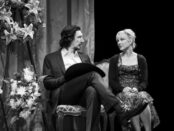
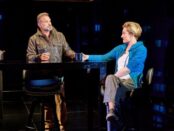
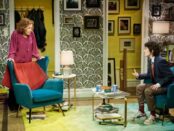
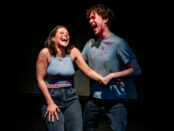
How can you make a new play about a couple on a blind date in a bar interesting for today’s jaded audience? In "Strategic Love Play," British playwright Miriam Battye makes them play games as well as dislike each other as soon as they meet. Under Katie Posner’s direction Heléne Yorke ("The Other Two," "Masters of Sex") and Michael Zegen ("The Penguin," "The Marvelous Mrs. Meisel") are able to keep up the startling interactions between them for the 90 minutes of the play. The play covers several arcs from dislike to interest to boredom to acceptance to disbelief. [more]
"Woman on a Ledge" is an adaptation by Hershey Felder of harpist Rita Costanzi’s writings about her life. Ms. Costanzi is a world-renowned harpist whose life experiences have been woven into a fascinating and highly engaging theater piece. As directed by Lissa Moira, this one-woman production beautifully integrates Ms. Costanzi’s superlative playing with her solid storytelling. One does not have to be a harpist or classical music fan to enjoy this production. Her storytelling alone is worth the time spent, and it becomes exceptional when coupled with her exquisite playing, used to underscore elements of her story. [more]
Ako's portrayal of Izumo no Okuni combines traditional Japanese dance movements with Western-style acting. The nature of the script limits the impact of her performance. The dialogue is simplistic, verging on a museum presentation. The story being told is too small for someone who is such a large character in the folklore of Japan. It is a story that calls for a larger cast to show the impact her dance and performance style could have on audiences. Okuni certainly did not dance alone, so what needs to be added is the pageantry and bravado of a fully engaged dance ensemble. Ako also portrays Lady Yodo, the mistress of the late Toyotomi Hideyoshi, credited with the unification of Japan that led to the establishment of the Tokugawa shogunate. [more]
Can the tale of two families living in Palestine just before the partition that created the State of Israel shine a light on the current status of affairs? Playwright Tom Block’s "Oud Player on the Tel" does just that with a combination of wit and empathy. The play, currently at HERE Arts Center in SoHo, is part of HERE’s SubletSeries. [more]
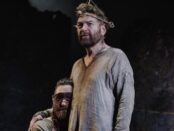
Firstly, the play has been shortened to two hours without any intermissions, when most recent productions have been three and a half hours with one intermission. This makes all of the events seem to take place too soon, one on top of the other, so that the sense of a world turned upside down is never felt in the production’s rush to the end. There is little sense of turning “the wheel of fortune” spoken of several times in the play. All the actors including the 63-year-old Branagh in the title role seem too young for their parts. While Lear describes himself as “a very foolish fond old man,” in fact, in this production he is a very vigorous and hearty leader, though capricious in his decisions. The supporting cast though excellent in their diction and authoritative in their roles seem lacking in technique to make the roles both interesting and their own. The low-key characterizations damage the play’s violence and viciousness. [more]
Director Scott Ebersold works wonders with the double-edged sword of the audience knowing full well these performances are colored by the play taking place close to 20 years ago when girls this age didn’t have the benefit of understanding their gender identity as girls do in 2024. Social media and sexual education have made great strides in these decades yet we don’t for even a moment feel that Mr. Ebersold’s concept gives us a museum piece. Ebersold gets vibrant heartfelt performances from each of the three actresses. [more]
"Café Utopia" by Gwen Kingston and directed by Ashley Olive Teague tells the tale of a juice bar that, on the surface, appears to be socially progressive, but behind the scenes, is a different story. Based on real stories from workers involved in the current efforts to unionize juice bars and coffee shops, this play lays bare the corporate behavior that puts profits before workers. During changes in some scenes, different characters read statements collected from workers about their work-related experiences. These moments are important in underscoring the overall content of the show as it relates to the plight of workers who lack union protection. [more]
As long as you come to John Yearley’s "Triptych" with the understanding that grief is a deeply personal and complex emotion and that just because two people are married doesn’t mean they will experience a traumatic event exactly the same way, then you will understand the plight of Joe and Blanche. It goes without saying, although it’s always said, nothing is sadder than the loss of a child; the parent is “supposed to go first” and the children are expected to grow older and have children of their own but life and unexpected tragedies have a way of getting in the way. [more]
Nevertheless, the play is one of several interesting takes on climate change in the theater recently like "Deep History." As the play evolves we are more and more immersed in the problems of climate change that are now only distant possibilities. The actors are compelling but do not entirely inhabit their roles. Making her Off Broadway debut, Rossum, best known for her work in the Netflix's series "Shameless" and film version of "The Phantom of the Opera," is suitably conflicted as one who has given up her chosen career and taken the opposite path. Winters, known for her breakout role in the HBO series "Succession" as well as many major Off Broadway roles, is more controlled as the current astronaut who is confused by her sister’s current choices. However, both sisters are a little too similar to make them dramatic opposites. In the underwritten role of Bryan, Foster is quite appealing though he can’t fill in the gaps that are missing. [more]
Haller has created a world where robots have conquered all of humanity through the ability to copy, with precision, the technical aspects of a functional society. The lack of understanding of human artistic creation keeps them from destroying a particular element of human culture: creative artists. The missing element in the totality of their superior nature is the spark of artistic creation. It is an aspect of humans they do not fully understand. So, they keep alive those humans considered to be creative artists in an attempt to understand and replicate the human ability of singular artistic creation. [more]
This is another one of those cut down versions of Shakespeare with only ten actors in total. As result, seven of the ten actors double (one triples). The problem is that almost all of the actors have to appear in every scene to fill out the stage. It is also very difficult to know who is who with almost every actor (other than the two leads) playing more than one character, some in gender swaps. The Nurse played by (Ms.) Tommy Dorfman also plays Tybalt, while Mercutio, The Friar and the Prince are all played by actress Gabby Beans. [more]
As both playwright Harry Teinowitz and his co-author Spike Manton spent time in rehab, they carry us through the epiphanies as well as the relapses by injecting humor in every “shot glass” of this play. This is most evident when George returns from a drinking binge with the front wheel of his bicycle mangled into a pretzel. The roommates focus on the “falling off the wagon” rather than the falling off the bicycle. The highlight of their days (and nights) is getting together to watch reruns of "Cheers," with the episode where Sam Malone relapses being one they can probably chant verbatim the way other people can act out all the parts of "The Rocky Horror Picture Show." [more]
"Bad Kreyòl" is gifted with a pre-show voiceover from the playwright herself: “To love a people is to learn their language.” This speaks volumes for two women who know what they know, aren’t keen on changing it up any, and are inherently both generous givers and caretakers in every aspect of their lives. And yes, sometimes you need to butt heads. [more]
"Rawshock" is a powerful, insightful, compelling play that lays bare the craven manipulation of corporate healthcare in the name of profits. It is beautifully written by Rita Lewis and superbly directed by Ken Wolf, who also did the lighting and sound design. It is a story about a group of patients in a psychiatric hospital setting and what happens to them when the new corporate owners of the hospital disrupt their therapeutic group. It is a gem of a show with outstanding performances that should not be missed by anyone who enjoys solid dramatic theater. [more]
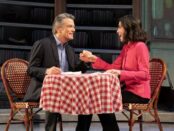
Although the play is graceful and appealing, it is mainly presented in narrative form with Delia played by Julianna Margulies in New York and Peter Gallagher playing Dr. Peter Rutter, her surprise new boyfriend from California, reading their emails to each other from desks at opposite sides of the stage. Left on Tenth, with its episodic nature, and many short scenes, is really a screenplay with the lead actors doing the equivalent of the voice-overs. Susan Stroman, best known for her choreography and direction of musicals, has piloted the play with polish and urbanity, but has not solved all the play’s problems. [more]
Wilder’s experimental play uses no scenery except for two tables, some chairs, a piano and usually two ladders for the upstairs bedroom windows of the young people. Here, however, Leon and set designer Beowulf Boritt have eliminated the ladders for two windows that open in the wooden back wall. Parsons’ description of the town and the street is so vivid that your imagination sees all that is meant to be there. Many of the stage effects are created by Allen Lee Hughes’ subtle lighting plot which takes us back to the end of the last century with lanterns both on the footlights and in Parsons’ hand. Leon has also added another one of the five senses by piping in the odors of heliotrope, vanilla, and bacon, one in each act. Professor Willard is here played by a woman, and as John McGinty playing milkman Howie Newsome is hearing challenged, the other actors speak to him in sign language, a new effect for this drama. [more]
Essentially a cri de coeur, "Vladimir" desperately wants to answer affirmatively; however, Sheffer forthrightly acknowledges that it's a dangerously knotty road to yes, requiring Raisa (Raya in the diminutive form) to not only imperil herself but also possibly cause the deaths of others. In particular, passivity is the much safer choice for Yevgeny (David Rosenberg), a financial analyst who, despite having experienced virulent anti-Semitism while attempting to navigate the Russian educational system, helps Raya link that aforementioned suspicious tax refund to the upper echelons of Putin's corrupt administration. Like Raya, Yevgeny is not purely plucked from Sheffer's imagination, as he also possesses a non-fictional counterpart, Sergei Magnitsky, who, in a tragic similarity to Politkovskaya, savagely lost his life for having the courage to tell the truth about Putin's misdeeds. [more]
Directed by Annette Mees, "Deep History" is a real eye opener but it is not depressing. Finnigan is so upbeat and compelling a storyteller it is not possible not be pulled into events as he describes, telling the history of the world from the point of view of a mythic woman who appears in all eras. The show is punctuated by Australian pop songs that figure in both Finnigan's life and the history he is recounting. The video design by Hayley Egan will sear the proof of climate change into your eyeballs permanently. You will never think about this topic the same way again: a not to be missed enlightening theatrical event. [more]
This stunning theatrical work is a creation of the two-member On The Rocks Theatre Co. (Christopher Ford and Dakota Rose), two ingenious artists who have been at work on "The Beastiary" since they were selected as Ars Nova’s fifth Company in Residence in 2019. Commissioned to create a new show from scratch, a first Ars Nova-produced reading came to fruition in 2021. Adding composer Dorit Chrysler to the team, later 2022 workshops added the theremin score and the puppets to the play. More behind the scenes development, a puppet build residency, and a two-week production workshop built the show that is now at Greenwich House. Ford and Rose have co-written and co-designed the scenic elements. Ford designed the glorious costumes and hand-made puppets and Rose directed the entire production. [more]
Lloyd Suh writes quirky historical plays from a unique perspective as ironic comedies. In "Franklinland," the latest entry in the EST/Sloan Project, commissioning and developing plays about science and scientists, Suh creates a Benjamin Franklin like you have never seen him depicted before. Unlike Howard Da Silva’s iconic and benevolent Franklin in the now classic musical "1776," this Franklin is crotchety, irascible, arrogant and demanding. In the play’s six scenes covering 33 years, we see him in his fraught and contentious relationship with his illegitimate and only son William who though not a great mind or a scientific genius like his father goes on to do well for himself politically. [more]
Comedian Hannah Gadsby became an international sensation with their Netflix Special "Nanette," in which they revealed traumatic episodes from their past along with a slew of jokes. Gadsby's latest, "Woof!," now at the gorgeous Abrons Arts Center, is more focused on laughs than serious matters, but it still has some serious moments. [more]
James Ijames’ new play now at The Public Theater is quite different from his satiric Pulitzer Prizing-winning "Fat Ham" which appeared there two years ago. "Good Bones" is a realistic depiction of black on black gentrification in an unnamed American city, a theme not often represented on our stages. This provocative and timely play also has some intriguing supernatural elements which are not fully dealt with in Saheem Ali’s otherwise polished and urbane production. [more]
Clearly, Hwang’s playwright-within-the-play has been on a colorful journey, full of characters that amuse, anger and move him. Hwang’s genius here is his ability to spin his real life into a fascinatingly entertaining work using all these events and characters. He is artful in balancing the lighthearted with the sardonic and the dramatic, the result being a colorful portrait. The flier for "Yellow Face" shows its handsome star Daniel Dae Kim holding a mask of his smiling face away from his own scowling visage, a witty take on the Greek Comedy/Drama masks, a shorthand for "Yellow Face"’s richness. Of course, having Daniel Dae Kim in the central role embodies his character with depth and subtlety. [more]
"Ashes & Ink," a new play by first time playwright Martha Pichey, is getting an excellent production at the AMT Theater in Manhattan. Tony-nominated actress Kathryn Erbe leads a strong cast smoothly directed by Alice Jankell. [more]
While "Sump’n Like Wings" is a lovely little play about a feisty 16-year-old girl who wants her independence in the 1913-16 period just after Oklahoma became a state, unfortunately Raelle Myrick-Hodges’ production is limp and undramatic, not making a good case for restoring this play to the American repertory. Ironically, while the fact that Riggs was gay and a Native American is being publicized by this production, neither of these themes appear in this play. The use of Junghyun Georgia Lee’s unit set for all five scenes makes the play seem thinner than it is and the beautiful poetry and high flown language of "Green Grow the Lilacs" (made available in the collection "The Cherokee Night and Other Plays" from University of Oklahoma Press) is nowhere in evidence in this play. Most of the important events take place offstage, unlike some of Riggs' other plays. [more]
In a theatrical era when "full-length" works often fail to exceed 90 minutes, the English playwright Jez Butterworth dares to dubiously dramatize for approximately twice that span. His previous Broadway epic, "The Ferryman," conflated The Troubles with anachronistic paganism, a disturbed old woman's fear of banshees, and lots of boozing, earning Butterworth much critical acclaim, as well as Olivier and Tony Awards, for this bold mix of pretentiousness and unabashed Irish stereotyping. "The Hills of California," Butterworth's latest overhyped synthetic slog teeming with underdeveloped characters, is basically a tale of two postwar entertainment cities: Los Angeles, the world's dream capital, and Blackpool, England, a fading resort town that's become uniquely fit for delusions. [more]
As in Ayad Akhtar’s plays "Disgraced," "JUNK" and "The Who and the What," all of which have been produced by the Lincoln Center Theater, "McNeal" is always interesting, always arresting. Unfortunately, in McNeal each scene seems to bring up a new theme and never completely finishes with the previous one. The individual confrontations are fine, but they never coalesce into a unified whole other than to depict the messy life of a famous author which can’t be the author’s sole purpose. Is the message that Artificial Intelligence is dangerous or only in the hands of the wrong people? [more]
“Lust, jealousy, and personal politics” are the punches promised by the publicity tag line for award-winning playwright Yussef El Guindi’s new play "People of the Book," currently on the boards at the intimately compact Urban Stages. The story centers around three high school friends, one of which has returned from the Middle East with a new bride and his newly written, soon-to-be-a-major-motion-picture celebrated book. Themes of competition, morality, and judgment are all bandied about in this ambitious play. [more]
Director Jared Mezzocchi uses the proximity of the actors to the audience to its best advantage. We don’t even question when one of our ranks is pulled out to play Young Sunny. It adds to the sense of community that is the cornerstone of this production. Kudos to Mezzocchi and the four actors in intuitively divining who in the audience is most right for participation. As the play dashes back and forth in time, the actors are kept moving, narrating as they go along. Again physical life clearly dictates whether they are in character or in narration mode. Mezzocchi incorporates projection design to complement the telling of the history of the ever-changing neighborhood. It provides a welcome steady stream of point-of-reference when one considers the land was once dry tundra in the shadow of a glacier twice the height of the Empire State Building. [more]
Welcome to 'Lakeplay," a character study-play written by Drew Valins and directed by Hamilton Clancy. It is billed as “a terrifying adventure” but does not live up to that description. There are moments of suspense, but not terror-filled. If being frightened by a story is what you are looking for, this is not the show for you. The show is more of a work in progress with issues relating to the venue, sets, and unevenness of some of the scenes. [more]
Despite this obvious shortcoming of The Counter, Anthony Edwards, a growing New York stage presence after much TV and movie fame, resolutely ignores it, never letting Kennedy's contrived writing come between him and the character (as a frustrated fan of ER, I've seen this steadfastness before). The scraggly bearded Edwards portrays Paul, a retired firefighter from far upstate New York whose geniality occasionally gives way to pronouncements about the monotony of his remaining days and the unfairness of his former ones. Although these gnawing thoughts are "secrets," he shares them with Katie (Susannah Flood), a fairly new transplant to the area who is also a waitress in the diner he frequents when nobody else is around. That's essential for Kennedy's ludicrous plot, because Paul's inner turmoil manifests itself in a grave request for Katie to do something that, if overheard, would cause any sentient adult to immediately contact the authorities, resulting in the play ending not too long after it begins, unless Kennedy felt like keeping the story going through a depiction of Paul's psychiatric treatments. [more]
Gabriel Kahane’s pair of song cycles are a welcome throwback to when lyrics were poetry and told great stories. Think of the 70's when the airwaves were blessed with the voices and songwriting of Harry Chapin, Joni Mitchell and Cat Stevens and you will have a basic understanding of what Kahane has successfully put together here. [more]
Barry Primus’ "Soup in the Second Act" is described in press materials as a "dramatic comedy" but it's more drama than comedy. The humor comes from old-fashioned actor jokes such as this one: "Two actors bump into each other on Times Square. 'God, where have you been? I haven't seen you in such a long time.' 'I'm doing a one man play all over the country.' So the other says, 'That's great. That's great. Anything in it for me?'" If you like that sort of thing, you'll enjoy "Soup in the Second Act" (which is itself the punchline for another actor joke). [more]
While the play is compelling, the question is what is the message? Is the play asking would we have done what the son did? The father is quoted by the son as calling him a traitor while the son defends his action as that of a patriot who was appalled by his father’s attacking the Capitol. The play is, to a great extent, preaching to the converted as only people who consider what happened on January 6th an insurrection would attend the play, while MAGA proponents will not view it that way. The ending is somewhat predictable though the twists and turns of the story do not always take the expected path. [more]
"Dickhead," written by Gil Kofman and directed by Richard Caliban, is a story about the patriarch of a dysfunctional family in the midst of a near-total disintegration. The action is centered on Richard (Ezra Barnes), an abrasive, abusive lawyer who is rightly called “a dick” by his wife and just about everyone who interacts with him. He is also called Dick, as a nickname for Richard. The only time he is called "Dickhead" is midway through the action, in a maybe friendly comment by his oldest friend Howard who is given a solid portrayal by Chuck Montgomery. In the opening scene, Richard is in the office of his therapist Dr. Adams (Frank Licato) on a cell phone call with a tech support person at the internet company. This action provides a portrait of Richard’s personality: nasty, abrasive, ego-centric; a real dick. It also indicates that things are not going well in Richard's home life and job. Barnes' performance is well-tuned to the character, although, at times, getting close to being too much of a dick. Licato effectively embodies the therapist who is not as balanced as he appears to be in the opening. Licato gives a good performance of another character late in the play, the doctor’s wife. [more]
Four hardened male plainclothes police officers are being coached for a “suppression hearing” – that is a court proceeding prior to trial to challenge the legality of the evidence taken from the crime, whether it be drugs, statements, or identification. In "The Witness Room," there are two bags of cocaine that were removed from the crime scene, but the sloppiness of the affidavits filed by the four police officers means some “rehearsal” is necessary for all four men to be in agreement on what actually happened months earlier when a man was arrested. This is not as dense as "Rashomon." In place of the exquisite storytelling that offered subjective, alternative and somewhat contradictory versions of the same incident, "The Witness Room" gives us a very real situation where the slightest discrepancy either frees a criminal or sends an innocent person to jail. [more]
"The Goldberg-Variations" by George Tabori (written in 1991, now having its belated new York premiere) is a confused and confusing conflation of Bible stories and backstage bickering amongst a playwright, his director, designer and actors. Now at the Theater for the New City, the overlong production, directed by Manfred Bormann keeps the audience scratching their heads as each part of the Good Book is explored. [more]
"Honor," a one-act play, written and superbly directed by T.J. Elliott, explores the conceptual nuances of “honor” within the context of a corporate investigation into a case of harassment and intimidation brought against a corporate executive. It is a clashing of privilege and ego between executives, revealing some ugly truths about corporate management while also dealing with the ambiguities of personality and individual perceptions. The play is short and solidly to the point, and I don’t see how expanding it will add anything to the mix. It is a beautifully executed production and will resonate with anyone with a passing familiarity of executive corporate culture. [more]
Quintero who obviously knows his Greek plays and Greek mythology is extremely faithful to the original myth and to Euripides’ play. What he has added is a contemporary vernacular all in rhyme, music played by two guitars and a beatbox, and the odes of the chorus presented as song. This gives the 2,500 year old story a modern sensibility, often lacking in productions of Greek tragedy. Although Quintero has had a career as an actor, particular at the Hudson Valley Shakespeare Festival the last five summers, what is most remarkable is that this is his first work for the theater, both as playwright and composer. Medea Re-Versed looks and sounds like the work of an experienced dramatist of many years standing. [more]
There is no program for the event nor a press script, which makes sense, since "The Spirits’ Speakeasy" is less theater and more experience. There are missed opportunities for the actors to move the attendees around so they experience more of what is going on in both rooms. My companion and I thoroughly enjoy catching up with each other, so much so that when Margery finally arrives in the lounge to give a few lackluster readings (based on the billets dropped into the box but presumably not seen by her, and half of the guests names she calls out do not answer anyway) we are unfazed. Finally, Houdini bursts into the room, challenges Margery’s authenticity by calling her a fraud, and insists she participate in a mysterious magic box trick, which was dramatic and fun. All told, although the activities of the evening are infrequent, we do not feel the evening is a disappointment at all. [more]
Of course, with Farrow and LuPone under the direction of six-time Tony Award winner Jack O’Brien, this is an occasion for cheering although this comedy drama, a cross between a female version of "The Odd Couple" and "Breaking Bad" is both predictable and razor thin. However, it is also a scenario for two consummate actresses to strut their stuff. The roles are not a great stretch for either of them – Farrow has often played grown-up waifs and LuPone has often been seen in recent years as a New York sophisticate, but these are the kind of performers that hold your attention at all times, making you afraid to look away and miss anything. [more]
Under Igor Golyak's hyper-inventive direction the production's form is masterfully daring, ignoring the barriers of past, present, and future, as well as performance and life. Golyak's double disrespect for temporal and fourth-wall distancing is most evident in the actors' frequently unsettling playfulness, including a foreboding sing-a-long with the audience during a pretend Jewish wedding. Smilingly staged by both Catholic and Jewish classmates when such interreligious bonhomie was still possible, the echoes of these characters' younger, imaginative selves continue to linger as some of them mature into monsters, their brutality imbued with an anachronistic childlike quality that strengthens the devastating sense of a lost innocence. [more]
In this return engagement of the site-specific "The Voices in Your Head" we are often asked to give pause in order to consider how differently we all process our grief. Earlier this summer another play, someone spectacular, tackled the same subject matter but in a more predictable way. With that play, we never forgot we were in a theater watching a support group navigating their weekly session (but for that evening without the benefit of their group leader). While that was presented in thrust staging (the audience surrounding the actors on three sides), The Voices in Your Head created by Grier Mathiot and Billy McEntee welcomes us as new members to the group. [more]
While "Counting and Cracking" is an unforgettable epic of a family and a country, it is also a study of the fight for democracy and the lengths people will go to fight for their beliefs. The title comes from Apah’s definition of democracy: “Democracy means the counting of heads, within certain limits, and the cracking of heads beyond those limits.” The play could not be more timely as we go into the last weeks of this fraught election campaign. Counting and Cracking will be one of those evenings in the theater that will become legendary both for its storytelling, its staging and its message. [more]
"In Search of Elaina" is a story by Kara Ayn Napolitano that digs into the weeds of a remembered past. It explores what happens when the life left behind catches up and crashes into the carefully laid-out landscape of now. Joy Donze skillfully directs a strong ensemble on this journey into the clash of the now with the memory of then. [more]
Although meaningful dialogue is written in iambic pentameter, not all text is so structured. There is a skill in delivering lines within the structure of iambic pentameter, but it is equally important that the rhythm of all the dialogue be consistent. The lines must be spoken as if they were a normal speech pattern without paying attention to the structure. Unfortunately, the delivery by the ensemble varies widely, ranging from sounding like a textual reading to a clear, direct delivery to one completely out of character for the words spoken. As a result, the interconnections between the elements of the story are lost, causing a breakdown in clarity. [more]
"Hurricane Season" is the sort of vanity production in which one assumes that the author thinks he or she has invented the next step in the avant-garde. Unfortunately, Estes’ production will give most theatergoers a headache attempting to follow his play as well as the unnecessary flashing video. Whatever the play wants to say about “erotic desire and national anxiety,” it is lost in the proceedings on stage. Incidentally in the cause of transparency, Hurricane Season is not the least bit erotic though there is a certain amount of simulated sex. [more]
Tarlton’s work is not without promise. As a social critique of people who are surgically attached to their smartphones, it is somewhat spot-on. (Heaven forbid we miss that recent post documenting what was ordered in the latest restaurant!) At points when actors were immersed in their phones rather than looking at or speaking to each other, the silence of audience realization, or rather revelation, was deafening. [more]
Doménica Feraud who has also written "Rinse, Release" has made a career of writing about very human psychological problems. While "Someone Spectacular" is rather untheatrical in its presentation as there are no fireworks which you might have expected in the situation, the characters become more absorbing as we get to know them, their stories and their problems. Not only is it all very real but it is easy to identify with one or the other as we all have gone through some loss in our lives. Tatiana Pandiani’s direction is smooth and fluid if a bit too serene. Some may also find the play comforting if they are going through the same thing or have suffered a loss recently. For the record, that title is explained near the end when Thom states “I lost someone spectacular” which how all the characters feel about their losses. [more]
"Odd Man Out" takes what is essentially a radio drama and puts the audience within the physical context of the story. You can hear the characters moving. You can smell the flowers in the garden or the blooming tree in the yard. You can hear and feel the rain. It is a sensory augmentation of what was once only an aural experience. Smelling a rose is no longer an act of imagination but one of immediacy, and that enhances the suspension of disbelief that an audience undergoes to make them actual though passive participants in the action of the story. [more]
"Airport and the Strange Package" effectively combines good old-fashioned paranoia with witty references to Kafka’s classic. King and his collaborators have fashioned a frightening but entertaining portrait of airport security gone crazy. After all, what modern traveler hasn’t feared the awesome, if arbitrary, power of the Transportation Security Administration? [more]
Max Wolf Friedlich's "Job" starts out with a bang or, more accurately, a near bang that elicits a couple of immediate worries: first, something awful will happen to a seemingly benign character and, second, a potentially overreaching playwright does not have anywhere dramatically to go after such a skillfully crafted throat-grabber. While the stress of the former concern rises and falls and rises again, the sense of foreboding from the other one eventually fades away as the thoughtful depths of Friedlich's compact, mind-bending two-hander become increasingly apparent. Given this gradual profundity, Job is the rare work that genuinely rewards repeat attendance, an opportunity undoubtedly appreciated by theatergoers who have seen Job in either or both of its off-Broadway stints during the past year (the play's world premiere at the SoHo Playhouse received an enthusiastic review from our Editor-in-Chief Victor Gluck). [more]
Seemingly not trusting the material, director Brian Mertes has used all kinds of stage gimmicks including having the two actors photographed live by a team of three videographers whose equipment runs on a track around one side of the stage while a huge screen covers the second half on which we see the actions of Wood and Curran blown up to one story high. (Aside from the distraction, those who sit in the audience on stage left may find this blocks part of their view.) The meeting at Trump Tower which precipitates the ostensible action is played by the two actors and six miniature (nude!) puppets by famed designer Julian Crouch. At various points the two actors enter a booth in the back of the stage for no explained reason, as if in a session at the United Nations. There is also unexplained dancing and singing that seems to have little to do with the events at hand. [more]
The cast does a beautiful job interpreting their characters. Watson plays Reynaldo as an anxious, emotionally fragile person ready to fulfill their employer's slightest request. Moore imbues Jacques de Boys with the haughty imperiousness of someone who feels his position is one of substance and importance, even if only for a brief moment on stage. Ethridge puts an interesting spin on his Boatswain, giving him a laid-back, almost California surfer vibe. It is not quite what one may expect from a character in a 17th century play but the characterization provides an interesting contrast. Parks embodies the Stage Manager with a flat-affect, matter-of-fact efficiency as expected until she reveals an inner child excited about trying new ways of being. DeBoer gives The Messenger an energy and perspective that delivers the play's central theme by showing the other characters and the audience that it is possible to escape the limitations of a static definition of self and explore the wonders of imagination. [more]
"It’s Not What It Looks Like," is a two-hander, written by John Collins in collaboration with Chesney Mitchell. It is the winner of the 2023 Soho Playhouse Lighthouse Series competition for new plays. The play is a cleverly devised procedural drama that does justice to its title: somebody died, but the how and why are unknown. It is a mystery with which to spend a summer evening. [more]
The play doesn’t tell us enough about any of the characters which gives the actors little to work from. What does Lotte do for a living or is she a trust fund kid? As Lena Drake plays her, she seems totally adrift besides her hatred of her mother. While David Z. Lanson’s Demetrius is described as a professional (albeit failed) comedian, he has nothing to say that is very funny. The jokes tend to fall flat. Asking for drink, Demetrious says, “Anything you’d use on a medieval axe wound is fine.” As the entitled Esme, Laura Botsacos is self-absorbed, egotistical and unsympathetic. However, the author makes us think that she is the wisest one of all as she is usually right. It is she who says “At what point in life do we stop blaming mom?” - a statement the audience must be thinking as well. While James Andrew Fraser’s Clancy at first appears very dense, he does have a large vocabulary and catches many nuances, so he is not as dumb as he comes across on a first impression. [more]