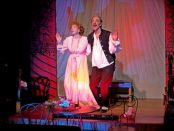
David Gow is the show’s producer and he also plays Tommy Flowers. Mr. Gow perhaps saw this showy role as a vehicle for him to shine in and he does up to a point. Gow is an appealing, very talented young man who gives an admirable performance in such problematic material. The part is up there with Ibsen’s epic Peer Gynt and Quentin in Arthur Miller’s verbose "After the Fall" in terms of duration. Mr. Gow winningly displays stamina and range. However, it would take a colossus of the likes of a Robert Morse in "How to Succeed in Business Without Really Trying" to make this play even a qualified success. [more]
There is nothing much very wrong with Susan Miller’s '20th Century Blues" that a few more revelations or dustups wouldn’t solve. Beth Dixon, Franchelle Stewart Dorn, Polly Draper, Kathryn Grody and Ellen Parker play believable, recognizable women at a plateau in their lives when some taking stock is in order as they approach the age of being considered senior citizens. A pleasant evening in this form, but Miller’s play gives an aftertaste that will leave you hungry for more. It seems that in order not to offend, she is playing it too safe. [more]
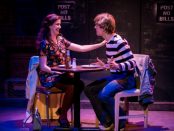
Crumm and DeVito have a marvelous chemistry together and terrific mutual comic timing that make them seem like a real couple. Their compelling performances energize and elevate what could have been a wan, sitcom-style stage show. [more]
Philip’s shaggy-dog yarn keeps exposing him as what used to be known as a pathological liar. And with little more than a wooden deck chair, a small table, a wooden slated floor and a sky-blue background (the set is by Alexander Dodge, the lighting by Alan C. Edwards), Crudup’s tour-de-force performance is a potent reminder that all you need for good theater is the actor’s voice--as well as a good script, of course. It’s also testimony to his having been well directed by Leigh Silverman, who seems to have gotten the best out of Crudup with his multiple voices and varied expressions. [more]
While this is not a Bedlam production as was Hamill’s hugely successful stage version of Austen’s second published novel, "Sense and Sensibility," director Amanda Dehnert has staged the play in their inimitable style for this co-production of Primary Stages and Hudson Valley Shakespeare Festival and has created a clever 19th century entertainment with a decidedly 21st century sensibility. The versatile Hamill has also given herself the plum role of Elizabeth Bennet, here known as Lizzy. [more]
Such changes as Captain Hook being a woman or Tinker Bell speaking French are neither explained nor meaningful, while some of the doubling simply makes the play hard to follow as the characters are not listed in the programs which are given out after the performance. A voice-over which appears to read stage directions from the original is both intrusive and inconsistent: why some characters but not others? There is a dark psychological story hidden in Barrie’s tale of a boy who refuses to grow up but this isn’t it. Whereas the original play is joyful, Bedlam’s Peter Pan is a glum affair in which no one seems to be having a very good time. Where is the Bedlam which brought such purposeful insight and visual dazzle to its previous work? The actors, mostly playing children, try hard but fail to bring the work to life. [more]
The protagonist of "Junk" is one Robert Merkin (Steven Pasquale), whose name alone is reminiscent of the real-life person he represents, Michael Robert Milken, the “Junk Bond King” of the mid 1980’s, who went to jail in 1990, and whose practices led to the world market crash a decade or so ago. “This is a story of kings, or what passes for kings these days,” says Forbes reporter Judy Chen (Teresa Avia Lim), in the play’s opening lines. “….enthroned in sky-high castles and embroiled in battles over, what else? Money.” [more]
After his teenaged son is called a “beaner” by one of his classmates at a WASPy private school, Leguizamo is inspired to educate the rest of the United States about the overlooked achievements of Latin culture. This is done as a wild, stand-up comedy routine where the audience is directly engaged and occasionally heckled, and with a superior theatrical presentation. [more]
Not only is Julia Cho’s "Office Hour" rivetingly acted by Sue Jean Kim and Ki Hong Lee, it is one of the few plays in recent memory to tackle a major social problem and offer an explanation or answer to society’s needs. Under Neel Keller’s astute direction and the production team’s superb physical production, "Office Hour" is both an important play and a compelling event in the theater. You may not agree with Cho’s conclusions but you will not be bored for a moment. [more]
Ms. Bioh’s snappy dialogue perfectly renders the rhythms of teenage lingo and the pain beneath the bravado, emitting the universality of adolescence. Bioh’s construction is meticulous as the events play out over 70 tight minutes. Besides the foreign setting there’s nothing really “new” about the play but’s it’s so well written and gloriously presented. [more]
Tunde Skovran as Shari and Julia Ubrankovics as Clara are sensational. The brunette Ms. Skovran and the blonde Ms. Ubrankovics are a dynamic team who each offer vivid portrayals with their powerful physicality and resonant voices that emit differing degrees of an East European accent. The outrageous finale has them gloriously carrying on in an extended, celebratory dance sequence. [more]
The conversations revolve around the topics of the New York Shakespeare Festival’s poor finances in 1958, Vaughan’s defection to the Phoenix Theatre which was paying a living wage while the NYSF was not, the choice of Mary Bennett (Vaughan’s choice) or Peggy Papp (Papp’s choice) to play Olivia, George C. Scott’s defection to the movies in his unnamed first film, the House UnAmerican Activities Committee appearances by both Papp and Gersten which has put their jobs in jeopardy, and whether Free Shakespeare in the Park can survive without charging admission. However, none of these conversations are allowed to erupt into real conflict. We are placed in the center of the action as though we are in the room where it happened, but the dialogue remains on the level of chit-chat rather than life or death threatening decisions. The problems never seem to be resolved and the play moves on to its next topic. [more]
Adhering admirably to its cultural mission, Kairos Italy Theater is treating downtown audiences to a double-bill of smartly written Italian one-acts, each exploring the contentious topic of immigration in their own unique and achingly human ways. Minimally staged, but with talented actors, the beauty of the plays is largely in the playwrights’ words, which seemingly have lost nothing in translation. Though if either play is appreciably better in Italian, some language lessons and a long trip is in order. [more]
Inspired by the true case of an affair between French diplomat Bernard Boursicot and Chinese opera singer Shi Pei Pu from 1960 – 1986 which led to a trial for espionage, Hwang’s problem in 2017 was that the story has become so well-known that the reveal at the end of the play is no longer a surprise. As a result, Hwang has worked to come up with new elements taken from the true case to make the play more startling for audiences that already know the tale. Director Julie Taymor who has in the past done wonderful work with exotic material ("The Transposed Heads," "The Green Bird," "The Lion King") does not give the play as much help as it needs, making it much too literal for its own good. [more]
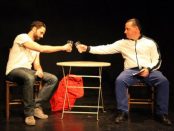
Guirgis and Brokaw manage to find the back-handed humor and pathos of this scene which sets the mood for a profane and scatological play that hits the audience between the eyes with its fresh use of language and its deep understanding of the two main characters. Guirgis turns profanity into a poetic x-ray of the human psyche. [more]
There is a fascinating story to be told in Franz Kafka’s involvement with the Yiddish theater in Prague during 1912 but Lu Hauser’s play isn’t it. "Prague, 1912 (The Savoy Café Yiddish Theatre)" is both episodic and repetitious without being clear as to the point that it is making. It simply seems to be a collection of scenes on the same themes that endlessly repeats itself. As Paula Vogel’s "Indecent" has demonstrated, there is a renewed interest in the Yiddish theater but "Prague, 1912" has not brought to life this world that is now gone with the wind. [more]
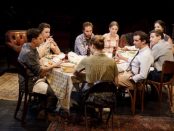
Played to perfection with an infectious joy by one and all, the entire cast also takes a deadly serious attitude towards their lines and their actions. Indeed Ludlam’s "Conquest" invokes "Hamlet" in its final scene, when many of the characters die--even following a previous “gravedigger” scene. And as staged by Quinton, the final “banquet” scene also invokes Da Vinci’s “The Last Supper.” All I can say is, go and enjoy! [more]
The problem is that under Albert Bonilla’s stolid and matter-of-fact direction, Elizabeth Ingham and Zack Calhoon's characters never come alive. Just trading quips is not a sophisticated style and as all of their lines are said the same way without variety, it becomes tiresome quite soon. While Donze continually surprises us as Beth, Melissa and Dave remain the same throughout. And the production design doesn’t help much. While the couple discusses what good taste Melissa has in buying Dave’s shirt, Viviane Galloway’s costumes are extremely conservative and colorless, no proof of any special taste whatever. [more]
With her marvelously fluty voice, imperious bearing, expressive physicality and animated facial features, Maja Wampuszyc as the haughty Corrine recalls Geraldine Page in all her grand glory. Ms. Wampuszyc is mesmerizing, delivering a searing performance of tremendous depth. She vividly conveys the character’s dysfunctional sensibility with heightened emotionalism and dry humor. [more]
With "What We’re Up Against," Theresa Rebeck looks back a quarter century to a time when gender inequality in the workplace was a real problem. Oh, wait…yep, unfortunately, if Rebeck’s script didn’t tell us the year was 1992, it would be pretty easy to believe she was writing about the present, especially given the recent avalanche of news concerning sexual harassment and assault in the entertainment industry. The story Rebeck tells never sinks to this horrific level, though it’s possible to imagine that it could have, if she had wanted to follow the male anger she portrays to a place it often leads. [more]
The hype that surrounds an award-winning performance on one side of the Atlantic can often preclude its impact if and when it arrives on the other side. This is not the case, I’m happy to report, with the overwhelmingly powerful performance of Denise Gough who deservedly won the Olivier Award as Emma in "People, Places & Things," a new play by Duncan MacMillan, which premiered in London in 2015, and is now enjoying its American premiere at St. Ann’s Warehouse in Brooklyn. [more]
It’s New Mexico in 1881, and during a series of short scenes, Billy contemplates his life. His stern mother, rough father, stalwart girlfriend and his sly pursuer, Sheriff Pat Garrett, all periodically appear. The dialogue is stiff, lofty, peppered with profanity and doesn’t impart much biographical details. [more]
Playwright Jonathan Leaf’s prodigious research, accomplished dramatic construction and clever device of threading a mystery throughout the events make the play quite engrossing. There’s also the sociological angle as the characters eloquently state and defend their differing beliefs and agendas that include careerism versus motherhood. [more]
Like the great comedy teams, Jos Houben and Marcello Magni are a study in contrasts. The Belgian Mr. Houben is tall, animated and relies on breezy patter. The Italian Mr. Magni is short, often dour and mostly silent. They have collaborated with Peter Brook at his Théâtre des Bouffes du Nord in Paris, and have performed together around the world. [more]
While the script describes the setting as simply a “rural place,” British and European productions apparently have set the play in medieval times. It is definitely pre-industrial as the farmers still need to have their grains ground at a mill and no one has yet seen a pen. Director Paul Takacs, who has staged the equally challenging Dark Vanilla Jungle by Philip Ridley in New York, has reset the play on the American frontier and made use of a multicultural cast. This grounds the play somewhat and makes it easier for Americans to identify with it, but it remains a difficult, challenging play due to its poetic language and its lack of specificity. [more]
Complementing his gorgeous stage pictures, director Craig Smith’s vibrant staging has the actors in constant motion on the small playing area. The cast precisely paces, dashes and undulates, achieving a propelling pace and focus. Chanting monks roaming through the audience is an eerie highlight. Slapstick, high comedy, bawdiness and dramatic truth are all vividly rendered by Mr. Smith’s superior sense of stagecraft. [more]
With so many interruptions, it hardly makes for riveting theater, and it never becomes as riveting as a genuine tennis match can be, even though one is ostensibly taking place from the beginning of the play to the end, which essentially presents a chronological series of sets between the two players, the Russian Sergei (Alex Mickiewicz) and the American Tim (Wilson Bethel). [more]
Cleverly staged by Kail ("In the Heights," "Hamilton," "Dry Powder") on Rachel Hauck’s magnificently realistic set for the ground floor of a suburban house subtly lit by Jennifer Moeller, "Tiny Beautiful Things" is entertaining, poignant and enlightening. You may hear audible sobs at times during the evening as Sugar’s personal stories touch a nerve or a chord in her viewers. Vardalos tells us how she took over the “Dear Sugar” column though she had never written one before nor did she have any training in therapy. Her remarkable success was due to her using her personal experiences as well as her “radical sincerity and open arms.” Her empathy is infinite. [more]
Well-meaning and sincere," Occupied Territories" is both generic and stereotyped, offering a story television and the movies have been offering for years: the traumatic effect of a father’s Vietnam experience on his family years later. Co-written by Nancy Bannon who appears in the play and Mollye Maxner who directed it, it offers no surprises or new enlightenment. Set in two locales and time frames, the play alternates between scenes in a suburban basement on the day of Stephen Collins’ funeral and scenes from the life of the same man 45 years earlier as a rookie in the jungles of Vietnam. Ironically, the actors playing the soldiers are more convincing than the actresses playing the family members at home in America in the present. [more]
While superficially poignant, "Torch Song" remains what it always was: a fierce play about the need for respect as a gay person, when it was painfully more difficult to come by acceptance, let alone respect. And to that extent, it may seem like a dated work, wedded to when it premiered as three one-act plays that were then put together as one, more than three decades ago. It’s still just as moving and tear-provoking as it comes to focus on a gay man whose mother (“the Sylvia Sydney of Brighton Beach”) has to cope with his adopting a young son. With the marvelous Urie and the always-superb Mercedes Ruehl as the mother, how could anything go wrong? Nothing does. [more]
Martha Graham called her dancers “athletes of God.” Watching David Greenspan perform all the roles in a six-hour marathon performance of Eugene O’Neill’s 1928 melodrama, Strange Interlude, caused me to wonder what I might call David Greenspan. Would “Son of Thalia” (the Greek goddess of theater) do? “Olympian of O’Neill”? [more]
In Jonathan Silverstein’s production, Arnie Burton and Matt McGrath as two friends who handle their fears of an unnamed epidemic in opposite ways do not seem to connect as real friends would. Ironically, while they are both known for their outrageous over-the-top comic performances, here they remain low-key and rather flat. The play may have been more involving if they had been allowed to give the kind of performances which they are most famous for. The play ultimately has a poignant denouement but it takes a long time getting there. [more]
Director John Collins, founder of ERS, has set the play in an office or conference room with three long tables (in Jim Findlay’s design which eventually grows tiresome) and a great many stick telephones by which the characters often call each other to relay Shakespeare’s lines as if they are working from their offices. The walls of the set become screens for the text to scroll upwards through most of the play; at time we even see it five ways including the ceiling and with four panels in the back as well as on the back wall. Whether this is to remind us that this is a play of language, it is usually distracting and not very revealing. Often the actors speak so fast that it impossible to follow them and then in a brilliant coup de theatre one scene (that between brother and sister Claudio and Isabella) is spoken so slowly that it seems to reveal hidden meanings not noticeable before. [more]
Set designer Charlie Corcoran ingeniously has the small stage’s walls adorned with sections of a yellow cab. Off to the side is a piece containing the steering wheel from where McDonagh periodically speaks. Above this, is a screen bordered by vintage billboard pictures. This showcases Chris Kateff’s dazzling projection design that illustratively displays imagery of New York City from various eras, video clips and slides such as the 1975 New York Daily News headline, “Ford To City: Drop Dead.” [more]
It is possible to enjoy Brian Friel’s "The Home Place" without knowing the background to this historical play set in rural Ireland in 1878 as a Chekhovian representation of a world about to come to an end. However, the play will be much more meaningful if one knows the historical events that have led up to this turn of events. Charlotte Moore’s handsome and genteel production will be enjoyed most by those who understand the play’s undercurrents and implications. The low-key staging of this subtle play which does not spell everything out requires the audience to be adept at reading between the lines. [more]
While the acting is compelling, the threesome does not reveal many layers to their characters; they establish a persona and stick to it, without divulging any further information. As Mae, Nicole Villamil is both stoical and passive, a rather flat reading of this ambitious though down-trodden young woman. Julian Elijah Martinez’s Lloyd definitely comes from the lower depths with his vulgar language, his self-pity and his inability to help himself. However, there is little variety in his performance and we have no idea what his relationship with Mae has been up to this time. He does get noticeable stronger after he begins taking the pills the clinic has prescribed. Unaccountably dressed in a sport jacket and a tie in Sarita Fellows’ costume design, Nelson Avidon’s Henry is the biggest enigma of the three. At first reticent and later lascivious, he tells us little about his attraction to Mae - or where he comes from. [more]
Nicolai Khalezin wrote Burning Doors with dramaturgy by him and Natalia Kaliada. Their aim is to bring attention to currently jailed artists Petr Pavlensky and Oleg Sentsov by weaving in their testimonies. Actors also proclaim from the works of Fyodor Dostoyevsky and Michel Foucault. Fleeting and sometimes sly allusions to Putin are laced in. [more]
hough it’s a one-woman show, Alison Fraser plays a number of characters by speaking in different voices with a certain technical prowess. The principal one is an upper West Side psychotherapist, Sharon, who is ostensibly talking to her own therapist (a “shrink’s shrink,” we’re told) at his apartment late one night. She’s relating the story of her going to her hometown of Lubbock, Texas, for her beloved nephew’s funeral, after he’s committed suicide. But has Eddie really killed himself, like Sharon’s mother did decades ago when Eddie was only three? For that matter, did Sharon’s mother really commit suicide, we’re made to wonder by the end? [more]
Signaling that we’re in for something different, Bauman has redubbed the play "Arden/Everywhere," a hint that home, and the emotional impact of losing it, is at the heart of her reimagining. Largely through design choices, but also some modest changes to the text, Bauman connects the diasporic struggles of the play’s characters to those experienced by the 65 million refugees the United Nations has identified throughout the world today, effectively arguing that, in both cases, the pain is there for anyone to see. [more]
The audience sitting on three sides of the airy playing area on wooden benches is part of Clifton Chadick’s super, environmental scenic design. The floor is covered with wood chips, logs and tree stumps, there are a several jagged wooden poles and a few red fire buckets strewn about. On one end is a stage area and the other is a screen where Joey Moro’s atmospheric projection design is shown. The crisp imagery includes fires, nature and abstractions. For several distracting instances the actors at the other end of the stage are projected onto the screen for no discernable reason other than as an aesthetic flourish. [more]
Director Ralph Lewis, apparently not trusting the material – or finding the play too dated – has staged a carnival-esque version (adapted by S.M. Dale in June 2016) which includes 16 songs and musical numbers and making contemporary references to the Trump Administration, as well as current New York City politics. The result, a series of Saturday Night Live political skits, is neither faithful to the original nor witty for a modern audience, more of a confused jumble than a historical rediscovery. [more]
Mr. Njikam offers a witty take on the classic mythology of a hero’s episodic journey with a lively African-American slant. There are a lot of high school and college scenes with wise teachers referring to James Baldwin and W.E.B. Du Bois, combative students, a dying father and an imperious mother. Rhyming battles, love and enlightenment occur along the way. The narrative is so eventful and spread out that it can be difficult taking it all in and its overall impact is diluted. [more]
Marinelli’s performance also contributes to the ennui. Heavy set, possessing a sullen countenance, speaking in a light voice, and lethargically shuffling around, he’s not the most charismatic performer to spend 90 minutes with. In the last portion, when he encounters a lost cat after being stood up on a date, his acting and the play has a jolt of energy and momentum as it reaches its upbeat conclusion. [more]
Possessed of a soaring tenor baritone voice that forcefully hits every note, an immensely likeable persona and boundless energy as he dances with brio, Moss commands the stage for 70 minutes. Periodically overcome with emotion, he gracefully collects himself and moves on. It’s a moving display of therapeutic showmanship. [more]
Although director Kimberly Senior who also piloted the Chicago production has staged the play with elegance, she never really turns up the heat so that there are not many sparks in Carter’s debate. Discord, yes; but no fireworks which might have made the discussion more dramatic. The play uses titles on the back wall to name each of the 14 scenes much in the manner of Brecht’s alienation effect. This breaks up the play but is not very informative. The device of the invisible fourth wall being a mirror in Wilson Chin’s all blue-grey interrogation room seems a gimmick to allow the men to face the audience directly for much of the play. [more]
With only a metal-mesh cage, bed-frame, and a gate--and gobs of black feathers that ultimately litter the stage--Nashman cavorts around the black box set (scenic design is by Marysia Bucholc and Camellia Koo) with abandon. If the challenge of every one-man show is to sustain our attention, Nashman succeeds spectacularly. He has some significant help with evocative lighting by Andrea Lundy, eerie music by Osvald Golijov (performed by the St. Lawrence String Quartet), and Cassidy’s direction, which always keeps him in motion. [more]
Most of the humor is at the expense of the Mesquite City Council and its steely-eyed mayor Linda Hadley (Liz Amberly) who could be accurately described as a Margaret Thatcher wannabe, if she had any idea who Margaret Thatcher was. With rapacious resolve, she has set her sights on doing something no other mayor has ever done in the entire history of Mesquite: win a second term. She is assisted in this quest by her right-hand toady (Jeff Paul), the financial backing of a shady resort magnate (Jed Dickson), and an underwhelming pool of potential challengers, led by Will Brown (the wonderful Joe Burby) whose hapless sincerity is seemingly no match for the mayor’s small-town realpolitik. [more]
Mr. Hagins has crafted an involving and affective take of a perennial scenario that captures the nostalgic essence of wartime films and plays of the past. There’s the spirit of "Casablanca" and echoes of "The Voice of The Turtle" and "John Loves Mary," combined with the novelty of the interracial angle that’s tenderly realized. [more]
The central character is actually Mrs. Fisher who worries about her children and plots to open Amy’s eyes to her husband’s faults. Unfortunately, Annette O’Toole has been directed to play her as shrill, strident and hysterical, rather than as a wise middle-aged lady who has no illusions about life. Given a great many ethnic prejudices in her dialogue which in 1924 defined her as a suburban provincial, played this way she simply comes across as a bigot. We ought to be rooting for her against the barbarian invasion but O’Toole makes her almost as bad as Aubrey. [more]
In 85 minutes, we really don’t learn much Rebecca, Nolan or Sukey as Mr. Donnelly imparts scant biographical details about them, but strangely does for Padgett. Donnelly takes the perennial premise of a divorced couple’s past romantic feelings for each other being reignited and clumsily tosses in the dramatic, morbid bombshell. His glum and stilted finale at Sukey’s apartment is out of Private Lives. The title refers to Sukey’s wish that when she dies that there be no wake. [more]
The new story concerns Wayne Hopkins, an American boy whose parents die tragically and his Uncle Dave informs him that he is a wizard and must attend a special school in England. Wayne is sorted into The Puffs which he discovers is the house for the losers, rejects and nerds who never win at anything. His one goal is to be a hero at something – eventually – while getting through magic school. There he meets the dashing older student Cedric (Andy Miller) several years ahead, as well as another American, the nerdy math prodigy Oliver Rivers (Langston Belton) who can’t seem to succeed at magic, and Megan Jones (Julie Ann Earls), who wears Goth make-up, all black clothing and resents being there. Megan is particularly angry because her mother is a prisoner and in thrall to the Dark Lord. [more]
The ambiguities in Mary Jane’s character seem to stem more from the writing than the acting: though her behavior remains dubious or questionable, Mary Jane comes to real life as enacted by Carrie Coon, who was such a memorable Honey in the recent Broadway revival of "Who’s Afraid of Virginia Woolf?" She’s a solid Mary Jane as well, but then, the character and her motives prove harder to pin down. The stalwart New York actress Brenda Wehle is a perfectly believable and no-nonsense Ruthie. The always reliable Liza Colón-Zayas is Alex’s caregiver Sherry, and Danaya Esperanza and Susan Pourfar are persuasive as, respectively Sherry’s niece and another mother with similar challenges. [more]
Known as the Shakespeare play with the most song lyrics, the production also includes a deliciously bouncy new score by Stephen Schwartz in different musical styles from the 1920’s – 1950’s, including setting some of Orlando’s mash notes to Rosalind which are usually spoken in verse. The musical numbers are mostly reassigned to the musical theater veterans like de Shields and Stillman who plays an onstage, upright piano, with Leenya Rideout on violin and double bass, and other members of the cast occasionally joining in on guitar and triangle. All of this adds to the festive, light-hearted atmosphere. Originally announced as a Jazz Age interpretation, that concept seems to have gone by the wayside. [more]
Having spent nearly five hours in the company of Ms. Parks’ parade of these beautifully written characters I find myself conflicted about these plays. She is brilliant at generating fire with the source of the heat difficult to pinpoint. It’s her talent to write dramas which sizzle, constructed in her strange vernacular, yet somehow leave too many questions unanswered, the better to prove her one-sided stories. [more]
Director Charles Weldon acted in the 1983, Mark Taper Forum’s Los Angeles production, and besides his meticulous casting he has perfectly rendered this revival. Mr. Weldon’s physical staging inventively, precisely and aesthetically utilizes the large stage to faithfully realize the material. [more]
In terms of the atmospherically detailed writing and Mr. Moad’s enjoyably intense performance that recalls a Sam Shepard hero, “Quittin’ Meth” is the most powerful of the program and its concluding play. It’s a poetically expressed evening’s odyssey of a 27 year-old Iraq War veteran who has returned to his Illinois hometown in 2007. Set in a rundown bar in this depressed steel mill neighborhood, we follow his memories of the war that contrast with his present observations and glimpses of the pitiful bar denizens . He encounters a war buddy who lost a leg and has descended into drug addiction. [more]
Chicago playwright Philip Dawkins makes a memorable New York debut with an involving and engrossing play which at the performance under review you could have heard a pin drop, so rapt was the audience. The play is, indeed, flawed by its avoiding real confrontations time and again, always stopping short of out and out war. Inspired by the true story of Miss Gloria Allen who volunteered to teach a class in etiquette at Chicago’s Center on Halsted, "Charm" is both a fascinating story and it covers unexplored territory on our stages. As Mama Andrews, the elegant Sandra Caldwell is both charismatic and compelling, never fazed by the behavior of the class even when they pay her no mind or reject her teachings. [more]
There are plentiful comic one-liners and also sharp observations in Mr. Giles’ well-crafted dialogue. Giles perfectly renders all four characters with personality details and traits. The tensions, concerns and sensibilities of the long-term gay couple all ring true, but interspersing these with the mildly entertaining hamster story feels like a strategic theatrical device that undercuts the main plot to no great effect. [more]