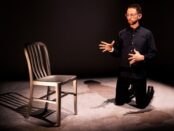
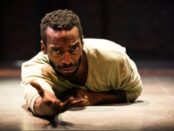
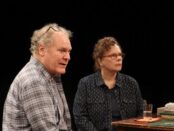
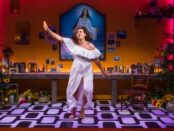
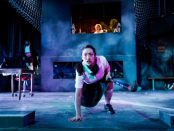
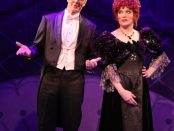
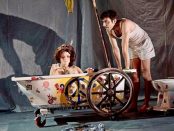
Each interviewee’s name is projected onto the back wall as Clark carefully transitions between the 21 people she’s interviewed; young, old, male, female, cis- or otherwise. This is a large number of roles for one person to play, so there is some blurring of “characterizations”; nonetheless, Clark establishes an effective conduit for what is ultimately most important: the messages that these individuals share about their experiences and varying successes with non-monogamy and/or polyamory. The direction by Molly Clifford seamlessly shapes the evening into an effective delivery device for thoughts on an intriguing subject. [more]
If a hallmark of our best stand-up comics is that he or she is unique—think of Whoopi Goldberg, Jackie Mason and Lenny Bruce—a relative newcomer named Neal Brennan belongs in their company. In his new work, "Neal Brennan: Unacceptable," directed by Derek Delgaudio, now playing at the Cherry Lane Theater—a jewel box space in the West Village—Brennan sustains his non-stop humor for 90 intermissionless minutes. This is despite our having been told it would only be for 75 minutes. But we welcome the 15 extra minutes. [more]
In his thankless role as Ray, Grossman’s performance is perpetually defensive, harried and out of breath. As unlikable a character as Ray is expected to be, Grossman doesn’t quite manage to bring enough variation, warmth, or earnestness to the part to engender the compassion or believability needed to sustain it. Ravera seems physically uncomfortable in the character of Una. She speaks her lines with intention, but she awkwardly drags herself around the stage as though she’s never worn heels before, and her body belies her words, words which are sometimes lost in her thick accent and lack of projection. It’s surprising to see tears come to her eyes when there doesn’t seem to be enough organic truth coming out of her lines to warrant them. [more]
We’re transported to Ms. Chen’s boldly oppressive spacious prison set with bars, an austere bed, a urinal, a tank to vomit in, and a retractable metal staircase for a menacing authority figure to descend from. Here, we meet the incarcerated “You No.2,” the male who gives his side of the romantic breakup during a cryptic and histrionic 40 minutes. We gradually realize he’s an artist being held in a government mental institution for crimes against the state. The finale strives for an emotionally resonant Twilight Zone-style twist ending, but it doesn’t make much impact, like the rest of this synthetic play. [more]
Sadly, these promises aren’t kept in this mishmash of plots and characters that never quite meshes into a viable whole; it remains an unsteady comedy/fantasy never morphing into a smooth-running play. Cissel awkwardly interrupts the play, alternating reality—such as it is—with colorful dance/mime sequences. The characters—including the Mother/aka Severed Head—yell at each other, most often about that poor, ubiquitous head, garishly made up for the Mexican celebration of El Día de los Muertos. Every time the head speaks her mind the play comes to impudent life. [more]
The new play, ironically, does not take place in Rhinebeck, New York, like the preceeding 11 plays but as explained in its subtitle it concerns “Conversations in Angers, France,” the home of the Centre National de Danse Contemporaire (CNDC). Like the previous Michael play, it is set on the eve of a dance festival honoring American dancer and choreographer Rose Michael who has passed away about six months before this play begins. However, unlike the earlier play which was about the art of creation, this play is mainly about living with the Covid pandemic and our adaptations to it, as well as the hermetically sealed world of dancers. While the play tells a lot of anecdotes about dancers and does a certain amount of name dropping of such people as Trisha (Brown), Merce (Cunningham), Dan (Wagoner), it eventually attempts to wax philosophical with such remarks as “there is no life without death,” and “life doesn’t last. Art doesn’t last. And it doesn’t matter…”; and “we dance differently at sixty.” [more]
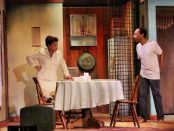
As his mother Bete (pronounced Bet–chi), Soria is bigger than life without a great deal of assistance from props, costuming or make-up. When he enters carrying an offering to the stage which is set up like a tropical altar to Iemanja, the Afro-Cuban diety whose picture is on the wall center stage, he is wearing a white linen skirt which he suddenly pulls up and it becomes his mother’s dress (designed by Haydee Zelideth). In English punctuated with pungent Spanish and Portuguese, sometime translated, often as not left unexplained, Bete tells us of her three marriages, each one unfulfilling, and of her children, her difficult son Arturo who from a young age wanted to dance ballet and was always getting into trouble, and his sister who always liked sports. We learn of her unconventional child rearing practices which was as much a tug of war with her children as it was a series of lessons in living, and marked Arturo for life. [more]
"Roles and Rules of Comedy," six short comedic bits of fluff written and directed by Harold Dean James is a character-driven view of contemporary New York City. Presented at the elegant Players Club on Gramercy Park by We Three Productions, James deals mostly with down-to-earth people like Donna (Donna Kennedy) and Jaymie (Sharon Fogarty) who meet at a bus stop awaiting a ride that never seems to arrive in “At the Bus Stop Part 5.” [more]
“Do I believe in heaven and hell or another parallel universe? If I parallel park in a parallel universe will I be double parking?” muses the affable performer Robert Dubac during his clever self-written comic solo show, "The Book of Moron." Dressed in gray trousers, a black shirt and a black jacket, the seasoned Mr. Dubac holds forth for 80 minutes with his appealing persona that recalls Mort Sahl’s topicality, David Steinberg’s impishness and George Carlin’s profundity. [more]
Written and directed by White who is the Obie and Lily Award winning director of "Our Dear Dead Drug Lord" (WP Theater) and "What to Send Up When It Goes Down" (Public Theater, BAM Fisher and Playwrights Horizons), a NYTW Usual Suspect and former NYTW 2050 Fellow, among other impressive credits, "Semblance" asks the question: in your everyday life, how do you encounter Black women? What do you see and what do you assume? Nikiya Mathis plays seven women from all walks of life, six of them depicted in various jobs and careers and each in her own setting. The women address us directly: a line worker in a salad take-out restaurant, a nanny and caretaker with her charge in Prospect Park, a chart-topping artist preparing for a music video, an unemployed mother getting her nails done in a salon, a public figure such as a politician about to be interviewed on a news program, a bus driver on her run on an MTA bus, a medium to low level consultant in an office, and finally the actress herself as she removes her makeup. [more]
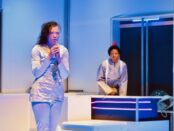
"Alma Baya" is distinguished by its impressive production design which wondrously theatricalizes what we’re used to from experiencing science fiction on the screen and television. Scenic designer Mike Mroch’s multi-level configuration of geometric white pieces adorned with gadgets is awesome. Besides the striking space suit and helmet, costume designer Ramona Ponce provides snazzy shimmering gray outfits reminiscent of Pierre Cardin. Federico Restrepo’s lighting design in collaboration Hao Bai is a jolting assemblage of hues, colors and tones. Before the show begins, Mark T Bruckner’s sound design is already arresting with its droning electric cords, later there’s the grand whooshing of air locks opening and closing. [more]
Fortunately, good things come to those who wait, even after an hour and a half. The play suddenly takes a turn when Karen X has a breakdown behind a dumpster at Whole Foods. Karen X may have been talking about her complexion in the opening scene when she tells Karen Y that “black don’t crack,” but in this scene it is her core that is cracked open, when she realizes her life is as empty and pointless as she’s always feared. “#influence me, please?,” she begs of God, as flies buzz around her head. It is a brilliant scene, and Day is brilliant in it. [more]
Nelson Mandela’s inestimable value to humanity in general and to the abolishment of apartheid in particular cannot be thoroughly assessed or overestimated, nor are they in a new play that bears his name. As written by Yolanda Brooks & John Ruiz Miranda, who also directs, Mandela is a meandering miasma of information. It also suffers by an utterly amateurish performance by Robert Greene in the title role. One winning asset, however, is the portrayal of Mandela’s wife, Winnie, by Nadijah Abdul Khaliq. Also to its credit is the evocative lighting design by Maarten Cornelis, which, more than merely illuminating the play, gives it a kind of life. [more]
Hamilton Clancy, the artistic director of The Drilling Company, joins forces with his assistant director Karla Hendrick to stage The Two Noble Kinsmen in a modern-dress version that makes the plot of the play more accessible to the al fresco audience but tends to devalue the Elizabethan language. They have even added a few very modern turns of phrases and pop tunes to elicit laughs during the few lighter moments of the plot. [more]
Early in the play, songs are sung by various members of the cast including the anachronistic “The House of the Rising Sun,” (sung twice) set in New Orleans in the twentieth century. The cast members use various accents even though all are supposed to be Irish. Characters come and go for no motivated reason and too many events happen more than once. The acting though vigorous is uneven and inconsistent, but this is mainly due to several underwritten roles which give the performers little to do and not enough backstory. The production’s pacing is deficient as parts of the play come fast and furious while others are slow, talky and languid. [more]
For "The Importance of Being Earnestly LGBTQ+" which wildly lives up to its title, director Maarten Cornelis updates Wilde’s scenario to present day New York City. Currency is in dollars; Manhattan landmarks replace London ones, though the fabled cucumber sandwiches remain. Amanda Scanze’s splendorous fashionista-type costume design and Martina Duque’s artfully basic scenic and projection design are all contemporary. Mr. Cornelis places us in an affectionate fantasyland true to the spirit of Wilde where logical inconsistencies and anachronisms are to be taken in stride. Algernon Moncrieff and Jack Worthing are still upper-class charmers pretending to be named Ernest to romance their eccentric objects of desire. Instead of Cecily Cardew and Gwendolen Fairfax, here we get Cecil and Gwyn. This production’s chief virtue is its matter of fact and sensual depiction of same-sex attraction. That is achieved through Cornelis’ skillful direction, his otherworldly lighting design and his energetic ensemble. [more]
In what might just be the best stage role of her career, Jackie Hoffman plays the multi-faceted Ariana in E. Dale Smith’s "Fruma-Sarah (Waiting in the Wings)" at Nancy Manocherian’s the cell theatre in Chelsea. Sitting in place, attached to a hefty rope, she takes the audience and her co-star, Kelly Kinsella as Margo Peterson, “substitute fly captain,” on a journey of a life not well, but interestingly, lived. [more]
There are installations, written words, video projections, and recorded spoken word. One setting is intended as a break area where patrons can dance or play with beachballs. Other interactive projects involve writing answers to questions and pinning them to a piece. To give specific descriptions of these clever inventions would be to spoil surprises. This one is memorable and representative of the exhibition. [more]
The Icarus of Icarus and Amina is a poster of Henri Matisse’s brilliantly colorful abstraction of that Greek mythological character who soared too close to the sun, and Amina (Sidney Caruth who skillfully balances sweetness and strength) is a Bangladeshi who has just this day graduated from a Catholic high school. Because Amina hasn’t made any real friends even after four years of school, she gravitates to Sister Tre’s classroom ostensibly to say good-bye, a farewell that morphs into a bit of soul searching. Rachel McCain (a walking illustration of “still waters run deep”) plays Sister Tre, a Filipina nun and Amina’s favorite teacher and mentor who cautiously welcomes Amina into her classroom as she does some end-of-term tidying up. [more]
Two police detective partners have breakfast while working a case at a generic U.S.A. hotel in author Gabriel Nathan’s electric 15-minute play Morning Was Safe. Mr. Nathan’s dialogue crackles with vernacular authenticity and his psychological scenario is a heated slice of life which briefly takes us into the heads of the two officers. It’s as if Samuel Beckett wrote an episode of "Law & Order: Special Victims Unit." There’s Netflix recommendations, personal information, and a reverie about bacon recalling The Holocaust. It’s a grand vehicle for its two actors. [more]
Havel’s Audience represents CAMT’s first foray into modern Czech literature having previously staged imaginative productions of folk material. This visit to contemporary theater, unfortunately, wasn’t as successful as most of CAMT’s fairytale presentations. The combination of whimsical marionettes and psychologically sophisticated drama didn’t gel. The autobiographical Audience pits Havel’s alter-ego, Ferdinand Vanĕk (played by Vít Hořejš who also translated and directed the play), against The Brewmaster (Theresa Linnihan) in what initially seemed to be casual, directionless banter during a workday at a beer brewing company. Preceding the actual play were a series of historic newsreels—prepared by Suzanna Halsey—showing how Czechoslovakia (when it was still called Czechoslovakia) descended from the high hopes of 1968—euphemistically called the Prague Spring—to the depths of despair following the Soviet Union’s crushing invasion to put down what they perceived as a pro-West revolution. The newsreel images were far more frightening than Havel’s two hander which is clearly meant to reveal in everyday terms just how nefariously the communist, totalistic credo infiltrated daily life in Prague. [more]
Aside from the unevenness of the acting, Drance’s production has no consistent tone, shifting from comedy to drama to tragedy and back again. Not all of his interesting ideas are carried through: the first two acts have different performers playing Admetus and Alcestis which demonstrates the shift of 12 years; however, in the third act when Alcestis should be an old woman, the same actress who played her in her prime continues in the part. While the costumes by Gian Marco Riccardo Lo Forte and Mark Tambella are serviceable they are rather bland and unprepossessing. The uncredited sound design and the original music by Sara Galassini are muddy and unclear as broadcast from the one speaker on the left side of the audience. While there is no lighting design as the play is performed in broad daylight at this time of year starting at 7 PM, by the time the play is ending it is twilight and the fading light will make it painful for some viewers. [more]
Read by unseen British stage star Juliet Stevenson, "Blindness" is as timely as Albert Camus’ "The Plague" with its story of an epidemic which affects first a community, then a city and finally an entire country. With the audience sitting in socially distanced pods of two, and listening on binaural headphones, the space has been equipped with bars of light both horizontal and vertical which turn either red, green, amber, blue or white and are raised and lowered at various times. However, since the story takes place in a city in which the inhabitants are struck blind, much of the play is performed in total darkness. [more]
"Lilies" is an attempt at old-fashioned theater or to couch a modern story in old-fashioned trappings. The problem with the play for modern audiences may be stated in its subtitle, “The Revival of a Romantic Drama.” Unfortunately, the first New York production of veteran Canadian playwright Michel Marc Bouchard’s controversial play neither does it justice nor is it very convincing. The gay triangle and the insidious homophobia appear up to date but the trapping of the play are that of another era, one that is foreign to most actors alive today, and certainly more operatic than most theater audiences expect. [more]
While the chronology is somewhat convoluted as the text occasionally skips around grouping some similar events (such as two trips to New York City), if you follow along, the script depicts Williams’ steady rise to success in the six years before "Menagerie" landed on Broadway. Many of the anecdotes are amusing, others are surprising tales of little known facts (a trip to Europe with his grandfather, meeting D. H. Lawrence’s widow on a trip to Taos, New Mexico.) Always engrossing, always believable, "Tennessee Rising: The Dawn of Tennessee Williams" accomplishes in spades what it sets out to do: revealing the trials and tribulations of a great playwright on the verge of his first success. [more]
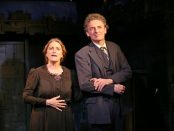
Directed by the author, "Two Sisters and a Piano" reveals its roots as a radio play from its reliance on poetry and language: this is a cat-and-mouse game in which the participants use words to circle each other in order to achieve their goals. But who is the cat and who is the mouse? Set in 1991 in Havana during the Pan-American Games and while the Russians are pulling out of Cuba, we meet sisters Maria Celia, a well-known novelist (played by Florencia Lozano), and Sofia, a pianist (Rubin-Vega), both under house arrest in the crumbling premises that they grew up in. As a punishment for a petition that Maria initiated and signed, the sisters were first place in prison and now are confined to their childhood home, and have not received any of their mail for months. [more]
"Jericho" has a great deal going for it. It is directed by Marsha Mason and features Jill Eikenberry. These two formidable theater artists’ participation promises quality which is evident from the first scene on to the quietly scathing denouement. Jericho also has proven itself in a run in 2013 at the 59E59 Theaters. Its intimate, six character scale lends itself to the close-ups of streaming which Mason deftly juggles with a combination of in-your-face emotion and wit. [more]
For "Coal Country," an investigation into the April 5, 2010 West Virginia disaster at Massey Energy’s Upper Big Branch coal mine which killed 29 men, authors Jessica Blank and Erik Jensen based their documentary play on first person interviews with the families of many of the victims, sons, brothers, fathers, husbands, nephews. Powerful in the piling up of evidence and malfeasance just as they had done in "The Exonerated," the play undercuts its dramatic power by revealing the end of the story at the very beginning so that the ultimate court decision comes as no surprise. Nevertheless, the individual stories told by seven actors speaking the real words of family members are very compelling. [more]
With its eloquent nods to conceptual art, good-natured comedic tone and superior performance, "The Artist Will Be With You in a Moment" is an intelligent entertainment. [more]
The inspiration for "About Love" is Ivan Turgenev’s "First Love," one of the greatest of all novellas. Subtitled “a play with songs and music,” that is exactly what it is: a dramatic presentation with five songs and underscoring by jazz musician and composer Nancy Harrow. However, unlike Harrow’s adaptation of Hawthorne’s "The Marble Faun," retitled "For the Last Time," director Will Pomerantz’s text appears to be taken directly from a translation from the original Russian without anything additional. The lovely show is best described as story theater in which all of the characters narrate at one time or another, at times alternating a single event, and all but the hero and heroine playing multiple roles. If one is looking for a musical, this is not it, but it eventually is a captivating staging of the story, if a bit on the long side. [more]
There is plenty of over-the-top acting, physical antics and far-fetched story lines, all perfectly acceptable ingredients for a zany gender-bending farce. The only thing missing are the laughs. Even the high school-quality set design by Ryan Goff and delightful costumes by Jimmy Moon are on par for this campy send up of a 1950’s rom-com. Ultimately, Vause’s script reads funnier than it plays, so there is more amiss than the smoking gun in this screwball comedy. [more]
Vivian Neuwirth’s "Mr. Toole" is a fitting tribute to a charismatic teacher and a brilliant author. However, the play, in the form it currently is in, seems to have been shoehorned into a shape it doesn’t entirely want to take. It is possible that it would be more successful as a screenplay opened up a bit. At any rate, it is a play that will be of interest to students of American fiction and those who know the two novels of John Kennedy Toole. The play may do something in the way of making Toole and his work better known. It will probably make you want to read one or both of his two novels, "A Confederacy of Dunces" and "The Neon Bible." [more]
However, it’s not until the second act that the play generates many laughs. Here, the tables turn on Jim. Gloria, returning to Kingston, has gained self-assurance from her escapades in the states, and she is ready to lay down the law in search of some R-E-S-P-E-C-T from her husband—or, rather, her ex-husband. Interestingly, what she has seen of the U.S. hasn’t impressed her. She doesn’t exactly refuse to follow through with the original plan that she and Jim had hatched, but she doesn’t promise anything. The fact that she is now legally American herself, and no longer Jim’s chattel, has given her both power and initiative. She even begins taking night courses to train as a nurse, so that she can do something more than scrub white Americans’ floors if and when the immigration happens. [more]
Mixing fiction and fact, new Signature Theatre Residency playwright Lauren Yee’s "Cambodian Rock Band" is an engrossing, entertaining and appalling investigation into the Khmer Rouge’s genocide in Cambodia in the 1970’s and its aftermath. Using authentic Cambodian rock music from the 1960’s and 70’s as well as the songs of Dengue Fever, the Los Angeles-based Cambodian American band, the play is emceed by the genial Duch played by Francis Jue who turns out to be the play’s greatest villain and a real person now in prison. Chay Yew’s production is one that does not require prior knowledge to get caught up in the fictional play and the ugly, true history of Cambodia. [more]
Some books and movies and poems do not lend themselves to theatricalization, and that’s certainly the case with "Incantata," which is currently being given its American premiere at the Irish Repertory Theatre. Though it’s only 80 minutes long, it felt like an eternity--and not only because of the story--but also the telling. What’s even more annoying is that it tells the same poem, again and again, and seemingly again. [more]
One of the most interesting attributes of this play (apart from the clever title being a less common and unharmful definition of the word “faggot”) is playwright J. Julian Christopher’s insistence that none of the characters be portrayed by cisgendered men. The most significant effect of this casting is demonstrated in scenes when the men are supposed to be naked and interacting with each other in sexual ways. Where true male nudity and sexual touching would have simply been gratuitous and distracting, clever costuming (presumably) provided by production designer Meghan E. Healey has the characters wearing body suits, onto which sequined phalluses and scrotums of different colors and sizes have been sewn. Each suit sports a large nipple and a heart as well. The depiction of sex and sexuality thus become representational and symbolic, allowing the play and its language to proceed unimpeded by gawking. [more]
“Spicy. Cajun. Alfredo. With Bourbon Infused. Crumbled. Bacon” is the hoped-for path to victory for the pivotal Memphis cooking competition in award-winning playwright Katori Hall’s uplifting "The Hot Wing King," where comedy and drama deftly converge. Strained relationships, personal despair and camaraderie among gay and straight black men are all dramatized in this rewarding contemporary work that has echoes of the wit and pathos of Mart Crowley’s "The Boys in the Band." [more]
This illustrates the biggest problem with "Suicide Forest": it takes on too many issues, jumping from social to sexual to mythological to intimate family subjects. Making the play even more difficult to understand is that it is performed in both Japanese and English. In addition there is some confusing cross-ressing. "Suicide Forest" is alternately funny, disgusting and moving, making it too often a tiring show to sit through despite its wealth of social commentary. The director Aya Ogawa kept the show rolling along but couldn’t make all the parts gel. [more]
MCC Theater’s New York premiere of C.A. Johnson’s new play "All the Natalie Portmans" is a lovely work which resembles other such modern coming of age plays from Carson McCullers’ "The Member of the Wedding" to Lynn Nottage’s "Crumbs from the Table of Joy" as well as moments from Tennessee Williams’ "The Glass Menagerie" in its depiction of a dysfunctional family struggling to survive. While the play is not entirely fresh, the characters are so honestly drawn that director Kate Whoriskey’s cast not only holds our interest but makes us worry about their futures. The play does not contain many surprises as the family is obviously on a downward spiral but we hope against hope that Keyonna and Samuel will survive the battle. [more]
If the show seems at times to be a bit of a mess, it’s an often entertaining and always lively one, thanks in good part to members of the acting ensemble, most of whom play multiple roles. Palacios is warm and winning as Rocky. Formica and Ross are engaging, especially when LaBarerra and Kayster have a falling out late in the play, which turns them from robust sparring partners into true foes. Colón and Wise also have plenty to do, and they seem game for all of it. [more]
Pearl Cleage’s "Blues for an Alabama Sky" gets a belated New York premiere courtesy of Keen Company in its 20th season. Although seen in many regional theaters since its 1995 premiere at the Alliance Theatre Company in Atlanta with Phyllicia Rashad in the leading role, it has long been overdue in New York even though Cleage is also a successful and acclaimed novelist. Framed as a domestic drama, the play manages to take in the topics of racism, sexism, homophobia, birth control and abortion, poverty, alcoholism, and extreme religious points of view among the bohemians of Harlem, circa 1930. [more]
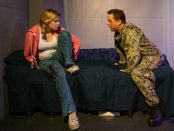
"Extremities" on a ship best sums up its playwright William Mastrosimone’s adept, if off-kilter, new psychological thriller "Rules of Desire," that’s been given a tidy production. In it, a dim 22-year-old U.S. Navy enlistee smuggles his troubled 18-year-old girlfriend in a duffel bag onto the aircraft carrier on which he is stationed. The couple surreptitiously sets up house in an airlock, but their connubial bliss is threatened by the licentious Chief Petty Officer discovering their love nest. Psychosexual hijinks ensue. [more]
As the centerpiece of its spring season, Classic Stage Company is presenting a repertory of adaptations of two legendary Gothic horror stories: Bram Stoker’s "Dracula" and Mary Shelley’s "Frankenstein" in new stage versions. Kate Hamill, go-to playwright for adaptations of 19th century literature, has given her take on "Dracula" a delightful comic slant. The sexism in the novel has been diluted by making this a feminist revenge fantasy. Turning Doctor Van Helsing, vampire hunter, and Renfield (under the sway of the vampire) into women changes the dynamic quite a bit giving the play a modern viewpoint. Director Sarna Lapine, who has worked with Hamill before on her "Little Women" and "The Scarlet Letter" adaptations, keeps the pace brisk and the humor buoyant as the women are given the best of the story. [more]
"Anatomy of a Suicide"’s title is more than accurate as two suicides are depicted. Dramatizing such subject matter would usually be intrinsically harrowing. However, acclaimed British playwright Alice Birch is concerned with hollow technique rather than rendering fleshed out characters straightforwardly grappling with life’s travails. Instead, we get three women’s cryptic underdeveloped stories mashed together, enacted simultaneously, structured as short scenes in this 90 minutes play. It’s an unsatisfying minor exercise with flashes of emotional resonance. [more]
Now that The Public Theater’s 2019 revival of the late Nzotake Shange’s "for colored girls who have considered suicide/ when the rainbow is enuf" has been critically acclaimed once again, The Negro Ensemble Company is reviving her only dialogue play, "a photograph / lovers in motion," in a new version. Originally produced at The Public Theater in 1977 as "a photograph / lovers in cruelty," the play was later revised and renamed for a 1982 production at the Houston Ensemble Theatre. The new version adapted and directed by Ifa Bayeza, the playwright’s sister, makes the play more of a choreopoem like Shange’s other plays and shifts the focus from the photographer Sean David to Michael, a female poet and dancer, adding poems for her to recite. The two titles of the play are still applicable as according to the director the relationship between Sean and Michael is both a duel and a duet. [more]
It might be about 90 years too late, but writer/director Ciarán O'Reilly is throwing a good old-fashioned Irish wake, with poems, songs, and a slice of barmbrack (Irish sweet bread) or each of the lucky attendees. And he's also summoned the dearly departed herself, Lady Isabella Augusta Gregory, and a few of her more notable friends (some guys named Yeats, O'Casey, and Synge) to join in the celebration, stitching together her words with some of theirs to create the waggishly titled "Lady G: Plays and Whisperings of Lady Gregory." It's a charming and touching tribute to a woman whose literary efforts are usually far less appreciated, unfortunately, than her advocacy. [more]
The inestimable Charles Busch has come up with something of a dud, as well as redundant, with his latest play, "The Confession of Lily Dare." Even its title leaves a lot to be desired. Based on a seemingly endless parade of Hollywood movies of the pre-code era (from the late 1920’s to the mid 1930’s), Busch has pulled out all of his old tricks--cross-dressing, an homage and parody of old movies, long pink arm gloves--and produced something stale and feeble. [more]
This current New York City revival, directed by Aimée Fortier, shifts the focus largely away from Jimmy and onto Alison (Elizabeth Scopel). Critics have described this character as passive, and there is evidence in the script that this is so. For instance, Alison can’t find the nerve or the right moment to tell Jimmy that she is pregnant. In this production, though, she seems to have a reserve of strength at her core. We identify with her in her struggle to cope with the insufferable verbal abuse she takes from Jimmy (Ryan Welsh). As the action proceeds, she seems to emerge as the play’s central character. This production even gives Osborne’s denouement a feminist twist. (We may again be reminded of Eliza Doolittle—specifically, her liberated final scene in director Bartlett Sher’s 2018 Broadway revival of "My Fair Lady.") It helps Fortier’s approach that, of the four leading players, Scopel delivers the smoothest, strongest and most believable performance in the production. [more]
Could there be five more self-involved, selfish, self-deceptive characters than those who populate Lily Akerman’s "The Commons" at the 59E59 Theaters? No, these five roommates aren’t evil, just depressingly of the here and now, young people who have lost the ability to communicate honestly with each other. There’s a problem with a 90-minute play about people who do not connect: it is an unrewarding slog for an audience to sit through. [more]
If it sounds challenging to do a two-performer version of "Frankenstein," it proves just that in the current production at the CSC, being performed in repertory with a new stage version of "Dracula." As adapted by Tristan Bernays from the novel by Mary Shelley, the first half-hour of the 80-minute show is more like performance art than a play, as very few words are spoken. During the first part of the play, there are more grunts and groans than there is anything resembling a script. [more]
Even before the playwright pays homage to William S. Burrough’s "Naked Lunch" through this last line, one is already drawing comparisons to the psychotic, structureless existence of that novel, and wondering whether there is anything more to "The Sickness" than the eventual demise of two wasted lives of X and Y. Later that evening my theater companion admitted to thinking, “die already” at some point during the play, because there seemed to be nothing else happening. The audience is given no reason to like the characters, no reason to think they’re ever going to change and no reason to root for their survival; all that they’re left with is the desire for the play to end. [more]
The trite set-up makes all of the characters one-dimensional, with the Jewish Seth a “knish maker” and shop owner on “Hester Street, Angie groping to find herself--not to mention a partner--and Sophia, a loving and understanding “Nonna.” Blake, of course, is a leather-clad roué, who also wears sunglasses throughout--until he loses them. What is somewhat surprising is to learn that Seth, an orthodox Jew, was in an “arranged” marriage before, and divorced his wife two years ago. But the play suffers from an inordinate lack of surprise. [more]
"Goy Friendly" is clearly meant as a light entertainment with lecture-demonstration components and succeeds as such. It’s delightful spending time with this superb raconteur, even if he cleverly sidesteps the deeper implications of his subject matter. [more]
In making her professional stage debut courtesy of Page 73, Zora Howard has written a powerful kitchen sink drama in 'Stew," as much about making a literal stew as about the emotional stew the four women in the Tucker family of Mt. Vernon find themselves in. While many of the elements are family, Howard combines them in new ways so that the play seems both new and true. With a terrific cast headed by Portia ("The Rose Tattoo," "Ruined," "Rinse Repeat," "Our Lady of 121st Street") as the family matriarch, director Colette Robert keeps the temperature continually simmering on a low boil until all of the secrets and events have been revealed. This is an American tragedy as well as a study in how we live in this era. [more]
Mr. Droege’s sharp and well-observed writing renders each of these familiar figures with biting depth, achieving grand mini-portraiture. Though preoccupied with comedy, an undercurrent of proportioned sentiment elevates the work above mere caricature. Promiscuity, aging, drugs, alcohol, loneliness and the past are among the issues eloquently explored in relation to the gay male lifestyle. Droege’s shrewd structure has each of the participants alternatively popping up to chatter while imparting pertinent personal details, fueling the semblance of a narrative. [more]
Amidst the hubbub that includes coerced audience clapping and singalongs, we attempt to discern what the point is. It appears to be the story of an outsider who takes up residence in a rural locality and is accused of a crime; the audience votes whether to convict or acquit him. Several audience members have been given pages of lofty speeches to recite. “The words your fellow Townspeople quoted come from Dr. Cornell West and Coretta Scott King,” states the program. Where We Stand’s 70 minutes are mildly engaging if often baffling and do make some impact. [more]
The Mint Theater Company has rediscovered and championed British actor/playwright Miles Malleson with Conflict and Yours Unfaithfully. Now they have combined two of his one acts adapted from great short story writers in an evening called "Chekhov/Tolstoy: Love Stories" in their premiere pairing. While the production directed by Jonathan Bank and Jane Shaw (each directing one play) is able to be performed on basically the same set, the two plays have little to do with each other and represent love in two different ways. Anton Chekhov and Leo Tolstoy are major writers, but the adaptations appear to be minor and do not show off their authors at their best. Although the Chekhov story is basically an anecdote, the Tolstoy tale is a fable with a message. [more]
The subject matter of "Chasing the River" is, of course, viable, but the play is not as nuanced and insightful as one would hope—nor is it particularly gripping. Sometimes the action feels stagey, and at other times it seems undercooked. Particularly problematic is the role of Nathaniel who is written and acted quite one-dimensionally. True, Giebel offers at least one surprising aspect of the character: We learn that he wanted a sports-playing boy-child, not daughters, and that he treated the tomboyish Kat (then called “Katie”) as a substitute for a son. We learn that he was able to gain Katie’s trust, which he then insidiously betrayed. We never wonder, however, whether he is anything other than an unrelenting nightmare of a person. There are scenes in which we see him being pleasant to Katie, but his bullying monstrousness seems always apparent. Most creeps—even the alcoholic ones—manage to hide their ugly sides now and then. [more]
ICE raids, harrowing border crossing journeys and transferring money home are depicted in the rousing and moving play "Fandango For Butterflies (and Coyotes)." It’s derived from undocumented Latin American immigrants’ stories of why they left their countries and of their lives in the United States. Reminiscences and dramatic complications are interwoven with terrific dance sequences and lovely songs. [more]
While Simon Stone’s adaptation is engrossing for its surprising updates, it never captures the emotions, seeming more like a gimmick that a reworking of the Greek tragedy. With most of the actors underplaying their roles, the emotional temperature never really heats up even when the audience is confronted with various horrors. The use of the video screen and the all-white set somewhat distances the audience from the events on stage which undercuts the tragedy unfolding. Don’t blame Rose Byrne and Bobby Cannavale, who have given much more impassioned performances elsewhere, as they seem to be pawns of Stone’s concept. [more]