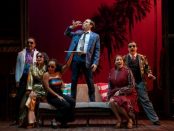
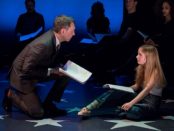
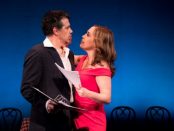
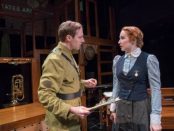
Usually considered one of Sondheim’s lesser musicals, albeit with one of his best scores--and needless to say, that’s saying a lot--this production provides a heft and a story that are sorely lacking in previous versions. There is no denying or gainsaying its power to impress, as each and every song comes through with its capacity to build characters and tell stories. If the stories are less than satisfying in earlier productions, that’s due more to bookwriter George Furth (adapting the original play by George S. Kaufman and Moss Hart) than to Sondheim or to his other collaborators, each of who has provided an impeccable contribution to the current enterprise. [more]
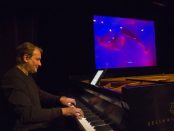
The York Theatre Company is to be applauded for taking the risk of staging this famously controversial musical in its New York premiere. It is also fulfilling its mission to bring to the stage musicals of quality that might not be done elsewhere. As Alan Jay Lerner is one of the legendary giants of the musical theater, it is a pleasure to be able to see this lost musical in a workable version. However, despite the excellent staging by director Emily Maltby, "Lolita, My Love," the casting still seems problematic and the musical is ultimately disappointing. And while music director Deniz Cordell has performed yeoman's work reconstructing the score and playing it entirely solo at the piano, John Barry’s music is not aided by being heard in this cut-down orchestration. [more]
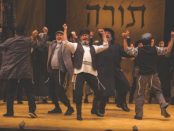
The property is now more than a half-century old. But this production makes it seem as though the 1964 iteration were merely an English-language version of a classic from even longer ago. There’s a greater feeling of immediacy than perhaps ever before. Hearing the characters speak and sing in the tongue that their real-life 1905 contemporaries would have used is deeply moving. What a shame that so many speakers of Yiddish from decades past never got the chance to experience the musical in this guise. [more]
The show’s talented mastermind is Preston Max Allen. Mr. Allen’s rollicking score is a pounding collection of catchy pop and showtune melodies matched with sharp lyrics. Allen’s well-crafted book is comical, suspenseful and problematic. However, there’s too much of it. The characters are all cleverly fleshed out, the milieu is authentically rendered, but the rambling structure is a drag. [more]
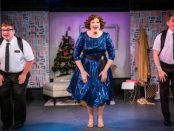
The York production has been directed and adapted by Marc Acito who has condensed the original two act script into a long one-acter. Realizing that the original setting of 1948 for a tenth year college reunion with no reference to W.W. II or returning veterans does not make a lot of sense, he has moved the romantic comedy plot up to 1959 with some new appropriate references to the fifties (Davy Crockett caps, McCarthyism). Although the story seems to flow well enough the new problem is that with the deletion of some of the plot and dialogue, the characters seem to have been reduced to one-dimensional stereotypes which gives the actors a great deal more to do in order to make them real. [more]
The creator of "Betty & The Belrays," now at the Theater for the New City, pretty much dares you to compare his well-meaning, but cartoony, new musical to Hairspray, a comparison in which the new musical fare poorly. Written—book and lyrics—and directed by William Electric Black, with music by Black, Valerie Ghent and Gary Schreiner, "Betty," like "Hairspray," tells the story of a white high school-aged girl, the eponymous Betty (Paulina Breeze), living in a racially divided city, here 1963 Detroit, where Motown and its distinctive style are being forged. [more]
Though not in the same class with Alan Jay Lerner’s masterpiece, "My Fair Lady," "Carmelina" has a similar theme: how a young woman reinvents herself. While the three soldiers are under the impression that they invented Carmelina Campbell in the classic Pygmalion and Galatea fashion, in fact Carmelina has reinvented herself, also a major theme in the Lerner canon, along with "Coco" and "Dance a Little Closer." This charming musical comedy also features a Tony Award nominated score which deserves a second and a third hearing. [more]
While "Clueless, The Musical" is never less than slick and professional in the best possible way, for those who know the iconic film it offers no surprises so slavishly does it follow the original storyline. What was charming in the 1995 movie about Cher’s sense of superiority and wishing to help others less fortunate is no longer as acceptable. What was amusing in the era of excess now seems selfish, elitist, and an example of extravagant wastefulness. Alicia Silverstone’s appeal in the film doesn’t carry over to the musical where Dove Cameron, Disney star of Liv and Maddie, comes across as spoiled rotten by her wealthy single parent father who has given her pretty much everything she wants. [more]
Intended for young people and their families, the jokey dialogue will amuse teenagers as well as teach them about the glass ceiling that talented women have had to fight against up until the present. The characters make clever reference to such modern music stars as Duran Duran, Michael Jackson, Berry Gordy, Hall & Oates, while older patrons will recognize the names of earlier music titans Bach, Beethoven, Mozart and Rachmaninoff. Among Townsend’s clever devices are choosing members of the audience to play additional characters, and using empty picture frames held up to people’s faces as stand-ins for Hensel’s portraits. [more]
But these speeches are only a part of the soundscape. The production is suffused with music—all of it a cappella vocalizing by the cast. We hear barracks songs, patriotic songs, hymns and drinking songs—and, of course, Christmas carols. Erick Lichte and Timothy C. Takach’s arrangements are exceptionally rich and intricate. The singer-actors weave a choral spell that is not soon forgotten. One could try to single out certain cast members or singers as exceptional, but this is truly the quintessential ensemble show. That such fine singers could also take on multiple speaking roles—portraying Britons, Irishmen, Scots, Welshmen, Germans, and others so convincingly—is impressive indeed. [more]
The holiday season is in for an irreverent satirizing in Gary Apple’s musical comedy "Christmas in Hell," a rude and entertaining fable for adults. With book, music and lyrics by Apple, a writer/producer for television, the show now being produced by The York Theatre Company is a diverting antidote to all the mindlessly clichéd holiday cheer that is everywhere. With some clever lyrics, hummable tunes and a colorful cast of characters, "Christmas in Hell" is a delightful little musical parody which is a change of pace for the season before us. It does require a good deal of suspension of belief of both kinds. [more]
The world premiere of "The Apple Boys: A Barbershop Quartet Musical" is a delightful show that pays tribute to this uniquely American art form. In a mash-up of history it also recognizes a great many famous New Yorkers placing them at Coney Island or Central Park at the same time. With a clever book by Jonothon Lyons (one of the quartet of talented actors who appear in the show) and melodic music and lyrics by Ben Bonnema, The Apple Boys is great fun with ample puns that almost get by you, accomplished close harmony by its cast of four playing all 40 characters, and a plot so far-fetched that it could have been true in the manner of tall tales. [more]
One of the beauties of the book by Mills and Reichel is that all of the characters in the large dramatis personae are very well defined and we have no trouble knowing who is who. Reichel’s direction and staging make the characterizations clear and consistent. Fishman’s Grace is efficient, fair-minded and heroic, always coming up with good ideas to make sure that things run more smoothly and we root for her throughout the story. As the assured, ambitious Suzanne, Skyler Volpe is very feisty, witty and acerbic, in the manner of an Eve Arden role. Chanel Karimkhani’s Helen, the farm girl, is constantly getting into trouble, not least of which is her problem being late most of the time and her naïveté and lack of sophistication. As the oldest operator and a married woman, Lili Thomas’ Bertha is a rock of stability when others are falling apart. Cathryn Wake’s very French Louise is a firecracker, always speaking her mind - even if it gets her into trouble. Christine O’Grady’s choreography for the dance hall scenes for the women and the doughboys is redolent of ballroom dances of the period. The show’s one flaw is that there is not enough tension until almost the very end when the war comes a little too close for comfort. [more]
It’s a very presentational show. The six ensemble members comprise a sort of group narrator, working in tandem to relate the memories of the Thomas character for the audience—sometimes sorting out how it all really happened and sometimes taking on the roles of characters from the memories. Nicholas Barasch plays wide-eyed “Dylan,” who is totally swept up in holiday magic. Naomi Louisa O’Connell is his mother and Dewey Caddell his father. Extended family and friends are played by Margaret Dudasik, Polly McKie and Ashley Robinson. [more]
The flier for "Shadows," subtitled "A Dance Musical," calls it “a Gothic ghost love story,” adding, “It’s Twyla Tharp meets Stephen King.” If only. "Shadows," written by Randall David Cook (book) and Edison Woods, Maxim Moston and Karen Biskho (music and lyrics) and choreographed and directed by Joey McKneely, does tell a love story and does have a good deal of dancing, but the eerie romance doesn’t rise to the complex Gothic levels of Stephen King and the choreography is far less creative than Twyla Tharp’s. [more]
Cute, whimsical and lightly enjoyable, the musical "The Other Josh Cohen" is hampered by its lack of a compelling plot. “This is the story of a strange piece of mail that changed my life.” After his apartment is robbed, a young New York City schlemiel receives a check from a distant relative for $56,000. This inspires a picaresque set of adventures with Neil Diamond popping up and romance along the way. [more]
The witty score with music and lyrics by Schwartz is a collection of both pastiche songs based on numbers Merman made famous and new ones that fit her style that suggest other famous songs. Directed and choreographed by Joe Langworth in a brisk and breezy fashion, "The Book of Merman" is a diverting, entertaining show that will be best enjoyed by musical comedy aficionados who know their Merman from their Mary Martin as there are a great many in-jokes. [more]
Three original one-act solo-performer musicals comprise "Inner Voices 2018," presented by the Premieres theater company. Since 2008 they’ve produced several editions of this enterprise. The format was inspired by British playwright Alan Bennett’s 1980’s and 1990’s acclaimed "Talking Heads," which were a series of 13 separate monologues that were originally broadcast on television and subsequently adapted for the stage. Here, the monologues are set to music and it’s cumulatively pleasing. [more]
In her own time, poet Edna St. Vincent Millay (1892 – 1950) was a rock star and a best-selling author until illness and postwar culture dimmed her luster. Still she fascinates with her bohemian lifestyle, beauty, love affairs with both men and women, feminist views, and effortless sounding poetry. In recent years, her life has again obsessed biographers and playwrights in such works as "Savage Beauty: The Life of Edna St. Vincent Millay" (2001), "Becoming Vincent" (2013) and "What Lips My Lips Have Kissed: The Loves and Love Poems of Edna St. Vincent Millay" (2014). Add to this list the adventurous Transport Group’s world premiere musical "Renascence," with book by Dick Scanlan and lyrics from Millay’s own poems set to music by Carmel Dean. Unfortunately, the new show is often arch and pretentious and the musical settings are entirely in the wrong style for Millay’s lyrics from the 1920’s. [more]
Elegantly inhabiting the small Triad stage, Holland’s Linda is clearly a class act, with a smooth, rich, dark voice. Hearing her tale of their days in the twenties cruising the high points of Europe, the culturally historical figures they carouse with—including Diaghilev, Chanel and Stravinsky—and Cole’s early successes are fascinating: cue “Ours,” “I Love Paris,” “Miss Otis Regrets” (written for the legendary Bricktop in whose boîte the Porters hangs out with their fun-loving, rich friends) and the adorable “Scampi,” the triumphant tale of a mischievous shrimp. [more]
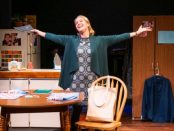
Adam Gwon’s song cycle, "Ordinary Days," became a cult hit when it opened the Roundabout’s Black Box Theatre in 2009 for a run of ten weeks. So successful was the show that it is one of the few Off Broadway musicals of its era to have an original cast album. As so few people were able to see the show, there has been a need for a major revival which Keen Company is now presenting at The Clurman Theatre at Theatre Row. While creating a show about commonplace moments offers its own problems, director Jonathan Silverstein’s choices have created new ones. [more]
For the first 25 minutes, the bushy red-bearded, receding with flowing hair Mr. Butler appears solo performing a series of his delightful songs. Butler superbly plays the banjo, guitar and harmonica as he conveys a Cat Stevens, Arlo Guthrie and Bob Dylan vibe. Then the ensemble joins him for a serious and light-hearted tuneful enactment. [more]
Mark Sonnenblick’s exceptional book is an accomplished mixture of prodigious research, well-drawn characters and adept if misguided construction. It skillfully dramatizes the gay experience of living in New York City in the 1960’s with all its glory and despair. The Checkerboard, Julius, The Village Vanguard, The Blue Angel, The Bon Soir and Cafe Wha? are among the legendary venues mentioned. The Stonewall Riots, organized crime’s control of gay bars and routine arrests of gay men are cited. [more]
Set in a dark time, "Girl From the North Country" creates a community on stage as do the best plays and musicals. Its tale of lost souls attempting to keep their heads above water is universal in both its message and its approach. Conor McPherson has never written so accessible a play before for Americans, and Bob Dylan’s songs have never sounded so poignant. "Girl From the North Country" is both unforgettable and not to be missed. [more]
Henry’s roommate and confidante, Gwen (a solid, appealing Leslie Hiatt) has her own heartache to deal with: Her wife, Diana, has left her, accusing Gwen of infidelity. Gwen and Henry support each other with wisecracks, gentle prodding and pleasant songs provided by Douglas J. Cohen (music and lyrics) and Dan Elish (book and lyrics, based on Elish’s novel, "Nine Wives"). [more]
Nevin Denham is a morose N.J. basement band guitarist whose estranged up and coming astrophysicist girlfriend Amy Leonardo moves to New York City to be an intern for Mr. Tyson at the Hayden Planetarium. After the news of the impending disaster is broadcast on television they realize they still have strong feelings for each other and they set out on odysseys to reconnect. Along the way there are apocalyptic vignettes with homeless marauders, moles and a snake. [more]
Anderson Cook’s jocular book is a silly amalgam of "Grease" and "Rock 'n' Roll High School" with shades of "The Rocky Horror Picture Show." Composer and lyricist Ben Lapidus’ Green Day-themed score is an appealingly thrashing affair with numbers such as “I Don’t Give a Fuck.” With rock star animation, Mr. Lapidus also portrays Derek conveying teenage angst for comic effect. [more]
You’d need a ten ton truck to haul away all the slings and arrows slung and shot at Donald Trump in "Me the People: Fire & Fury Edition," the red-hot political revue currently on stage at the Laurie Beechman Theatre. Written by the sharp-witted Nancy Holson whose hilarious lyrics repurpose many well-known songs for her nefarious criticisms of our misbegotten president, the show is an update of an earlier version. [more]
Using a format that has worked for him before in his George Gershwin and Leonard Bernstein evenings, Hershey Felder has returned to 59E59 Theaters in a charming biographical musical as legendary songwriter Irving Berlin. As Felder narrates his story becoming Berlin, he also sings and plays over 30 of his most famous songs, as well as some not so familiar today, including “Blue Skies,” “White Christmas” and the iconic, “God Bless America’. [more]
The complexities of this Greek tragedy are shoe-horned into a Gospel service with songs ranging from the thoughtful (“The Invocation”) to the formal (“Creon Comes to Colonus”) to the awe-inspiring (“The Descent of Oedipus”) and finally to the heartbreaking (“The Sermon” and “Closing Hymn”), all variations on the well-known Gospel/Blues/Christian Hymn musical repertory. [more]
Although "Smokey Joe’s Café" has been seen in New York before, the new production now at Stage 42 is an entirely different incarnation of the show that still holds the record for Broadway musical revues having racked up 2,036 performances. The new version which again uses nine talented and dynamic singers and dancers, five men and four women, has deleted five songs and added five, rearranged the song list for a new total of 40, and eliminated the intermission. It is now a more streamlined version of the 1995 show. [more]
The mellow sound of Brandt’s score proves to be easy listening, but the individual musical numbers do not build to any dramatic climaxes so that the show seems tamer than material concerning depression and alcoholism suggests it should be. However, the ballad forms and guitar/violin instrumentation are pleasant to the ear. Some of Giles’ dialogue which is not part of Aldrin’s story seems extraneous and the show takes a while to get started. "1969: The Second Man" is entertaining enough in this concert form, but needs some work before going to the next level. Jacob Brandt, however, proves to be a talented new musical voice. [more]
"Be More Chill" is an impressive musical version of Ned Vizzini’s cult novel. Not only does it reproduce the plot on stage, it also gives it a high tech look that dramatizes the story where the novel left it to the imagination. Joe Iconis, long thought to be one of the most promising new theater composers, makes good on that promise, and Joe Tracz demonstrates for a second time that he can put difficult material on the stage. While Ryan Rumery’s overly loud sound design will turn off older theatergoers who are not more chill, those in the swing of things will have a memorable evening in the musical theater. [more]
What’s missing from the nondescript music is originality, soul or spirit, and the same can be said about the book. Under the guidance of director James Will McBride, the cast, however, features some strong performances. In addition to Bober, Irion, and Sabulis, these include especially the red-haired Claire Leyden as Cynthia--with a strong, soprano, operatic voice-- and alto Blair Medina as Patricia, who plays the “Femme Fatale” in Three Card Monte. [more]
The clever invention is that each of them has a best friend who only they can see and hear: Neurosis (Brennan Caldwell) is Frank’s best buddy, a more cautious, nervous version of Frank, and Neurosalina (Morgan Weed) is Abby’s neurosis, a mean girl who Abby can’t get out of her head. Both of them need help but are not getting it from their neuroses who are always giving them bad advice and are stopping them from moving on. The show is bookended by musical advice from Samantha (Lacretta), a therapist, who takes on the task of freeing Frank from his problems: his overbearing Jewish mother Geri (Susan J. Jacks), his “underbearing” father Kenny (Joel Blum), his low self-esteem, and his lack of poise around women. [more]
Spirited, tuneful and fabulously performed but lacking a strong plot, the silly "R.R.R.E.D." might have made for a lively hour-long cabaret show. However, as a full-length musical, it’s a tiresome experience. The exuberant Hee Haw-style opening number has the two principal performers disguised as hillbillies in a garden. [more]
Shaina Taub’s joyful and sunny updated musical version of Shakespeare’s comedy, "Twelfth Night," is back in a full production courtesy of Free Shakespeare in the Park and Public Works which premiered an earlier production for four performances during Labor Day Weekend 2016. This slightly trimmed and tightened version is even more entertaining and the witty contemporary lyrics make this fun for young and old, as well as Shakespeare veterans and novices. [more]
"This Ain’t No Disco" is a compressed, zany look at the years in the 1970s that Studio 54 ruled the social whirl of New York City, complete with debauchery, drugs, loud music, semi-nudity and dancing (brilliantly evocative choreography by Camille A. Brown—herself no slouch with "Once on This Island" under her belt.) The libretto hews closely to the facts about the rise and fall of this mecca of A-list celebrities, including real people—Steve Rubell, Andy Warhol (here called The Artist)—and a host of fictional characters who represent a cross-section of the clientele, from pretty boy bartenders/drug dealers to undercover government agents looking for a chink in Rubell’s armor. The Mudd Club also makes a guest appearance as well as the homes of several of the characters whose mixing and matching drive the play. [more]
In telling the rest of this shattering story, the creators of Comfort Women, inexplicably, rely heavily on musical theater conventions that result in wrongheaded, if not downright offensive, choices. The most cringeworthy is the choreographed sequence of a Korean woman being gang raped by Japanese soldiers. At some point, in their effort to visualize this atrocity, director Dimo Hyun Jun Kim and choreographer Natanal Hyun Kim should have realized that they were, in fact, trivializing it. [more]
Steven Skybell’s Tevye warms up from a salt-of-the-earth, everyday philosopher to the much put-upon tragic existential hero upon whom God—to whom he speaks frequently—has heaped much tsouris. By the time he has lost a third daughter Khavele, this time to a Russian Christian, his interpretations of the songs and his line readings are heart-breaking. [more]
This plotless, mostly sung-through exhibition conveys the tumultuous 20th century urban African-American experience through Micki Grant’s dazzling score for which she wrote both the music and lyrics. “Universe in Mourning,” “Harlem Streets,” “Ghetto Life” and “Billie Holiday Blues” are some of the titles. [more]
Rebecca Aparicio’s book is a skillful fictionalization of the true story of Operation Pedro Pan, which facilitated the immigration of over 14,000 children from Cuba to the United States between December 1960 and October 1962. Ms. Aparicio successfully dramatizes the harsh era of the Castro regime, the promise of freedom in the U.S. and the realities of racism, all through a child’s perspective. The incidents are illustrative, historical facts are imparted, and the dialogue is engagingly simple yet effective. [more]
The unison of Jason Robert Brown’s accomplished score, Kate Whoriskey’s exciting direction and Rennie Harris’s vibrant choreography make this New York City Center Encores! Off-Center’s revival of his 1995 debut show "Songs for a New World," a dynamic theatrical experience. Mr. Brown’s surprise appearance at the piano to play a song in the second act was electrifying. [more]
Unlike the musicals "Rent" (an update on Puccini’s "La Boheme"), and "Miss Saigon' (inspired by Puccini’s "Madame Butterfly") both of which had all new music by other composers for their contemporary stories, "Carmen Jones" uses the original Bizet score. However, it is not simply an English translation. Hammerstein has written all new lyrics to place the story in a W.W. II Southern community (possibly North Carolina) and with the characters ending up in Chicago for the denouement. While "Carmen Jones" was a smash hit originally running for 503 performances at the Broadway Theatre during the war years, some like then critic James Baldwin found the dialect that Hammerstein had used for his African-American characters both embarrassing and demeaning, and the show has not had a New York revival until now. Notwithstanding, the first London production in 1991-92 was also a tremendous success at the Old Vic Theatre with a mix of both opera and theater stars in the cast. [more]
This is "God Save Queen Pam"’s world premiere and though spirited, it’s sluggish at a full length of two and half hours with an intermission. There’s repetitiousness, extraneousness and a wan presentation. With editing that enforces more of the plot and higher production values it’s conceivable that its evident whimsical charms could be whipped up into a madcap entertainment. For now, it’s best viewed as a workshop with potential that showcases the game cast. [more]
The show then become energized when Babatundé describes how Jefferson was discovered by a music executive when he was singing on the Texas streets while holding a tin cup. A recording contract follows and Jefferson became a leading blues performer in the 1920’s. Another bright sequence is a recreation of a concert. In the second half, we learn more about Johnson and the narration is more connected to the musical portions as it successfully concludes. [more]
Shakespearean spoofs are almost as old as Shakespeare himself, dating back to at least the Restoration period. Although the vast majority has faded into history, there are still some real standouts like the classic musical "Kiss Me, Kate," which thanks largely to Cole Porter is arguably even more enjoyable than its source material, a rare feat that the relatively new musical "Desperate Measures," now in its second off-Broadway run, also accomplishes. [more]
While "The Beast in the Jungle" is a musical for our time it contains a message that was dear to the heart of writer Henry James, that of the unlived life. Ultimately very moving when the story reaches its conclusion, the exquisite Vineyard Theatre production is for elite tastes but all dedicated theatergoers, not the casual entertainment seekers, should see it. It may well start a new trend in theatre musicals, one in which the emotional sections are danced rather than sung. [more]
Standing in the way of the show’s success is the workshop-like production. Some of Pellegrino’s melodies are pleasant but musical director Michael Wittenberg’s piano playing drowns out many of the weak voices. The lyrics tend to be very thin and extremely repetitious. The uncredited set is actually that of another show with unnecessary portions covered over in brown cloth, giving the look of the show no atmosphere whatever. The uncredited costumes are mainly coordinated in bland brown and white which does not help recall the period one bit. Stone’s choreography is extremely basic and not very decorative. If you sit on the left side of the theater, you are likely to be blinded periodically by designer Christina Verde’s two spotlights aimed right into the eyes of the viewers. [more]
Mr. Carlyle’s giddy opening is a thrilling mise-en-scène of a chorus line of servants, floating props and a grand back drop of a miniature representation of the country estate where the action is set. Act II starts with a rollicking cricket and tennis on the lawn segment showcasing cast members in gleaming casual wear and the commanding gyrations of Mark Evans who wonderfully plays a fatuous cad. There’s also a daffy number where portraits of ancestors in clothing of different eras come to life and dance. [more]
With a Judy Collins-style mane of blonde hair and wearing jeans and suede, the sleek Luba Mason as Joy certainly looks the part. That mien is reinforced by Ms. Mason’s smoothly conversational vocal inflections and marvelous singing. Mason is totally convincing as the weed-smoking matriarch who follows her heart. [more]
What makes the storytelling riveting are the performances by the talented cast. As the free-spirited Beatriz fighting for her life, Rubin-Vega is at her fiercest and she is a memorable three-dimensional character. Jiménez as the confused, angry Olivia is charming as she reveals her best childhood memories, lists her favorite books which have been a refuge, and grows up in the course of the road trip. David Patrick Kelly and Michael Mulheren are suitably touching as a gay couple who have loved each other for 50 years. Danny Bolero is sensitive as the still grieving widower who takes a shine to Beatriz. [more]
In the mode of vibrant Broadway leading ladies of the likes of Donna Murphy is the red haired and vivacious Kaitlyn Baldwin as the home economics teacher, Ms. Benson and as Private Jayne, the assistant to the nutty colonel. Cracking wise with the precision of Eve Arden and exhibiting superior singing and dance skills, Ms. Baldwin invests herself in the material with colossal force as if she were starring in "Wonderful Town" or an edition of "Forbidden Broadway." [more]
In performance, "One Thousand Nights and One Day" is a like a play with songs shoehorned in as none of them forward the story but take the emotional temperature of the characters instead. With all of the actors playing at least two parts, modern and ancient, with little costume change, it is often difficult to be certain where we are at any moment. Some play very similar characters, others play against their earlier incarnation. Erin Ortman’s direction is assured with the characterizations but she cannot solve the problems inherent in the writing. [more]
The Q Brothers Collective (made up of GQ, JQ, Jackson Doran and Postell Pringle) is best known in New York for their hip hop variations on Shakespeare: "Othello: The Remix" in 2016 and "The Bomb-itty of Errors" in 2000. As the entire show is in rhyme and rhythm, there are very few discrete songs, but the couplets come so fast that it is at times difficult to make out the clever lyrics. The upside of the new show has all the hijinks of a teen musical but with the unsophistication of a college parody (the downside). It is the latest musical version of Aristophanes’ most famous comedy, but unlike the 2011 "Lysistrata Jones," "ms. estrada" has eliminated all of the politics for an exploration into the social aspects instead. [more]
After the first song, “We are in the house where I grew up,” says Abigail, with the bacon and eggs and toast and tea in the morning, on the first day of a new school year. Adding to the confusion are Abigail’s many family members, including her sisters--one of whom is named Emily (Ashley Pérez Flanagan), not to be confused with her new friend Emma (Adina Verson)--her parents, her aunt (the stalwart Maryann Plunkett) and her cousins. Another part of the problem is that there are simply too many people to be contained on the small stage of the Connelly Theater, which may be why the majority of them begin the show in the balcony in the rear of the auditorium. (The Lucky Ones has been directed with an overcrowded zeal by Anne Kauffman.) [more]
Zoe Farmingdale’s book is a tart and good-natured treatment of the salvation of a high school misfit. The cheery, witty and melodious score has lyrics by Ms. Farmingdale and Toby Singer and music by Mr. Singer. An ode to IKEA is particularly catchy. Mr. Singer’s successfully eclectic music is perfectly realized by his arrangements and sound design. [more]
Twist’s “Creator’s Note” in the program alludes to Wassily Kandinsky’s musical metaphorical paintings and Twist’s youthful attraction to the possibility of using abstract puppetry in combination with music. The five-part Symphonie, subtitled “Episode in the life of an Artist,” called to him for its color and storyline which vaguely guide his creation although only the changing moods, rhythms and colors of the score seem be the inspiration for the series of moving abstract images that were mostly treats for the eyes, if not the mind—seductive, clever, dreamy, sensually involving, but more a vacation for conscious thought than an intellectual challenge. [more]
Michael Roberts’ music is a tuneful assortment of melodies some of which have an appropriate ethnic flavor. Mr. Roberts’ lyrics range from inspired to rudimentary with the overall score being quite charming. The caustic “Visiting Your Mother” stands out as a Leonard Bernstein/Betty Comden & Adolph Green-style showstopper as sensationally performed by the appealingly forceful Sarah Beth Pfeifer as Eleanor. [more]
“We'll Take a Glass Together” is an exhilarating production number. Brandon Uranowitz’s animated youthfulness is up to the task of equaling the impact of Michael Jeter’s legendary turn in the original production as the dying bookkeeper enjoying a carefree spree. Mr. Uranowitz’s limber movements are thrilling as he euphorically undulates up and down flanked by a large gold dance barre carried by the terrific ensemble. [more]