Articles by Victor Gluck, Editor-in-Chief
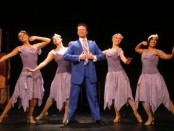
Initially based on Plautus’ Roman comedy, "Amphitryon," "Out of This World" is an uneasy mix of 1950’s slang and idiom, and classic Greek themes handled in a jokey manner. One of the major problems with the show is finding the right style for this broad-winking sex farce. After she was fired, Agnes De Mille stated that if she had more time she would have directed the show in “a mock heroic style.” Musicals Tonight!’s director Norb Joerder hasn’t solved this problem either and his few dance numbers look more like Native American dances from "Annie Get Your Gun" than those of the ancient Greeks. [more]
Travels with My Aunt
Havergal’s adaptation is unusual in that it uses four male actors to play 25 roles including the central role of Aunt Augusta, with all the actors taking turns narrating the story. Dressed exactly alike in each act, Thomas Jay Ryan, Jay Russell, Daniel Jenkins and Rory Kulz switch identities, nationalities, age, and genders in a madcap adventure told with decided British understatement. This is challenging for the audience as well as the actors: since the performers do not change costumes, it is necessary to follow the plot closely to follow who is who, with the actors sometimes changing characters in the same scene. Steven C. Kemp’s minimal but clever unit set is not much help either as it remains basically the same in each act throughout all of the outrageous adventures that unlikely hero Henry Pulling is taken on by his aunt. [more]
Barbecue
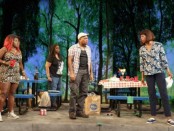
Robert O’Hara’s "Barbecue" may seem like a series of sleights of hand, but as a satirist of American culture, the playwright has a good deal to say about how the media shapes and defines our culture by how it reports the evens of the day. Under the direction of Ken Gash, Barbecue will take your breath away at its invention and cleverness while holding up the mirror to our natures, exactly what theater is supposed to do. [more]
Cloud Nine
What is most remarkable about Caryl Churchill’s time traveling comedy "Cloud Nine" is that this prescient play about sexual politics and repression is now 36 years old, though it could have been written this year. Still a challenging gender-bending play, it asks us how far we think we have come from the Victorians in our attitudes about sex and identity. Set among the British in Africa during the repressed 1879 in Act I and back in England in liberated London in 1979 in Act II, the characters switch roles, genders and ages in the course of the evening. It isn’t obvious until the second half where the play is headed or how brilliant Churchill has been. Cloud Nine (which proves not to be a nirvana for the characters) challenges a great many of our strictly held beliefs about the way the world is or should be. [more]
Oh, Kay!
From the evidence of Colgan’s Musicals Tonight! production, "Oh, Kay!" not only still works in the original but has a glorious score including such Gershwin classics as “Dear Little Girl,” “Clap Yo’ Hands,” “Do, Do, Do,” “Fidgety Feet,” “Heaven on Earth” and “Someone to Watch over Me.” The three songs cut from the original production (“When Our Ship Comes Sailing in,” “Ain’t It Romantic?”, and “Stiff Upper Lip” used in the film A Damsel in Distress) while not lost treasures are very pleasing lyrics and melodies. [more]
Sisters’ Follies: Between Two Worlds
With a cast led by downtown icons Joey Arias and Julie Atlas Muz, "Sisters’ Follies" includes life size puppets, flying ghosts, music and dance, topless performances, talking masks, and spectacular recreations of their most famous productions. When we first meet them, they are ghosts flying about the stage in long white diaphanous gowns glad to be back in their theater. They then sing a duet of Irving Berlin’s “Sisters” with appropriately new ribald lyrics. From their clever banter, we discover that Alice (Arias) was an actress and Irene (Muz) a dancer who were continually warring over everything from billing to which of them received more flowers to their legacies. Self-centered Alice, the older sister, is always cool and collected while Irene, who worships her even though she always seems to get the short end of the stick, is more passionate and temperamental. Today Irene is remembered as having founded the Costume Institute of the Metropolitan Museum of Art, while the acting school they both founded, The Neighborhood Playhouse School of the Theatre, is also very much alive. [more]
Death of a Salesman in Yiddish
Although Arthur Miller grew up in a Jewish family, none of his characters with the exception of the antique dealer in The Price are explicitly Jewish. Yiddish stage star Joseph Buloff sought to correct that when he adapted "Death of a Salesman" as "Toyt fun a Seylsman" and presented the play in Argentina in 1949. In 1951, Miller permitted Buloff to bring the translation to Brooklyn’s Parkway Theatre where it was deemed a great success. Not seen again in New York until now, New Yiddish Rep is giving the Yiddish adaptation its Manhattan premiere in a slightly revised version in which the non-Jewish characters speak in English and the text is projected with English supertitles for a contemporary audience that does not know Yiddish. [more]
The New York Pops: “My Favorite Things: The Songs of Rodgers and Hammerstein”
The New York Pops’ 33rd season opened with a joyful tribute to one of the legendary songwriting teams of Broadway. Entitled “My Favorite Things: The Songs of Rodgers and Hammerstein,” the evening featured guest artists American soprano Sierra Boggess and British baritone Julian Overden, along with Judith Clurman’s Essential Voices USA. All proved to have an affinity for this music which was greeted rapturously by the sold-out audience. [more]
Old Times
The production includes the Broadway debuts of British screen and television stars Clive Owen and Kelly Reilly, and a return of British stage star Eve Best after her Tony Award nominated performance in the 1908 revival of Pinter’s "The Homecoming." Unfortunately, to some extent they are appearing in three different plays so different are their acting styles. Even Constance Hoffman’s costumes take your mind away from the play before you. A pity actually as "Old Times" has not been seen in New York since the Roundabout’s Off Broadway revival which ran from 1983-84 but had an odd combination of American and British actors of film and stage. [more]
The Magic Fish
Sunny Knable’s music is romantic and lilting. He has called his style a cross between Stephen Sondheim and Benjamin Britten. In this he does himself an injustice as his music is much more melodic. As an American opera composer, he follows in the footsteps of Douglas Moore, Carlyle Floyd, Dominick Argento and Thomas Pasateri. Jim Knable’s libretto cleverly uses spoken dialogue for the prose passage and rhymed verse for the musical settings. The vocabulary is suitable for young children but the sentiments and plot complications are entertaining for adults. [more]
Daddy Long Legs
Jean Webster’s classic epistolary novel of the coming of age of a college age girl at the beginning of the twentieth century, "Daddy Long Legs," has been dramatized many times. What makes this charming new Off Broadway musical now at the Davenport Theatre different is that it is played by only two characters and as a result it remains extremely faithful to the original book. Although the show written by composer/lyricist Paul Gordon and book writer/director John Caird, (Tony Award winner for the original "Les Misérables" and "Nicholas Nickleby"), the team responsible for the 2000 Jane Eyre, can’t compete with the big brassy Broadway musicals down the block, its very old-fashionedness and fully rounded characters make it extremely satisfying and endearing in a way that few musicals are today. Just try to not care about these characters. [more]
The Awful Truth
If this story sounds familiar, it is the plot of the classic thirties screwball comedy "The Awful Truth" which starred Cary Grant and Irene Dunne. In fact, Arthur Richman’s 1922 play of the same name has been filmed four times including a 1925 silent version, a 1929 sound version with original stage star Ina Claire which has been lost, and a 1953 musical version with Jane Wyman and Ray Milland. As part of its 24th Season devoted to “Hope,” Metropolitan Playhouse is producing the first New York revival of this unpublished play, surprisingly as the original production ran a successful 144 performances. [more]
The Pumpkin Pie Show: Labor Pains
The annual "The Pumpkin Pie Show" is back for its 17th year. Performed with no sets and no costumes, it has been described as “bedtime stories for adults.” Usually presented around Halloween (hence the pumpkin), this year the show has a run from September 24 to October 10. The reason is simply that creator, storyteller and writer Clay McLeod Chapman is about to become a father. The due date for his baby boy is October 31. As result Chapman’s scary and engrossing evening this year is called “Labor Pains” and includes five tales about babies from birth to childhood. Parenting has never been dissected so closely or seemed so chilling. [more]
A Midsummer Night’s Dream – Pearl Theatre
If you thought Bedlam’s artistic director Eric Tucker had created physical productions for his acclaimed acting troupe in the past, think again. His "A Midsummer Night Dream," seen this summer at the Hudson Valley Shakespeare Festival and now in residence at the Pearl Theatre, gives the actors a workout from beginning to end. Whether all audiences will go along with it – it is tiring for both performers and viewers – is a question, but like watching a world-class circus or ballet troupe, you know at the end of the evening that you have seen an extraordinary imagination at work. Tucker just expects everyone to go the extra mile. This is not a "Midsummer" for people who have never seen the play before, but one for whom the traditional interpretation no longer has anything to offer. [more]
The New Morality
When American born Londoner Harold Chapin was killed in W.W. I in 1915, he was a highly regarded actor, stage manager and playwright, although not as famous as his colleagues George Bernard Shaw, James Barrie or John Galsworthy. While he had completed four full-length plays, his early death led to an eclipse of his work and his fame. In the centenary of his death, the Mint Theater Company well-known for uncovering lost works of merit, has revived his major comedy, "The New Morality." While Jonathan Bank’s production is elegant and polished, this diverting play unfortunately seems lightweight and thin today. [more]
Radio Mystery 1949
Could Dennis Richard’s new play "Radio Mystery 1949" be inspired by the Mad Bomber George Metesky who terrorized New York in the 1940’s and 1950’s? Otherwise, there is no explanation for why this mild recreation of a radio mystery show which is beset by a mysterious actor who may or may not be carrying a bomb is set in 1949. Aside from no references to the post-war period, there are also some anachronisms like speaker phones which came from a later era. [more]
Hamlet in Bed
The play is told mainly in monologues by both actors on microphones, alternating with rehearsal scenes from the Gertrude/Hamlet confrontation. This makes the evening more of a performance piece than a stage play. Once we are given the facts, the ending becomes very predictable though the actors are very intense throughout the play’s 90 minutes. Except for the battered white mattress, Rachel Hauck’s set is entirely black, as are most of the costumes by Jessica Pabst. Sometimes due to Scott Zielinski’s lighting, the actors fade into the dark walls of the set. [more]
Laugh It Up, Stare It Down
Romantic comedy was once the staple of Broadway. Today it turns up more often in the movies. When it appears on the stage it is fairly unusual today and something of a throwback to an earlier era. Alan Hruka’s "Laugh It Up, Stare It Down" is quite charming in its way. However, its whimsical style tends to undercut the serious topics it deals with on the subject of love, marriage and how to treat life’s problems. As a result, it seems more than vaguely inconsequential. However, it remains a diverting if innocuous evening of light entertainment. [more]
Desire: An Evening of Plays Based on Six Stories by Tennessee Williams
Having commissioned evenings of one act plays by major American playwrights based on the short stories of Anton Chekhov and the sonnets of William Shakespeare, The Acting Company has now turned to the work of a native author. As directed by Michael Wilson, the result, "Desire: An Evening of Plays Based on Six Stories by Tennessee Williams," is a mesmerizing work of one acts in which each author handles the original material differently and the brilliant group of nine actors, mainly Acting Company alums, get to tackle two – four roles each. Many give such vivid and varied performances that it is necessary to examine the program to realize that you have seen the same performer in a contrasting role. [more]
Isolde
Experimental playwright/director Maxwell has a uniquely personal vision of theater. He has said in interviews that he directs his actors to be “neutral,” in other words all emotions are drained from the performances. Only the subtext tells us what they are feeling. His characters never seem to finish their sentences. Questions are left dangling. Much information is withheld. The play pulsates with unspoken tensions. He makes use of traditional forms and archetypes but explodes them partly by avoiding our expectations. "Isolde," which uses the Arthurian legend of Tristan and Isolde for its underpinnings, is absorbing theater. However, you will either find it pretentious or brilliant depending on what you want from a theatrical experience. [more]
The Odyssey
Aside from the wonderfully eclectic score by Almond (jazz, pop, Latin, blues, Broadway, gospel, folk music, etc.) who also acted as narrator and singer, the production offered exciting performances by Brandon Victor Dixon as Odysseus, Karen Olivo as Penelope, Andy Grotelueschen as the Cyclops, Elizabeth Ely as Princess Nausicaa, and Travis Raeburn as the Prince of Phaecia. At times deBessonet was required to work as a traffic cop to get the large number of performers on and off stage, but her work with her leads both professional and newcomers alike was first rate. [more]
Mercury Fur
In his 2005 "Mercury Fur," being given its belated Off Broadway premiere by The New Group under the direction of its intrepid artistic director Scott Elliott, there has been a complete breakdown of society: gangs roam the city and kill and destroy in supermarkets and museums, while the population is addicted to hallucinogenic butterflies. The one redeeming factor: people will still go to any lengths to save the ones they love. However, "Mercury Fur" is not for the squeamish or faint-hearted: Ridley’s original publisher refused to publish the text. [more]
Drop Dead Perfect
Everett Quinton has found the ideal vehicle in the hilarious "Drop Dead Perfect" to revive the style of the Ridiculous Theatrical Company for which he originally found fame. Like the plays of the late Charles Ludlam plays, Erasmus Fenn’s Drop Dead Perfect parodies a specific genre using movie and television quotes and characters, situations lifted from famous melodramas, and sexual puns placed in new contexts. Here the new play is a satire of 1940’s and 50’s Bette Davis and Joan Crawford melodramas, with dollops of I Love Lucy which allows Quinton do sparkle as a Southern heiress with many scores to settle. Director Joe Brancato manages to keep the melodrama believable at all times and none of the quartet of actors goes beyond the histrionics inherent in the plot. [more]
Informed Consent
Deborah Zoe Laufer’s fascinating and engrossing "Informed Consent" tells three interlocking stories that eventually become one by the end. Under Liesl Tommy’s assured direction and with Tina Benko’s riveting central performance as a research scientist, the play, co-produced by Primary Stages and Ensemble Studio Theatre under the auspices of the Alfred P Sloan Foundation, deals with such issues as genetic testing, science versus religion, scientific ethics, and early onset Alzheimer’s. Inspired by a true story," Informed Consent" uses various theatrical devices to tell its compelling story and remind us of the necessary work needing to be done if we are to find cures for unsolved diseases like diabetes which involve a great many victims. [more]
Hamilton
The Broadway transfer of the acclaimed Off Broadway musical "Hamilton" has finally taken place and the show looks and sounds even more comfortable on the larger stage of the Richard Rodgers Theatre. Alexander Hamilton may have been the unsung hero among the Founding Fathers of the American Revolution but this new musical has changed all that. "Hamilton," now safely ensconced on Broadway, blows the dust off history and turns his story into the most exciting stage show in town. Inspired by Ron Chernow’s biography, triple-threat creator Lin-Manuel Miranda, the composer, librettist and star of the show playing the title role, has had the terrific idea to write Hamilton as a through-composed hip-hop, r & b, rap musical which gives the 200-year-old story a tremendous shot of adrenalin. This may well be the first hip-hop musical to reach Broadway but also pays homage to the styles that preceded it. [more]
Cymbeline
At The Public Theater’s Shakespeare in the Park venue, director Daniel Sullivan has proved himself a brilliant interpreter of the Bard’s comedies, both dark and light, from the evidence of his "Merchant of Venice," "The Comedy of Errors" and "Twelfth Night," to name only a few. Therefore it is a great disappointment to report that his "Cymbeline," the second and last 2015 Shakespeare in the Park offering, based on his 1999 Old Globe Theatre, San Diego, staging, is both confused and uneven, both visually and theatrically. Even more discouraging, the production wastes the talents of noted stage stars Kate Burton, Raúl Esparza, Patrick Page, and Lily Rabe and Hamish Linklater, the acting couple being reteamed on the New York stage for the fifth time. [more]
Summer Shorts 2015 – Festival of New American Short Plays – Series B
Series B of Summer Shorts 2015 is similar to Series A in that all three plays are also relationship dramas, here between a woman (or three women) and a man in which the men aren’t sure they want to give in to the women. Unlike Series A, all three have endings that are open ended and rather unsatisfying to varying degrees. Although two of the three authors have excellent credits (Lucy Thurber and Robert O’Hara), the plays may feel unfinished or early drafts. [more]
Summer Shorts – Festival of New American Short Plays 2015 – Series A
Summer Shorts – Festival of New American Short Plays has returned to 59E59 Theaters for its 9th annual outing offering six world premieres by famous playwrights, as well as some who ought to be more well-known, along with different casts and directors for each. The three plays in Series A are a fascinating grouping of new one acts in which women attempt to manipulate their companions for various ends. Neil LaBute, Vickie Ramirez and Matthew Lopez take very different stories and handle them in distinctive ways. All of these new plays can use a bit of pruning, but they are all works that will get under your skin and stay with you. [more]
Three Days to See
Using a versatile cast of seven (Ito Aghayere, Patrick Boll, Marc delaCruz, Theresa McCarthy, Chinaza Uche, Barbara Walsh, and Zoe Wilson) who all play both Helen Keller and her teacher Anne Sullivan at some point in the evening, "Three Days to See" will impress you with the courage of this remarkable woman and remind you how grateful you should be for having your five senses unimpaired. While Keller’s early life was brilliantly dramatized in William Gibson’s "The Miracle Worker," that play and movie only dealt with Keller at age seven. "Three Days to See" tells the rest of the story as well as gives us insight into her beliefs, ideas and causes to which she was passionately devoted. [more]

Threesome
Yussef El Guindi’s "Threesome" is really a political treatise in the guise of a romantic comedy. Engrossingly performed by Alia Attallah, Quinn Franzen and Karan Oberoi, it is in the end more than a bit superficial and unconvincing, though it will generate a good deal of diversion. Chris Coleman’s direction covers up some of the play’s flaws by keeping the pace moving swiftly along. [more]

Songs for the Fallen
Definitely not for children, "Songs for the Fallen" is a sophisticated cabaret/vaudeville celebrating the decadent life. Its main character Marie Duplessis, better known today as Marguerite Gautier, aka Camille, gives Australian singer/actress/playwright Sheridan Harbridge a star turn of which she takes full possesion. You may feel as exhausted as Harbridge’s Marie looks at the end of this dense and crowded show, but you will know you have had a complete theatrical experience. [more]
Mrs. Smith’s Broadway Cat-tacular
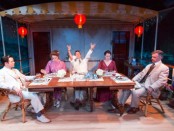
Of course, Mrs. Smith is the marvelous creation of writer/actor/performance artist David Hanbury and director Andrew Rasmussen, based on a character created by Hanbury, who has played Mrs. Smith in four previous shows with a Broadway version promised for the near future. The evening is a show business parody with Mrs. Smith narrating the story of her life (childhood in upstate New York with Carlyle, talent show winner, Ziegfeld star, her 14 marriages, international touring artiste, Pat Nixon’s Birthday Bash, and retiring when Carlyle went missing.) Along with the video footage of Mrs. Smith’s life are Skype hook-ups with Sylvia Cleo, “Pet Psychic to the Stars” (played by Andre Shoals) and appearances of Carlyle as a puppet as well as on film. [more]

I Know What Boys Want
A very powerful and topical theme runs though Penny Jackson’s play, "I Know What Boys Want," but the author’s understandable anger leads to a good deal of melodrama. Tackling the topics of cyberbullying, sexual double standards, and misuse and abuse of the social media are timely and provocative themes and deeply in need of public discussion. However, the play also takes on the topics of drug addiction, teenage drinking, same-sex marriage, date rape, effects of divorce on teenagers, SAT tutoring for rich kids, etc. While the basic story is absorbing, I Know What Boys Want tries to cover a few too many topics in its 90 minutes. [more]
Judith & Vinegar Tom
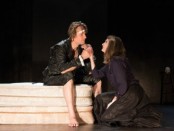
For PTP/NYC (Potomac Theatre Project)’s 29th season they have chosen to pair one-acts by two of their favorite playwrights, Howard Barker and Caryl Churchill, who are also among Britain’s leading dramatic authors but who are not seen here as much as they ought to be. At first glance, the two plays could not be more different, but on closer examination they deal with similar themes, particular as both have strong historical women as their central characters, and offer modern sensibilities on ancient themes. As an addition to the more familiar work of these acclaimed contemporary writers, this makes a fascinating evening for those who follow British drama. [more]

Of Good Stock
Plays about three very different sisters go back to Shakespeare’s "King Lear." In modern times, the topic immediately recalls Chekhov’s "Three Sisters" and more recently Wendy Wasserstein’s "The Sisters Rosensweig" and Beth Henley’s Pulitzer Prize-winning, "Crimes of the Heart." Melissa Ross, whose excellent Nice Girl just completed its world premiere at the Labyrinth Theater Company, has entered the fray with "Of Good Stock" with a cast led by film star Alicia Silverstone returning to the New York stage. While the play is entertaining and believable under Lynne Meadow’s direction, it is also overly familiar without revealing any new depths. [more]

Sayonara, The Musical
Although "Sayonara, The Musical" had an acclaimed lavish production at Paper Mill Playhouse in 1987 and a later version at Houston’s Theatre Under the Stars in 1993, it has not been seen in New York until now. Pan Asian Repertory Theatre, now in its 38th Season, is presenting the local premiere of the adaptation with its book by playwright William Luce ("The Belle of Amhurst," "Lillian," "Lucifer’s Child," and "Barrymore"), lyrics by Hy Gilbert and music by George Fischoff. Surprisingly, "Sayonara" has a great deal in common with "South Pacific": the exotic Asian locale, the fraternization between Yankee officers and Asian women, a tale of prejudice and bigotry, and two parallel love stories. Unfortunately, at this post Sondheim junction, the way 'Sayonara" follows the Rodgers and Hammerstein formula seems dated, while the material, based more on the movie than the original novel, has deflated Michener’s story by making it oversimplified and superficial. [more]

SeaWife
The six members of the Lobbyists make up the cast along with Raymond Sicam III (on cello) who perform all of the characters as well as play all the instruments. The Melville Gallery has been decorated by set designer Jason Sherwood as a 19th century inn that seems to encircle the audience. Samantha Shoffner’s props (suggestive of both an inn and a schooner) include netting, ropes, glass jars, baskets, paintings and a ship’s wheel. After the band plays an introduction, Caldi (played by Tony Vo) offers to tell us the story of Gravesight, “the greatest harpooner who ever lived.” [more]
10 out of 12
While this is a fascinating idea, anyone who has worked in theater will tell you that Tech rehearsals are long and tedious with all the stopping and starting to get the lights, sound, set and costumes right as time is running out. Unfortunately, much of 10 out of 12 falls into this category. At two hours and 40 minutes, the play is a bit of an endurance test for the uninitiated. Although as the Tech rehearsal goes on we get to know the characters better, the play is revealing about only some of its characters. [more]
Gloria
His new play "Gloria" goes in another direction, a scathing satire of the media (magazine work, book publishing and television development) as well as the public’s frenzy for the details of high profile news stories. Evan Cabnet who has also piloted new plays by Theresa Rebeck and Christopher Shinn, has cast his crackerjack production with some astute newcomers to local stages (Catherine Combs, Jennifer Kim, and Ryan Spahn) as well as some accomplished New York veterans (Kyle Beltran, Jeanine Serralles, and Micahel Crane) in this always absorbing office drama. The cast is articulate and smooth-tongued as they should be playing people in the media. [more]
Doctor Faustus
Much of the play is directed using Brecht’s so-called alienation effect in which the audience is constantly reminded that this is all a play, a poor choice for a tragedy that wants to put both awe and fear into the hearts of its listeners. Tony Strages’ set design resembles a circus or vaudeville and much of the performance is played on that level. What is sacrificed is the seriousness of the theological and moral issues. There are continual shifts in tone which simply draw attention to themselves, rather than add to the meaning. [more]
Guards at the Taj
Rajiv Joseph’s plays are filled with emotional or physical violence as in "Bengal Tiger at the Baghdad Zoo," "Gruesome Playground Injuries" or "Animal out of Paper." His new play, "Guards at the Taj," being given its world premiere by Atlantic Theater Company, has both. Set in India in 1648, this riveting drama which works on many levels has been directed by Amy Morton, best known for her New York performances in Steppenwolf transfers to Broadway ("August: Osage County" and "Who’s Afraid of Virginia Woolf?"), and features Omar Metwally and Arian Moayed who are always commanding. [more]
The Tempest
The first thing one notices on entering the Delacorte Theatre is how empty the large stage looks. In Riccardo Hernandez’s scenic design, except for a tiny desk on the right and a small pile of rocks on the left, the playing area is simply a large open expanse that is backed by scaffolding which offers a kind of balcony or catwalk and in front of which are hung curtains or screens. On this is projected dark, churning seascapes in streaming video. As the setting for the play is an island, this is initially attractive but as it continues throughout the play, it becomes both distracting and superfluous. The costumes by Emily Rebholz in black and white are also devoid of color. David Lander’s lighting occasionally turns the stage blue, green or red, but this comes as an intrusion to the rest of the concept of the production. Along with the lack of magic until almost the end of this long play, it appears as if Greif’s interpretation of the play were simply to keep things spare and unadorned. Unfortunately, this tale which calls out for enchantment and sleight of hand is not the play to do this with. [more]
Injunction Granted
The recent national rallies to raise the minimum wage have made the Federal Theater Project’s 1936 "Injunction Granted" relevant all over again. This play created by the Editorial Board of the Living Newspaper Unit of the FTP depicting the conflict of labor versus capital in the U.S. over almost 300 years turns out to be powerful theater in this revival by Metropolitan Playhouse. The third of the FTP Living Newspapers to be revived by this theater following "One-Third of a Nation" and "Power," Alex Roe’s lively and inventive production uses six actors to play 200 characters in a vaudeville-like atmosphere. [more]
Cagney
Although he was probably Hollywood’s most famous tough guy, James Cagney’s life story is not as well-known as that of many other legendary movie stars. The York Theatre Company’s new musical, simply called "Cagney," hopes to do something about that. Created around the obsession of actor Robert Creighton who looks a great deal like the red-headed Irish star, this entertaining show business musical also reveals the difficult times he had both on the streets of New York and at Warner Brothers in Hollywood which typecast him and wanted him to go on making the same picture over and over. [more]
Casterbridge
In recent years, there have been many Off Broadway attempts to musicalize the works of Thomas Hardy. The latest is composer Christopher Beste and writer David Willinger’s ambitious, "Casterbridge," a very engrossing version of Hardy’s novel "The Mayor of Casterbridge." While some of the lovely music proves to be too difficult for some of the singers, under the direction of Willinger with musical director Bob Goldstone at the piano, the almost all sung-through stage version is an impressive and faithful retelling of the Hardy story. [more]
For the Last Time
As a follow-up to their musical based on Fitzgerald’s This Side of Paradise, lyricist/composer Nancy Harrow and writer/director Will Pomerantz have turned their sights on Nathaniel Hawthorne’s 1860 novel, "The Marble Faun." Renamed "For the Last Time," this new jazz musical has changed the setting from Rome in 1860 to New Orleans, circa 1950, and uses an all-Black cast to tell the original story. The show’s glory is its magnificent score, a combination of jazz and blues ballads, wonderfully sung by its cast of seven. The problem is that the show started as a concept album and to some extent hasn’t progressed very far from there: the book by Pomerantz and Harrow remains too thin to deal with the plot’s very deep themes. [more]
The Spoils
Can an obnoxious, sadomasochistic nerd be the central character of a play? This is the thought that will run through your mind as you watch Jesse Eisenberg’s third play, "The Spoils," being given its world premiere by The New Group. As it turns out if you knew Ben, the latest role Eisenberg has written for himself, you would probably run the other way. However, staged by The New Group’s artistic director Scott Elliott,"The Spoils" is absorbing theater and you sit riveted to see if Ben will get what he deserves. [more]
Permission
Robert Askins’ hilarious and engrossing new play is set in Texas just like his Hand to God also produced by MCC Theater at the Lucille Lortel Theatre in 2014 and now on Broadway. And just like "Hand to God," this comedy-drama is about needy, unfulfilled people, but this time it is about adults, rather than damaged teenagers. He writes full rounded characters and clever, believable dialogue that reveals the speakers at all times. Here and in "Hand to God," he also deals with fresh subject matter not seen on our stage before. While nothing really shocking happens on stage in Permission, it is most definitely for adults – and prudes should stay home. [more]
The Two Gentlemen of Verona
For those who saw Fiasco Theater’s inventive and clever version of "Into the Woods" at the Roundabout’s Laura Pels Theatre earlier this year, you know what a delightful take this company has on material that has previously been performed in a traditional manner. If you didn’t see their Into the Woods or their previous production of "Cymbeline," then you are in for an absolutely delightful treat with their latest production, "The Two Gentlemen of Verona," now at the Theater for a New Audience’s Polonsky Shakespeare Center. Performed with a cast of six talented and resourceful actors (five of whom were members of both the "Cymbeline" and "Into the Woods" casts) in a barebones production which hits all its marks, this early Shakespeare comedy is always hilarious, always surprising, always accessible and always romantic. [more]
Don Juan
The Pearl Theatre Company’s express aim in reviving this curiosity according to translator Jess Burkle, responsible for this world premiere adaptation, is “to connect the experience of the play in the original French to American audiences in 2015.” Burkle’s method is to use “alliteration, idiom, and mixed metaphor” as “the key to getting us all to pay attention to Moliere’s glowing words.” Much of the problem with Hal Brooks’ production is that while all of the characters aside from Don Juan (who is clothed as a rock star) are dressed in 17th century costumes, the text is made up of contemporary language. [more]
The King and I
The Lincoln Center Theater revival of Rodgers & Hammerstein’s The King and I is a provocative, eye-filling and poignant experience. Both younger and older theater writers and audience members can learn a good deal about how to tell a story on stage that is both emotionally moving and makes you care about the characters from Rodgers & Hammerstein’s expert storytelling. "The King and I" will send you out of the theater feeling that you have had a fulfillingly memorable experience filled with unforgettable songs, dances and theatrical moments. [more]
‘Tis Pity She’s a Whore
We associate Jacobean revenge tragedy with the reign of King James I. Each play’s atrocities seemed to dare the next playwright with an unspoken “Can you top this?” Playwright John Ford continued the genre under the next king, Charles I, coming up with new and even more lurid variations. Red Bull Theater which specializes in the plays of Shakespeare and his contemporaries is offering a staging of Ford’s rarely revived masterpiece "‘Tis Pity She’s a Whore." While artistic director Jesse Berger has piloted a solid production which is a good introduction to this unfamiliar play, it all seems a bit tame when the script seems to cry out for tremendous excesses. As always, however, with Red Bull productions, the diction in this revival is impeccable and totally intelligible. [more]
Finding Neverland
Directed by the usually innovative Diane Paulus (whose credits include the critically acclaimed "Hair," "Porgy and Bess," "Pippin"), "Finding Neverland" has been created by the numbers and its staging suggests a great many earlier musicals. The score by Gary Barlow & Eliot Kennedy, long associated with the UK band, Take That, and writing their first musical, is filled with serviceable and prosaic ballads and anthems (with many false rhymes) to pleasant melodies but none which really forward the story. With titles like “Believe” and “Neverland,” they often have an overly familiar feeling. While Finding Neverland steals shamelessly from the 1954 Jule Styne-Comden & Green musicalization of Barrie’s play"Peter Pan," it never comes close to the charm of that earlier musical. [more]
Airline Highway
Unlike D’Amour’s last New York play, "Detroit," a Pulitzer Prize finalist which had four characters and a tight arc, "Airline Highway" is diffuse and sprawling with a large cast of 16 actors ably piloted by director Joe Mantello. Set in the shabby, rundown Hummingbird Motel on New Orleans’ Airline Highway, the play introduces us to a colorful but down-and-out cast of characters just eking out a living: Krista, a now homeless stripper in her 30’s; Tanya, a 62-year-old hooker and drug addict; Terry, an African American handyman always in need of money; Francis, a 50ish poet who seemed to have missed his moment, and Sissy Nan Na, a transvestite bartender and karaoke wrangler on Bourbon Street of African American and Puerto Rican descent. The motel is managed by Wayne, in this late 50’s, always good for a soft touch or ready to tell his life story. [more]
Wolf Hall, Parts One & Two
As deftly adapted by British playwright Mike Poulton and vigorously directed by Jeremy Herrin, the plays on the stage of the Winter Garden vividly bring to life the British court and its intrigue during the early sixteenth century, from about 1529 - 1536. Poulton wisely leaves out Cromwell’s childhood and youth described in the first novel and begins with him as lawyer to Cardinal Wolsey where the real story begins. However, like the published books, many of the major events take place between the scenes and the characters meet up to discuss the outcome. These are not plays for those who have not read the novels or are not familiar with the historical events or characters as there are too many people and relationships to keep straight if one doesn’t. Nine of the actors play one character each, the rest play between two and four. [more]
Gigi the Musical
Though this sophisticated story was intended for equally sophisticated adults as part of the mores and manners of a society and culture gone with the wind, the stylish and colorful Broadway revival has solved all these problems with Heidi ("Call the Midwife," "Cranford," "Upstairs Downstairs") Thomas’ new adaptation of the Alan Jay Lerner book and the casting of Disney heroine Vanessa Hudgens in the title role. Gigi is now over 18 and Gaston is in his 20’s, which puts a decidedly different complexion on things. “Thank Heaven for Little Girls” is now sung by Gigi’s grandmother Mamita and her Aunt Alicia. All decidedly right and proper and the word courtesan (which is what this is about) is never once mentioned. Sex is never even an issue. Here love is simply a game. So what are we left with? [more]
Hamlet
The first problem is the attractive modern setting by Walt Spengler of the wedding breakfast of Claudius and Gertrude with a huge cake in the background. The issue is that the table and the cake remain on stage for the entire evening, a terrible distraction. Does this palace have only one public room? The next situation is that Pendleton has chosen to cut both ghost scenes so that the audience is never told that Gertrude had an affair with her brother-in-law or that Claudius poisoned his brother Old Hamlet. The problem that this creates is that young Hamlet has to be played as paranoid as we have no way of knowing what the off-stage ghost told him, nor do we know what is bothering him when he acts so badly to his mother and step-father. [more]
The Undeniable Sound of Right Now
Like Laura Eason’s "Sex with Strangers" seen at The Second Stage last summer, "The Undeniable Sound of Right Now," her new play having its world premiere in New York in a joint production of Rattlestick Playwrights Theater and Women’s Project Theater, has a pulsating urgency that pulls you into it from the moment the lights come up. Director Kirsten Kelly, another long time Chicago resident along with Eason, has obtained dynamic characterizations from her cast of six including Jeb Brown, Margo Seibert and Daniel Abeles. While the play has a rather abrupt and unsatisfying ending as well as its clunky though accurate title, it brims with the authority of real life rather than theatrical artifice. [more]
Pardon My English
Ironically, the only script that has survived is the original one by Hebert Fields (Annie Get Your Gun) and Morrie Ryskind (Pulitzer Prize for Of Thee I Sing). Musicals Tonight! is giving this pleasing confection its second outing since New York City Center Encores! reclaimed it in 2004 with a delightful revival marked by a top-notch cast of comedians. This rarely heard Gershwin score (which premiered “The Lorelei,” Isn’t a Pity,” and “My Cousin in Milwaukee”) is filled with musical riches, both famous and forgotten including two witty songs cut out of town, “Freud and Jung and Adler” and “He’s Oversexed.” [more]
Jules Verne: From the Earth to the Moon
ERC’s unusual evening includes music by Ernest Chausson, Cécile Chaminade and Jacques Offenbach, video taken from George Méliès’ silent film A Trip to the Moon and the Apollo rocket launch and moon landing, and choral singing of songs by Stephen Foster. Co-artistic director Eve Wolf’s text which makes up the theatrical parts of the evening is based on letters, interviews and memoirs and presents Jonathan Hadary as Jules Verne, Jayne Atkinson as his wife Honorine, and Samantha Hill as intrepid American reporter Nellie Bly. A heady evening of fascinating treasures. [more]