Articles by Victor Gluck, Editor-in-Chief
The Wall is also used by the performers who climb on it, disappear into it, and use it as both a platform and a launching pad. The most remarkable act is the finale – the “Trampo Wall” performed by the ten Crickets in green. A colony of Crickets run, jump, and travel straight up the four story vertical wall without artificial support. They also use air track and trampolines to take flight from the back of the stage to the very apron. One watches with bated breath in absolute disbelief. [more]
Measure for Measure (Theatre for a New Audience)
He has updated the play to a contemporary city rife with decadence and corruption. The audience enters the theater from backstage in order to visit Mistress Overdone’s brothel with sex toys and rooms for peep shows on display. Twelve members of the audience sit on either side of the thrust stage, a jury for morality one would suspect. The second act begins in a night club called "The Moated Grange” where Mariana is now a singer with the on-stage band. Six audience members are invited up to sit at the café tables that now dot the stage. [more]
In a Word
Told mainly in reenacted flashbacks, In a Word plays multiple language games. It also proves the limits of language. Can you really describe exactly what happens at any given moment? And if you misunderstand a word or take it to mean something else the whole meaning changes. After two years, Guy wants to know what Fiona didn’t tell him on the day Tristan disappeared. Fiona brings evidence to the detective but fails to be exact in her suspicions. Tristan misunderstands things he is not meant to hear and proceeds on his own explanations. [more]
Cost of Living
The play is enlightening for a physically abled audience as to the needs of the disabled both physically and emotionally. Both stories include a tender, poignant bathing scene as the caretakers learn how to adapt to their charges. However, there is more to Majok’s story. Both Jess and Eddie are dealing with their own problems. We discover that Jess is a first generation Princeton graduate down on her luck, all of her family having returned to her native country, never named. Eddie has been a long time alcoholic (which probably wrecked his marriage) and has lost his license and his job after a DUI charge. Ultimately, we discover that Jess and Eddie are coping less well than their charges and adversity is just around the corner. [more]
Sweetee
"Sweetee" is an admirable attempt to depict determination in the face of prejudice in the Deep South 80 years ago. While the cast appears to be older than their characters, they make a valiant attempt to make more out of the material than the show has going for it. Unfortunately, "Sweetee" seems rather thin considering the possibilities inherent in the story line. The score is pleasant but innocuous and unmemorable, always a deal breaker in a musical. Ironically, the most effective musical numbers are the actual interpolated hymns: "Amazing Grace," "This Little Light of Mine," and "Joyful, Joyful." [more]
On Strivers Row
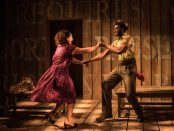
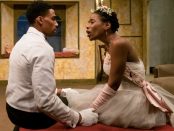
Like in a Noel Coward comedy, the witty zingers come fast and furious: “That her big white Cadillac looks like a pregnant Frigidaire,” “Did you say she was from Newark or Noah’s Ark?”, “Harlem has gotten to be such a cesspool of nobodies,” “You can’t raise a rose in a junkyard,” “The ribbon around your neck is loose. Tighten it.” It also offers some very wise statements on the relationships between men and women: “women grow old from neglect and not from age,” “Regardless of how bad we women look in the morning, Oscar, we never wake up needing a shave,” “She loves the ground he staggers on.” However, the play also makes clear the rivalry between various Black enclaves: Harlem, Brooklyn and Washington, D.C. Dolly, Tillie and Mrs. Pace make pronouncements on the classiness of each. [more]
The Whirligig
Say this for actor Hamish Linklater: he writes juicy parts for his fellow actors. He also knows how to set up a sense of community. The New Group production directed by its artistic director Scott Elliott has a fine cast led by two-time Tony Award winner Norbert Leo Butz and Zosia Mamet, just off six seasons of the recently ended HBO television series, Girls. [more]
Building the Wall
Unlike such political plays as Arthur Miller’s "The Crucible," David Hare’s "Stuff Happens" and the current "Oslo" by J.T. Rogers, Building the Wall is speculative political fiction. Projected into the not-so-distant future, it takes place after a terrorist attack has released a dirty bomb in Times Square irradiating two square blocks. As a result, President Trump has declared Martial Law and begun rounding up millions of immigrants for deportation. This extraordinary move which had gotten out hand has led to his impeachment and exile to Palm Springs. "Building the Wall" takes place in 2019 in a prison meeting room in a federal lock-up in El Paso, Texas. Gloria, an African American historian and college professor, has come to interview Rick, a white man, who is awaiting sentencing for his role as the former warden of a new Magnum Security private prison facility outside of El Paso for illegal immigrants awaiting deportation. It is Rick’s role in the disposal of bodies after a cholera epidemic in the overcrowded facility which has landed him in prison. [more]
Sojourners & Her Portmanteau
Expect great things from Udofia in the future. Both plays demonstrate that she writes full-bodied, three-dimensional characters, while "Her Portmanteau" reveals that she can also write a play from the heart whose emotions will pull you in and stay with you long after the final curtain. Also keep your eye on Chinasa Ogbuagu: playing two different women 36 years apart she is totally unrecognizable, you have to read the program to discover that it is the same actress, an extraordinary feat. [more]
Pacific Overtures
The playing space designed by Doyle is a narrow white runway with a stool at one end and at the other, an archway created by continuing the flooring into the air on which Japanese writing appears as on a banner. The audience sits in stadium-type seating on either side of the playing space. Eschewing pageantry, the production puts the cast in very bland outfits of black, grey, white, blue or beige (costumes by Ann Hould-Ward), adding fabric or robes when absolutely necessary. The lighting by Jane Cox occasionally bathes the stage in either red or blue mood lights. [more]
The Lucky One
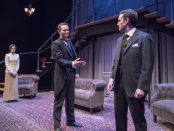
Director Jesse Marchese has cast the play very strangely. Ari Brand’s Bob is a good deal shorter than his younger brother so that one must continually remind one’s self which is which. As Pamela, Paton Ashbrook also is taller than Bob. Is this a subtle hint that she doesn’t belong with him? Gerald has three friends who are guests in his father’s house. Andrew Fallaize’s Tommy, an idle fellow mad about golf, and his girlfriend Letty, played by Mia Hutchinson-Shaw, seem so much younger than Gerald that it stretches the imagination that they are his close friends. Gerald’s friend Henry Wentworth, a successful barrister played by Michael Frederic, looks so much older that it also seems rather unbelievable that they are bosom buddies. A delightful Cynthia Harris plays wise, compassionate Great Aunt Harriet in such an astute manner that she highlights all the subtext of her lines, the only actor in the production to do so. [more]
T.B. Sheets
The opening resembles that of Mann’s novel: a horse and buggy deliver a visitor to a tuberculosis sanitarium on a mountain top overlooking a valley, suggesting that the unspecified time is 100 years ago, prior to W.W. I. Immediately, the doctor discovers that the newcomer has T.B. and needs weeks of rest. This One Who Has Come from the City to Heal meets and interacts with the other denizens, including a healer, a mother of a degenerate child, one who is building a space ship, and one who composes sounds and visions, as well as having the ability to see those who have passed away. [more]
A Doll’s House, Part 2
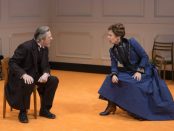
Hnath’s new story is absorbing and twisty, interestingly creating an entirely new set of ethical and social questions than was handled by Ibsen in 1879. He has handled it in a similar fashion to Bergman’s "Scenes from a Marriage" but without the painful emotional fireworks. It is 15 years since Nora had left her husband, stating he had no further claim on her. She has not been heard from since. Having become a famous feminist author with advanced ideas writing under a pseudonym, she has recently discovered due to a blackmail attempt that Torvald has never divorced her which she assumed he had done. Having lived as a single woman, signing contracts, controlling her own money, and having relationships with men not her husband, she is guilty of a criminal offense under Norway’s laws at the time and can be sent to jail. She arrives at his door to obtain her divorce to really be a free woman. [more]
Ernest Shackleton Loves Me
McCollum is both charming and charismatic playing among other characters the self-entitled and irresponsible Bruce, the hippie techie Sal, Kat’s spaced-out boss Madison, and the intrepid and heroic Shackleton, although at first it is not obvious that he is all of these characters. It is a bravura performance showing tremendous range as he makes each one entirely different. Vigoda is another story. Her Kat is plucky but is mainly a device to get Shackleton to tell his story. We never learn much about her and she never changes as the adventure unfolds. Her violin playing is excellent but it is a bit of a distraction from her other activities in the musical. [more]
And Miss Reardon Drinks a Little
Retro Productions’ 50th anniversary revival of Paul Zindel’s "And Miss Reardon Drinks a Little" put the spotlight on an almost forgotten play that is worthy of revival. Shay Gines’ production with a game cast of seven is absorbing and compelling theater with characters that are bigger than life. Paul Zindel’s semi-autobiographical play comes alive in their hands. There may be more theatrical treasures to be mined from his collected plays. [more]
Marry Harry
The two leads David Spadora and Morgan Cowling are charming but that isn’t really enough to carry the show. The script isn’t too kind to their parents. As Big Harry, Lenny Wolpe is overbearing and possessive and as Sherri’s mom Francine, Robin Skye is controlling and possessive. Both are quite convincing and unpleasant – just as the script wants them to be. As the Village Voices, Chavez, Manocherian and Saunders demonstrate tremendous versatility playing all sorts of roles and are excellent singers. [more]
The Roundabout
Although the play seems to have something to say about economics and political systems, it is simply a very light romantic comedy making use of elements of change during the Great Depression. Ross’ production is quite proficient and fast-paced, but the characters are generic and we don’t learn much about them. As Lord Kettlewell, Brian Protheroe is the typical crotchety but wise aristocrat, Richenda Carey is most eccentric as the impoverished Lady Knightsbridge, and Lisa Bowerman is level-headed as the previously estranged Lady Kettlewell. Carol Starks’ Mrs. Lancicourt is the manipulative upper-class woman who attempts to dominate all situations. Hugh Sachs is a raisonneur straight out of classic drawing room comedy and would have been as at home in a play by Wilde, Shaw, Pinero or Galsworthy. [more]
War Paint
Written by the same team that created the musical version of "Grey Gardens" (Doug Wright, book, Scott Frankel, music, and Michael Korie, lyrics) which gave Ebersole the two best roles of her career, the new show is absorbing, elegant and urbane hewing closely to the facts while at times compressing time and offering a few composite characters. Suggested by the joint biography "War Paint" by Lindy Woodhead and the documentary film, "The Powder and the Glory," the musical tells the parallel stories of the rivalry and careers of these two remarkable women from the 1935 to 1964. As they are never reported to have met, Wright’s book for the musical either alternates their lives or uses a split stage effect to show us both at the same time in their own milieu. Occasionally, they lunch at the St. Regis at the same time but avoid meeting each other seated on their own banquettes. [more]
Present Laughter
As the ageing matinee idol who never forgets to check his appearance in the mirror, Kline plays a man who is always acting, both on stage and off. His animated physicality in his roles has always been in evidence but here he outdoes himself. Using his arms, hands, head, face and body as his canvas, he is almost never still showing us what can be done on each and every line. He makes even an ordinary line into a witticism and his comebacks wither with every additional jibe. He cajoles, seduces, emotes, wheedles and at the same time suggests he pities himself. He creates a bigger than life character (is John Barrymore his model?) and watching him is a lesson in consummate acting. So completely does he make Garry Essendine his own, you cannot imagine anyone else in the role – although among other New York revivals he has been played by such stars as George C. Scott, Frank Langella, Victor Garber and Coward himself. [more]
Samara
The play seems to be in the genre of the classic Western movie though highly poeticized and slow-paced. It resembles the 60’s films of Sergio Leone and Sam Peckinpah but with much less plot and without the scenic vistas. It follows the rules of the old West but creates a mysterious world of its own. Very little is revealed by the characters about themselves, most of whose names are generic (the Supervisor, the Messenger, the Drunk, the Cowboy, the Beast). Much could be read into the events but they remain opaque and obscure as do the characters who reveal little. This is a Samara of the imagination, not a real geographic place. [more]
Gently Down the Stream
In between the scenes between the two men in Beau’s living room, Rufus records Beau’s reminiscences of his life and times. In this way, Sherman gives us a review of what things were like for gay men from 1940 up to the present, from the stories Beau had been told about the war years to his own personal and painful experiences from 1960 on. Beau’s memories include gay life in New Orleans, New York, San Francisco, Paris and London and cover police brutality and the rise of AIDS. Besides being flattered to be asked to tell his story, Beau also want to pass on his experiences to the next generation who have had its easier. While the play becomes schematic alternating scenes between the two, Fierstein is so convincing in these authentic but surprising tales of the past that it never becomes simply a device. [more]

The Lightning Thief: The Percy Jackson Musical
Theaterworks NYC’s stage version of Rick Riordan’s best-selling novel, "The Lighting Thief," about Percy Jackson and other demi-gods, first seen in 2014, has returned in an expanded two act format that, from reaction of the audience at the Lucille Lortel Theatre, is sure to become a cult musical. This fast-paced fantasy-adventure story would not seem to be destined for the stage due to the number of special effects needed to tell the story. However, designer Lee Savage and other technicians have come up with a series of clever low tech solutions which are always inventive and always witty. Using masks, puppets and elaborate costuming, five members of the cast of seven play multiple roles which often require quick changes. [more]

Vanity Fair
Tucker’s production uses seven actors playing 20 named characters plus members of the ensemble: the women (Joey Parsons and Hamill play one each, good girl Amelia Sedley and bad girl Becky Sharp, respectively) and the men play all the rest, including other female characters with the addition of wigs and slight costume changes. This allows the cast to demonstrate tremendous versatility in these juicy roles. [more]
Miss Saigon
The scenic design with original concept by the late Adrian Vaux, production design by Totie Driver & Matt Kinley, and projections by Luke Halls is as eye-filling as a movie would be. The new helicopter scene during the evacuation of Saigon uses both scenery and video in a breathtaking stage effect. Connor makes excellent use of the cinematic and realistically three-dimensional sets in moving his crowds around to completely populate the stage picture. Bruno Poet’s lighting varies from shadowy evening scenes, to romantic moonlit ones, to blatantly lit day time scenes. [more]

Du Barry Was a Lady
The show has a great many topical references to celebrities of 1939 (Minsky, Sophie Tucker, Tallulah Bankhead, Franklin and Eleanor Roosevelt) not all of whom still ring any bells for most theatergoers. Aside from the justly famous “Friendship,” which has also been interpolated into Anything Goes since the 1962 NY revival, the show is second-rate and unfamiliar Porter. Ironically, three of the songs (“It Ain’t Etiquette,” “Well, Did You Evah!” and “Friendship”) resurfaced in Peter Bogdanovich’s flop original movie musical, At Long Last Love, in 1975. The patter songs, “But in the Morning, No,” “Give Him the Oo-la-la,” “Well, Did you Evah!,” and “Katie Went to Haiti” have clever lyrics but are not up to Porter’s usual standard. [more]
Church & State
Rob Nagle (who created the role in the Los Angeles production) plays “compassionate conservative” North Carolina Senator Charles Whitmore who is up for reelection in a statistical dead heat in just three days’ time, running on a campaign slogan of “Jesus is my Running Mate” (chosen by his wife Sara). However, earlier that day he has been shaken by attending the funeral of 29 students shot by a lone gunman at the local elementary school which his sons attend. It could have been his sons who had been killed. [more]

Joan of Arc: Into the Fire
Don’t blame singer Jo Lampert who gives a passionate performance as the Maid of Orleans. Unfortunately, she hasn’t been given anything very interesting to sing in this mostly sung-through musical. Her lyrics are trite and repetitious. She may have been a teenager, but there is no reason to have written lyrics that continue to sound like they were written by a junior high school student attempting his or her first songs. The endlessly repeated refrains do not serve to make Joan seem more simple and holy but sound like a lack of imagination. The minimal spoken dialogue is used for the various narrators and the trial testimony taken from the actual transcript of the event. [more]

Beneath the Gavel
Bated Breath Theatre Company specializes in original works inspired by and in partnership with museum collections and exhibitions. However, this show about the fate of the “Haddie Weisenberg Collection” painted by artist Daniel Zeigler appears to be entirely fictional. Written and directed by Mara Lieberman, executive artistic director of the company since 2012, the play uses six actors in 43 different roles from artists both famous and imaginary, to auction house sales personnel and staff, to collectors to dancers, as well as having actors impersonate free standing sculptures. Ironically, 59E59 Theaters was at one time part of Christie’s Auction House and Theatre B was actually one of the firm’s galleries. [more]
The Last Days of Judas Iscariot
And what of the play which had its world premiere at the Public Theater in 2005? Parsons’ uneven production cannot keep this long play from seeming unwieldy. In fact, using so many actors is almost distracting as some of them are simply walk-ons, and disappear almost immediately. The new production seems less trenchant and more like a vaudeville with its set pieces than Philip Seymour Hoffman’s original staging. Nevertheless, the play still retains a cumulative effect and is ultimately compelling. [more]
Anything Goes
The score which has been drawn from the four previous New York productions of Anything Goes plays like a Cole Porter greatest hits parade and almost all of the songs are among his most popular masterpieces. Played by a three piece combo expertly led by Christopher Stephens, the show has just the right syncopated thirties sound, while the perfect diction on the part of the large cast makes every lyric a gem. The dazzling production numbers which often evolve into precision tap dances with most of the 18 member cast trapping in unison are as dazzling as Jack Maisenbach’s brightly colored, coordinated costumes. This excellently cast production has dancers, singers, comedians and character actors all work at the top of their game. [more]
The Moors
Although the play demonstrates a surface knowledge of the genre and the period, it wants to have it both ways: it takes place in 1840 in a desolate mansion on the Yorkshire Moors but the characters talk and behave as though it is the present. It appears to be making a feminist statement by making all the members of the household female but has nothing new to say on the subject other than as a variation on these famous novels. And it attempts to be funny but isn’t clever or surprising enough to trigger much laughter. [more]
If I Forget
Steven Levenson’s "If I Forget" is the kind of family drama that doesn’t get written much anymore: one that has something to say other than just depicting a dysfunctional situation. Not only are we pulled into the family wrangling, the issues under debate are major ones and their outcome is serious business. Director Daniel Sullivan and a splendid cast of seven make this one of the most compelling plays of the season. This is a play you won’t soon forget and its provocative nature should trigger much discussion. [more]
The Glass Menagerie
Sam Gold’s revival of "The Glass Menagerie," the fifth major production of the play in New York since 2005, is such a one. He has decided to remove all of the historical relevance as well as the scenery from this classic Tennessee Williams’ memory play. What he has also done is remove all of the poetry and all of the emotion in a play that on the surface would seem director proof. Ultimately, the production is more a director’s exercise in seeing how much he can cut from a play that tells a realistic story in a lyrical manner. A pity as his cast has two-time Academy Award winner Sally Field returning to Broadway after an absence of 15 years, two-time Tony Award winner Joe Mantello, Finn Wittrock (Theatre World Award and Clarence Derwent Award for "Death of a Salesman"), and debuting actress Madison Ferris. [more]
The Skin of Our Teeth
Thornton Wilder’s "The Skin of Our Teeth" with its benign belief in the resilience of the human condition is unlike any other American play you are likely to see. Both heavily influenced by earlier European experiments in theater, it is also influential in itself. While Arin Arbus’ production for Theatre for a New Audience at times seems as though it need tighting up, it is a play that must be experienced in the theater which is why it has never been turned into a Hollywood movie. Go and see for yourself what only the live theater can do to expand your imagination. [more]
Messenger #1, A New Ancient Greek Tragedy
In addition to the swiftness of the storytelling and the use of contemporary language, Jackson uses a sort of upstairs-downstairs approach. Aside from what is happening to the royals, we also see everything from the point of view of the three messengers. The messengers deliver their reports to us the populace, interact with each other, and interpret for us how the events of their world affect them. They also work as the chorus but each has something different to reveal rather than speaking in unison as in ancient Greek drama. Jackson has tweaked the legend somewhat which makes his version all the more surprising and absorbing. [more]
Kid Victory
It would be difficult to imagine anything darker than the content of the second musical collaboration by John Kander and Greg Pierce having its New York premiere at the Vineyard Theatre. Possibly Kander’s own"Cabaret" or "The Visit" - but both take place long ago and in faraway lands. Kid Victory relates the tale of a 17-year-old youth who was kidnapped for a year and has returned to his Kansas family. All the members of the community want to behave as though nothing has changed but for Luke Browst nothing is the same and things can’t go back to the way there were before. [more]
Louisiana Purchase
Based on a story by lyricist/bookwriter/producer B.G. DeSylva (“Good News,” “The Best Things in Life Are Free,” “The Varsity Drag”), this musical satire sends unworldly, teetotaler Oliver P. Loganberry, “the Watchdog of the Senate,” to New Orleans to investigate the corrupt dealings of the Louisiana Purchasing Company run by Jimmy Taylor, Colonel Davis, Junior Davis, Dean Manning of the university, and Captain Whitfield of the city government. Jimmy, the president of the company, who was out of town when the others used his powers of attorney for their illegal scheme, is left to sort out the mess. [more]
Dear World
Having played such indomitable women as Mama Rose and Maria Callas, Daly slips into the role of the Madwoman of Chaillot which fits her like a glove with her crisp, authoritative delivery. As a woman who refuses to see reality for what it is, she gives a powerful rendition of “I Don’t Want to Know,” the show’s only hit song. She does a lovely job with the new number, “A Sensible Woman,” as well as the haunting ballad, “And I Was Beautiful.” [more]
Leah, the Forsaken
Nevertheless, while the play is startlingly not politically correct, the acting is of a high caliber. In the title role, Regina Gibson (who appeared last season in the rediscovered operetta "The Golden Bride" by the National Yiddish Opera Folksbiene) gives an impassioned, persuasive performance. In the ingénue roles, Jon Berry (Rudolf) and Noelia Antweiler (Madalena) are charming. Jeffrey Grover captures all of the self-righteousness of the bigoted schoolmaster Berthold. Joe Candelora as the Magistrate Lorenz and Ron Nummi as the Doctor and Barber (which he never stops telling us) give hearty, comic portrayals. The rest of the large cast of 15 also throw themselves into their respective roles. [more]
Evening at the Talk House
However, as the title implies it is also a very verbose, long-winded affair giving an excellent cast made up of such veterans as Matthew Broderick, John Epperson (a.ka.a Lypsinka), Jill Eikenberry, Larry Pine, Claudia Shear and Michael Tucker not much to do. Shawn has written the best role for himself but that is not saying much. While the play may be meant as a cautionary tale, it is also over-written and self-indulgent. Long before you realize where the play is going you may have lost interest due to all the explanations. [more]
Man from Nebraska
Birney seems to have cornered the market on sensitive, ordinary guys and his performance is similar to his awarding-winning “Erik” in The Humans. However, here he is extremely sympathetic and heartbreaking while in the earlier play he was revealed to be complicit in criminal behavior. Birney’s work is so subtle and low-key that he suggests worlds of unspoken feelings, which is quite a remarkable feat. O’Toole, who recently appeared on the New York stage in "Hamlet in Bed" in 2015 and "Southern Comfort" in 2016, just keeps getting better and better, and her emotional collapse as Nancy is extremely well delineated. As their daughter Ashley, Boras beautifully captures the whiney demands of the adult child with a black and white view of the world who has never seen her parents as separate people with needs of their own. [more]
Life According to Saki
The evening is narrated by Saki (played by an appealing and suave David Paisley) talking to us from the trenches of France, in 1916. His five soldiers (played by Phoebe Frances Brown, Ellen Francis, Tom Lambert, Tom Machell and Caitlin Thorburn) all like stories and he obliges. As he tells his eight tales, the cast enact them, using slight costuming added to their uniforms and occasionally use puppets to represent animals and children. [more]
The Object Lesson
Illusionist/actor Geoff Sobelle’s show is a combination of happening, art installation, and a meditation on the role objects have in our lives. Using audience participation, objects both hidden and seen, and magical illusion, Sobelle forces us to examine out relationship to the objects in our lives as well as how they ultimately define us when seen altogether as the detritus of a life. Performed in 11 segments with no intermission, "The Object Lesson" is not for everyone, but for those willing to go with the flow and give themselves up to Sobelle’s droll reflection, self-examination and visual theatrics, the evening is fascinating and rewarding. [more]
Berlin to Broadway with Kurt Weill: A Musical Voyage
One of the remarkable things about the theater songs of Kurt Weill is that like the later songs of Stephen Sondheim they are all really little one act plays which give the performers a great deal of latitude in how to perform them. As sung by Karl Josef Com, Rachel de Benedet, Michael Halling and Meghan Picerno and as narrated by Brian Charles Rooney, Berlin to Broadway with Kurt Weill is an extraordinary musical voyage through some of the greatest theater songs of all time written by among the best talents of the 20th century. [more]
Jonah and Otto
While the play is at times Pinteresque, it is talky in a way Pinter never is, explaining everything over and over, covering the same ground again and again. Nothing much happens other than that the men become more confiding and reveal more of their personal pasts. The play implies that Jonah is menacing, but under Hughes’ direction, he never seems much of a threat. The pace is slow and methodical, too slow for its own good. Sean Gormley’s Otto and Rupert Simonian’s Jonah are well-rounded characters but the acting style is too refined, too genteel to make much impression. [more]
Hi-Fi | Wi-Fi | Sci-Fi: Predictions Past Present and Future
The only real high-tech exchanges take place only three times during the run of the show. At the performances of February 6, 9 and 17, one of the roles in "Camera Obscura" will be performed telematically from Seoul Institute for the Arts in Korea and directed by Il Kyu Park. "Hi-Fi | Wi-Fi | Sci-Fi" which uses a great many sound specialists for little effect is an interesting idea but doesn’t go far enough either dramatically or in terms of modern technology to have much impact. As a cautionary tale, time has caught up with these plays and passed them by. [more]
Bound to Rise
Unfortunately, Policoff’s book is too cluttered with characters too allow for much development. While some of his lyrics are clever, most are prosaic and heavy-handed. As played by music directors Gregory Nissen and Jonathan Matthews, the score sound tinny, rather than melodic, for its 1890’s period. The direction by Oliver Conant, with an assist by Paul Murphy and Regan Batuello, is all over the place using various parts of the shabby (uncredited) set, so that it is too busy for its own good. This free-wheeling approach would be more suitable to a movie rather than the stage without a much strong hand in control. Occasionally the actors make a pithy remark about society or the political order and then freeze, starring at the audience. This Brechtian technique goes against the grain of the rest of the production, as does various character narrating themselves or others. [more]
The Liar
However, it is Ives’ joy in language that is the most infectious. The rhymed couplets keep coming and surprising us over and over again (bitter/twitter; prize/rhapsodize, jocular/interlocutor, kiss/dentrifice, carbuncle/uncle). He has also created remarkably agile, felicitous and contemporary turns of phrase: meet-and-greet/ bittersweet; Chanel perfume/key to my room; perfect ten/tragic flaw again; chance to laugh/some dumb gaffe; believe this boy/pure trompe l’oeil. Considering the nature of lying, the anachronisms like contact lens, superglue, outed me, Kid Dorante, party clown, pants on fire, etc., seem like natural hyperbole for these poseurs who take themselves all too seriously. So too Kahn’s clever direction is highly in tune with this style: Dorante and Alcippe’s duel is fought without swords in pantomime and Cliton appears with a modern paper coffee cup. [more]
92Y’s Lyrics & Lyricists Series: “Get Happy: Harold Arlen’s Early Years”
The show began with Arlen’s first hit, “Get Happy,” 1930, and ended with his 1939 score for the MGM film, "The Wizard of Oz." The first half of the evening was devoted to Arlen’s stand-alone popular tunes, his songs written for the Cotton Club Revues (1932-1934), and musical numbers for early sound movies. Blackhurst recounted how Arlen (born Hyman Arluck of Buffalo, New York), was a child prodigy singing in his father’s choir when he was seven, forming his own bands in his late teens, and occasionally appearing as a vocalist with them on records in his twenties. [more]
Yen
There are many questions that the author fails to answer. Although the boys have not attended school in years and Bobbie has been diagnosed as ADHD and should be in the British equivalent of special education, no social worker seems to have visited to check up. Who is paying the rent or the electricity? Is the mother on welfare and are these items paid automatically? There is no explanation of how the boys are eating and how Taliban stays alive if they have not been feeding it for days or even weeks. While the neighbors are aware of Bobbie’s stealing, he seems to be getting away with it. The dog’s continual barking from his locked room can be heard on the street but no complaints have been filed. Is all this a metaphor or a slice of life drama? [more]
Milk and Honey
While the jokes may be hoary, Unger’s production has cut down on the show’s sentimentality and given it a sharp edge which elevates the material. As the heroine Ruth, Runofsson is genuine, contemplative and sympathetic, while Delavan’s Phil is the strong silent type. They have the bulk of the songs and give lovely renditions of “There’s No Reason in the World,” “That Was Yesterday,” “Let’s Not Waste a Moment,” “As Simple As That.” Korey as the gossipy yente Clara Weiss who is free with her advice steals every scene she is in and gets to sing the clever ode to her late husband, “Hymn to Hymie” as well as lead the hilariously staged number, “Chin Up, Ladies” which includes witty audience participation. [more]
Jitney
Director Ruben Santiago-Hudson has himself won a Tony Award for his performance in Wilson’s "Seven Guitars" and has directed acclaimed Off Broadway revivals of "The Piano Lesson" and "Seven Guitars." He has assembled a cast of nine in which seven of the actors are veterans of Wilson play including Antony Chisholm who appears in the 2000 production. A true ensemble led by John Douglas Thompson and André Holland (currently in "Moonlight"), a better staging could not be imagined of this involving and engrossing play. [more]
Yours Unfaithfully
One problem is that the play (unlike Noel Coward’s "Design for Living" or Somerset Maugham’s "The Constant Wife" which cover similar territory) is neither witty not clever, and none of the lines are particularly sparkling or original. While the play may delineate liberated sexual behavior, its drawing room comedy format is too conventional and refined. All five performers always seem to be acting as their style is too arch to be truly believable. [more]
Orange Julius
On the one hand, it is a punch in the gut dramatizing the cold hard facts of disintegrating with this disease; on the other, the non-linear time scheme is difficult to follow, offering more questions than it answers. What "Orange Julius" really is could be described more accurately as a screenplay or a teleplay with cuts and fades. There is a powerful work hiding in this material but it still remains unshaped. Under Dustin Wills’ fast-paced direction, Jess Barbagallo, Ruy Iskandar, Irene Sofia Lucio, Stephen Payne and Mary Testa give fine performances despite the fact that the play seems to wander around trying to find its center. [more]
The Present
Upton’s version solves some problems and creates others. Updated to the 1990’s, the play is no longer about life in Tsarist Russia but the post-Perestroika world of Glasnost. While the original has characters talk about how much better life will be in the future, the new version has the characters wax nostalgic about the recent past but also talk about the challenge of the new Russia in the present. It is not obvious for much of the first scene that the play takes place in the Russian country. [more]
Blueprint Specials
Never before seen on mainland U.S.A, the current show is an amalgam of the four existing shows ("P.F.C. Mary Brown;" "Hi, Yank!;" "About Face" and "OK, USA") of the six that were written. Directed and adapted by Tom Ridgely, co-artistic director of Waterwell, the entertaining show is a co-production of Waterwell in association with the Intrepid Sea, Air & Space Museum under the auspices of the Public Theater’s Under the Radar Festival. Performed on the hangar deck of the USS Intrepid just like it might have been done in 1944 or 1945, the show is a site-specific environmental production with limited scenery but using a combination of Broadway stars and featured players, Waterwell members, Active Duty U.S. military and veterans, and Reserve Special Members. The dance chorus is provided by the Limón Dance Company. [more]
Martin Luther on Trial
Set in The Afterlife, a crossroad between Heaven and Hell, the play presupposes a trial of Luther on the grounds of being guilty of “the unforgiveable sin.” The prosecuting attorney is The Devil and the defending attorney is Katie von Bora, also known as Mrs. Martin Luther, with Saint Peter acting as judge. The witnesses called are Hitler on Luther’s anti-Semitism in his later years, Dr. King on Luther’s stance on civil rights, Dr. Freud on Luther’s Oedipus complex, and the current Pope on the Catholic Church’s stance on Luther’s objections today. Along the way, the play also dramatized scenes from Luther’s life. Ultimately, it ends with a recreation of Luther’s trial before the Diet of Worms officiated over by the Holy Roman Emperor in 1521. [more]
What We Wanted
While Harms has a fine ear for dialogue, the play moves by revelation and incident. Consequently, it plays like a sophisticated soap opera as every scene brings a new wrinkle not previously suggested. Drew Foster’s direction is smooth and polished but he can’t prevent the play’s plot from having too many incidents that aren’t foreshadowed. Steven Hauck, Elizabeth Rich and Amy Bodnar are charming in a worldly, cultivated way. However, we learn so little about each of them other than how events affect them that they seem one-dimensional. Important facts are left out: what is the rooming situation, are Julian and Agnes married, etc.? The sexual tension is clearly defined: dancing seems to be foreplay to sex. But one can’t live on love alone. [more]
The Mikado Reimagined (NYGASP)
In keeping with Sullivan having been hit over the head, the cast is clothed in a motley collection: a combination of late Victorian and Japanese styles. Some are in all Japanese, some in all Victorian, most are in a combination of the two. Even the Victorian costumes have baroque additions to make them look exotic. The women all wear Victorian gowns with bustles open in the back just as though they had not finished dressing. The concept while colorful is quite a mess with every possible variation on stage at the same time. [more]
God of Vengeance
Surprisingly, Eleanor Reissa’s production for New Yiddish Rep has made some debatable choices which damage the power of the play. First of all and most obviously, although not a word has been updated, the characters wear contemporary clothing and use modern objects like headphones, a plastic umbrella and platform shoes. Since there are references to opening a horse stable and the sexual mores of 1907 have changed considerably, this is both distracting and confusing. (The word “roubles” has been eliminated for the more innocuous bucks and coins.) [more]