Articles by Joel Benjamin
"Body" dovetails Ensler’s personal agonizing battle with cancer and her involvement with a feminist group in the Democratic Republic of Congo where women have faced violence, rape and almost unending disruption of their lives. Ensler’s input was requested by Dr. Denis Mukwege, a Congolese gynecologist whose ministrations to the female victims of the sadism of soldiers and government officials paints a litany of one tragic event after another. [more]

Fill Fill Fill Fill Fill Fill Fill
Produced as part of the Flea’s Season of Women, Del Rosso’s freshman effort shows great promise. Under Marina McClure’s insightfully freewheeling direction the members of The Flea’s resident acting troupe, The Bats, takes the play and exuberantly runs with it with their usual unabashed energy and courage to expose themselves—right down to their underwear! [more]
Malpaso Dance Company: 2018 Season
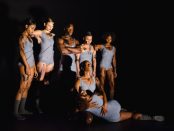
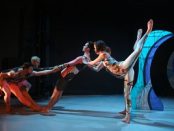
The first work on the program was “Indomitable Waltz” (2016) choreographed by Aszure Barton to dark hued music by the Balanescu Quartet and Nils Frahm. Barton achieved a graceful, yet dramatic flow for these dancers dressed in Fritz Masten’s black and grey costumes. Barton knows how to spread her dancers about the stage like a single organism continually splitting apart and coming together again. They danced warily about each other, performed leans and sensual embraces that faded as the dancers melted to the floor. The work ended on a contemplative note as Dunia Acosta moved with careful steps and twisting hips, in a journey across the stage. Although the emotions of “Indomitable Waltz” ranged from dark to sensual to giddily physical, it ended up as a head scratcher, beautifully performed by the Malpaso dancers. The intriguingly moody lighting was by Nicole Pearce. [more]
Josephine: A Burlesque Cabaret Dream Play
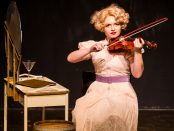
The main event, however, is the performance of Harris who doesn’t just imitate Baker but uses her own gifts to illuminate the multitalented cult figure. It’s as if Baker has brought out the best in Harris and she returns the favor with her vivid singing, unabashed dancing and direct connection with the audience. The songs include well-known ditties like “I’m Just Wild About Harry,” “Ain’t Misbehavin’,” “Blue Skies,” a particularly moving “And Then I’ll Be Happy,” “Minnie, the Moocher,” the Civil Rights anthem “Strange Fruit,” “The Times They Are A-changing,” and a heartbreaking “La Vie en Rose.” [more]
Works & Process at the Guggenheim: “One of Sixty-Five Thousand Gestures”/”NEW BODIES”
“NEW BODIES” (2016) choreographed by Melnick was initiated by Sara Mearns in a summer workshop at Jacob’s Pillow Dance Festival. Skilled classical ballet dancers who were interested in expanding their understanding of movement beyond the strict formalities of ballet choreography joined Mearns and Melnick to experiment with just how movements emerge into choreography. The result is not an earth-shattering rethinking of the art of dance, but a loose web of crossing paths where touching and light partnering follow from soft collisions. [more]
Pillowtalk
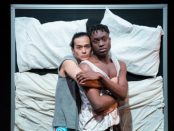
Kyoung H. Park's "Pillowtalk" mixes the mysteries of passionate, but flawed, love with the realities of racism in today’s society, specifically, Brooklyn, New York, where Sam (Basit Shittu), a hunky African American and former Olympic swimmer is married to Buck (JP Moraga), a sleek Asian American journalist. Both are in a constant battle with the White-dominated society which constantly undermines the lives of people of color. Park’s direction of his play is straightforward and “in your face” giving this rarely seen corner of society some needed exposure. [more]
The Band’s Visit
Yazbek’s songs—ranging from the darkly comic “Welcome to Nowhere” (sung by the town folk) to Dina’s romantically tinged “Omar Sharif” and ending with the upbeat, danceable “Concert” played as a finale by the Band—rise magically from the dialogue, just as Patrick McCollum’s choreography emerges naturally from walking, singing and thinking. [more]
Soaring Wings
The famous Chinese ability to subsume themselves in crowds was evident in the flowing choreography for the mass “flight” of the Ibis across the stage. The precision of the corps de ballet did not, however, lessen regarding each dancer as an individual as they flew past in ever-changing patterns. The creators of "Ibis" also gave life to the inhabitants of the small town and the young modern urbanites who show up at a museum to learn about the birds with which they had peacefully co-existed. [more]
Mary Shelley’s Frankenstein
Fairchild speaks well and communicates much with his physique, but his choreography is repetitive and uninventive. Here was a chance to breathe new life into a too familiar character. All Fairchild could come up with is lurching movements and awkward falls to the floor. He takes the obvious path to create his character with movement when he had a chance to illuminate the Monster’s inner emotions. [more]
Alvin Ailey American Dance Theater – Winter 2017 Season
The middle work, “Walking Mad,” choreographed by the Swede, Johan Inger, has inadvertently taken on an urgency and timeliness. Always a surreal study of off-handed violence, the current tidal wave of sexual harassment revelations has given “Walking Mad”’s series of violent episodes against women an added shock value. [more]
The Children
Despite a brilliant display of achingly detailed acting—reason enough for connoisseurs of acting to rush to this production directed by James Macdonald—its uneasy blend of a frightening nuclear apocalypse and an ugly romantic triangle might be an obstacle for some. "The Children" is a quiet, whispered scream of a drama that takes viewers by surprise even as the characters bleed and brood. [more]
Mimi Garrard and Friends
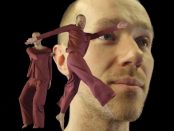
In “Lines,” the videos were straightforward representations of Mr. Selden, clad in a loose-fitting red outfit, pausing his image in dramatic moments while in the second work, “Untranslatable,” directed by Ms. Garrard and choreographed by her and the very solid dancer, Ms. Hopkins-Greene (formerly of the Alvin Ailey troupe), the visual elements—produced by Ms. Garrard—were far more abstract, chaining together tiny images of the dancer in fantastical patterns like giant letters, globes, maps, etc., as the dancer, clad in a chic two-piece purple outfit designed by Mindy Nelson bounded about. Snatches of poetry by Walt Whitman were cut and shifted about to provide an aural accompaniment to the steps which were vigorous with lots of quick direction changes. Images of Ms. Hopkins-Greene floated about the screen making it seem as if she were dancing with clones, all equally talented. [more]
ZviDance: Like
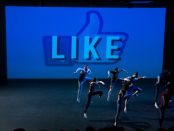
This time Gotheiner put his dancers through a faux competition that fell in mood somewhere between "Dancing with the Stars' and "Shark Tank," combining eager striving with off-handed sadism. Electronic gadgetry virtually turned the beautiful dancers into products that viewers in the NYLA Theater were inadvertently bidding on. [more]
Big Dance Theater: 17c
Big Dance Theater, conceived and directed by Annie-B Parson, presented "17c" at the BAM Harvey Theater. The work somehow combined the diary of Englishman, Samuel Pepys, the works of Margaret Cavendish (whose play-within-the-show—contemporary with Pepys—displayed proto-feminist ideals), classical theater (Euripides), modern writings on gender inequality (Jill Johnston who promoted a Lesbian world without men) with high production standards and a keen sense of storytelling all held together by a cast of great actor/dancers. [more]
Jesus Hopped the ‘A’ Train
Guirgis and Brokaw manage to find the back-handed humor and pathos of this scene which sets the mood for a profane and scatological play that hits the audience between the eyes with its fresh use of language and its deep understanding of the two main characters. Guirgis turns profanity into a poetic x-ray of the human psyche. [more]
The Red Shoes
Hanging over this presentation is, as indicated, the film which divides the audience into those who did not see it and must take or leave Bourne’s clever version and those who saw it and compare each of the film’s campy, colorful moments to the dramatically dull Bourne version in which characters seem to fall in love after barely meeting. Characters who are boldly drawn in the film could not be inhabited by Bourne’s young cast, particularly Nicole Kabera as an unstylish Lady Neston who introduces the main character, her niece Vicki Page (a saucy, plush Ashley Shaw) to ballet owner and Diaghilev surrogate, Boris Lermontov. This rich character was played by a much too young Sam Archer whose charisma is totally absent. It’s difficult to stage a story at whose heart is a tragic love triangle when at least one angle had no magnetism and was, in fact, a mass of outrageous eccentricities compared to the seething elegance of Anton Walbrook in the film. [more]
Big Apple Circus 2017
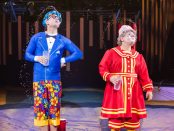
The Wallenda family’s act is the climax of a show that is held together by Ringmaster Ty McFarlan and the ongoing antics of Grandma the Clown and Joel Jeske aka Mr. Joel. The big-voiced and charismatic Ringmaster Ty prowls about introducing acts, touting tidbits about Big Apple Circus and generating excitement while Grandma and Mr. Joel involve audience members in good-natured slapstick shtick involving water, balloons and costumes. [more]
This One’s for the Girls
During the jam-packed ninety minutes of "This One’s For the Girls," the foursome run through a batch of songs that show the ups and downs of the last one hundred or so years through the eyes of women. Ms. Marcic puts her characters through the romantic, social and professional wringer. Their individual tales are illuminated by songs and clever dialogue, helped by the set design of Josh Iacovelli which includes walls painted with artful pictures of famous ladies and a continuous slide show of portraits and scenes of historic and social importance such as fashions, sheet music, popular literature and family portraits. Mr. Iacovelli also designed the subtle lighting which makes the most of the tiny stage. [more]
Strange Interlude
Martha Graham called her dancers “athletes of God.” Watching David Greenspan perform all the roles in a six-hour marathon performance of Eugene O’Neill’s 1928 melodrama, Strange Interlude, caused me to wonder what I might call David Greenspan. Would “Son of Thalia” (the Greek goddess of theater) do? “Olympian of O’Neill”? [more]
Fall for Dance – Program E
The highlight of the program was watching the world-renowned premier danseur David Hallberg perform a work specially commissioned for him by Fall for Dance. Mark Morris, the equally famous and respected choreographer, chose Benjamin Britten’s “Twelve Variations for Piano” as his score for the coyly humorous “Twelve of ‘Em.” The tone was set by Isaac Mizrahi’s wry costumes for both Mr. Hallberg and the adroit pianist Colin Fowler who was totally in synch with Morris’ tongue-in-cheek sense of humor. Both wore ancient Greek-like flowing tunics over t-shirts and jeans. [more]
Tomorrow in the Battle
Ruth Sullivan, Allison Threadgold and Patrick Hamilton in a scene from “Tomorrow in the [more]
Fall for Dance 2017
Michelle Dorrance, this troupe’s director, has become a force in tap dance because she understands both its legacy and its future. She played Pied Piper to a large troupe of very talented dancers who were all given opportunities to shine and create moods that varied from sexy to flirtatious to hilarious and sad. With additional choreographic contributions by Ephrat “Bounce” Asherie and Matthew “Megawatt” West—fine soloists—“Myelination” ebbed and flowed as soloists floated out of groupings of the twelve dancers to express themselves in brilliant bits that combined tap with modern dance, jazz, break dancing and even a touch of ballet. [more]
Cool! The 60th Anniversary and Reunion Event: West Side Story
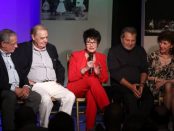
Each was asked about their first audition. Marilyn D’Honau couldn’t remember, although she clearly made an impression on Robbins who subsequently used her in "Gypsy." Tony Mordente, just an acting hopeful, was working in a Times Square Howard Johnson’s when he heard that WSS was being assembled and he showed up with no professional experience and managed to impress the powers-that-be. Some flew in from the Coast or Las Vegas or were known by Robbins before hand, like Ronnie Lee who was in "Peter Pan." All were reminded by Robbins before the opening night that they were “handpicked.” [more]
Mette Ingvartsen: 7 Pleasures
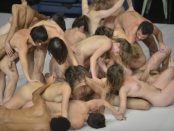
Ingvartsen has a record of intellectualizing her work taking all the juice out of them in the process. "7 Pleasures"—a misnomer if there ever was one—takes her dry, over thinking to the extreme in a work that somehow made the nudity and sexual activities of her twenty-something cast members boring and ugly. (There’s something unappealing about a stage-full of performers jingling all their various body parts as they did in one extended section of 7 Pleasures, no matter how it related to “that other crucial element [of dance], the body,” or “political, sexual, desiring, linguistic, historical, racialized, gendered, and agential flesh matter.”) [more]
Twyla Tharp Dance: 2017 Season
Twyla Tharp (Photo credit: Robert Whitman) [avatar user=”Joel Benjamin” [more]
The Red Letter Plays: Fucking A & In the Blood
Having spent nearly five hours in the company of Ms. Parks’ parade of these beautifully written characters I find myself conflicted about these plays. She is brilliant at generating fire with the source of the heat difficult to pinpoint. It’s her talent to write dramas which sizzle, constructed in her strange vernacular, yet somehow leave too many questions unanswered, the better to prove her one-sided stories. [more]
Faustin Linyekula: In Search of Dinozord
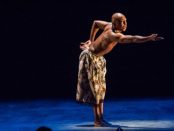
"In Search of Dinozord" is Linyekula’s futile, naive attempt to turn the devastating history of his homeland into art. There was choreography—simple, spasmodic, realistic, but ultimately falling short of expressing anything but physical tension. There was a wonderfully minimal stage setting—by Studios Kabako/Virginie Dupray—that turned the well-equipped NYU Skirball Center for the Performing Arts stage into a sleek black box, with colored lines intersecting, a large red vertical structure and a back wall consisting of joined sheets of wood that served as a screen. Costumes—not specifically credited—were worn-looking casual street wear in faded colors. Lighting was exquisitely expressive. [more]
Stairway to Stardom
Disguised as a snazzy cabaret act, set against constantly projected images from a sleazy Eighties public access talent show—from which the show’s title is derived—the short, intense performance is delivered without a single intake of breath it seems, an energy level that makes it difficult to actually hear—rather than merely listen to—the women’s histories of how they were forced into jobs and professions they found irritating or shallow by pressures applied by loved ones and even themselves. [more]
Dietrich Rides Again
On a multi-tiered set that takes advantage of every square inch of the tiny Medicine Show Theatre—designed by the authors—Ms. Kostek narrated Dietrich’s life story, from middle class childhood in Berlin to theater and cabaret actress to Hollywood star and on to her virulent anti-Nazi activities and beyond, clearly telescoping some of the events for convenience. (Did Dietrich’s audition for the great director Max Reinhardt really lead to performing at his cabaret the very next day?) [more]
Ariel Rivka Dance: 10th Anniversary Season
Ms. Grossman tended toward overuse repetition of movements and arm gestures. Emotional states were supported by little else than the titles and her husband’s gemlike scores. “No Words,” to a score composed and played by Mr. Homan, opened the program. His music sounded like an anguished string quartet to which she made an honest stab at using gesture and arrangement of the eight dancers to express the anger and loss in a poem, “Fury: In Praise of Stone,” by Janet R. Kirchheimer and Jaclyn Piudik, which was printed in the program. [more]
Works & Process Rotunda Project: “Falls the Shadow”
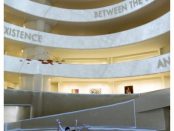
The title comes from T.S. Eliot’s "The Hollow Men," the one that famously includes the line: “This is the way the world ends/Not with a bang but a whimper” - which is exactly how Falls the Shadow ended, the dancers swirling off to the borders of the Rotunda performing space after a series of meetings and partings that too often found them lying in geometric patterns on the floor, their arms spread out in cross forms or moving their limbs in unison to produce a Busby Berkeley effect. (The audience stood above the action on the ramps, looking down.) The two couples rarely mixed and matched, but did occasionally form lineups that wound up dragging the unlucky fourth dancer who was face down on the stage. The actual movement palette was limited to walking, soft arabesques, rolling on the floor and some hip-level lifts, all repeated too many times. [more]
False Stars
Nora Sørena Casey’s "False Stars," part of this year’s Corkscrew Festival at the Paradise Factory, starts slowly but gradually grows more involving as all the interconnections between the characters slowly reveal themselves. [more]
Van Gogh’s Ear
Projected titles indicate place and year—beginning with Arles, 1888 and progressing until van Gogh’s suicide—which we hear as an offstage gunshot—in July of 1890. The audience is treated to Vincent’s thoughts on his painting technique, his poverty, his mental health, his fellow artists, stars, sunflowers, all interrupted by chamber music by Debussy, Fauré, Chausson and Franck played—in various combinations—by Henry Wang (violin), Yuval Herz (violin), Chich-Fan Yiu (viola), Timotheos Petrin (cello), Max Barros (piano) and Renana Gutman (piano). [more]
Lili Marlene
The songs never come up to the title song made famous by Marlene Dietrich who’s mentioned several times during the play. Antin’s attempt at playful seduction, “Take Me Home Tonight,” sung by the half-dressed cabaret girls and his German-style drinking song, “Fill My Stein with Beer” are pleasant pastiche, but “How Can Germany Survive?” (sung by the beleaguered Willi) and “Time to Stand Up” (sung by Josef) are heavy-handed and obvious. The lyrics throughout, even in the love songs are of the “moon-June” variety, but, as mentioned, are sung with great feeling. [more]
Lucky (Atlas Circus Company)
Watching Evans being bossed around by the tall beanpole Russel Norris, whether in an office job, cleaning a park or waiting on tables, was to watch classic comedy performed with brilliant, but invisible timing. (Credit choreographer Tyler Holobaski for his seamless contributions.) [more]
Virtual Memory
Mark Finley, the director, knew enough to keep the play charmingly low-key with just enough animated physicality to illustrate the story. Finley clearly understood all of Strothmann’s best qualities as a storyteller and how to keep him on his toes as an actor and memoirist. [more]
Jessica
Vermillion writes distinctive characters who each have their own language, but fails to make his story believable or emotionally gripping by turning it into something closer to the surreal, expecting the audience to accept the rationalizations rather than science fiction. There are moments that communicate real emotion, particularly the low-key ending, but due to the nature of the story, Vermillion finds himself spending far too much time explicating the pseudoscience behind the title character. [more]
Jewels (Lincoln Center Festival)
The three-part ballet is considered Balanchine’s tribute to the three major artistic influences in his professional life: the French school, the Russian school and, of course, his own American style of classical ballet as taught in his School of American Ballet in Lincoln Center. Therefore, it was not just logical, but inspired, that the Paris Opera troupe would dance the dreamy “Emeralds” to Gabriel Fauré, the New York City Ballet, the fresh and jazzy “Rubies” to Igor Stravinsky, and the Russian troupe the very classical “Diamonds” to Piotr Ilyich Tchaikovsky. [more]
Arcadia
The joy of Stoppard’s writing comes to the fore as the second act characters debate what happened in the first act, too often getting it all wrong, misinterpreting the evidence or jumping to too many conclusions that aren’t justified. These actors are so enjoyable to watch that we can only sit back and enjoy their self-delusions. [more]
Navigator in Love
Hapless Rostom (a perfectly cast Michael Propster who wears his emotions close to the surface) is low man on the totem pole in a nameless construction company and is removed from his comfortable office job to a position that forces him to travel about the country in a company car. He has the distasteful job of investigating corruption in the company’s many construction sites. He is aided in his travels by the Navigator (the voice of his GPS, Lauren Riddle who somehow finds a way to express emotions in her monotone voice). [more]
Trump Lear
"Trump Lear" turns out to be a gem, a brilliant gem with many facets that shine an intensely comic light on Trump. It’s a brutally honest x-ray as only a comedy can be, a sardonic, scary, funny take on Donald Trump as seen through the eyes of a victimized playwright/performer who is—shades of 1984!—kidnapped and imprisoned for making fun of the President! [more]
Custody
Shannon and Brendan are first seen in her simply decorated apartment in 1994 on her 41st birthday just before Brendan’s departure for Phoenix to join his significant other Ted (who doesn’t appear until the third scene). They discuss the custody of their “children,” actually a ceramic bird called Henny and a cloth puppet of a little girl whose limbs are wooden dowels. She has been dubbed Melly-Lou and she has been diagnosed with Dutch Elm disease—all part of the imaginative scenario assembled over the years by the two “parents.” The title of the play refers to the quandary of where these kids will reside, a source of friction that is finally resolved. [more]
American Ballet Theatre: Whipped Cream
Richard Strauss’ surprisingly lighthearted score was first staged as a ballet in 1924 to a libretto he also wrote. Strauss is, of course, best known for his serious, dark operas ("Salome," "Elektra," "Der Rosenkavalier," "Die Frau ohne Schatten"). This work, originally "Schlagobers" in German, appears to be a whimsical musical detour that, happily, has landed in the hands (feet?) of the very much in demand Ratmansky who, with the superior creative support of Mark Ryden (sets and costumes), Brad Fields (lighting) and, of course, the talented dancers of the American Ballet Theatre produced a candy-colored entertainment that might just serve as its new Nutcracker, a ballet that appeals to both children and adults. [more]
Momix: Opus Cactus
In eighteen short sections, Pendleton and his dancers evoke images of the western deserts of the U.S., using whatever means necessary, be it skateboards, puppetry, classical Indian dance, acrobatics, technological gimmickry or a truckload of imaginative costumes. [more]
Lydia Johnson Dance 2017 Season
Johnson’s choreographic ethic borders on the minimalistic, repeating some basic movements, particularly certain arm gestures, in all of the works. In two of the three ballets, it works, in one it fails terribly, and in the fourth, it merely comes up short. [more]
The Reception
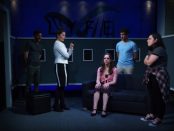
Soon little rends in the fabric of normalcy became apparent. Bits of dialogue are repeated senselessly and the five revelers keep returning to the same positions (three on a couch, one alone at the border of the space and one behind the bar). Attempts at dancing get more and more inelegant, even leading to a bit of physical sparring. Even worse, there is an intermittent ominous, crackling sound emanating from deep in the floor, as if the house were about to collapse. [more]
Martita Goshen’s Earthworks: “Sanctuary”
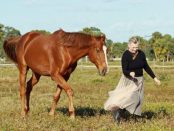
Martita Goshen’s love of horses, one in particular, and nature in general, is a driving force in “Sanctuary,” her gentle and genteel dance recently performed by her troupe, Earthworks at the Paul Taylor Dance Studio. “Sanctuary” is the final section of a three-part work dedicated to the memory of the famous equine, Barbaro, who died tragically after an injury. [more]
Terezin
Loaded with many characters and incidents, "Terezin" focuses on two sisters, Alexi (Natasa Petrovic) and Violet (Sasha K. Gordon) who, along with their father, Kurt (Sam Gibbs, playing his complex palette of emotions quite well) and mother, violinist Isabella (Sophia Davey, a calm presence who returns frequently as a spirit) are savagely grabbed by the SS for deportation to Terezin. (One of the shocking first events is the rather realistic strangulation of one of the characters followed soon by the usual vile language—“Jewish swine,” etc.—used by the clichéd glowering Nazis.) [more]
Underground
Two likeable people, James (Michael Jinks) and Claire (Bebe Sanders) meet online, have dinner in a local pub owned by Steve (Andrew McDonald) and take the Underground home. That’s about it. Of course, that’s only the basic, very basic, outline. What makes "Underground" a quiet delight is the way van Tricht takes this trite situation and beefs it up with insightful conversation, intriguing situations that border on the fantastic and a clear empathy with her characters. [more]
Angels in America (New York City Opera)
By eliminating most of the extended fantasy elements of the play, they reduced the storyline to the domestic turbulence of two couples and a deservedly ugly portrait of Roy Cohn. Add in a visit by the iconic Bethesda Fountain Angel (here totally generic) and some very dramatic, brass-heavy music and you have this intriguing production by New York City Opera that succeeds as an opera as long as one is not familiar with the source material. What seemed heavy going and existential in the original comes across on a much more human level in the opera. [more]
Invincible
Betts' "Invincible" has been compared to Alan Ayckbourn’s work. Although there are similarities, particularly in Betts’ ear for capturing the jargon of his characters and his feel for social class distinctions, Ayckbourn’s plays are more delicately constructed and make their points—whether social or emotional—more cleverly than Betts. Even so, Invincible—the title a football reference—is satisfying as both a comedy and a drama, breaking more than a few hearts. [more]
Bella: An American Tall Tale
Featuring an energetic, game cast headed by bigger-than-life Ashley D. Kelley as the title character, "Bella" follows this “big booty Tupelo girl,” as she travels (under an assumed last name) to meet her staid fiancé, Buffalo Soldier Aloysius T. Honeycutt (handsome, sweet voiced Britton Smith) and to escape the law. She meets a slew of fascinating characters—some who really existed and some fictitious—and finds her life taking a surprising turn in her bumpy road to marital bliss. [more]
A Hunger Artist
"A Hunger Artist" takes morbid subject matter and turns it into a metaphorical look at obsession and human suffering. By focusing on one hunger artist, Luxenberg and Levin manage to make a universal statement that leaves the audience bereft, images of unbelievable suffering lingering long after leaving the theater. [more]
Jody Sperling/Time Lapse Dance: “Book of Clouds”
The ostensible theme of Sperling’s series of performances at the Baryshnikov Arts Center was climate change. Had spectators not read that in the program they would have come away from Sperling’s performance thinking it was an ode to spring with some cosmic overtones in Huestis’ colorful slide projections of circular forms that evoked the earth, the moon, Mars, stars, subtle earth formations and, of course, clouds. [more]
Janis Brenner & Dancers: Spring 2017 Season
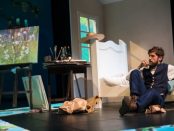
Wearing pale, simple but elegant costumes with small colorful patches around the hips (designed by Sue Julien and Brenner) the dancers in “Soul River/Blues” entered singly at first up a diagonal, almost as if sneaking on. As the dance unfolded they rolled and paused, looking over their shoulders to a score by Ry Cooder and V.M. Bhatt which was a hybrid of Indian classical and bluesy American guitar styles. One man (Aaron Selissen) and four women (Kara Chan, Ruth Howard, Sumaya Jackson and Kristi Ann Schopfer) interacted in slow lifts and groupings that became ever more complex in their angles and internal relationships. [more]
Parsons Dance – Spring Season 2017
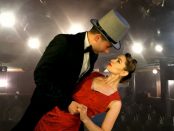
Company member, Omar Román De Jesús choreographed the third world premiere, “Daniel,” to a multiple-sourced score. He took his eight dancers through a dramatic visit to those on the autism behavior spectrum, finding beauty, sadness and even some humor. The emphasis was definitely on the darker elements with angular knee and elbow jutting movements repeated over and over again. Unlike his mentor, David Parsons, De Jesús dared to end his work with two sections that each used two dancers. [more]
Lou
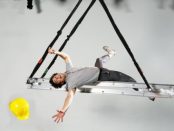
The opening scenes augurs well, hinting at the deeper emotional motivation for Salome’s future behavior, her decision to avoid romantic involvement. As the lights gradually rise to reveal Salome, seated at her desk, her back to the audience, she is described by disembodied voices as a contradictory figure who is loved and respected in equal measure. Then Salome, the product of a respectable, well-to-do upbringing, tells a tale of being duped by the kitchen help when she was a child. The look on Mieko Gavia’s face as Lou Salome after revealing this traumatic event makes it clear that she will never be duped again. Ms. Gavia skillfully portrays Lou Salome as a stalwart anti-romantic who, nevertheless, knows that friendships with the influential males of her time were a necessary evil. [more]
Venus
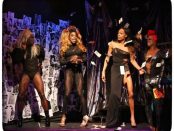
The adept cast is led by Zainab Jah in the title role. In the one detail in which Parks’ play matches "The Elephant Man," Ms. Jah, a shapely, lovely actress, transforms herself into Venus right in front of the audience, painfully pulling on a padded costume that leaves nothing to the imagination. Ms. Jah’s Venus is a strong figure who rolls with the punches but is no match for the hypocrisy of the powers that be. She is a strong enough actor to keep her head above the fray. [more]

Ellen Cornfield/Cornfield Dance: “Close-Up” (2017)
There was a mysterious coolness about “Close-Up” which, according to a program note by Ms. Cornfield, was meant to delve into the personalities of her five dancers, doing this by assigning very particular gestures—touching the face with a finger, holding a palm to the forehead, quivering hands, mimed pouring, nods—and facial expressions like appearing to laugh or shout to each dancer. She called these intimate, non-dance details, “zoom close-ups.” These quirky bits were additions to sleek, catlike movements that included lunges, low leg circling and the kind of balletic movements that were the centerpiece of Cunningham’s choreographic output. [more]