Archive
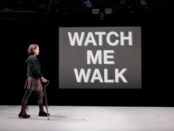
Anne Gridley begins "Watch Me Walk" by taking its title at punishingly literal face value. She introduces herself, grips her walking stick—never a cane, a semantic correction that quickly reveals its philosophical weight—and proceeds to walk the length of the stage again and again, in near silence, for so long that the initial charge of provocation slowly discharges. What remains is not suspense but facticity. In another theatrical ecosystem, this might register as endurance art or a sly conceptual prank; here, in a Soho Rep production presented in association with the recently concluded 2026 Under the Radar Festival, it operates as a recalibration of spectatorship itself. We arrive alert, waiting for the performance to “start,” only to discover that it already has—and that the only thing lagging behind is our attention. [more]

The Disappear
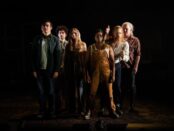
Watching these creative people misbehave is part of the fun though a great deal must be taken on faith: Julie’s tremendous talent, Raf’s inordinate fame and highly emotional depth, Ben’s genius as a filmmaker though Raf has never seen one of his movies, and that Mira’s novels earn more money than Ben’s films. However, nothing Schmidt has written for these characters demonstrates these qualities. Julie is portrayed as pretentious and overacting. Raf is so low-key it is hard to see him as having a great deal of depth on screen. With Ben's self-dramatizing and egotistical nature, it is hard to imagine him finding time to focus on his work, while the items we hear about from Mira’s novels hardly seem like the material for best sellers. Possibly Schmidt who has directed her own play needed a second pair of eyes and ears to get her play whipped into shape. [more]
R.I.P. “UNCLE FLOYD” VIVINO—A REMEMBRANCE by CHIP DEFFAA
Floyd Vivino honed his comic skills working everywhere from circuses to burlesque shows. When his "Uncle Floyd Show" ended its 24-year run, it was the longest-running New Jersey-based show in television history. But Floyd always said his first love was performing "live," and he'd perform as many as 300 "live": shows in a given year. [more]
Cimino’s Defeat
Eric Faris’ "Cimino’s Defeat" seems under researched while attempting to make a play from a few salient facts. At times the play seems endless, at others repetitious with all the arguments that never reach any conclusions. A good deal of the play seems amateurish though this may be the fault of co-directors Sam Cini and Ryan Czerwonko who allow for much ranting and raving from the actors. There may well be a play in the "Heaven’s Gate" debacle but this isn’t it. [more]
Bug
Seen first Off Broadway in 2004, Tracy Lett’s "Bug" has now reached Broadway via the Steppenwolf Theatre Company production being presented by Manhattan Theatre Club. While "Bug" has the reputation as a thriller (and has all the elements.) David Cromer’s leisurely direction turns this into a character study instead. Michael Shannon’s electrifyingly crazed protagonist in the Off Broadway staging has given way to Namir Smallwood’s low-key insidious portrayal of Peter Evans, an Iraqi vet who has escaped from four years in an army hospital facility. The play which deals in conspiracy theories does seem more relevant now than two decades ago as there are so many more such theories swirling around us on a daily basis. [more]
and her Children
Hailey McAfee in a scene from Rosie Glen-Lambert and McAfee’s “and her Children” at SoHo [more]
Going Bacharach: The Songs of an Icon
Legendary composer Burt Bacharach died in 2023 and it has taken until now for there to be a fitting stage tribute to his 1,000 song output (mainly written with lyricist Hal David) which includes six Grammy Awards and three Academy Awards. Entitled Going Bacharach: The Songs of an Icon, the musical revue has been conceived by producer Jack Lewin along with Will Friedwald (who has been called “the poet laureate of vintage pop music,”) musical supervisor Tedd Firth and musical director Adrian Galante, who is also responsible for the arrangements and orchestrations as well as playing piano and clarinet in the show. While Bacharach was best known for his mellow sound as sung by Dionne Warwick who recorded most of the songs in the show, the volume of this Going Bacharach is very loud, though this may be the fault of sound designer Matt Berman. Those of us who grew up with these songs won’t recognize the arrangements while younger people may be pleased to experience them for the first time. [more]
Falling Out
Review by Jack Quinn, publisher Amelia Grace Beckham and Gavin Cole in a scene from Josée [more]
Try/Step/Trip
The choreography by Toran X. Moore is exquisitely attuned to both context and cast. Moore’s steps and motifs create a full canvas of movement that breathes with the beat and bends to the demands of the narrative. "Try/Step/Trip" announces itself through a distinct physical vocabulary, one that is not merely stylistic but historical and communal: step, the percussive dance form forged and refined within historically Black colleges and universities. Here, the body becomes both instrument and archive—feet striking, hands clapping, chests resonating in rhythms that carry lineage as much as sound. The choice of step is not ornamental; it is foundational, lending the work a muscular, collective language that insists on presence, discipline, and shared breath, and that roots the piece in a tradition where movement functions simultaneously as music, memory, and social bond. Rooted firmly in Black dance, the choreography adapts itself to the tonal shifts of each song and scene, turning the evening into a literal and figurative adventure. At 90 minutes, the piece demands stamina and precision from its performers, and the ensemble meets that challenge with discipline and collective resolve. [more]
Dream Feed
What "Dream Feed" does is evoke feelings, and images, and hopefully dreams. Most effective are the times when what I assume are actual dreams are recited, in one case through a voice changer, which is both funny and emotional. The music is mostly singing, but Justin Hicks plays the autoharp, an instrument you don't get to see too often in the theater (or at all). He's excellent and it makes me want to get one myself. There's also drums, but these are fairly quiet and don't take over the piece. It's mostly about the vocals, which are terrific. The audience goes bananas for it, clapping along to songs they've never heard before and leaping to their feet at the end. [more]
The Opening
While ABBA’s "Chess" is receiving its first revival on Broadway, a delightful new musical about chess has come to Off Broadway’s Players Theatre. "The Opening," billed as “The Second Most Famous Musical About Chess,” is a fun entertainment which keeps you guessing throughout about the world and denizens of chess tournaments. Inspired by a true chess scandal in 2022 in which a tournament player was wrongly accused of cheating, this musical spoof has a clever book by Brooke Di Spirito, melodic music by Mateo Chavez Lewis, and witty lyrics co-written by Di Spirito and Chavez Lewis. An expert cast directed by Nick Flatto keeps the show merrily rolling along. Who knew chess could cause such shenanigans? [more]
Packrat: The Quest por la Abundancia
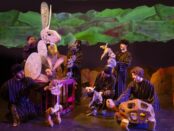
Do we want to be led to a utopia full of shiny objects or can we find abundance at home, in friendship and family? Symbolically, and at times explicitly, Concrete Temple Theatre explores this ever-timely question in "Packrat: The Quest por la Abundancia," an inventive parable written and directed by Renee Philippi with puppetry, projections, and sets designed by Carlo Adinolfi. By offering well-paced visual and auditory surprises, it keeps viewers' attention for over an hour, which is no small feat. [more]
Hildegard
Sarah Kirkland Snider’s first opera arrives with a confidence that feels almost paradoxical: it is at once tightly focused and lavishly expansive, a work that fixes its gaze on a single hinge in medieval history while allowing the implications of that moment to ripple outward in all directions. "Hildegard" does not so much resurrect Hildegard von Bingen as acknowledge what she has always seemed to be—a figure who belongs as much to myth as to chronology, a woman whose historical footprint feels improbably modern, even futuristic. [more]
Picnic at Hanging Rock
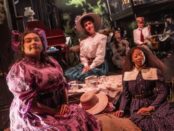
However, where the Peter Weir film used magical lighting and the atmosphere of the actual filming at Hanging Rock to recreate a mystical, supernatural feeling, the musical instead adds songs and dialogue. Unfortunately, Bell’s lyrics are either too prosaic or too poetic without creating a magical world, while Gold’s folk-pop score often sounds the same throughout. The busy set by Daniel Zimmerman which attempts to shoehorn the school and its stairway to the second floor, the hanging rock and its environs, and the five-piece orchestra all on the same stage seems rather cluttered along with the forest of trees and foliage in the background. The many-colored costumes by Ásta Bennie Hostetter for the girl students’ dresses vie with the background for our attention and there are often too many hues on stage simultaneously. While Barbara Samuels’ lighting is often exactly right, her plot using red for the picnic seems to make many of the girls look like they have picked up terrible sunburns in a very short time. [more]
Honoring Irving Berlin at Christmas …
On Christmas Eve, a group of New York performing artists gathered outside Irving Berlin’s longtime home to sing the songs he loved most. Begun by John Wallowitch in the 1980s, the tradition continues—spanning generations, honoring Berlin’s legacy, and celebrating music, memory, and community on the very doorstep where history was made. [more]
Night Stories
"Night Stories" is, first and foremost, about Jewish life. The show’s characters are mainly Holocaust survivors, yet they are never reduced to simply being symbols of suffering. They go on tangents, they make jokes, they express unimaginable pathos before quickly moving on, and they navigate life as best they can. There are so many moments in this play that are deeply human, and deeply Jewish. The production imbues Sutzkever’s poetry with a magnificent resonance. His words are as strikingly beautiful as when he first wrote them, and this modern production is a heartrendingly beautiful affirmation of life. [more]
MOMIX: Alice
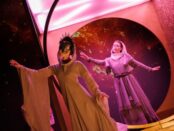
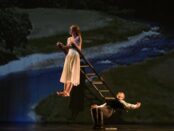
MOMIX’s "Alice" returns to the Joyce Theater for the first time since its 2022 premiere and continues to dazzle in its inimitable way with illusion and dance. Choreographer Moses Pendleton’s creation does not strictly follow the plot of Lewis Carroll’s two books, Alice in Wonderland and Through the Looking Glass, but appears to be a fantasia inspired by them and using all the elements of dance, gymnastics and imagery to bring it to teeming life. Using nine dancers, five women who seem to alternate as Alice, and four muscular men, the evening consists of 22 episodes taken from the two books but not always obvious as to their source. The score consist of 23 songs, some which seem to have been written specifically with the Lewis Carroll book in mind. [more]
Amahl and the Night Visitors
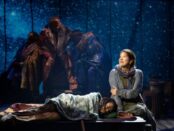
Albert Rhodes, Jr. and Joyce DiDonato in a scene from the Lincoln Center Theater and the [more]
The New York Pops: “A Place Called Home” with Megan Hilty
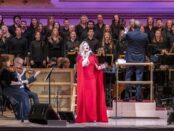
The opening sequence established that tone. “Deck the Hall” and “We Need a Little Christmas” moved briskly and confidently, their energy functional rather than decorative. Reineke kept the wit light and the pacing tight. When guest artist Megan Hilty entered for “It’s the Most Wonderful Time of the Year,” she did so not with flash, but with command — a voice arriving fully present, already in conversation with the orchestra. This was Hilty’s second Christmas concert with The Pops. The first came eight years ago, shortly after her son was born. Friday night, that same son sat in the audience, now eight years old. The fact wasn’t underlined from the stage, but it registered — not as sentiment, but as grounding. There was a sense of continuity in her presence, a confidence shaped over time. [more]
Anna Christie
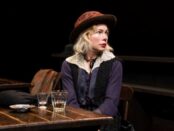
Michelle Williams and Tom Sturridge in a scene from Eugene O’Neill’s “Anna Christie” at St. [more]
Gotta Dance!
"Gotta Dance!" is a hugely entertaining revue of dance in the American musical recreating icon moments from 17 Broadway shows including four that started life as MGM movies starring Gene Kelly and later ended up as stage shows. Appearing under the auspices of The York Theatre, this is the work of the reconstituted American Dance Machine which existed from 1976 – 1987, and has been reestablished in 2012 by Nikki Feirt Atkins as American Dance Machine for the 21st Century along with co-founder choreographer Randy Skinner. American Dance Machine’s mission is to be a living archive of Broadway dance recreated by its original choreographers and/or dancers. All of the performers in "Gotta Dance!" are given a chance to show what they do best whether it is tap dancing, ballet, modern dance or swing. [more]
If We Kiss
What "If We Kiss" captures, with rare delicacy, is the way young people experience such convergences as both comic and catastrophic. The play treats adolescent feeling with respect, refusing to condescend to its intensity while still allowing space for humor and grace. In doing so, it reminds us that first love is never merely personal: it is social, moral, and—when the generations begin to rhyme—quietly political. [more]
Rashid Johnson’s “The Hikers”
Performed beneath Rashid Johnson’s "A Poem for Deep Thinkers," "The Hikers" unfolds inside the Guggenheim rotunda, where architecture, elevation, and live music shape a restrained duet by Lloyd Knight and Leslie Andrea Williams. The building becomes an active partner in the choreography, guiding how the encounter is seen and felt. [more]
Predictor
Jennifer Blackmer’s "Predictor" expands a single moment of insight into a sharp examination of authorship and agency. Anchored by Caitlin Kinnunen’s quietly compelling performance as Meg Crane, the production traces the birth of a home pregnancy test with clarity, momentum, and discipline—most persuasive when it trusts process over proclamation. [more]

The Baker’s Wife
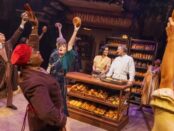
Greenberg’s greatest achievement is his refusal to inflate or apologize for the material. He treats "The Baker’s Wife" as what it is: a musical of sensibility rather than momentum, concerned with romance, regret, and the cost of impulsive desire. There is a deliciously vaudevillian, music-hall bustle to “Bread,” the ensemble number that marks the village’s first ecstatic encounter with Aimable’s handiwork. The song clatters and skips with comic precision, its rhythms suggesting both hunger and sudden abundance, and Stephanie Klemons’ dances here leans into that sense of organized chaos, shaping the townspeople’s delight into a playful choreography of anticipation, consumption, and communal relief. Paul’s dynamic rendition of “Proud Lady,” with its Brel-inflected toughness, certainly gets its desired effect. In revealing the show’s emotional coherence, Greenberg demonstrates that The Baker’s Wife was never broken beyond repair—only misunderstood. Here, at last, it feels whole. [more]
Marjorie Prime
Director Anne Kauffman, who impressively guided the play's Off Broadway premiere a decade ago, returns to do the same for its Broadway debut. With Michael Almereyda's cinematic adaptation having been released between these productions, the new challenge for Kauffman is navigating a wave of narrative familiarities she first fostered. Not only has Harrison's once intentionally disorienting plot become straightforward on a second or third pass, his formerly fanciful depiction of artificial intelligence now carries an impending sense of mundanity, too. [more]

Oedipus
Icke’s version avoids the religious and ethical themes of the original but instead makes it a riveting thriller as the tension rises to almost unbearable heights – even if you know the outcome of this classic tale. In rearranging the story and telling it differently, Icke gives us the hope against hope that this time it will turn out differently. Set on the night of a political election in an unnamed country, Oedipus is first seen on video making a speech to reporters and the populace. He is not yet the ruler but a shoo-in to be elected on this night. However, he makes two promises that will lead to his downfall but he doesn’t know it yet; he will release his birth certificate and he will investigate the death of Laius, a previous leader and the previous husband of his wife Jocasta. [more]
Conversation with Dominick LaRuffa Jr.
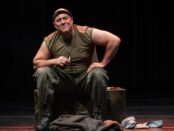
Dominick LaRuffa Jr. speaks without mythology about acting, teaching, and building a sustainable life in the business. In this conversation, he reflects on discipline, long-term patience, and why his work with Blue Collar Artist Studio — including its Veterans Acting Fellowship — treats artists not as students, but as working professionals. [more]
The Surgeon and Her Daughters
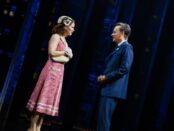
According to the author’s note, he wrote the play to acquaint theatergoers with the “forgotten war” in Sudan. Unfortunately, as there is no backstory for the leading character the Sudanese Mohammed-Ahmed, we learn nothing about this war or how it has affected him. Eventually we learn that he was a surgeon there and lost his wife and daughter. We assume that he was not able to become qualified as a doctor in New York as he has been working as a sign holder for a midtown Irish bar. However, the circumstances of the deaths of his wife and daughter are never explained nor why and how he came to New York (one assumes he was seeking asylum but this is never stated either.) Not surprisingly, no one he meets in New York believes he has been a surgeon as he never tells his life story. [more]
A Seasonal Salon Worth Noting
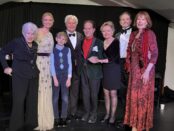
Cabaret artist and storyteller Fiona-Jane Weston launches a pair of online Christmas History Salons tracing the holiday’s evolution from ancient ritual to modern tradition. Blending historical narrative, period readings, music, and conversation, the salons offer a reflective, intimate alternative to seasonal noise.
[more]

BUM BUM (or, this farce has Autism)
In "BUM BUM (or, this farce has Autism)," EPIC Players—New York’s indefatigable standard-bearer for neuroinclusive performance—unfurls a world premiere that feels less like a conventional new play and more like a controlled theatrical detonation. Written by autistic playwright Dave Osmundsen, the play arrives disguised as farce, yet beneath its slapstick velocity lies an exacting critique of how neurodivergent lives are shaped, softened, and rendered consumable for mainstream audiences. It is a work that understands comedy not as an escape from politics but as one of its most effective instruments. Under the brisk, clear-sighted direction of Meggan Dodd, EPIC Players has assembled a company of actors on the spectrum to bring to life the buoyantly subversive text of award-winning Osmundsen—a writer whose instinct for farce is matched only by his ear for the humiliations, large and small, that so often attend the rhetoric of “inclusivity.” [more]
The Faggots and Their Friends Between Revolutions
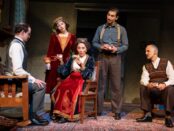
In the cavernous expanse of the Park Avenue Armory, where spectacle often arrives inflated to mythic proportions, "The Faggots and Their Friends Between Revolutions" materializes as a frequently mad, occasionally mystical, and resolutely LGBTQIA+ fantasia. Adapted from Larry Mitchell and Ned Asta’s 1977 queer fable-book—part manifesto, part utopian parable—this incarnation, shaped by composer Philip Venables and director Ted Huffman (who first unveiled it to British audiences in 2023), announces itself with a great deal of theatrical flourish. For all its conjurations and incantatory ambition, it is ultimately a work whose whimsy gleefully shines on the backs of this diamond’s many facets. [more]

Mary Foster Conklin — Mirrors Revisited (50th Anniversary)
Mary Foster Conklin’s Mirrors Revisited stripped Peggy Lee’s 1975 art-album down to its core. With a tightly aligned ensemble led by John DiMartino, Yoshi Waki’s bass, Vince Cherico’s percussion and luminous violin from Sara Caswell, the performance revealed the cycle’s psychological through-lines and affirmed Sue Matsuki’s thoughtful curatorial vision for Winter Rhythms. [more]
Kathy Kaefer — Kiss Me Once: Stories from the Homefront
Kathy Kaefer’s Kiss Me Once: Stories from the Homefront transforms 1940s wartime songs into moving portraits of real families, lovers, and soldiers. Through tender storytelling and beautifully sung classics, she honors the Greatest Generation not with nostalgia, but with living, breathing remembrance. [more]
The American Soldier
The American Soldier, written and performed by Douglas Taurel, is a solid evening of theater with important messages about war and the soldiers who fight them. Taurel is an excellent actor and he has done a nice job adapting the show from actual soldier's letters and their accounts of their time in battle. [more]
This World of Tomorrow
This World of Tomorrow resembles the films "Back to the Future" (Bert cannot risk changing anything), "Groundhog Day" for its repetition of the same events, and "You’ve Got Mail" in which two undeclared lovers run the risk of missing each other. Both the message and the structure resemble those time travel movies of the 1940s like René Clair’s "It Happened Tomorrow" where the characters get to view a glimpse of the future only to end up back where they started. The problem with "This World of Tomorrow" is that the play attempts to do something that the movies do much better. While Derek McLane’s clever scenery making much use of projections on a series of square pillars which rearrange themselves for each scene as the projections change is appealing as well as eye-catching, it can only do so much to suggest the extensive and imposing World’s Fair, as well as other parts of New York City. All this will be more successful in a future film version in which CGI will allow us to really see the bygone fair and NYC in 1939. [more]
A Noel Coward Celebration — Steve Ross & Friends
Steve Ross and a gifted ensemble brought Noël Coward’s world vividly to life at the Episcopal Actors’ Guild, blending wit, longing, and theatrical history. Highlights included Shana Farr’s luminous “Someday I’ll Find You,” young Austin Hardy’s charming poem, and a show-stopping turn from 100-year-old Dorothy. A night of artistry with purpose. [more]
Diversion
I come from a family of nurses, and apparently so does playwright Scott Organ whose play "Diversion" is set entirely in an ICU nurse’s breakroom. Organ has clearly done his homework, because he’s written an honest, intense, and yet often funny piece centering on a few days in the work life of six nurses under the pressure of a “diversion” investigation. For those unfamiliar with the word in a medical setting, “diversion” is the delicate term given to the illegal practice of diverting drugs away from their intended use, on patients, and instead toward personal use or sale. [more]
Meet the Cartozians
Talene Yeghisabet Monahon’s new play "Meet the Cartozians," being presented by The Second Stage at The Pershing Square Signature Center, is simply the best new American play in New York this fall. This riveting two-part play set in two time frames 100 years apart asks the questions what does it mean to be an American, what does it mean to be white in America, and what does it mean to be an Armenian American. The timeliness of these questions will not be lost on audiences well aware of the current administration’s views on immigration particularly of non-white applicants for asylum. The Armenian American playwright’s last three plays ("How to Load a Musket," "Jane Anger" and "The Good John Proctor") have all had historical backgrounds but this one is personal to Monahon as it deals with her own heritage. Director David Cromer who has proven himself to be a wizard with new plays as well as his brilliant reinvention of Thornton Wilder’s Our Town has chosen a superb cast led by two-time Tony Award-winner Andrea Martin and 2024 Tony Award-winner Will Brill who are all excellent playing two roles each. [more]
Tom Stoppard: An Appreciation
With Tom Stoppard’s passing, we look back on a career that transformed theatrical language and feeling. Our tribute revisits Arcadia, Leopoldstadt, Travesties, and The Real Thing through TheaterScene’s critics, capturing the wit, humanity, and intellectual daring that shaped his enduring legacy. [more]
Practice
With a three-hour running time (the first act runs two hours straight without an intermission) the play is too long for its repetitiousness having the actors go over the same theater games and monologues over and over again. Of course, the play becomes an endurance test for the actors as well as viewers, whether it was intended to or not. Actors who have undergone this kind of training may be amused; those of us who have not may be bored or lose interest. Although the actors who make up the ten-member cast of "Practice" play very different personalities, we see so little of them individually that it is hard to keep them separate and they become a big blur. [more]
Eddie Bruce — The Magic & Music of Tony Bennett
Eddie Bruce brings warmth, wit, and timeless swing to Winter Rhythms, marking his first Urban Stages appearance with charm, heart, and musical finesse. [more]
Interview with Ty Jones, Classical Theater of Harlem
Harlem Holidays features Renée Elise Goldsberry in an intimate CTH celebration of music, storytelling, and community-driven artistry on Dec 15, 2025 [more]
Gingold Theatrical Group’s 20th Anniversary Gala at The Players
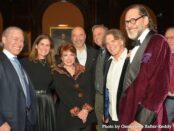
The occasion was the 20th Anniversary Gala of Gingold Theatrical Group, the company that celebrates and revitalizes the work of George Bernard Shaw [more]
The American Soldier – An Interview with Douglas Taurel
In The American Soldier, Douglas Taurel gives voice to generations of service through real letters, lived experience, and fourteen sharply drawn characters. In this conversation, he speaks about honor, sacrifice, brotherhood, and the careful craft required to carry other people’s grief onstage—night after night—without ever letting it become abstract. [more]
A Bodega Princess Remembers La Fiesta de los Reyes Magos, 1998
Iraisa Ann Reilly in her one-woman show “A Bodega Princess Remembers La Fiesta de los Reyes [more]
Full Contact
In its final form, the piece stands as both elegy and proclamation: a testament to a heritage reclaimed, and to the fierce, necessary act of making contact—full, unguarded, and profoundly human—with oneself. Estrada exists here in a purgatorial tension, suspended between the gravitational pull of guilt and the stark instinct toward survival. The play chronicles not simply his attempt to move forward but the Herculean labor of taking even the first tremulous step toward healing—an act rendered as perilous as any physical combat he has ever undertaken. At times it seems his own mind, a treacherous and labyrinthine opponent, threatens to drag him beneath its tide. And yet, in the fragile space between collapse and catharsis, the work finds its most haunting register: a portrait of a man grappling to reclaim his narrative before the darkness that shaped him claims him once more. [more]
Sweet Smell of Success
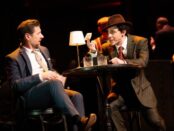
The film version starring Burt Lancaster as sleazy yet powerful gossip columnist J.J. Hunsecker (similar to the notorious Walter Winchell) and Tony Curtis as hungry press agent protégé Sidney Falco was not a success as the ugly underbelly of tabloid journalism was not what filmgoers wanted from some of their favorite box office stars in 1957. Some of the same problems apparently recurred when nice guy John Lithgow took on the role in the stage musical in 2002. The reedited version by Guare and Carnelia (which is closer to what they originally intended) remains faithful to the original plot but gives a more humanizing backstory and a more palatable ending. They have also restored the original opening (“Rumor”) and a duet for Hunsecker’s sister Susan and her boyfriend Dallas (“That’s How I Say Goodbye”), cut on the road. [more]
Kyoto
Unlike J.T. Rogers’ Tony Award-winning "Oslo" which handled similar material about the secret Oslo Peace Accord conference, "Kyoto" by Joe Murphy and Joe Robertson makes little concession to its audience giving almost too much information and depicting too many characters, while being patently undramatic much of the time. However, the topic is so explosive that it carries its audience through its 11 conferences. (One hardly notices Natalie Pryce’s costumes so closely does one have to listen to follow the flow of the arguments.) One does come away with the knowledge these sorts of conferences are almost futile with each nation having its own agenda and limits to how far it will go even at the expense of other nations. It is almost remarkable that the Kyoto conference reached any consensus at all. The question now is how much of that was actually enforced by the signatories to the protocol. [more]
The Seat of Our Pants
Michael Lepore as the Telegram Boy, Micaela Diamond as Sabina, Ruthie Ann Miles as Mrs. Antrobus, [more]
Richard II (Red Bull Theatre)
If you know the play, you many have trouble following it as several actors double: Ron Canada plays both John of Gaunt, Duke of Lancaster (Richard’s uncle and Henry Bolingbroke’s father) and later the Bishop of Carlisle. Daniel Stewart Sherman doubles as both Sir Thomas Mowbray, Duke of Norfork and later as courtier Sir Stephen Scroop. Ryan Spahn is seen as Richard’s favorite Bagot, a Welsh Captain, and as a companion to the Queen. The ending has been changed as there is no Sir Piers Exton: another character comes to murder Richard in his cell, giving a different import to the scene. As there is no Duke and Duchess of York, the Duchess’ defense of her traitorous son after Bolingbroke becomes King Henry IV is given to the Queen instead. [more]
GLORIA! — Canterbury Choral Society
GLORIA! from the Canterbury Choral Society unites Vivaldi, Puccini, and Arnesen in a luminous performance shaped by expressive voices and rich ensemble color. [more]
Gruesome Playground Injuries
In Neil Pepe’s stark revival of Rajiv Joseph’s "Gruesome Playground Injuries," Nicholas Braun and Kara Young trace three decades of bruised connection. Childhood scars, teenage volatility, and a late-night reckoning unfold in jagged time jumps that reveal how two people can orbit each other without ever landing in the same emotional place. [more]
The New York Pops: Everything I Know: Mandy Gonzalez Sings Lin-Manuel Miranda
These highlights stood out not because they were big, but because they were grounded. Nothing felt inflated or overworked. Reineke kept the orchestra responsive, and Gonzalez moved through Miranda’s catalog with the ease of someone who knows the material from the inside out — from the early basement-club creativity of "Freestyle Love Supreme" to the cross-platform storytelling that carries him from "In the Heights" to "Encanto" without changing his fingerprint. [more]
Chess
Strong’s book belies his name, its overlong (two hours, 40 minute) narrative, with all its scheming realpolitik, being more formulaic than authentic. Its points about the individual vs. the state, personal ambition vs. national loyalty, truth vs. propaganda, the pressures of celebrity, and so on, are clear, but Chess is too addicted to larger-than-life histrionics to make us more than cerebrally grateful or deeply invested in the choices the characters must face. [more]
HardLove
By the time the play reaches its understated yet piercing climax, the question is no longer whether ChiChi and Theodore are “right” for one another—though that question lingers—but rather what it means for any of us to seek connection in a world where desire is both compass and mirage. "HardLove" distills the fragile thrill of two strangers attempting to divine each other’s contours—emotional, physical, moral—and uses that single night’s encounter as a prism through which larger anxieties of belonging, expectation, and becoming refract. In the end, this bold, darkly funny, and unexpectedly tender work stands as a testament to the theater’s capacity to anatomize intimacy without anesthetizing it: a funny, poignant hour that leaves its audience pondering not only these two characters but the mysterious machinery of desire itself. [more]
Bruno Giraldi: Love or Death? at Don’t Tell Mama
Bruno Giraldi’s "Love or Death?" at Don’t Tell Mama blends cabaret performance, philosophy, and intimate storytelling. Each idea leads to a personal revelation; each revelation breaks into song. This cabaret review highlights a show where love, loss, and music intertwine, creating a powerful emotional journey on a small New York stage. [more]
Two Strangers (Carry a Cake Across New York)
With its big, if economical, imagination, "Two Strangers (Carry a Cake Across New York)" also seemingly contains a metropolis of non-digital humanity, thanks, in particular, to Tony Gayle's robust and amusingly familiar sound design ("stand clear of the closing doors, please"). But Robin and Dougal are the only people ever actually present onstage, which is enough. As they repeatedly scale the twin mounds of literal baggage on Soutra Gilmour's circular treadmill of a set--rotating away from and towards each other--the metaphoric intent is obvious. Still, it's the promptly endearing Pitts and Tutty who must translate that visual meaning into a palpable bond, so that the audience cares deeply when it is eventually threatened by both past and future complications. [more]
The Burning Cauldron of Fiery Fire
Tom Pecinka and Marianne Rendón in a scene from Anne Washburn’s “The Burning Cauldron of Fiery [more]