News Ticker
- December 16, 2025 in Broadway // Marjorie Prime
- December 14, 2025 in Broadway // Oedipus
- December 14, 2025 in Interviews // Conversation with Dominick LaRuffa Jr.
- December 14, 2025 in Off-Broadway // The Surgeon and Her Daughters
- December 14, 2025 in Features // A Seasonal Salon Worth Noting
- December 13, 2025 in Off-Broadway // BUM BUM (or, this farce has Autism)
- December 12, 2025 in Musicals // The Faggots and Their Friends Between Revolutions
- December 12, 2025 in Cabaret // Mary Foster Conklin — Mirrors Revisited (50th Anniversary)
- December 11, 2025 in Cabaret // Kathy Kaefer — Kiss Me Once: Stories from the Homefront
- December 11, 2025 in Off-Broadway // The American Soldier
- December 9, 2025 in Off-Broadway // This World of Tomorrow
- December 9, 2025 in Cabaret // A Noel Coward Celebration — Steve Ross & Friends
- December 7, 2025 in Off-Broadway // Diversion
- December 5, 2025 in Off-Broadway // Meet the Cartozians
- December 5, 2025 in Features // Tom Stoppard: An Appreciation
Archive
The eye-filling sets by Hannah Beachler and video and projection design by Daniel Brodie include subtle tributes to Black Culture that not all theatergoers may notice on a first look. When Dorothy first lands in Oz, the landscape and houses are reminiscent of Tremé, the Black neighborhood in New Orleans decimated by Hurricane Katrina. The overhead set piece is inspired by the arch in New Orleans’ Louis Armstrong Park as well as incorporating patterns found in quilts on the Underground Railroad. African symbols are carved into the bark of the trees along Dorothy’s path on the Yellow Brick Road as well as depicted on the sides of the theater proscenium arch. When Glinda enters, she comes out of house at the address 1804, commemorating the year of Haiti’s independence. The red and black sets and costumes (by Sharon Davis) for the sequence in the Castle of Evilene are a tribute to West African culture.
[more]
If the play's goal is to pay homage to Wright, it misses the mark for most audiences. If one is unfamiliar with Wright, most of the symbols revealed in the play will not be understood in terms of her life story. This fact is not necessarily a distraction from the action since the play provides a suitable level of mystery, imagination, and surprise, resulting in an entertaining but possibly unsettling experience, starting with the opening and carrying through to a satisfactory ending, all without spoken dialogue.
[more]
Christie Perfetti Williams’ genial new play "Bettye and the Jockettes Spinning Records at the Holiday Inn" transports the audience back to the moment Elvis Presley became an international star via his appearance on the Ed Sullivan Show in July 1956. Working at the tiny all-female Memphis radio station, WHER, tucked off the lobby of a Holiday Inn, Bettye (Heather E. Cunningham) is devoted to spinning jazz records and does the occasional interview. She is not a fan of Presley’s music but is given the assignment of interviewing him, a task made all the more important for the station now that Presley’s career is about to zoom into the stratosphere.
[more]
The lead of the show is film star Eddie Redmayne, who won the Olivier Award for his performance as the Emcee in the London production and is also Tony nominated for this show. Director Rebecca Frecknall’s staging (with her British production team) is imaginative and innovative, quite unlike any Cabaret you have seen before. The new Sally Bowles is Scottish American actress Gayle Rankin who appeared as Fraulein Kost on Broadway in Sam Mendes’ 2014 Broadway revival of "Cabaret" which appeared at Studio 54. Frecknall’s interpretation is more dissolute and dissipated than most versions so that when American writer Clifford Bradshaw arrives in Berlin to get material for a novel the city is already deep in the throes of degradation and degeneracy when he meets second-rate singer Sally Bowles as the party girl par excellence and lead female singer of the Kit Kat Club.
[more]
The play, taken by Phelim McAleer from witness accounts in interviews performed by Ann McElhinney and McAleer in Israel in the immediate aftermath of the attacks, is incredibly powerful, if a bit relentless. It opens with people dancing at what we learn is the Nova festival, one of the sites of the October 7 attacks. Told mostly in direct address monologues, the cast is uniformly excellent, and quick costume changes keep things moving (the simple but effective costume design is by Sara Tzipi bat Devorah). It's difficult to call out any cast member in particular but Paul Louis and Jeff Gurner do nice work as people who go out of their way to help others. Geoffrey Cantor, best known as an actor, does a terrific job staging a complicated narrative. He should get more directing work.
[more]
"The Heart of Rock and Roll" at the James Earl Jones Theatre is one of the more pleasant entries in the jukebox musical derby. Using the musical catalog of Huey Lewis and the News, Tyler Mitchell and Jonathan A. Abrams, (book by Abrams), have fashioned an amusing story of a working class Joe who is torn between his love of rock music and his need to make a living in business. Heart began its Broadway-bound journey in 2018 at the Old Globe in San Diego, but is set firmly in the 1980’s.
[more]
In fact, the play which ought to be hilarious is almost devoid of jokes as the premise which is politically incorrect will make many white playgoers uncomfortable – unless this is the point of the play. As the setting is an event space/rental studio/production facility, we see a trendy photo shoot of a high fashion model, a taping of a motivational speaker, and a business meeting to plan a new advertising campaign for a rapper’s new product line, a pop star whose street cred is that he is on trial for aggravated assault and has been to jail a few times for drugs and theft. All of this is pushed to the limit which undercuts its humorous possibilities. Of course, there are the obvious jokes about Michael Jordan and wearing Jordan jeans.
[more]
Koogler began writing "Staff Meal" in January 2020 and completed the first draft in April 2020…well, he certainly had time on his hands, but so did a lot of people. It’s a wonder we didn’t have a great outpouring of “the great American novels” during Covid, or at least as we were being released from our lockdowns so we’d have something to read as we made our way back into the subway. What is striking about "Staff Meal" is that we begin with what passes for so much normalcy – two people begin conversation, even if it’s minimal Millennial-bleats, and graduate towards commiserating about the coffee in this particular café finally leading up to finding lunch somewhere…but this won’t be a quick run into a (low-end) McDonald’s or (slightly better than low end) Pret a Manger…this will be a foray into Ruth Reichl territory. They land in a high-end perhaps Michelin-starred restaurant where the staff gathers to eat gourmet cuisine before the dinner crowd comes in.
[more]
"Redemption Story," written by Peregrine Teng Heard, is an exploration into the psyche of Connie Lee, an actor with 20 years of experience acting in noir films of the 1940’s and 1950’s, who now calls herself a housewife. Christine Toy Johnson expertly embodies the character, skillfully revealing the psycho-social dynamics that keeps her somewhere between the reality of 1971 and the roles she played in film. Director Sarah Blush guides a strong cast, effectively supporting the narrative themes of the show as it explores the idea of redemption in a self-perception fashioned by past film roles. It is coupled with the social alienation of being an Asian woman playing stereotypical characters. It was the norm in the movie business in those years, but if those issues are not enough, mix in feelings of conditional love and estrangement.
[more]
"Mother Play," though based on Vogel’s own life, is her most schematic, more an outline barely fleshed out with lots of details rather than the intense emotional revelations of her earlier works such as "How I Learned to Drive" and "Indecent." The chronological span of the play precludes anything but a quick portrayal of a procession of life-changing events in the Herman family and the rest of the world. Only Martha comes close to revealing her inner tumult at being torn between her mother and her brother. AIDS and other markers of the fast-moving decades are served up too quickly and with foregone conclusions in weak attempts to pluck the audience’s heart strings.
[more]
Director Nicholas Viselli has done well with the characterizations but is unable to resolve the thinness of the backstories which are not fleshed out by the script. The shallow set which has most of its furniture and appliances lined up across the stage makes some of the blocking awkward and repetitious. Making her Off Broadway debut as Libby in the role that won Dinah Manhoff the Tony Award, Makenzie Morgan Gomez is spunky and quick with the retort. She has a breezy, wise stage presence. Her use of a wheelchair and a cane is no problem to the character but when she says that she has hiked and hitched her way across half of America one wonders if this is realistic. And today in 2024 do 19-year-old women risk hitching alone that distance?
[more]
Jessica Burr’s Blessed Unrest production of Marguerite Duras’ "La Musica Deuxième" in the 1992 translation by Barbara Bray is like a violent Jean Paul Sartre short story directed in the cool style of filmmaker Éric Rohmer. Whether this is best for the material, you will have to decide for yourself. Aside from the 2023 film of Duras’ play Suzanna Andler, this is the first New York presentation of one of her plays since Savannah Bay at the Classic Stage Company in 2003.
[more]
"David and Katie Get Re-Married" is the creation of David Carl and Katie Hartman. Using original songs, funny and timely commentary, and interesting props, they take a musical romp through the trials and tribulations of tying the knot again. Michole Biancosino provides outside-the-box direction for the humorously demented exploration of whether marriage is an institution or whether the people doing it should be institutionalized. In the end, it becomes clear that it is, maybe, both. It is a show to be savored in the afterglow of the experience.
[more]
As we are instructed early on, the meal and the service are divided into 15 sections. The Seder is held in the midst, or as a significant part, of the whole of the play. It is then complemented by the opera portions. Einhorn gets a big assist from composer Avner Finberg’s exotic score and musical director Mila Henry as she leads the chamber sextet from the piano. Tenor James Benjamin Rodgers as Moses, soprano Tharanga Goonetilleke as Tzippora, one of the God voices, and a messenger, and lyric bass Matthew Curran as the Pharaoh, Reuel, and the other God voice are exemplary.
[more]
"Fingers & Spoons" does have its titillating moments, with descriptions of sex and even mild simulations. (The show is sexual enough that it would probably be a hit at the Edinburgh Fringe.) You will leave knowing that Pascale Roger-McKeever, the author and star, likes to be called a slut, at least under the right circumstances. You will not, however, leave with a greater understanding of open marriage.
[more]
The play is an expression of the quiet whirlwind within Mary Jane’s soul, exquisitely expressed by the warm McAdams, surrounded by the boundless support of the others. Director Anne Kauffman masterfully allows the play to express vast emotions in the most subtle ways. What might have been a tearjerker is so much more, a chance to completely belong in this character’s mind and heart.
[more]
The new musical "Hell’s Kitchen" has made a successful transition to Broadway from The Public Theater and the new version seems to have corrected some of the flaws from before. This juke-box musical with a score by singer/songwriter Alicia Keys and a book by playwright Kristoffer Diaz (The Elaborate Entrance of Chad Deity), is a big ambitious show, a love letter to New York, and inspired by the coming of age story of Keys’ 17th year. It is no longer over-miked by sound designer Gareth Owen, characters seemed to have deepened, the plot seems to have gelled into a distinct coming of age story, and the redesigned set by Robert Brill has moved much of the action closer to the audience. It is a crowd pleaser with the iconic Keys’ songs “Girl on Fire,” “Fallin’” and “Empire State of Mind.” Excitingly performed by its cast made up of a handful of characters and a large ensemble of 15 singer/dancers, its most famous leads Shoshana Bean and Brandon Victor Dixon as Ali’s parents are given less to do as this is the daughter’s story. In the leading role of 17-year-old Ali, making their professional Broadway debut, is Maleah Joi Moon who proves to be an exciting musical personality who can hold a show such as this together.
[more]
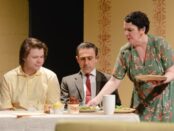
The transfer to Broadway has brilliantly expanded the show. The new production designed by Riccardo Hernández (scenery), Paul Tazewell (costumes), Lap Chi Chu (lighting) and Charles G. LaPointe (wigs & hair) brings Taub’s script to vivid life, much better than the more didactic and spare Public Theater rendering. These artists put Taub’s script into historical context making the battle all the more vibrant. The new version also has rethought the casting, reshuffled and improved the songs and, more importantly, is more focused and effective in telling about the conflicts—internal and external—that plagued the suffrage movement. These included dissonance between Catt and Paul; the thorn-in-the-movement’s side of the Black contingent led by the brilliant Ida B. Wells (a charismatic Nikki M. James); and the far left, Socialist ideals of the hothead Ruza Wenclawska (Kim Blanck, brilliantly avoiding caricature).
[more]

So, instead of watching shady videos online, why go for something legit that helps the people who make the magic happen? A one-year subscription to BroadwayHD is $199.99, expensive but gives you on-demand viewing of hundreds of full-length shows.
[more]
As for previous theatrical takes on the classic Jazz Age novel--and a few cinematic ones, too--the understandable allure of Fitzgerald's breathtaking sentences has represented a deathly siren's song for those tempted to dramatically interpret Fitzgerald by emulating him. Adopting a much smarter tack, book writer Kait Kerrigan avoids crashing into the tony shores of Long Island, where the story is mostly set, by remembering that imitation is not only the sincerest form of flattery but also usually very boring. Kerrigan still dutifully opens ("In my younger and more vulnerable years...") and closes ("So we beat on, boats against the current...") with the literary hits, also leaving in place the unhappy character arc of the novel's Midwestern narrator Nick Carraway (Noah J. Ricketts), but she lets the transplanted naif enjoy a friskier journey arriving at the disillusionment that he eventually feels from witnessing the cruel machinations of the East Coast elite.
[more]
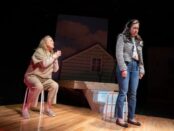
"The Frybread Queen," a unique narrative penned by Carolyn Dunn and brought to life under the direction of Vickie Ramirez, delves into an intergenerational conflict sparked by the death of a man who held significant roles in the lives of four Native American women. While the making of frybread serves as a tool to highlight the characters' diverse attitudes and emotions, it is not the central theme of the play. The primary focus is on the fate of the deceased man's daughter and the mystery surrounding his death.
[more]

Things are not helped by Mini Lien’s bland setting that looks more like a furniture showroom than the family manse held for decades and passed down to the present inhabitants. The new adaptation reduces the plot to one more dysfunctional family story while Chekhov is always more than that. Even more damaging is that the direction by Lila Neugebauer (best known for new plays by Sarah DeLappe, Zoe Kazan, Kenneth Lonergan, Brandon Jacobs Jenkins, Tracy Letts and Annie Baker) has staged the play so that it is in isolated conversations, one that should be called Scenes from the Life of Uncle Vanya. The lighting design by Lap Chi Chu and Elizabeth Harper highlights this by isolating various characters with light changes. Kay Voyce's costumes, except for the surprising brightly caftans of the grandmother, are characterless and monochromatic.
[more]

While the ensemble cast is excellent throughout, we do feel Taylor Mac’s absence when he goes offstage to change costumes (and that is quite a few times, one more sumptuous than the other – though not rivalling what goes on at a Cher concert). Most importantly the “new gender reveal” in Constantinople also occurs offstage. Inhabiting Orlando as a woman, Mac gives us one of the most heartfelt realizations, “How odd. When I was a young man, I insisted that women be obedient, chaste and scented. Now I shall have to pay in my own person for those desires. For women are not…obedient, chaste and scented by nature. They can only attain these graces by tedious discipline. There’s the hairdressing…that alone will take at least an hour of my morning…there’s looking in the looking glass…there’s being chaste year in and year out…Christ Jesus.”
[more]
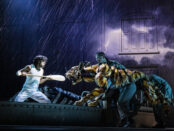
In the very first scene it becomes apparent that we are watching "The Pursuit of Happiness," a new play from the Good Company, an indie theater group that has been known for radical and experimental work that no one came to see but now wants to reach a wider audience and find a producer who will foot the bill. African American playwright Luce is in an unmarried relationship with her director and costar Mike, similar to that of Sally and Tom whom they are playing, and just like Sally Hemings who bore Jefferson six children, Luce discovers that she is pregnant. The play alternates between scenes backstage among the actors in their dressing rooms and onstage as they rehearse the play with opening night only two days away, making changes as they go along.
[more]

"In the Common Hour" is a play with text by Marie Glancy O'Shea inspired by the writings of Italian author Italo Calvino of six stories about an other-dimensional place on the edge of reality. A dream world filled with the consequences of people lost in the projections of their being, unsure of what the next moment holds for them. It is a story, or more realistically, a series of episodes, exploring the liminal space created by dreams and hallucinations. The stories bring to mind the speculative and absurdist work by Rod Serling, Ursula Le Guin, and Philip K. Dick, among others.
[more]
If there's a compelling reason to see "Patriots," it's Stuhlbarg, a Julliard-trained actor who can elevate flawed material with the best of them. In "Patriots," his talent bridges a director and writer who are never in sync, finding meaning in Goold's absurdity and a recognizable person in Morgan's pomposity. Actually, the latter frequently has benefited from this type of good fortune. молодец, mate!
[more]
David Adjmi’s "Stereophonic" at the Golden Theatre, a transfer under the auspices of Playwrights Horizons, is a minutely detailed, almost minute-by-minute recreation of a recording session by a rock band, purportedly based on Fleetwood Mac’s creation of its epic album "Rumours" in 1976. (Adjmi has denied that this was his inspiration, claiming that the show has an amalgam of sources.)
[more]
A good deal of fun is had by Brian Pacelli’s projection design which is shown on the modern and chic living room/dining room set by Christopher and Justin Swader. It takes us to the virtual reality world inhabited by Scarlett and later Kevin: forests, deserts, jungles, icescapes which change at the drop of a hat. It also lets us keep track of Kevin’s progress with fitness data and the success of the RealFit apps as to the number of new users. Emily Rebholz has created an attractive collection of clothes in monochromatic colors for these fitness-oriented people. The lighting by Jamie Roderick enhances the set and projections by changing the mood each time we find we are projected somewhere else.
[more]
The scenes establishing the outlines of the mystery tend to be episodic rather than tightly integrated narrative, building tension to a dramatic resolution. Colette Robert's direction of the fine ensemble is spot-on and well-tuned within the confines of the script. Still, the script's structure leads to the production's episodic nature and ultimately fails to develop the strong air of mystery and suspense in a ghost story.
[more]
The performances are quite stellar. Jayne Atkinson’s Helen is simply gorgeous. We do see that woman who 30 years ago wore a red dress to a party…and that was enough for Mark and Lorraine to have a fight, as Mark “not to hurt Lorraine” had described Helen as plain. Thirty years later she is still anything but plain. Atkinson is that woman who could have broken up a marriage if Mark and Helen continued communicating over those 30 years. She is vibrant, earthy and quick-witted, all the things Lorraine may not have been. Tim Daly finds that illusive charm in Mark that may or may not allow the audience to forgive that this meeting reeks of the premeditated. He too provides us with an easy glance at what it must have been like for them to be together. He is more prepared for this meeting…the stops and starts and even Helen’s unintentional changes of subject. Daly, despite his character’s references to a heart attack and arthritis, gives us that glimpse of the youthful Mark that Helen fell in love with years ago, and could fall in love with once again.
[more]
In attempting to make a feminist statement out of Shakespeare’s "Macbeth", Harris has made Lady Macbeth into the same murderous monster that her husband became in the original. This does not seem to further the feminist cause that if women were in power they would do things differently. Lady Macbeth’s treatment of Lady Macduff (kidnapping her back from her home, attempting to take her child away, etc.) makes her almost worse than Shakespeare’s protagonist. Having eliminated most of the scenes outside of the Macbeth Castle, the second half seems both long and repetitious as things get worse and worse for the new queen. The famous “Tomorrow and tomorrow” soliloquy is rather chopped up so that it does not make her sympathetic as it did Macbeth when hearing about his wife’s suicide.
[more]
The cast of "The Outsiders: A New Musica"l bring their own substantial charisma to the stage, but it's been dramaturgically constrained by Adam Rapp and Justin Levine's book, which sacrifices poetry for explanation. That unfortunate choice is abetted by a score from Levine, Jonathan Clay and Zach Chance (the latter two comprising the folk duo Jamestown Revival) that, influenced by "Oklahoma!" instead of pure sentiment, is far too Rodgers and Hammerstein, when it should have aimed for Rodgers and Hart.
[more]
In telling the life story of Tamara de Lempicka, the show begins with a fascinating premise. Unfortunately, neither the score nor the book lives up to her high standards. Unlike "Sunday in the Park with George" which showed us the workings of the artistic process, "Lempicka" is more interested in the social aspects of the 1920’s and 1930’s Paris than in Tamara’s revolutionary paintings. The cast works hard to put over the new musical but they are defeated by commonplace situations, banal song lyrics, and over-used pronouncements. The musical of Tamara de Lempicka’s life still has to be told.
[more]
«
1
…
13
14
15
16
17
…
114
»
Copyright Jack Quinn, 2001-2023