
The New York Pops: “United in Sound: America at 250”
Ambitious New York Pops program traces 250 years of American music, blending strong vocal performances with moments where the orchestra feels secondary. The sweeping scope sometimes compresses depth, and the chorus is underused, but Reineke’s vision, programming, and talent curation deliver a thoughtful, fitting Carnegie Hall season finale.
By Jack Quinn, Publisher
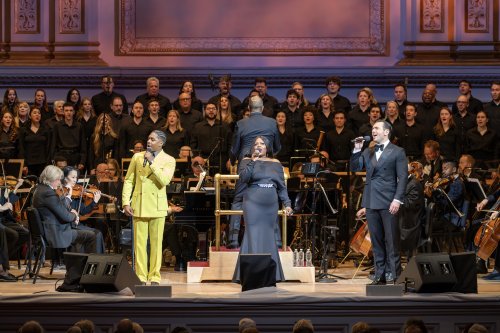
Guest stars Ephraim Sykes, Nova Payton and Max Clayton with Maestro Steven Reineke and The New York Pops at Carnegie Hall on March 13, 2026 (Photo credit: Richard Termine)
There was something inherently ambitious—perhaps even unwieldy—about The New York Pops’ season finale, “United in Sound: America at 250.” Spanning two and a half centuries of American music in a single evening, the program, curated and conducted by Steven Reineke, attempted nothing less than a musical biography of the nation.
That ambition was both the concert’s greatest strength and, at times, its limiting constraint.
The evening opened with a striking moment of stillness as Tchin, performing on Indigenous courting flute, offered a traditional piece rooted in Blackfeet and Narragansett heritage. It was less a “song” in the conventional sense than an invocation—an atmospheric reminder that American music begins long before the concert hall. The tonal palette here was intimate and breath-driven, a stark contrast to what would follow.
From there, the program moved into early American identity with William Billings’ “Chester,” a Revolutionary-era hymn later orchestrated by William Schuman. With the Essential Voices USA chorus under Judith Clurman, the piece carried a firm, declarative energy—its famous sentiment, “Let tyrants shake their iron rod,” still resonating with clarity.
The first half traced a familiar but effective arc through spirituals, ragtime, and early Broadway. “Swing Low, Sweet Chariot,” attributed to Wallace Willis, featured Nova Payton, whose warm, grounded tone gave the spiritual a sense of lived-in authenticity. Her phrasing leaned into the song’s yearning—“Coming for to carry me home”—with a restrained emotional weight rather than overt dramatics.
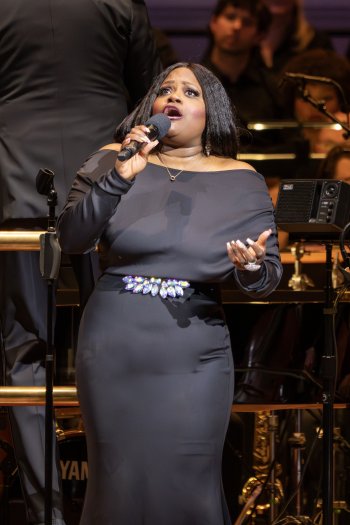
Guest star Nova Payton with Maestro Steven Reineke and The New York Pops at Carnegie Hall on March 13, 2026 (Photo credit: Richard Termine)
Payton also delivered a poised interpretation of “Lift Every Voice and Sing” (James Weldon Johnson / J. Rosamond Johnson), often called the Black national anthem. Here, her control and clarity of diction allowed the text to lead, supported by the chorus in a reverent, almost ceremonial frame.
Instrumentally, Scott Joplin’s “Maple Leaf Rag” offered one of the evening’s rare chances for the orchestra itself to take center stage. The Pops handled the syncopation with crisp articulation, though one couldn’t help wishing for more moments like this where the ensemble’s color and rhythmic precision were foregrounded.
That tension—between vocal showcase and orchestral identity—surfaced repeatedly throughout the night.
Broadway and early popular song were represented through George M. Cohan’s “Give My Regards to Broadway” and George Gershwin’s “I Got Rhythm” and “Summertime.” Max Clayton, a natural Broadway performer, brought a bright, forward placement to his vocals, with clean phrasing and an easy theatrical presence. In “I Got Rhythm,” originally from Girl Crazy, his delivery captured the buoyant optimism of the lyric—“Who could ask for anything more?”—without overplaying it.
Ephraim Sykes, by contrast, brought a more contemporary vocal edge to “Summertime” from Porgy and Bess. His tone had a slightly grainier texture, leaning into phrasing that felt more interpretive than classical, which gave the piece a modern immediacy.
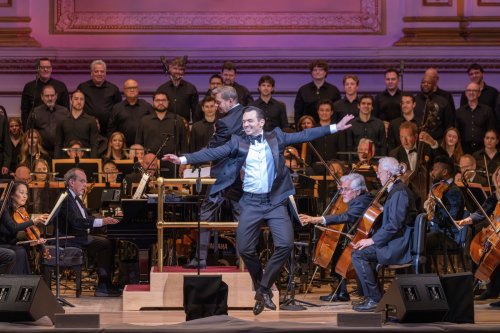
Guest star Max Clayton with Maestro Steven Reineke and The New York Pops at Carnegie Hall on March 13, 2026 (Photo credit: Richard Termine)
Irving Berlin’s “Cheek to Cheek,” made famous by Fred Astaire in Top Hat, allowed the trio of Clayton, Payton, and Sykes to interact. The blend was appealing, though again the orchestra often receded behind the vocal line rather than driving it.
After intermission, the program shifted into Americana and modern popular genres. Hilary Hawke’s banjo work in Earl Scruggs’ “Foggy Mountain Breakdown” was one of the evening’s highlights—technically precise, rhythmically sharp, and refreshingly instrumental in focus.
Woody Guthrie’s “This Land Is Your Land,” performed by the full ensemble of guest artists and chorus, leaned into its communal roots. The familiar lyric—“This land was made for you and me”—was delivered with a straightforward sincerity that avoided sentimentality.
The middle of the second half moved through country and early rock. Payton returned for Willie Nelson’s “Crazy,” bringing a softer, more intimate tone, her phrasing stretching slightly behind the beat in a way that suited the song’s emotional vulnerability—“I’m crazy for trying, and crazy for crying.”
Clayton’s “Blue Suede Shoes” (Carl Perkins, popularized by Elvis Presley) was energetic, if somewhat constrained by orchestral arrangement. His vocal style remained polished, though the raw edge of early rock ’n’ roll is difficult to fully capture in a symphonic setting.
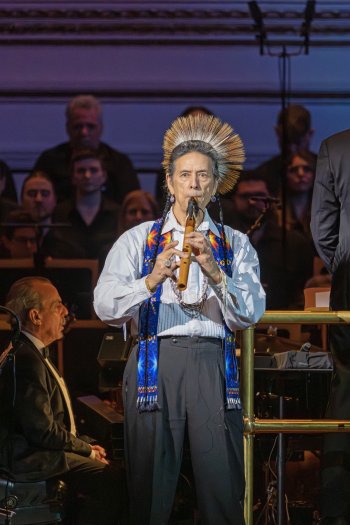
Guest star Tchin on the Indigenous American Courting Flute with Maestro Steven Reineke and The New York Pops at Carnegie Hall on March 13, 2026 (Photo credit: Richard Termine)
One of the most effective moments of the evening came with Sykes’ performance of Sam Cooke’s “A Change Is Gonna Come.” Here, his voice found its fullest expressive range—controlled but urgent. The line “It’s been a long time coming” carried both musical and historical weight, and the arrangement allowed more dynamic build than earlier selections.
The program continued through disco and new wave—“Last Dance” (Paul Jabara) and “Once in a Lifetime” (Talking Heads)—before landing in late 20th-century pop with Michael Jackson’s “Beat It.” Sykes again led, bringing a rhythmic precision and physicality that matched the material, though the orchestral setting inevitably softened the song’s original edge.
The concert closed with “Glory” (John Stephens, Lonnie Lynn, Che Smith) from Selma, performed by the full cast and chorus. As a contemporary civil rights anthem, it provided a fitting bookend to the evening’s historical scope. The repeated refrain—“One day, when the glory comes”—felt less like a finale than an ongoing statement, tying the past to the present.
Still, not everything fully landed.
At times, the sheer breadth of the program worked against it. Compressing 250 years of music into a single evening meant certain selections felt abbreviated or transitional rather than fully realized. The guest singers, all strong in their respective idioms, were often asked to shift styles rapidly, which can dilute interpretive depth.
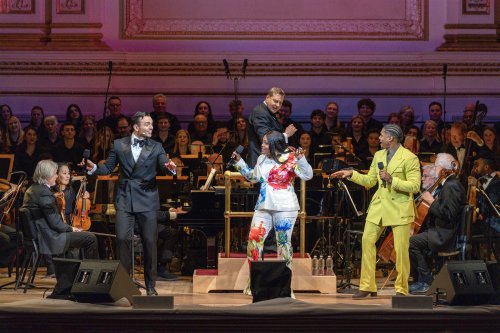
Guest stars Max Clayton, Nova Payton and Ephraim Sykes with Maestro Steven Reineke and The New York Pops at Carnegie Hall on March 13, 2026 (Photo credit: Richard Termine)
There were also moments where the orchestra—arguably the central identity of The Pops—felt secondary to the vocal performances. In a program of this scale, one occasionally longs simply to hear the orchestra breathe on its own terms. Similarly, while Essential Voices USA played a crucial role in key moments, they spent a noticeable portion of the evening underutilized.
Yet these are, in many ways, the byproducts of ambition.
What remains undeniable is Steven Reineke’s remarkable ability to conceive and execute large-scale thematic programming. His commitment to bringing new artists to the Carnegie Hall stage—Clayton, Payton, Sykes, Hawke, and Tchin all making notable appearances—continues to define The Pops as both a presenting and curatorial institution.
If the evening occasionally felt overextended, it was in service of a larger idea: that American music, in all its diversity and contradiction, resists easy compression.
As a season finale, “United in Sound: America at 250” was less about perfection than perspective—and in that sense, it succeeded.
The New York Pops: “Untied in Sound: America at 250) (March 13, 2026)
Carnegie Hall
Stern Auditorium/Perlman Stage, 881 Seventh Avenue at 57th Street, in Manhattan
For tickets, call Carnegie Charge at 212-247-7800 or visit http://www.NewYorkPops.org
Running time: two hours including one intermission


Leave a comment