
House of McQueen
A sumptuous, soul-baring elegy, Darrah Cloud’s play dazzles and devastates—where fashion is weaponized, beauty bleeds, and art becomes a cry for grace.
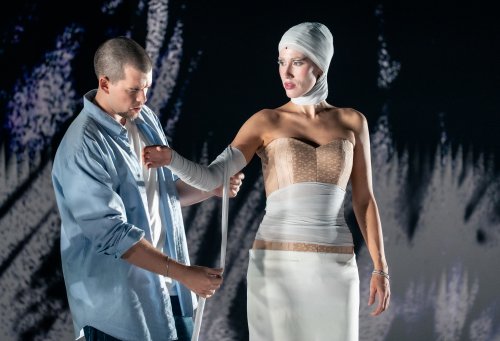
Luke Newton and Jonina Thorsteindotter in a scene from Darrah Cloud’s “House of McQueen” at The Mansion at Hudson Yards (Photo credit: Thomas Hodges)
House of McQueen, a kaleidoscopic plunge into the brilliant, tortured mind of a fashion revolutionary, now commanding the stage in a new Off-Broadway production that is anything but typical, is as titillating as those front row seats during Fashion Week. Staged in the freshly christened Mansion at Hudson Yards—a venue as sleek and stylized as one of McQueen’s own runway spectacles—this limited engagement is not so much a play as it is a haunting, immersive elegy; a fever dream stitched together with ambition, artistry, and anguish.
And a sincere recommendation: do arrive early to take in the adjacent gallery of archival McQueen pieces—a poignant prelude to the extravaganza that awaits.
Crafted with sensitivity and spectacle by playwright Darrah Cloud and brought to life with unflinching precision by director Sam Helfrich, House of McQueen dares to unravel the mythos of the late, great Alexander McQueen (1969–2010), the enfant terrible of British fashion. Here, the theater becomes both confessional and catwalk, memory palace and mausoleum, as the production careens through the designer’s short but incandescent life. McQueen’s nephew, Gary James McQueen, serving as Creative Director, lends the production an air of intimacy and authenticity rarely achieved in biographical theater. This is no sanitized tribute, no saccharine memorial. It is raw. It is fractured. It is McQueen.
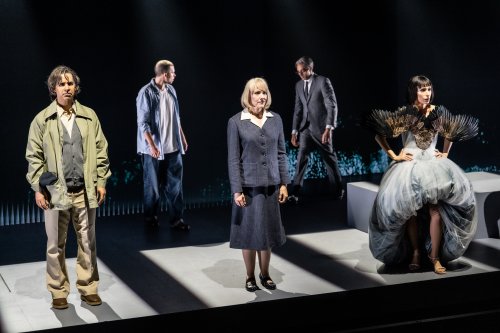
Denis Lambert, Luke Newton, Emily Skinner, Fady Demian and Catherine LeFrere in a scene from Darrah Cloud’s “House of McQueen” at The Mansion at Hudson Yards (Photo credit: Thomas Hodges)
Told in a fragmented, time-jumping narrative befitting its subject’s own iconoclastic tendencies, the play eschews linear storytelling for a more textured tapestry of scenes—moments stitched together like fabric swatches on a designer’s table. We see Lee (as he was known to those closest to him) in all his iterations: the boy sketching dresses on his bedroom wall, the outsider grappling with a bruising family dynamic, the unapologetically queer artist ascending the gilded staircases of the fashion elite. From his apprenticeship on Savile Row to his notorious reign at Givenchy, from the agonizing disintegration of his friendship with Isabella Blow to his relentless pursuit of “everything, everything, everything,” the play charts a rise so meteoric it seems destined to implode.
At the center of this whirlwind is Luke Newton, delivering a luminous, layered portrayal of McQueen. Newton captures not just the genius but the jagged, often unbearable contradictions of the man—his vulnerability cloaked in bravado, his visionary artistry shadowed by addiction, self-doubt, and trauma. He is beautifully counterbalanced by Emily Skinner as Joyce, McQueen’s mother, whose presence—both real and imagined—serves as an emotional anchor. Their scenes, presented as a sort of spectral interview, are some of the production’s most affecting, offering a glimpse into the son beneath the celebrity.
And then there is Catherine LeFrere, magnificent as the doomed Isabella Blow. With elegance, edge, and a whisper of madness, she evokes the magnetic, maddening muse whose belief in McQueen helped launch his career—and whose descent into despair echoes his own. Her chemistry with Newton is electric, their shared scenes imbued with both theatrical glamor and aching humanity.

Matthew Eby in a scene from Darrah Cloud’s “House of McQueen” at The Mansion at Hudson Yards (Photo credit: Thomas Hodges)
The supporting cast is uniformly excellent. Alternating with Matthew Eby, Cody Braverman’s Young Lee is a revelation, embodying the precocious spark of a boy who finds salvation in sketchbooks and silhouettes. Margaret Odette’s fashion critic morphs from a dismissive observer to a humbled admirer, mirroring the arc of an industry that first scorned and then deified McQueen. The ensemble—Tim Creavin, Fady Demian, Joe Joseph, Denis Lambert, Spencer R. Petro, and Jonina Thorsteinsdottir—navigate a carousel of roles with chameleonic dexterity, slipping in and out of personas like garments in a backstage quick change.
Visually, the production is a stunner. Jason Ardizzone-West’s minimal black-and-white set acts as a blank canvas onto which memories, dreams, and nightmares are projected—literally—thanks to Brad Peterson’s vivid video and projection design and over 1,000 square feet of LED screens. One moment, we are in a modest South London flat; the next, in the glittering, grotesque theater of a McQueen runway show. Robert Wierzel’s lighting, G Clausen’s sound design, and Benjamin Freedman’s increasingly frenetic choreography all conspire to conjure an atmosphere of both ecstasy and dread.
Of course, in a show about a fashion deity, the costumes must rise to the occasion—and rise they do. Kaye Voyce’s designs, aided by Tommy Kurzman’s hair, wigs, and makeup, deftly bridge the mundane and the sublime. From oversized tees to extravagant couture, they serve not just as wardrobe but as visual storytelling, revealing emotional and psychological states with every sequin and stitch.
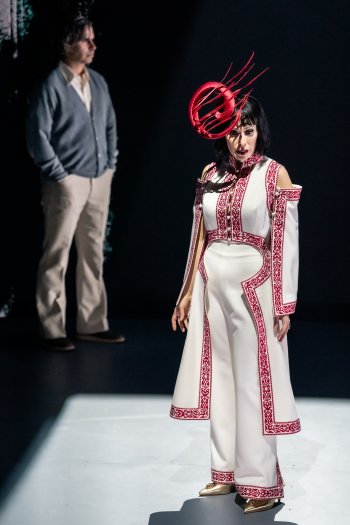
Catherine LeFrere in a scene from Darrah Cloud’s “House of McQueen” at The Mansion at Hudson Yards (Photo credit: Thomas Hodges)
And yet, for all its dazzling surfaces, House of McQueen is, at its core, a tragedy—a requiem for a man who wielded beauty like a weapon, but could not outrun his demons. The show does not shy away from the darker contours of McQueen’s life: his fraught sexuality, the media’s initial cruelty, the relentless pressure of creation, and the toll of fame. It builds inexorably toward that final, tragic chapter—his suicide at the age of 40, just days after the death of his beloved mother. And when it comes, it hits like a closing curtain—sudden, absolute, and devastating.
House of McQueen is a triumph of form and feeling, a production that dares to match its subject’s audacity with its own. It is not merely a bio-play. It is a runway of memory, a stage-bound séance, a theatrical fashion show in which the heart is always the boldest accessory.
House of McQueen (through October 12, 2025)
The Mansion at Hudson Yards, 508 West 37th Street, in Manhattan
For tickets, visit http://www.thehouseofmcqueen.com
Running time: two hours including one intermission


Leave a comment