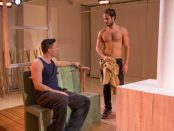
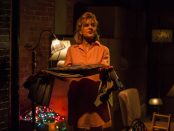
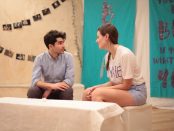
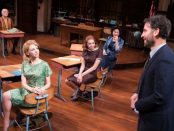
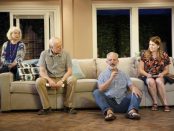
This volatile quartet battle over the personal and the political during a Scotch-fueled weekend at Ira’s Fire Island house. There’s not much in the way of plot, but secrets are revealed, scores are settled and life goes on with new insights. It’s reminiscent of a Terrence McNally play but lacking in polish. [more]
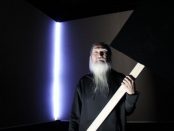
The only real high-tech exchanges take place only three times during the run of the show. At the performances of February 6, 9 and 17, one of the roles in "Camera Obscura" will be performed telematically from Seoul Institute for the Arts in Korea and directed by Il Kyu Park. "Hi-Fi | Wi-Fi | Sci-Fi" which uses a great many sound specialists for little effect is an interesting idea but doesn’t go far enough either dramatically or in terms of modern technology to have much impact. As a cautionary tale, time has caught up with these plays and passed them by. [more]
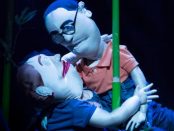
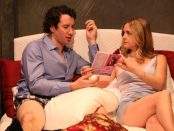
Playwright James Lecesne has been acclaimed for his solo performance works, most recently "The Absolute Brightness of Leonard Pelkey." Here, he has written a traditional play employing theatrical devices that’s a mélange of David Sedaris, Charles Busch and Modern Family. There are one-liners galore, wacky situations and a decidedly campy sensibility. It’s a bunch of superficial antics that never really meaningfully connect. [more]
However, it is Ives’ joy in language that is the most infectious. The rhymed couplets keep coming and surprising us over and over again (bitter/twitter; prize/rhapsodize, jocular/interlocutor, kiss/dentrifice, carbuncle/uncle). He has also created remarkably agile, felicitous and contemporary turns of phrase: meet-and-greet/ bittersweet; Chanel perfume/key to my room; perfect ten/tragic flaw again; chance to laugh/some dumb gaffe; believe this boy/pure trompe l’oeil. Considering the nature of lying, the anachronisms like contact lens, superglue, outed me, Kid Dorante, party clown, pants on fire, etc., seem like natural hyperbole for these poseurs who take themselves all too seriously. So too Kahn’s clever direction is highly in tune with this style: Dorante and Alcippe’s duel is fought without swords in pantomime and Cliton appears with a modern paper coffee cup. [more]
The ensuing journey is a bizarre and sometimes hilarious exploration of China and the culture within, even if it doesn’t always make the most sense. "Made in China" makes the most of the liberties that puppetry allows, and features some very impressive techniques and performances from the actors behind the scenes. Though the two main characters are both interesting, they are both made all the more entertaining by their canine companions. The two dogs, Lily and Yo-Yo (Dorothy James and Andy Manjuck among others) are completely lovable, and every single scene they are a part of is instantly heartwarming. [more]
Periodically the cast calls for a “Family Meeting.” The theme from Jeopardy is played on a kazoo and three audience members are picked to come up. The one who is wearing the funniest nametag that relates to dialogue from the play is the winner, receiving a free vodka shot. Drinking games also take place. All of these festive tangents never sidetrack the plot of the play. Ms. Hudson is also the director, and her giddy, all-over-the-place staging in this large living room, enhances the exuberance of the piece. Improbably and cleverly, Chekov’s tone and intentions survive the mayhem. [more]
There are many questions that the author fails to answer. Although the boys have not attended school in years and Bobbie has been diagnosed as ADHD and should be in the British equivalent of special education, no social worker seems to have visited to check up. Who is paying the rent or the electricity? Is the mother on welfare and are these items paid automatically? There is no explanation of how the boys are eating and how Taliban stays alive if they have not been feeding it for days or even weeks. While the neighbors are aware of Bobbie’s stealing, he seems to be getting away with it. The dog’s continual barking from his locked room can be heard on the street but no complaints have been filed. Is all this a metaphor or a slice of life drama? [more]
Behind the theme of war," Incident at Hidden Temple" is a thriller of sorts. Sisters Ava (Ying Ying Li) and Lucy (Briana Sakamoto), first seen in China travelling on a train littered with American soldiers, are separated when a disturbing road block forces their train to a halt. With some time to kill, the sisters exit the train and are introduced to a mysterious stranger--Dinh James Doan as a blind man with a penchant for speaking in riddles--who tells them about a Hidden Temple located just a short ways away. The temple, the blind man cryptically tells them, is filled with lost treasures but will only be revealed to those of pure heart. [more]
What truly distinguishes the show is Dixon’s fearless psychological focus on Rose and himself. The predominant theme is of hero worship and its bruising disappointments. It also attempts to explore the issue of the often-dark contrast between the on-stage and off-stage lives of great entertainers. In examining their involvement, Dixon doesn’t spare Rose or himself from honest scrutiny. [more]
Director Ruben Santiago-Hudson has himself won a Tony Award for his performance in Wilson’s "Seven Guitars" and has directed acclaimed Off Broadway revivals of "The Piano Lesson" and "Seven Guitars." He has assembled a cast of nine in which seven of the actors are veterans of Wilson play including Antony Chisholm who appears in the 2000 production. A true ensemble led by John Douglas Thompson and André Holland (currently in "Moonlight"), a better staging could not be imagined of this involving and engrossing play. [more]
One problem is that the play (unlike Noel Coward’s "Design for Living" or Somerset Maugham’s "The Constant Wife" which cover similar territory) is neither witty not clever, and none of the lines are particularly sparkling or original. While the play may delineate liberated sexual behavior, its drawing room comedy format is too conventional and refined. All five performers always seem to be acting as their style is too arch to be truly believable. [more]
Mr. Refael’s simple but well-crafted scenario takes place in a contemporary apartment in Israel, and has the elderly Salvado looking back at his past. This is theatrically achieved by having him directly addressing the audience. His best friend and fellow survivor is to be honored at the Holocaust memorial center Yad Vashem during a ceremony where he will light a torch. When he becomes incapacitated, that task falls to Salvado. This situation instigates a flood of painful reminiscences that explore his guilt at having survived. [more]
The concept of Love for Sale, though not particularly original, is not a bad one, except for one very important factor: Ms. Burke is not up to either the singing or acting demands of Love for Sale, a voyage from innocence to jaded sophistication as told in mostly dark, melodramatic songs, ironically influenced by the American films that flooded Europe in the twenties and thirties. It’s an extraordinarily difficult repertoire that constantly threatens to be silly expressions of impossibly colorful and desperate characters. [more]
Essentially it’s a glorified and arch 90-minute, scripted, sketch comedy show. The conceit is that it’s inspired by audience suggestions. The composition of the program changes from performance to performance. Throughout the show, slides are projected of printed extracts from online surveys of people’s theatrical preferences with the dates that they responded. These have been collected over a period of many months. The cast then performs a scene based on these answers. [more]
On the one hand, it is a punch in the gut dramatizing the cold hard facts of disintegrating with this disease; on the other, the non-linear time scheme is difficult to follow, offering more questions than it answers. What "Orange Julius" really is could be described more accurately as a screenplay or a teleplay with cuts and fades. There is a powerful work hiding in this material but it still remains unshaped. Under Dustin Wills’ fast-paced direction, Jess Barbagallo, Ruy Iskandar, Irene Sofia Lucio, Stephen Payne and Mary Testa give fine performances despite the fact that the play seems to wander around trying to find its center. [more]
What Evett delivers—using ample quotes from the poem and robust contributions from himself and Spangler—is a terrifying inside look of the Mariner’s experiences, beginning with being hijacked by a friend at a pub. He breathlessly illuminates what the day-to-day life was like with lurid descriptions of illnesses and exciting second-by-second reports of battles with other ships. [more]
Reading David Foster Wallace’s Infinite Jest while lying on a couch is Jay, a slacker-looking type in his 30’s. Sitting in the living room nearby is his 60ish mother who enjoys watching Dr. Phil on television and complaining about her ailments. Gabe McKinley’s Homebody is an enthralling black comedy with shades of Grey Gardens. Mother and son bicker, rehash recriminations and share their joy over the possibility of Jay’s novel being published. In 35 minutes, Mr. McKinley delivers a very well written, plotted and satisfying one-act play. It’s so pleasurable that a full-length version would be most welcome. [more]
Upton’s version solves some problems and creates others. Updated to the 1990’s, the play is no longer about life in Tsarist Russia but the post-Perestroika world of Glasnost. While the original has characters talk about how much better life will be in the future, the new version has the characters wax nostalgic about the recent past but also talk about the challenge of the new Russia in the present. It is not obvious for much of the first scene that the play takes place in the Russian country. [more]
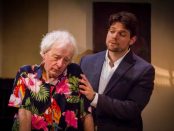
As Paul Harold, a 60ish artist, Pendleton has a leading role that wonderfully showcases his idiosyncratic and considerable talents. With his unruly white hair, limber physicality and distinctive vocal twang, he mines all of the humor and depth of this fascinating character. Sharing the memory of when he met Pablo Picasso in his youth is a vivid moment. [more]
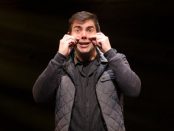
O'Connell’s script is a well-structured series of confessional anecdotes interwoven with the lore of the movies. His performance is a riveting blend of stand-up comedy and grand stage acting with Shakespearean flourishes. The audience is on three sides of the very small theater. This intimate space at times feels too constrained for the unbridled emotionalism on display. [more]
In "DannyKrisDonnaVeronica," playwright Lawrence Dial bitingly delves into the lives of two Brooklyn couples each with two small children. Through his precise, often humorous and realistic dialogue, Mr. Dial has his very well-drawn characters who all in their mid 30’s eloquently express their conflicted feelings and despair. Short on actual plot, the play is rich in incident and is a wistful character study. [more]
The stories included are equal parts humorous, stirring or sobering but always meaningful and intimately personal. Deblinger is a natural storyteller, and every tale is polished and fully developed, and--more importantly--consistent with the show’s overall theme. Further, Deblinger is a fantastic impressionist, and the show contains no less than 15-20 fully realized character impersonations. The versatility he displays is a testament to both his natural abilities as well as his dedication to his craft. [more]
Set in The Afterlife, a crossroad between Heaven and Hell, the play presupposes a trial of Luther on the grounds of being guilty of “the unforgiveable sin.” The prosecuting attorney is The Devil and the defending attorney is Katie von Bora, also known as Mrs. Martin Luther, with Saint Peter acting as judge. The witnesses called are Hitler on Luther’s anti-Semitism in his later years, Dr. King on Luther’s stance on civil rights, Dr. Freud on Luther’s Oedipus complex, and the current Pope on the Catholic Church’s stance on Luther’s objections today. Along the way, the play also dramatized scenes from Luther’s life. Ultimately, it ends with a recreation of Luther’s trial before the Diet of Worms officiated over by the Holy Roman Emperor in 1521. [more]
Playwright Beth Hyland’s very effective conceit is that we’re watching the dress rehearsal of Annie Lambert’s memorial celebration in an auditorium of the State University of New York at Onondaga. There, students act out Ms. Lambert’s story in the manner of a Greek chorus often directly addressing the audience. “What would Annie have wanted?” [more]
While Harms has a fine ear for dialogue, the play moves by revelation and incident. Consequently, it plays like a sophisticated soap opera as every scene brings a new wrinkle not previously suggested. Drew Foster’s direction is smooth and polished but he can’t prevent the play’s plot from having too many incidents that aren’t foreshadowed. Steven Hauck, Elizabeth Rich and Amy Bodnar are charming in a worldly, cultivated way. However, we learn so little about each of them other than how events affect them that they seem one-dimensional. Important facts are left out: what is the rooming situation, are Julian and Agnes married, etc.? The sexual tension is clearly defined: dancing seems to be foreplay to sex. But one can’t live on love alone. [more]
Surprisingly, Eleanor Reissa’s production for New Yiddish Rep has made some debatable choices which damage the power of the play. First of all and most obviously, although not a word has been updated, the characters wear contemporary clothing and use modern objects like headphones, a plastic umbrella and platform shoes. Since there are references to opening a horse stable and the sexual mores of 1907 have changed considerably, this is both distracting and confusing. (The word “roubles” has been eliminated for the more innocuous bucks and coins.) [more]
Director and choreographer Jessica Burr has created a number of dazzling moments with her precise unison of expressive staging, movement and dance. With only a few vintage trunks and a door, all on wheels, Ms. Burr achieves many vivid stage pictures. Walking up a flight of imaginary stairs is a thrilling display of mime. Burr’s work with the ensemble, most of whom play several roles is excellent with their colorful characterizations as evidence. [more]
Two ways to invigorate Shakespeare in our time is to either cast actors not identified with classical roles or to reset the play in some unfamiliar setting. Sam Gold’s magnificent production of "Othello" at the New York Theatre Workshop has done both. [more]
Aaron Port (Josh Radnor), a down on his luck writer, is reduced to teaching Adult Ed classes in middle class/middle brow 1960’s Levittown, Long Island. Richard Greenberg ("Take Me Out," "Our Mother’s Brief Affair") in his new play, "The Babylon Line" at the Mitzi E. Newhouse, has Port frequently speak directly to the audience, doling out information and setting the scene, from the vantage point of 2015. Although it’s an awkward device it does come in handy, particularly at the end when a number of plot strands come together. Port’s frustration with his career is exacerbated by having a successful friend, Jay, confront him en route to his teaching assignment. [more]
Seven musicians of Egypt’s Alexandria Ceremonial Police Orchestra have been sent to Israel to open the new Arab cultural center at Petah Tivah. Due to a mix up at the border, they end up in the dead-end desert town of Bet Hatikva which has no hotel, no culture, and no bus until the morning. However, their visit is the most interesting thing to happen in Bet Hatikva in years as these unlikely visitors represent something different from the outside world. Restaurant owner Dina (Lenk) once a dancer in a big city, now resigned to her boring fate, takes pity on them, feeds them and arranges for them to stay the night in three places including her home. She takes dour, formal conductor Tewfiq (Shalhoub) and young ladies’ man, Haled (Ari’el Stachel). Although the visit is only one night, none of them will ever be the same again. [more]
Raucous highlights include a jive reinterpretation of A Christmas Carol, “by Chazzie D, about a cat called Scrooge...who lives in Scrooge Tower.” There’s also Buckley’s irreverent take on The Gettysburg Address, “I’m a Lincoln cat.” Intertwined are Broder’s cool renditions of “On The Sunny Side of The Street” and “Georgia On My Mind.” He also demonstrates excellent saxophone and tambourine playing. [more]
The audience sits on either side of the large runway stage that set designer Laura Jellinek has arrestingly fashioned into an indoor soccer field. It’s a green vista of Astro Turf that gives the sense “…that the field goes on forever,” writes playwright Sarah DeLappe in her stage directions. [more]
LeFranc’s dialogue is a marvelous blend of the realistic and mundane. The well-delineated main characters all express themselves with true to life simplicity. Plot developments are the combination of subtle details that gradually do build to a satisfying resolution. It all has the sense of John Cheever’s suburban short stories where the darkness behind bonhomie is revealed. Swimming pools are mentioned in passing. [more]