Maria Baranova
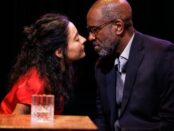
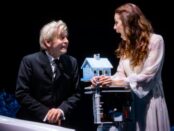
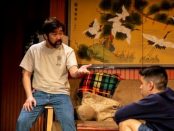
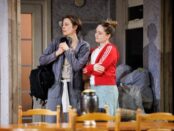
According to the author’s note, he wrote the play to acquaint theatergoers with the “forgotten war” in Sudan. Unfortunately, as there is no backstory for the leading character the Sudanese Mohammed-Ahmed, we learn nothing about this war or how it has affected him. Eventually we learn that he was a surgeon there and lost his wife and daughter. We assume that he was not able to become qualified as a doctor in New York as he has been working as a sign holder for a midtown Irish bar. However, the circumstances of the deaths of his wife and daughter are never explained nor why and how he came to New York (one assumes he was seeking asylum but this is never stated either.) Not surprisingly, no one he meets in New York believes he has been a surgeon as he never tells his life story. [more]
Nothing Can Take You from the Hand of God
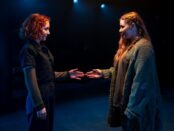
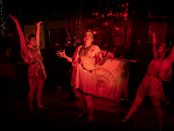
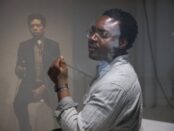
Jen Tullock in the one-woman play “Nothing Can Take You from the Hand of God” at Playwrights [more]
Lady Patriot
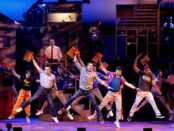
Ted Lange’s "Lady Patriot" reunites the author/director with his cast mates from The Love Boat series, Jill Whelan and Fred Grandy. Leaving that aside as it has little to do with his new historical play, the third in Lange’s American history trilogy, "Lady Patriot" is based on true events that took place in the Jefferson Davis White House and the neighboring house, the Elizabeth Van Lew Mansion, in Richmond, Virginia, during the Civil War, 1861 – 1865. While the play purports to tell the story of the leak in the Davis cabinet and the successful Union spying ring in the Confederacy in Richmond, it lacks urgency and tension even at the end when the Confederacy is about to come to an end. Told in 18 short scenes, the play could use a good deal of pruning of its two and a half hour running time. [more]
Nine Moons
Although Cobb makes references to Iago, Othello’s, second-in-command, and Barbary, the maid to Desdemona’s late mother who brought her up, Nine Moons does not tell us anything we don’t already know from Shakespeare’s play. Since the one thing we are waiting for is Othello’s wooing of Desdemona which will result in their elopement, this does not begin until one hour and five minutes into this 115 minute play. What transpires before that is chit chat about the state of Venice and Cyprus, Othello’s unease in this new city, and Cassio’s army ambitions at odds with his drinking problem, all of which is covered in Shakespeare’s later tragedy. [more]
Ceremonies in Dark Old Men
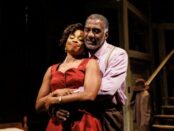
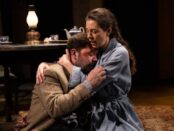
At this vantage point 55 years after its premiere, like the Wilson plays which intentionally cover the previous 100 years, "Ceremonies in Dark Old Men" feels like an historical play wedded to its own time period. Its story and characters are a combination of a Black version of "Death of a Salesman" and a Harlem version of "A Raisin the Sun." Like the story of Willy Loman and his hapless family, the tale of Russell Parker and his two wastrel sons could only have a tragic ending, as their values are so hollow. And like "A Raisin the Sun," the Parker family is so desperate to succeed as Black people in Pre-Civil Rights Era America that they put their hopes in a man that even a child would not have trusted. [more]
Talking with Angels: Budapest, 1943
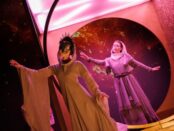
So much of "Talking with Angels" is taken up by the rantings of these otherworldly emenations, which are filled increasingly by cryptic, impenetrable spoutings referencing religious imagery, that the play loses all momentum. Even though these Angels are the eponymous subjects, the really dramatic stretch of the play begins with Gitta’s plan to save not only her Jewish intimates, but scores of Jewish women after these Friday kaffeeklatsch idylls are suddenly interrupted as the Nazis bomb and then enter Budapest with frightening speed. [more]
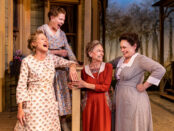
Garside’s Career
While Dickson’s production is elegant and pitch-perfect for its 1914 era, the characterizations are partly satiric and off base. While Daniel Marconi is fine as the designing, unprincipled and power-hungry Peter, he seems to be playing him as a comic character with a wink in his eye though there is no evidence in the play that Brighouse intended this. Madeline Seidman’s Margaret is rather bland, failing to show us what Peter first saw in her. As his mother, Amelia White is almost as ambitious and designing a social climber as her son. The most problematic characterizations are those of the aristocrats who are all played too broadly, rather than true to the period. As Lady Mottram, Melissa Maxwell is almost a gorgon out of Oscar Wilde rather than simply a high class snobbish member of the gentry. Sara Haider’s Gladys fails to give off the kind of signals that would tell Peter she is interested in him, while Avery Whitted as her brother Freddie is practically one of the those silly-ass men of leisure out of P.G. Wodehouse. [more]

The 7th Voyage of Egon Tichy [redux]
The fun is in the technological achievement of the piece, which is impressive. Gelb performs center stage while his image is broadcast to screens on either side of the theatre. What happens on those screens is extraordinary – Gelb, as Tichy, interacts with himself flawlessly in perfectly choreographed scenes. You kind of feel like you're on a ship roaming the space-ways. The screens make things feel cramped, in a good way, and it's surprisingly believable when a wrench floats in outer space. [more]
The Wind and the Rain: A story about Sunny’s Bar
Director Jared Mezzocchi uses the proximity of the actors to the audience to its best advantage. We don’t even question when one of our ranks is pulled out to play Young Sunny. It adds to the sense of community that is the cornerstone of this production. Kudos to Mezzocchi and the four actors in intuitively divining who in the audience is most right for participation. As the play dashes back and forth in time, the actors are kept moving, narrating as they go along. Again physical life clearly dictates whether they are in character or in narration mode. Mezzocchi incorporates projection design to complement the telling of the history of the ever-changing neighborhood. It provides a welcome steady stream of point-of-reference when one considers the land was once dry tundra in the shadow of a glacier twice the height of the Empire State Building. [more]
Fatherland
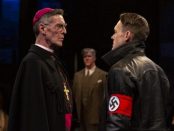
While the play is compelling, the question is what is the message? Is the play asking would we have done what the son did? The father is quoted by the son as calling him a traitor while the son defends his action as that of a patriot who was appalled by his father’s attacking the Capitol. The play is, to a great extent, preaching to the converted as only people who consider what happened on January 6th an insurrection would attend the play, while MAGA proponents will not view it that way. The ending is somewhat predictable though the twists and turns of the story do not always take the expected path. [more]
That Parenting Musical
While "That Parenting Musical" will not tell you anything you didn’t already know, it is a pleasant and undemanding way to spend an evening. The six attractive performers four of whom appear continually as other characters are good company and keep the show moving. That Parenting Musical is the latest in the series of cabaret style revues around a single theme. It is obvious Graham and Kristina Fuller are fully versed in their subject matter. [more]
Small Acts of Daring Invention
If the play's goal is to pay homage to Wright, it misses the mark for most audiences. If one is unfamiliar with Wright, most of the symbols revealed in the play will not be understood in terms of her life story. This fact is not necessarily a distraction from the action since the play provides a suitable level of mystery, imagination, and surprise, resulting in an entertaining but possibly unsettling experience, starting with the opening and carrying through to a satisfactory ending, all without spoken dialogue. [more]
Existentialism
The text created by Bogart in collaboration with Maddow and Zimet is a collage of assembled passages from the works of Sartre and de Beauvoir, amongst others. Maddow and Zimet don’t often speak to each other in the piece, yet they are still very much “in dialogue.” The piece is designed as to keep them separate, though inseparable. The moments where they share stage action: putting away groceries, having sex (brief, then on to the next thought), and dancing is charming as comic relief in contrast to all the other serious content of the piece. One tongue-in-cheek moment that sheds light on how much history they share is their little jazz dance routine abruptly segueing into the Jim Carroll Band’s New Wave classic, “People Who Died.” The change is as abrupt as it is disconcerting, but it is seamlessly incorporated into the stage business. [more]
you don’t have to do anything
"you don’t have to do anything" written by Ryan Drake is a story that explores a gay man’s coming of age from the time he was in seventh grade until graduating from college. It is set in the period when cell phone and computer messaging were becoming more prevalent. The central theme of the production is the psycho-social impact of homosexuality from a young man’s adolescence into his early twenties. Ryan Dobrin's direction is effective, given the nuanced presentation of the central theme with dialogue that suggests misinterpretation of events and misunderstandings of emotional content. [more]
The Following Evening
Although written and directed by Abigail Browde and Michael Silverstone of 600 Highwaymen, "The Following Evening" is a tribute and a summing up of the 50 year career and marriage of experimental theater legends Ellen Maddow and Paul Zimet, co-founding members of the Talking Band. In the past they were usually seen at La MaMa ETC, but the new show is part of the inaugural season at the Perelman Performing Arts Center (PAC NYC) in the black box theater known as Theater C. The space is perfectly suitable to the minimalist performance piece which includes all four actors. [more]
The Whole of Time
Aside from the title not being explained, the Jean Graham-Jones translation seems to end very abruptly. Nothing is settled at the end of its short running time and it certainly feels like more is to come, unlike Williams’ play. There are also too many unanswered questions like what does Ursula do that supports the family of three, why has Lorenzo chosen Spain to move to, what event caused Antonia to stop going out, what is the relationship between Lorenzo and Maximiliano, etc. While Ursula is proud of her Hungarian and Mexican heritage we don’t learn much about it. The Whole of Time plays like a sketch of a play that hasn’t been written or that need a second act to deal with all the loose ends. [more]
Make Me Gorgeous!
As Kenneth/Kate Marlowe, Wade McCollum not only becomes the character but inhabits it. Required to act as narrator as well as performer in both male and female attire, McCollum is totally convincing. His personal charm and rapport with the audience also makes this a pleasurable experience. Make Me Gorgeous! is an unusual biographical show as the details of Kenneth Marlowe’s story will likely be unfamiliar to most theatergoers who will also be entertained by the musical portions of the evening. [more]
Ode to the Wasp Woman
"Ode to the Wasp Woman," written and directed by Rider McDowell, is a play done in the style of film noir and true crime films of the 1950’s. The show focuses on the events leading up to the death of four actors from the B-movies of the 1950’s: Carl "Alfalfa" Switzer, Susan Cabot, George Reeves, and Barbara Payton. It is essentially four acts in style and dialogue that are uneven in terms of theatrical structure, but given the nature of B-movies, they fit within the two dominant styles of noir and true crime. Even though McDowell captures the feel of a B-movie, there are issues within the production that don't fit. It also takes some knowledge of B-movies in terms of genres and styles. If you do not know what the B-movies were like, you may not like the show, and even if you are a B-movie fan, you may not pick up on the resemblance to those movies. [more]
Salesman 之死
Not only is Jeremy Tiang’s "Salesman 之死I" an important document of a classic American play, it is also an illustrative reminder of the cultural differences between China and the United States. Under the direction of Michael Leibenluft, the cast of six is always engaging and always convincing playing both men and women alternately. The design puts the audience directly into the rehearsal room from March to May 1983. The play also allows us to watch major American playwright Arthur Miller as he explores and rethinks a play he had written over three decades before. The fact that the Chinese actors eventually did so well with this typically American text demonstrates the universality of Miller’s greatest play. [more]
Helen.
"Helen." is a new play by Caitlin George based on Greek myths that is being given a terrific production at La MaMa by SuperGeographics in association with La MaMa and the storied company En Garde Arts. The acting is top-notch, the direction excellent, and the lighting (by Jackie Fox and Connor Sale) is atmospheric and evocative. [more]
Zoetrope
Clearly, "Zoetrope" often becomes difficult to follow for non-Spanish speakers. The dearth of realistic sets makes knowing which location is which confusing, despite the occasional descriptive titles. Then, the fact that most of the actors—all of whom are terrific—play several parts in a rapidly time-shifting plot makes figuring out who’s who and who is in a relationship with whom difficult to ascertain. Why is Puerto Rican independence glossed over? How does Claudio become a filmmaker? It’s the debut of his movie that ends "Zoetrope." [more]
Prometheus Firebringer
Somewhere there are rules for what theatre is supposed to do: it should entertain, it should instruct, it should provoke. To say that Annie Dorsen’s "Prometheus Firebringer" checks all the boxes is an understatement of what she has done here. It is a brilliant reactionary, and yes, even cautionary, piece that takes a 2,500-year- old play that doesn’t really exist anymore (what is left of it is the title and a fragment or two – the rest has been lost over time) and thrusts it into an exercise for the unwitting specter of Artificial Intelligence. The results are fascinating, yet unremarkable; provocative, yet giddy. [more]
No Good Things Dwell in the Flesh
Everyone loves a good immigrant story, from The Godfather on down. 'No Good Things Dwell in the Flesh" doesn't reach that high, but it succeeds in what it tries to do, which is to be an accurate portrayal of a specific experience. Agata (played by reliable veteran Kellie Overbey) is an aging Russian tailor with a shop in Queens who wants to retire. She's 64 years old and hasn't had a vacation in 12 years. She'd like to give the shop to her young assistant Janice (Carmen Zilles). Janice is interested but also boy crazy and generally doesn't have good judgment. [more]
What Else Is True?
Another problem with the play is that although the subject is “Improv” we never actually witness any, just theater games to prepare for group improvs. Games like Mind Meld, Mating Call, 99 Problems, Zip Zap Zop and the Pattern Game are practiced but as the rules are not made clear, many in the audience be confused by what is happening. Throughout the play we are told that Miles is the most brilliant of them all, based on his auditions and performances, but except for a brief moment in the next to last scene in which he performs two characters in an improv alone, we are never shown any evidence of this. [more]
Eisenhower: This Piece of Ground
Based on a range of Eisenhower’s memoirs, speeches and letters, the play demonstrates without a doubt his belief in moderation and his liberal bent of which many people today are unaware. Set at his Gettysburg farm in 1962, two years after the end of his presidency at age 71, the premise is that while recording his memories for a book on his White House years, he is incensed by a New York Times poll of 75 historians which places him 22 out of 31 presidents, “a great American, not great president.” He then attempts to defend his life and work in the two acts that follow, with the first half taking us through W.W. II and the second half delineating his presidency. [more]
GAS
"GAS" by Charles Cissel explores the “never-never land” of a war without end. It is a time when the characters examine the unreality of the experience. It occurs within an ill-defined dimension resembling a bombed-out children's playground. Felicia Lobo guides the able cast through what is, at times, a complicated, multilayered story that ultimately fails to deliver the nuances of the script engagingly. [more]
Misconceptions
Abortion, pro or con? The Blessed Unrest theater company has taken on this thorny issue. Steven Wangh’s "Misconceptions"—an ironically perfect title—unfolds in the form of a series of interviews which take us into every nook and cranny of the issue—pro and con. It is by no means just a dry documentary or a blasting screed, but a warm, sophisticated and ultimately moving humanization of the subject. [more]
The Orchard
Such an event is the high-tech adaptation at the Baryshnikov Arts Center calling itself "The Orchard," conceived and directed by Igor Golyak, described as based on "The Cherry Orchard" by Anton Chekhov as translated by Carol Rocamora. If you don’t know the play, you will be entirely at sea. If you know the play, you will marvel at all the totally unnecessary tricks used by the director that do nothing to help with understanding the play or ferreting out its meaning. Although the production has a fine cast headed by Mikhail Baryshnikov and Jessica Hecht, the actors are swamped by all the unnecessary trappings around them. [more]
Islander: A New Musical
An import from the Edinburgh Fringe Festival, "Islander" embraces that renowned international jamboree's artistry and experimentalism, most notably by forgoing musicians for sound looping machines operated by Findlay and Tennick themselves. Especially for the technophobic (cough, cough), it's an extraordinary feat to witness actors become part of the production crew without the conceit ever feeling gimmicky or compromising the flow of the storytelling. That's no doubt due mostly to Findlay and Tennick's on-the-spot sound engineering abilities, which, to be sure, still take a backseat to their even more remarkable singing and acting. [more]
Sky of Darkness
Following the lead of Francis Ford Coppola’s "Apocalypse Now," Siting Yang has updated Conrad’s "Heart of Darkness" to the present but left the story mainly set in Africa. In "Sky of Darkness" as the narrator Ma Luo (Yang’s new Marlow) is Chinese, the tale is now an exposé of Chinese interference in African affairs both financial and military. However, Yang complicates the story by having it periodically interrupted by The Ghost of Nigerian novelist Chinua Achebe who famously gave a lecture criticizing Conrad’s novella in 1975 from an African point of view as racist and stereotyped. But this Achebe doesn’t object to the story as a xenophobic work of post-colonialism but criticizes Conrad for what he says he did not see. He doesn’t take into consideration that Conrad’s story is told by a series of narrators and that Captain Marlow is horrified by the repression he does see by the European rulers (in his time the brutal Belgian occupation). [more]
¡Americano!
Tony Valdovinos who grew up in Phoenix, Arizona, was 18 before he found out that he was an undocumented immigrant. The new musical "¡Americano!" is based on the true story of his life and challenges. Impassioned and spirited with an animated cast that seems to be living their roles rather than acting them, the show is a superior musical entertainment. Staged with vigor and energy by Michael Barnard, artistic director of The Phoenix Theatre Company where the show premiered in 2020, and choreographer Sergio Mejia, ¡Americano! is both moving and entertaining, moving along with the speed of an express train with never a minute wasted in its urgent storytelling. [more]
Hart Island
Whether or not Tracy Weller’s "Hart Island" directly harkens back to Masters, it certainly has similarities, most particularly in its poetically rendered revelations of the underbelly of life and death. Weller turns Hart Island, impeccably rendered in Christopher & Justin Swader’s set occupying most of the Gym at Judson, into a dark metaphor revealing more than any statistics or headlines could ever do about existence during the Covid pandemic. Hart Island is where the bodies of indigent and anonymous people wind up, usually buried by prisoner work details from nearby Riker’s Island. Of course, during the last two years Hart Island’s necropolis has burgeoned both in reality and in Weller’s imagination as fertile in this time as Masters’ was in his. [more]
The Daughter-in-Law
The Mint Theater Company which gave the first New York production of "The Widowing of Mrs. Holroyd," Lawrence’s best play and one of the great British tragedies of modern drama, has revived "The Daughter-in-Law" which it first staged in 2003 in an excellent new production again directed by Martin Platt. While the authentic and thick Midlands dialect (developed with specialist Amy Stoller) may be a problem for some theatergoers, not only does it get easier as the play develops but the local slang is easy enough to figure out. Unlike the other two plays in the trilogy, the engrossing Daughter-in-Law is not usually considered autobiographical (Lawrence had not married Baroness Frieda von Richthofen Weekley at the time he wrote it), but it was written at the time of his very autobiographical Sons and Lovers which has similar themes: mothers and sons, and wives and husbands. [more]
The Hang
After a grand Pippin-style introductory opening, one exhilarating number follows another in acclaimed theater maker Taylor Mac’s "The Hang." Derived from jazz and opera, this vibrant musical fantasia is inspired by the Greek philosopher Socrates’ last hours in 399 BC Athens. He’d been sentenced to death by drinking the poison hemlock for “corrupting the youth” and “impiety.” The show is based on his student Plato’s account of these events. As there’s a homoerotic strain to the Greek philosophical milieu, "The Hang" has a raucous queer vibe. [more]
Morning’s At Seven
Dan Wackerman’s revival for The Peccadillo Theater Company and Woodie King, Jr.’s New Federal Theatre has an equally starry cast some of whom have not appeared on New York stages for quite a while: Lindsay Crouse, Alma Cuervo, Tony Roberts, John Rubinstein and West Coast stars Patty McCormack and Alley Mills. Demonstrating the enduring worth of this piece of Americana, the production is as equally delightful as the previous two revivals. It is also graced by a beautifully realistic setting by Harry Feiner for the shared backyard of the two homes where all the action takes place. The new production emphasizes the humor in the dialogue and, if memory serves, it is more dramatic than the previous two revivals. [more]
Tammany Hall
Co-creators and co-directors Darren Lee Cole and Alexander Flanagan-Wright have crafted a novel documentary premise, enforced with immaculate historical detail without being pedantic. The events and sense of this period are imparted through precise information characters deliver. That’s aided by the company wearing costume designer Grace Jeon’s smart dark suits, a variety of hats, and smashing flapper dresses. Lighting designer Emily Clarkson and sound designer Megan Culley add to the authenticity with their high caliber contributions. [more]
1-2-3 Manhunt
DiMurro writes with an acute sense of the rhythm of New York speech and its old-school jargon, helped by director William Roudebush’s complementary sense of timing, not to mention four expert actors who know how to embody these characters. Herrick Goldman’s atmospheric lighting and Andy Evan Cohen’s brilliant urban soundscape immeasurably added to the overall impact of "1-2-3 Manhunt." [more]
Chekhov/Tolstoy: Love Stories
The Mint Theater Company has rediscovered and championed British actor/playwright Miles Malleson with Conflict and Yours Unfaithfully. Now they have combined two of his one acts adapted from great short story writers in an evening called "Chekhov/Tolstoy: Love Stories" in their premiere pairing. While the production directed by Jonathan Bank and Jane Shaw (each directing one play) is able to be performed on basically the same set, the two plays have little to do with each other and represent love in two different ways. Anton Chekhov and Leo Tolstoy are major writers, but the adaptations appear to be minor and do not show off their authors at their best. Although the Chekhov story is basically an anecdote, the Tolstoy tale is a fable with a message. [more]
Fandango for Butterflies (and Coyotes)
ICE raids, harrowing border crossing journeys and transferring money home are depicted in the rousing and moving play "Fandango For Butterflies (and Coyotes)." It’s derived from undocumented Latin American immigrants’ stories of why they left their countries and of their lives in the United States. Reminiscences and dramatic complications are interwoven with terrific dance sequences and lovely songs. [more]
The Gospel of John
After marveling at Ken Jennings’ power of memorization, one has to admire his ability to deliver the entire text of "The Gospel of John" with unwavering clarity and devotion to its meaning both as literature and as a Christian lodestone. An agile actor (and singer), Jennings (the original Tobias in "Sweeney Todd"), deftly tells the story of Jesus as seen through the eyes of John the Baptist. The actor roams about a simple raised platform in front of a rough-hewn back curtain made of wrinkled tan cloth. What looks like a handmade bench—a subtle reference to Jesus’ vocation?—completes the set. [more]
Harry Townsend’s Last Stand
Cariou is now appearing Off-Broadway as the titular character in playwright George Eastman’s slight though moving two-character work, Harry Townsend's Last Stand. Sharp one-liners, funny set ups and punchlines and wistful observations abound throughout Mr. Eastman’s effective familiar scenario. It is playwrighting at its basic best, delivering two hefty empathetic roles for actors to attack while delighting the audience. [more]
Monsoon Season
Vieh’s script is extremely clever in its telling two sides of a story completely by separate monologues. The dialogue is real and yet extremely funny, never revealing too much, allowing the audience to piece together what’s going on as the actors deliver their lines with impeccable timing and tumult. [more]
Freemove Dance: “ …it’s time…”
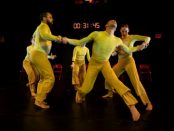
Co-presented by The Theater at the 14th Street Y, '…it’s time…" explored the dynamics of a small group of five—excellent—performers whose existence appeared to be controlled by a large digital countdown clock that frowned down upon them from the back wall. They were all dressed in tight outfits in shades of yellow, uniforms designed by Mondo Morales.To a stark, ingenious percussive score by Dani Markham, co-arranged and played brilliantly by drummer Price McGuffey situated high above the stage in his own cubbyhole, the dancers meandered onto a stage occupied only by five red folding chairs in a neat row. The score ranged from clicks to drum rolls to bossa nova rhythms. [more]
Ballet Festival 2019: Program D
The fourth piece, titled “3 with D” was choreographed by Javier de Frutos and was the only performance that included live music. Patrick Gallagher was on piano in front of the stage and Dan Gillespie Sells sang and played guitar center stage, simply and straightforward, making the most of music, which was a compilation of songs by Ivor Novello, George Gershwin, and Cole Porter. Next to Sells were two chairs – something of a “set” compared to the other bare-stage designs. Danced by Watson and Fairchild, it was more of a drama than any of the other pieces. Although there was little linear plot, it was a gay love story. The familiar lyrics of Gershwin’s “The Man I Love” had a different connotation when referring to two men. The two performers were such gorgeous dancers, and very similar body types, so when they moved in synchronistic unison, it created a beautiful effect. [more]
Ballet Festival: Program A
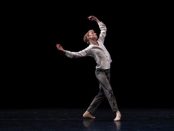
Joseph Sissens in Sir Frederick Ashton’s “Dance of the Blessed Spirits,” in The Joyce Theater’s Ballet Festival (Program A) (Photo credit: Maria Baranova)The Joyce Theater is presenting a two-week Ballet Festival, four programs under the artistic direction of Kevin O’Hare, director of The Royal Ballet. Each program is curated by a different dance expert, the first by O’Hare, himself.Program A was divided into two parts, the first the more sedately classical, the second showing newer, more contemporary fare. It was a fascinating, focused study of the state of ballet today, featuring, appropriately, two works by the British master of classical ballet, Sir Frederick Ashton. [more]
Not Even the Good Things
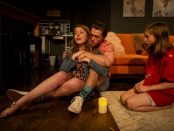
If ever a play needed a talkback afterwards, Joseph Scott Ford’s bewildering, grating and slight "Not Even the Good Things" does. By the end of its gobsmacking 75 minutes, the eerie ever-present appearance of a bedraggled little girl in a red T-shirt who interacts with a single character is never explained. Is she a ghost? A symbolic apparition? Or a figment of his depressed imagination? This is never conclusively answered. [more]
Open
Skillman unfolds an achingly beautiful story, dropping bits and pieces of Kristen’s thoughts and memories as she balances her tightrope of love, commitment, sacrifice and transformation. Hill’s performance as Kristen is funny, honest, compelling and heartbreaking; one cannot take their eyes off her, and it’s not because she is the sole occupant of the stage. [more]
Brief Chronicle, Books 6-8
“It’s best when each performer is older, or younger, or of a different gender- expression, ethnicity, or ability than you might expect. This keeps the play vibrating in your imagination” are from Borinsky’s stage directions. For this production we get a youthful cast playing roles opposite their presumed genders with skillful exaggeration. [more]
Paul Swan Is Dead and Gone
Claire Kiechel’s "Paul Swan Is Dead and Gone" (directed by Steve Cosson) gives audiences a glimpse of the last stand of the author’s great grand-uncle, a dancer-actor-painter-sculptor who was once proclaimed “The Most Beautiful Man in the World.” Tony Torn gives a brave and memorable turn as Swan (1883-1972) in an immersive-ish production at Torn Page, a studio, salon and classroom in what was once the Manhattan home of Torn’s celebrated actor parents, Rip Torn and Geraldine Page. [more]
Be More Chill on Broadway
"Be More Chill," the dazzling and inventive musical based on the cult Young Adult novel by Ned Vizzini, has made a successful transfer to Broadway Lyceum Theater with the same cast and an expanded production team after a tryout production at Two Rivers Theater in Red Bank, New Jersey in 2014, and a YouTube soundtrack that has had over 150,000,000 hits which led to an Off Broadway production at the Pershing Square Signature Theatre Center during the summer of 2018. If memory serves after ten months, in some ways the show is strong and in other ways weaker. Bobby Frederick Tilley II’s costumes are more colorful, while Charlie Rosen’s orchestrations seem to be less so. On the plus side the performances of Will Roland as Jeremy, Jason Tam as the Squip, Tiffany Mann as Jenna and Lauren Marcus as Brooke have deepened. The show seems less comfortable at the Lyceum Theatre than it was at the Irene Diamond Stage but a good many more fans can now get to see the show at each performance. [more]
All Our Children
“These are difficult times, a character observes in playwright Stephen Unwin's engrossing historical drama, "All Our Children," that crackles with tension. Nazi Germany’s forced euthanasia program for the mentally and physically impaired is the play’s searing concern. In a concise 90-minutes Mr. Unwin’s masterful writing expertly blends exposition, documentary detail and drama in this American premiere seen in London in 2017. [more]
June Is the First Fall
The personable Alton Alburo as Don manages to make this underdeveloped character compelling with his charming presence. Playing his father David with easygoing humor and poignancy is the outstanding Fenton Li. Stefani Kuo as Jane offers a winning portrait of familial sturdiness with her solid performance. Scott is vividly brought to life by Karsten Otto with his engaging blend of goofiness and soulfulness. Mr. Otto brings much depth to his scenes with Mr. Alburo regarding Don’s feelings for him. Speaking mostly in Chinese and existing as a domineering vision, Chun Cho does achieve a pleasing distinctiveness in the difficult role of Yu Qin. [more]
Shareholder Value
Attea’s point concerns business models that are overly focused on the needs of shareholders, rather than on those of management and employees. But the play is curiously bloodless. Strong plays about the ferocity of capitalism—from Arthur Miller’s "Death of a Salesman" to David Mamet’s "Glengarry Glen Ross"—take interest in the human equation. They focus on the personal anguish that the system can induce. Attea doesn’t delve that deeply here. [more]
Chick Flick the Musical
Suzy Conn’s zesty score is a fusion of her peppy music and well-crafted lyrics. “Quandary” is rhymed with “laundry” and among the 14 bright songs there’s a comical ode to Meryl Streep. Ms. Conn’s upbeat book is an orderly framework charting the everyday predicaments of her plucky stock characters. “I think that the Botox went to your brain!” “What’s next? An evening of Chardonnay and shingles?” are representative of the dialogue’s good-natured wit. The scenario manages to just about sustain its 80 minute length. Conn strives for and achieves a feel-good tone for this escapist escapade. [more]
Be More Chill
"Be More Chill" is an impressive musical version of Ned Vizzini’s cult novel. Not only does it reproduce the plot on stage, it also gives it a high tech look that dramatizes the story where the novel left it to the imagination. Joe Iconis, long thought to be one of the most promising new theater composers, makes good on that promise, and Joe Tracz demonstrates for a second time that he can put difficult material on the stage. While Ryan Rumery’s overly loud sound design will turn off older theatergoers who are not more chill, those in the swing of things will have a memorable evening in the musical theater. [more]
Fruit Trilogy
Her newest work, "Fruit Trilogy," an evening of three one acts, “Pomegranate,” “Avocado” and “Coconut,” has all of the strengths and weaknesses of her previous stage plays which include going on at too great length when the audience has already gotten the point. Directed by Mark Rosenblatt who staged the world premiere at the United Kingdom’s West Yorkshire Playhouse, the play features Kiersey Clemons and Liz Mikel who are frightening in their intensity and realism. Although the three settings are unstated, the fact that both actresses are black suggests that the plays may have been inspired by Ensler’s humanitarian work in Africa. Although it will not be immediately obvious to theatergoers, the plays move from two women enslaved, to a woman traveling to freedom, to finally a woman finding liberation through her own body. [more]
The Gentleman Caller
Every once in a while the exactly right actor is matched with the right role and magic occurs. Such is the case with Juan Francisco Villa as the 34-year-old Tennessee Williams (before he became famous) in Philip Dawkins’ "The Gentleman Caller." Looking exactly like the playwright did at that age and sporting Williams’ well-known Southern accent, Villa is so ebullient, irrepressible and high-spirited that one has the feeling one has met the playwright himself. With perfect timing for Williams’ verbal comeback, many of which are taken from his own letters, quotes and diaries, Villa gives an extraordinarily three-dimensional performance in a role that has been depicted in other recent plays and one-man shows about the author. Some of the credit must go to director Tony Speciale for helping to craft this remarkable portrayal. [more]
Terminus
In the semi-autobiographical "Terminus," part of a seven-play cycle set in the fictional town of Attapulgus, Georgia, playwright Gabriel Jason Dean unleashes this intriguing Southern Gothic setup which touches off a deeply felt personal story about racism in a place that is obviously more real to Dean than imagined. Unfortunately, as it goes along, Dean’s initially captivating ghost story exponentially loses steam, finally grinding to a halt well before Eller’s big, shameful secret is revealed at the play’s not-so-stunning conclusion. [more]
Platonov, or A Play with No Name
Director Jessica Burr’s fast-paced yet thoughtful staging includes over-lapping dialogue, rapid entrances and exits all over the space and striking visual flourishes. Ms. Burr’s tremendous grasp of stagecraft markedly benefits the play’s morose and draggier second half which contrasts with the frothier first part. The performances are uniformly delightful. [more]