News Ticker
- December 14, 2025 in Broadway // Oedipus
- December 14, 2025 in Interviews // Conversation with Dominick LaRuffa Jr.
- December 14, 2025 in Off-Broadway // The Surgeon and Her Daughters
- December 14, 2025 in Features // Notes Toward a One-Man Play About Scammers, Character, and Control
- December 14, 2025 in Features // A Seasonal Salon Worth Noting
- December 13, 2025 in Off-Broadway // BUM BUM (or, this farce has Autism)
- December 12, 2025 in Musicals // The Faggots and Their Friends Between Revolutions
- December 12, 2025 in Cabaret // Mary Foster Conklin — Mirrors Revisited (50th Anniversary)
- December 11, 2025 in Cabaret // Kathy Kaefer — Kiss Me Once: Stories from the Homefront
- December 11, 2025 in Off-Broadway // The American Soldier
- December 9, 2025 in Off-Broadway // This World of Tomorrow
- December 9, 2025 in Cabaret // A Noel Coward Celebration — Steve Ross & Friends
- December 7, 2025 in Off-Broadway // Diversion
- December 5, 2025 in Off-Broadway // Meet the Cartozians
- December 5, 2025 in Features // Tom Stoppard: An Appreciation
Archive
The best reason to see Isobel Mahon’s "Party Face" is to see the ever-lovely Hayley Mills who used to play mischievous teens and now is playing busy-body mothers. The play is diverting though it has nothing new to say about women and their contemporary roles. Under Amanda Bearse’s direction, the play also gives Klea Blackhurst another off-beat comic role in which she shines.
[more]
Classic movies such as "It’s a Wonderful Life," "Miracle on 34th Street" and "Moonstruck" are citied in the play and author June Daniel White is clearly inspired by and seeks to emulate them in this fable. Those films resonate due to their appealing characters and well-crafted scenarios. "Delta in the Sky with Diamonds or Maybe Not"’s rambling plot is too ambitious as a stage play.
[more]
This comedy/drama/fitful musical also suffers from major tonal challenges, as it strains to push all of our emotional buttons. It’s a shame, because the cast gives it their all. Particularly good is Zoe Wilson, as Leni, a severely depressed teenager whose body dysmorphia has led to self-cutting and bouts of suicidal ideation. Wilson is just the right mix of pained and angry. Whenever she speaks, or sings, The Pill feels centered and we’re ready to delve deeper into Leni’s personal struggles.
[more]
The first work on the program was “Indomitable Waltz” (2016) choreographed by Aszure Barton to dark hued music by the Balanescu Quartet and Nils Frahm. Barton achieved a graceful, yet dramatic flow for these dancers dressed in Fritz Masten’s black and grey costumes. Barton knows how to spread her dancers about the stage like a single organism continually splitting apart and coming together again. They danced warily about each other, performed leans and sensual embraces that faded as the dancers melted to the floor. The work ended on a contemplative note as Dunia Acosta moved with careful steps and twisting hips, in a journey across the stage. Although the emotions of “Indomitable Waltz” ranged from dark to sensual to giddily physical, it ended up as a head scratcher, beautifully performed by the Malpaso dancers. The intriguingly moody lighting was by Nicole Pearce.
[more]
Though there’s a major surprise lurking at the top of the second act, and though it’s about how sins of the past can impinge on the present, Scott Organ’s "The Thing with Feathers" is ultimately a play without many virtues. Early references to Emily Dickinson and poetry--the title apparently comes from a bastardization of a Dickinson poem--fail to lift the work out of the made-for-TV movie-of-the-week sensibility that keeps bringing it down.
[more]
“I never met a peanut butter junkie” is one of the many sharp zingers in Fran Handman’s romantic park bench meetup, "A New York Encounter" (directed by Elowyn Castle) between an older man and woman. It’s in the well-trod, zany territory of Murray Schisgal, Elaine May and Herb Gardner, and it’s well-trod again here. The red-haired and vivacious Marie Wallace and the quirky James Nugent are priceless.
[more]
Playwrights Kevin Armento and Bryony Lavery take the well-known facts that have been explored in documentaries and in the feature film "Battle of the Sexes" and shovel on a cascade of imagined sub plots, heavy-handed theatrical techniques and sociological trimmings. The opening voice-over prologue is a wry pseudo-scientific lecture about men and woman. This narrator sounds like Jane Lynch at her most sarcastic and it’s supposed to be funny but falls flat. The strident tone of the show is set.
[more]
The problem with Laura Braza’s production is the lack of chemistry between Vasile Flutur’s Jericho and Hannah Sloat’s Julie. While Jericho should be charming and seductive, Flutur is only sinister and arrogant. Sloat is convincing at the innocent young girl routine but less so as the self-sacrificing woman in love where she comes off as rather bland. Just as McDonald walked off with the honors as Julie’s friend Carrie in the last Broadway revival of "Carousel," Ginna M. Doyle is most believable as the friend here called Mary (Marie in Molnár’s version.) Vivacious and sparkling, Doyle lights up the stage every time she appears as a woman in love with an ambitious but conventional doorman who climbs the ladder of success. So too Jack Sochet as Jericho’s criminal friend, here called Tynk, devious to his last breath and as wily as a coyote, appears to be living inside of his character.
[more]
Whether bantering with the audience, displaying energetic dance moves, reciting factual details or performing Bobby Darin’s signature songs, the boyish Groff was sensational. “Splish Splash,” “Mack The Knife” and “If I Were a Carpenter” were all given galvanizing renditions. There was his soaring treatment of the emotional “Once in a Lifetime” near the end of the show.
[more]
And that’s essentially the problem with "A Kind Shot." Clocking in at 75 minutes, the “performance” feels more like a motivational speech than a theatrical event. It’s well-meaning and well-told, but other than the charismatic Mateer, there isn’t much else to it. The set, a masking tape outline of a shrunken basketball key, accomplishes so little visually that it begs the question, “Why bother at all?” Mateer completes the obvious motif with a flower-emblazoned basketball, which she dribbles around a bit and bangs off the wall as if she’s making shots. I’m all for audience imagination, but, come on, just hang up a basketball hoop.
[more]
Soviet born actor Ilia Volok is quite personable and definitely commands the stage; his performance is heroic but it is so intense and his accent is often intrusive. Comical and sensitive portions are overshadowed by the perpetual ranting. It’s 70 minutes of an actor’s bravura performance as he plays a character mentally unravelling and the plot gets sidetracked. There’s a lot of histrionics that don’t pay off.
[more]
The main event, however, is the performance of Harris who doesn’t just imitate Baker but uses her own gifts to illuminate the multitalented cult figure. It’s as if Baker has brought out the best in Harris and she returns the favor with her vivid singing, unabashed dancing and direct connection with the audience. The songs include well-known ditties like “I’m Just Wild About Harry,” “Ain’t Misbehavin’,” “Blue Skies,” a particularly moving “And Then I’ll Be Happy,” “Minnie, the Moocher,” the Civil Rights anthem “Strange Fruit,” “The Times They Are A-changing,” and a heartbreaking “La Vie en Rose.”
[more]
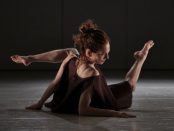
“NEW BODIES” (2016) choreographed by Melnick was initiated by Sara Mearns in a summer workshop at Jacob’s Pillow Dance Festival. Skilled classical ballet dancers who were interested in expanding their understanding of movement beyond the strict formalities of ballet choreography joined Mearns and Melnick to experiment with just how movements emerge into choreography. The result is not an earth-shattering rethinking of the art of dance, but a loose web of crossing paths where touching and light partnering follow from soft collisions.
[more]
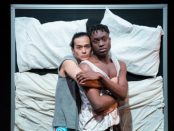
Kyoung H. Park's "Pillowtalk" mixes the mysteries of passionate, but flawed, love with the realities of racism in today’s society, specifically, Brooklyn, New York, where Sam (Basit Shittu), a hunky African American and former Olympic swimmer is married to Buck (JP Moraga), a sleek Asian American journalist. Both are in a constant battle with the White-dominated society which constantly undermines the lives of people of color. Park’s direction of his play is straightforward and “in your face” giving this rarely seen corner of society some needed exposure.
[more]
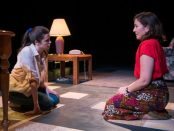
Murky, glacial and hypnotic, "Sheila" is a dreamy reunion drama among two 28-year-old women who haven’t seen each other in 10 years. It recalls the sort of off-beat female-centric play director Robert Altman might have staged in the 1980’s and then filmed. The script is collaboratively written by members of The Associates, the theater company who is presenting it. It comes across as a collaboration with a feminist slant rather than an organic play. Still, its 70 minutes have an enigmatic appeal.
[more]
Ms. Orlandersmith skillfully organizes the material into short monologues that are revelatory, insightful and often tinged with humor. Visually striking with her animated facial features and flowing dreadlocks, Orlandersmith subtly yet forcefully offers a series of rich characterizations. Varying her vocal inflections and altering her physiognomy she conveys the essence of each individual. It’s a riveting performance of range and depth.
[more]
John Haidar’s energized production turns this material into a tour de force for Campbell and Lynch who are continually moving about spewing volumes of words, almost choreographed by movement director Naomi Said. Deeply in character, they seem to be living their adventures which include humor, fantasy and violence. However, American audiences will have difficulty with the thick Cork accents and Irish slang, as well as Pig and Runt’s private language which often resembles baby talk when it doesn’t sound like street poetry.
[more]
Dull, smug and interminable," The Undertaking" is a multimedia play written by Steve Cosson that explores the meaning of death. Jean Cocteau, Marcel Duchamp and Greek mythology are trotted out during this 80-minute hodgepodge. Mr. Cosson is also the director and his physical staging ranges from sedate to overdrive, with the actors incited to be manic. The ending, however, does have an affirmative simplicity.
[more]
But in John Lithgow: Stories by Heart, Lithgow tells an even more compelling tale about growing up with his father Arthur Lithgow, an actor who taught Shakespeare even as he opened and ran Shakespeare festivals throughout the Midwest. Lithgow’s peripatetic experience with this show is not unlike, in other words, his father’s experiences when his son John was growing up. Though it’s truly sui generis, "Stories by Heart" is reminiscent of Lynn Redgrave’s tribute to her father, Sir Michael.
[more]
With the support of film director, screenwriter and playwright Neil LaBute, the St. Louis Actors’ Studio has held an annual festival of one-act plays since 2013. This is the third year that the festival has been presented at 59E59 Theaters in New York City, and it’s a very enjoyable program.
[more]
Another irony is that while Fury is kind of a bore, another character is not. Yeah, you guessed it. Him. When the president (David O. Friedman) appears in Fury’s bedroom like the Ghost of Christmas Present, Attea’s writing finally comes to life. His take on you-know-who isn’t unique, but the situation is wonderfully silly, and Friedman’s impression is a funny profile in petulance.
[more]
Yazbek’s songs—ranging from the darkly comic “Welcome to Nowhere” (sung by the town folk) to Dina’s romantically tinged “Omar Sharif” and ending with the upbeat, danceable “Concert” played as a finale by the Band—rise magically from the dialogue, just as Patrick McCollum’s choreography emerges naturally from walking, singing and thinking.
[more]
Playwright Robert O’Hara’s fertile premise might have made for a provocative, sober sci-fi take on gender roles, sexuality and parenthood. Instead, it’s broadly conceived and lame. The flat dialogue is in the vein of Abbott and Costello with numerous jokes about “fathers” since there are no mothers. The “Dude, I’m pregnant” bit gets painfully recycled.
[more]
The famous Chinese ability to subsume themselves in crowds was evident in the flowing choreography for the mass “flight” of the Ibis across the stage. The precision of the corps de ballet did not, however, lessen regarding each dancer as an individual as they flew past in ever-changing patterns. The creators of "Ibis" also gave life to the inhabitants of the small town and the young modern urbanites who show up at a museum to learn about the birds with which they had peacefully co-existed.
[more]
Shaw employs the gruff cadences of George C. Scott and Weaver has the calm and measured tone of Peter Sellers and both are thoroughly delightful. Their tremendous rapport is most evident in the phone scene from the film between the U.S. president and the Soviet leader: “How do you think I feel?”
[more]
Washington, D.C.’s acclaimed Happenstance Theater is making is New York debut with its 2015 show "BrouHaHa," which has been seen previously in Baltimore, Maine and New Haven. Taking for its theme what would you do if the world were about to end, this “clownesque escapade collaboratively devised and performed by the ensemble” follows the company of six through a series of skits and journeys almost all of which lead to death but from which the actors bounce back. While the company members are extremely talented, the material lacks impact and structure and cries out for both a playwright and a director. Although intended to be comic, there are no laughs in this show though it may provoke smiles.
[more]
Along with some contemporary updating which always gets a laugh, Albert Bergeret’s direction is sharp and shrewd and his conducting of Sullivan’s sprightly and animated score is equally assured as well. The diction is crystal clear, a must for Gilbert’s intricate and clever lyrics. With an attractive and realistic setting by Albère and pleasingly color-coordinated costumes in blue, white and red (the colors of the Union Jack) by Gail J. Wofford, this is a delectable and entertaining revival for both those familiar with it and others discovering its pleasures for the first time.
[more]
The set for the opera was itself a living, organic phenomenon; it functioned as an additional character in the opera. IONE sat near the moveable stage-flats; her back was to the audience, yet she was one of us. Hovering above the stage set were great canvas triangles – mildly billowed faluka sails – on which IONE projected Victorian and Edwardian era images of the British Empire in all its beauty and its ugliness. Priestess and manager, oracle and medium, IONE was at once a participant in the visual commentaries on Kitchener’s internal dramas and their director.
[more]
Chen Yi’s music is, in the best possible sense, powerful: it affirms. Musicians and audience alike, at the end of each piece, are strengthened in the continuing determination to do one’s best. The evening’s concluding work, "Sparkle" (1992), a rugged, intricately disciplined wildness of both melody and rhythm, felt like an exposition of new ways of putting sounds together to create music, an immersion in how layering and linearity can coexist. The work’s sudden end – too soon and, simultaneously, at the only possible right moment – was gorgeously big and exciting
[more]
As "Rock of Ages" did for the 1980’s, "Cruel Intentions: The Musical" does for the 1990’s. This is a carefree entertainment accompanied by the revelry incited by a two-item minimum in a nightclub. For many audience members, the Proustian pleasure of experiencing songs that they fondly recall shoehorned into the plot from a minor movie they might remember will suffice. It’s decidedly not an event for musical theater connoisseurs.
[more]
The Tallis Scholars’ most recent turn in the Columbia University Miller Theatre Early Music Series was billed as “Heinrich Isaac at 500.” This concert title wasn’t quite accurate: the evening was a more like a bouquet of music by Isaac (c.1450-1517) and three contemporaries, Josquin des Prez (c. 1450-1521), Nicolas Gombert (c. 1495-1560) and John Browne (1453-c. 1500). – What a fabulous bouquet it was!
[more]
Fairchild speaks well and communicates much with his physique, but his choreography is repetitive and uninventive. Here was a chance to breathe new life into a too familiar character. All Fairchild could come up with is lurching movements and awkward falls to the floor. He takes the obvious path to create his character with movement when he had a chance to illuminate the Monster’s inner emotions.
[more]
Cohen then spoke; he presented the four-movement structure of the piece about to be performed. Although various passages in "Voyagers" evoked the diversity of music offerings on the Golden Record, highlighting “both the fragility and the power of human artistic expression,” the fairly traditionally structured piece was inspired by three main Golden Record offerings – what Cohen referred to as “source material” – a late Beethoven quartet, an Indian Raga and a Renaissance dance. "Voyagers"’ four movements are entitled Cavatina, Bhairavi, Galliard, and Beyond the Heliosphere.
[more]
«
1
…
65
66
67
68
69
…
114
»
Copyright Jack Quinn, 2001-2023