News Ticker
- December 14, 2025 in Broadway // Oedipus
- December 14, 2025 in Interviews // Conversation with Dominick LaRuffa Jr.
- December 14, 2025 in Off-Broadway // The Surgeon and Her Daughters
- December 14, 2025 in Features // Notes Toward a One-Man Play About Scammers, Character, and Control
- December 14, 2025 in Features // A Seasonal Salon Worth Noting
- December 13, 2025 in Off-Broadway // BUM BUM (or, this farce has Autism)
- December 12, 2025 in Musicals // The Faggots and Their Friends Between Revolutions
- December 12, 2025 in Cabaret // Mary Foster Conklin — Mirrors Revisited (50th Anniversary)
- December 11, 2025 in Cabaret // Kathy Kaefer — Kiss Me Once: Stories from the Homefront
- December 11, 2025 in Off-Broadway // The American Soldier
- December 9, 2025 in Off-Broadway // This World of Tomorrow
- December 9, 2025 in Cabaret // A Noel Coward Celebration — Steve Ross & Friends
- December 7, 2025 in Off-Broadway // Diversion
- December 5, 2025 in Off-Broadway // Meet the Cartozians
- December 5, 2025 in Features // Tom Stoppard: An Appreciation
Archive

"Admissions" is often very funny like when Sherri has to try to explain why Melville’s Moby Dick is not being taught anymore (a book about a white whale by a dead white guy) and when Charlie is annoyed that girls in his class object to reading Willa Cather, a woman and a lesbian rather than a person of color. Although the play is intended to be unsettling to white liberals, it is too neat in its setup. It would have to be Sherri who has spent 15 years creating diversity at Hillcrest whose son may be affected by affirmative action and Charlie and Perry who have been best friends almost all their lives should be divided by Yale’s admission choices. Perry’s picture in the admissions catalogue is rejected as he photographs white and does not look like a person of color, but to find a group shot demonstrating diversity it ends up having to be staged. And Charlie’s 180 degree change of heart plunges his parents into a great dilemma: do they use their personal contacts to see what can be done, something Sherri and Bill have not been averse to in the admissions office at Hillcrest for others.
[more]
"Education," Brian Dykstra’s new play, is an incendiary investigation into censorship, free speech and responsibility in electric theater. It purports to be about Art as a Weapon but its themes go much further than that. The protagonist Mick, a biracial 17-year-old high school senior, has a rant that lists all the things wrong with American society at this time which is simply scorching. All high school students should be so articulate. In the astute hands of director Margarett Perry, the play moves like greased lightning. You may be dizzy from the provocative ideas but you will not be bored.
[more]
After the four musicians connected by eye contact to exactly synchronize their ‘phones, the piece began; sound emanated entirely slowly – it seemed like almost a minute before a steady something audible materialized from the steel sheet. The extent to which it might be considered ‘music’ remained unclear until the sound was joined, initially almost equally imperceptibly, by definitively musical synthesizer notes. Within the context of steady sound, passages of shifting intensity -- ranging from pianissimo to mezzo forte, never louder – rose and fell in discrete, discernible rhythms. Over the course of the piece, the musicians at each corner took turns playing music; only occasionally did two musicians play at once, producing instrument overlaps of embrace, enhancement, mutual revelation and then separation. Mostly, however, the musicians floated their musical energies in each other’s directions like invisible shimmers through the audience’s fairly settled quiet.
[more]
Noted theater artist John Jesurun wrote the opening sequence. From 2014 to 2017, Mr. Jesurun engaged in a collaboration with Japanese playwright and director Takeshi Kawamura. They each wrote alternating 10-minute sections with Aya Ogawa translating the Japanese portions into English. This technique is an homage to the Japanese poetical form renga where different authors contribute to a poem.
[more]
“We'll Take a Glass Together” is an exhilarating production number. Brandon Uranowitz’s animated youthfulness is up to the task of equaling the impact of Michael Jeter’s legendary turn in the original production as the dying bookkeeper enjoying a carefree spree. Mr. Uranowitz’s limber movements are thrilling as he euphorically undulates up and down flanked by a large gold dance barre carried by the terrific ensemble.
[more]
Baker’s lines are spiky and colorful, often dark, sometimes banal, but his portrait of these two and the two lesser characters is always illuminating and full of real emotion. The fade-out, a quiet revelatory moment, is simply lovely—and sad.
[more]
Any further comparisons with the Broadway musical "Come From Away" end with the Nova Scotia setting as Chaim and Chaya quickly settle in Montreal where the 19-year-old Chaim marries the 24-year-old Chaya, who lost her husband on the trek from Romania to Russia to escape the pogroms. (Her husband died of typhus, which becomes a recurring theme in the story that unfolds.) To be sure, their tales are “dark” ones, as put together in the play by an apparent descendent Hannah Moscovitch of the real Chaim and Chaya.
[more]
The lithe and silvery-haired Ms. Gilbert dazzles for 90 minutes as she addresses the audience directly with her warm and joyous presence. She tells jokes, sings, and dances, all while conveying pathos. In addition to her vivid primary characterization, she portrays 16 other characters of various ages and nationalities with a commanding assortment of dialects and physical traits.
[more]
Bruce Norris’ plays are so different from each other that you have to take his fingerprints to recognize his hand. His recent New York plays have dealt with racism and gentrification ("Clybourne Park"), politics ("Domesticated"), sexual mores ("The Qualms"), theories of time and space (A Parallelogram), and now in his latest production to reach NYC, "The Low Road" at The Public Theater, he offers a fascinating take on capitalism and the free market told as a picaresque and ribald 18th century tale of colonial America on the brink of statehood. Of course, its real target is today’s untenable global economic situation but his criticism is couched as an historical parable.
[more]
In an “Author’s Note” to his play "Later Life," A.R. Gurney explains that it was inspired by "The Beast in the Jungle," a famous novella by Henry James, about a man who leads a “guarded” life. The sweet but slight resulting play is now in revival by the Keen Company, in a production that does nothing to elevate the play above its overly modest ambitions.
[more]
It would be a pleasure to say that Musicals Tonight! is going out on a high but that would not be accurate. While the book by Ronald Hanmer and Phil Park based on the play by Charles K. Freeman is very old-fashioned and the original score by Sammy Fain and Paul Francis Webster is quite derivative, the real problem is with the production staged by Devin Vogel making his Off Broadway directing debut. While the Wild West material suggests color and ambiance, this "Calamity Jane" is devoid of those things.
[more]
Mr. Graber’s trite scenario is rendered as a superficial by-the-numbers treatment and the presentation is overwrought. Near the end there is an exchange between Jim and Gavin as they sit on stools during an awkward party. The writing and acting are intense and coupled with the simplicity of the situation, the reaction is, “Ah! THIS is the play!” Unfortunately, it’s only a tantalizing respite from the hollow machinations that have come before and the inevitable strobe-light and roaring finale.
[more]
On the basis of “Is God Is,” Aleshea Harris is a new voice in the American theater whose work bears watching in the future. The play is the latest in a long line of revenge stories from the Bible to Quentin Tarantino. The nagging question becomes does Harris have an underlying theme other than the righting of past wrongs by violence. However, Magar’s riveting production never gives the viewer a chance to ponder on this dilemma while the tightly written drama is unfolding before you. While the play has a dark humor throughout, in a parody of the famous Louis Jordan song, it seems to ask the question, “Is God is or is God ain’t?” After witnessing the retribution of the sisters, only the viewer can decide for him or herself.
[more]
The trouble is that there is nothing new or daring or particularly interesting about the play despite its intriguing subject matter. It is an old-fashioned play—think warmed over Clifford Odets with a touch of Chekhov and more than a few hints of Greek hubris—that deals with the treatment of Pakistani-British Muslims in Great Britain, specifically West London, 2011. It is full of clichéd writing including having characters appear just as their name is brought up.
[more]
Dan Hodge commandingly plays the American narrator who has written a book about his youthful experiences in Rwanda during its 1994 civil war and genocide. Mr. Hodge created the role in the 2017 Philadelphia production of the play. The boyish yet mature, and personable Hodge perfectly portrays this young man traumatized by witnessing atrocities. His All-American presence, good looks and charisma energize the grim and familiar material. He enters through the theater and addresses the audience throughout with charm.
[more]
Casting of Brewer (best known for her several roles on "American Horror Story"), an individual with Down syndrome, is a real coup as she doesn’t have to be inventing a role she knows intimately. Her feistiness, timing and personality make Amy a three dimensional character from the time we first meet her. (A program note tells us that her understudy is another individual with Down syndrome, Edward Barbanell and when he plays the part the play is known as "Andy and the Orphans" in a rewritten version.) Another note reveals that Ferrentino’s heroine is based on her Aunt Amy who grew up with Down syndrome when the medical community had no idea how to deal with it except to institutionalize such people rather than to give them training and support. The play is a fitting tribute to Ferrentino’s aunt who the playwright never got to know as much as she would have liked.
[more]
Except for the frustration level of the characters, there does not seem to be a movement towards change or catharsis which may partly explain why the play seems so long. Harris and Madigan retain their cool as therapists throughout until almost the end when they can’t hold in their emotions any more. The most dramatic story is that of 12-year-old Frannie beautifully and realistically played by young Rileigh McDonald. However, as written the role of her foster mother played by Rhea Perlman is a one-note tale and doesn’t give her much wiggle room to make it her own.
[more]
Just in time for Easter, TACT/The Actors Company Theatre has adapted and combined two Christmas-themed Damon Runyon short stories into the seasonally inappropriate, but nonetheless very charming, "Three Wise Guys." Gleefully peppered with Runyon’s distinctive demi-monde argot, or Runyonese, the comedic play depicts a Prohibition-era New York of principled crooks and hustlers who, in true Runyon style, end up having hearts much bigger than their ill-gotten bankrolls, which, of course, doesn’t mean they’re ready to commit to their matrimonially frustrated gal pals. Like another Runyon adaptation about some guys and dolls, the sparsely musical "Three Wise Guys" fancifully speaks to the, perhaps not so unreasonable, belief that those on the make are much more trustworthy than the ones who’ve already made it.
[more]
One sits there for two hours numbed by the experience of watching the talented cast often vigorously playing for laughs that aren’t there. They are Rand Guerrero, Ralph Guzzo, William Laney, Chris McFarland, Hannah Jane McMurray, Sarah O’Sullivan, Tom Paolino and Gameela Wright.
[more]
Hilariously impersonating Marlene Dietrich while playing an accordion, singing and trotting about, is one of the grand highlights of performer Phoebe Legere’s "Speed Queen." Spanning from W.W. I to the present, it’s a madcap lesbian historical and musical fantasia about Joe Carstairs, for which Legere has written the book and original score.
[more]
"Jerry Springer - The Opera" is not for opera purists nor is for people who are easily offended by four letter words and other bad language of which there is a multitude. However, its irreverence skewers social, religious and political hypocrisy. The New Group’s production directed by John Rando is one of the most exciting musical theater experiences to be currently obtained in New York. It actually seems more relevant in Trump America where this sort of thing is cable-fodder every night of the week. If you are a dedicated theatergoer, miss this show if you dare.
[more]
"Subway Story (A Shooting" is the fifth and final installment of William Electric Black’s Gunplay Series, a sequence of plays “dedicated to all who have lost their lives to the senseless gun violence plague.” In this concluding chapter, ongoing gun violence, particularly its link to urban youths, is the prevailing theme. Black is a seven-time Emmy award-winning writer. His work often broaches societal-conscious issues.
[more]
Despite some terrific acting, it’s hard to root for any of the four characters in Kings, even if the play is one long competition between all of them. This smart new work by Sarah Burgess ("Dry Powder") fails to introduce little that’s new about the present state of politicians and lobbyists--and their overly intimate relationships. But it’s also been put together with an admirable efficiency that spells it out clearly for those members of the audience who haven’t been paying enough attention to the daily headlines and all they entail.
[more]
Originally titled "A Test Case" when the play had its premiere in New York in 1892, it is one of Daly’s many adaptations of European successes, this one based on a German comedy of Blumenthal and Kadelburg. While "A Marriage Contract" is a charming evening and has much satire that is still relevant, its genre is that of drawing room comedy. While stylish and graceful, Alex Roe’s production is much too broad to be entirely successful. Several of the actors give over-the-top characterizations of recognizable types which somewhat unbalances the play. In the manner of the popular form of 19th century popular theater, the play is a bit too long for its content and could use a bit of trimming. Nevertheless, the production is entertaining though many of the surprises are telegraphed long in advance of their revelations on stage.
[more]
Esperance Theater Company’s artistic director Ryan Quinn directed the production. Mr. Quinn’s inventive staging is vigorous and aesthetic yielding in visually charged sequences that energize the uneven writing. Watching the Super Bowl becomes a frenetic production number.
[more]
All the good jokes get lost in the onslaught of cast members vying for their moments and looking for the audience’s approval, which admittedly was offered freely. "Bitches" becomes chaotic, crude and in your face, not to mention clichéd, the clichés hiding behind dirty jokes and blatant shtick. Raine clearly can’t rein in the cast’s enthusiasm even though they are portraying animals with animal passions.
[more]
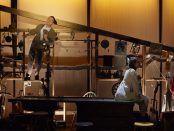
They’re friends in the present. Someone picks up yellowed newspaper articles from the past. Then we’re in New York City’s Lower East Side in 1911. We meet the spunky 13-year-old Roselia. She is the daughter of immigrants and her goal is to become a muckraking journalist. An exposé of the local butcher was one of her scoops that have been published. Her older sister is to marry a genial young man. Her parents are very affectionate but due to their hardscrabble circumstances it’s decided that after her impending 14th birthday, Roselia will leave school to join her mother and sister in working in a garment factory to bring in more money to the family. This heartbreaking thread is the most substantive, affective and dramatic of the three tales. The girlish and luminous Lena Hudson makes a great impact as Roselia. Kate Loprest’s practical but maternal characterization of the mother is perfect. “The House on Ludlow Street” is a haunting song that is woven through the narrative.
[more]
Of the twelve soloists, several were outstanding. Tenor Scott Mello’s "Nigra Sum" was a virtuosic, romantically charged reveling in sensuality. The soprano duet, "Pulchra Es," with Molly Quinn and Melanie Russell, though it began a little shakily, finished well: as the two women’s voices came together in extremely difficult passages, the modernity of Monteverdi’s “secunda prattica,” or “newer style,” shone.
[more]
Jordan Harrison’s "The Amateurs" is certainly an ambitious new play acted to the hilt by its cast of six. However, at times it bites off more than it can handle, at other times its anachronisms tear at the fabric of its story, and finally it goes out of its way to draw connections that the audience has already made. The play may need a stronger director than Oliver Butler has proved to be to pull this unwieldy drama into more satisfactory shape.
[more]
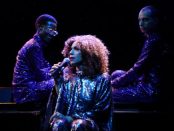
Thus begins the unique show, "Black Light," which is a concert cum confessional. In her sequenced gowns--and there are five costume changes during the 90-minute performance--and with her red lipstick and frizzy, frazzled, dark hair, Jones sometimes provides a strong, alto voice for her intermittent songs, ranging from ballads (“Crossroads”) to hard rock (“Life is motion”).
[more]
"Candide"’s giddy overture was of course the euphoric opening number of the 92nd Street Y’s Lyrics & Lyricists Series: "Lenny’s Lyricists." This was a splendid concert celebrating Leonard Bernstein’s centennial by spotlighting his collaborators. The novelty here was that we watched footage of a close up of the hands of pianist Ray Wong as he superbly played via video projected onto a large screen as artistic director Rob Fisher turned the score’s pages.
[more]
"Subways Are for Sleeping" is a valentine to New York and projection designer Lacey Erb has created atmospheric slides and streaming video of such iconic locations as Grand Central Station, Park Avenue, Rockefeller Center and the Metropolitan Museum of Art. Unfortunately, the original problem with the material has not been solved: Tom and Angie are just not very interesting. They have little or no back story and no outstanding characteristics. As was famously true in the original production, the show is stolen by the secondary leads. With their continually inventive schemes to get through each day, slacker Charlie who lives off his former friends and would-be nightclub performer Martha with her Southern accent are a total delight. Unfortunately, they are off stage most of the time. The rest of the many characters are simply walk-ons.
[more]
Author Lizzie Vieh’s brilliant play "The Loneliest Number" initially appears to be a slight off-beat comedy about a swinging couple’s encounters but after its first third evolves into a profound, suspenseful and searing exploration of relationships. Ms. Vieh’s dialogue is sharp, filled with well-crafted jokes and painful depth. A wistful description of a children’s Halloween parade with them in their costumes becomes an insightful reverie of desires.
[more]
«
1
…
63
64
65
66
67
…
114
»
Copyright Jack Quinn, 2001-2023