
Joy: A New True Musical
A feel-good musical based on the rags-to-riches success story of Joy Mangano, inventor and entrepreneur.

Betsy Wolfe (center) and the company of “Joy: A New True Musical” at Laura Pels Theatre (Photo credit: Joan Marcus)
Joy: A New True Musical tells the incredible rags-to-riches story of inventor/entrepreneur Joy Mangano. This attempt at a feel good musical written by veteran producer Ken Davenport with pleasant but low-key music and lyrics by AnnMarie Milazzo (who is better known as a Broadway vocal and musical designer and arranger) is rather superficial in its storytelling and has an under-heated score. However, its hard-working cast led by Tony Award nominee Betsy Wolfe as Joy helps put this over despite its flaws. One of the problems with the show is if you have seen the 2015 movie with Jennifer Lawrence as Joy you have a pretty good idea what is coming though neither version sticks to the entire truth of her story.
In the early 1990’s, Long Island housewife and would-be inventor Joy Mangano is hardly making ends meet. On her salary as a TWA customer service ticket agent she is supporting her ex-husband Tony, an unemployed musician living in her basement, her agoraphobic mother Toots divorced from her husband and who spends all day watching television, her philandering father who has also moved into her basement after his latest girlfriend threw him out, and her teenage daughter Christie who resents how little quality time her mother spends with her as well as missing her soccer games. When Joy loses her hated job at La Guardia Airport just before Christmas, she has hit rock bottom.
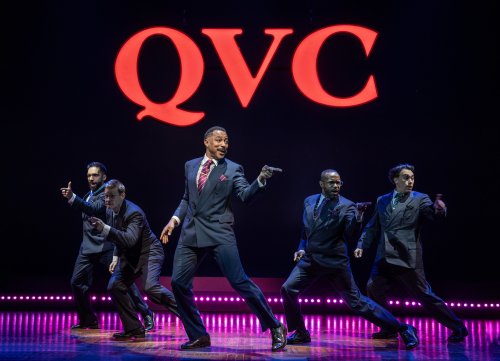
Charl Brown (center) and the company of “Joy: A New True Musical” at Laura Pels Theatre (Photo credit: Joan Marcus)
Then she cuts herself on a mop while cleaning up a wine bottle that crashed to the floor from her kitchen counter and she imagines a new mop that twists so that it can be wrung out without touching it. Also what if you could throw the mop head in the washing machine so that it came out looking good as new without having to replace it? After attempting to sell her prototype in malls and local stores but selling only seven in six weeks, she discovers the new QVC, the home shopping network, headquartered in Pennsylvania. Showing up at their executive office she is at first turned down by the all-male board, but when Ronni, the one woman in the room, assistant to the president, says she would buy three, they decide to give her a chance.
The QVC execs believe that women only buy from men (though Joan Rivers is their biggest seller!). This leads to their male on-air salesman making a terrible flop with the first airing of the new “Miracle Mop.” However, when Joy insists she be allowed to sell her product herself, things begin to change. In the show’s funniest scene, she freezes on air like a deer caught in the headlights but then thaws out in time to just be herself and goes on to make record sales. That is not the end of the story of The Miracle Mop as Act II recounts the lawsuit over her contested patent and leads to her phenomenal career having sold three billion products as of now.
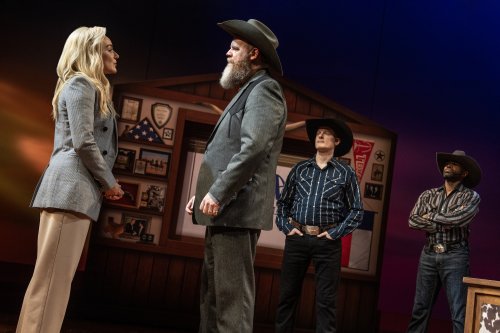
Betsy Wolfe, Paul Whitty and the company of the new musical “Joy: A New True Musical” at Laura Pels Theatre (Photo credit: Joan Marcus)
Under Lorin Latarro’s direction, there is little or no character development in Davenport’s book, with all of the personages remaining the same throughout, and the only thing that propels the show are the surprising events that happen. Joy’s family remains negative and dismissive about her inventing career (while eventually helping out in the marketing) until almost the very end. Davenport fudges the last scene by not telling us how the biased Texas judge ends up ruling in Joy’s favor so that the ending leaves us hanging. When the judge demeans Joy as a one-time inventor, we know that she has one of her clever inventions in her pocket (a reflective dog flea collar) but she never takes it out in her own defense. The songs are more like window dressing than adding much to the show and Milazzo’s generic lyrics tend to be very repetitious and give away their message in their titles. The show might have been more powerful as a straight play without the musical score.
Two songs do morph into exciting production numbers, “Ship It to Your Door,” sung by Texas manufacturer Cowboy Eddie (Paul Whitty) and his cowboy assistants, a television ad seeking future inventors, and “We Sell Stories,” delivered by QVC’s president Dan Hardy (Charl Brown), his male executives and female saleswomen, in which they explain the key to their success. Choreographer Joshua Bergasse’s witty Tony Award nominated dances for Smash and On the Town are nowhere in evidence. The score also includes two powerful solos: Joy’s mother Toots finally receives a song of her own at the end of Act II called “Mother’s Daughter” which gives good advice to Joy and the eleven o’clock number “A Better Way,” Joy’s personal statement to the Texas court certain that she is going to lose her case.
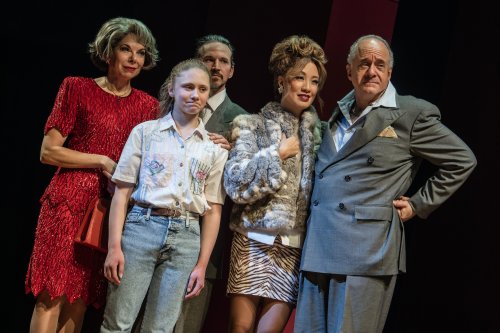
Jill Abramovitz, Honor Blue Savage, Brandon Espinoza, Jaygee Macapugay and Adam Grupper in a scene from the new musical “Joy: A New True Musical” at Laura Pels Theatre (Photo credit: Joan Marcus)
Wolfe as Joy adds another feather to her cap after her acclaimed performances in &Juliet, Waitress, Falsettos, Bullets Over Broadway and The Mystery of Edwin Drood though it is based on her personal magnetism rather than the writing of her character. Her family played by Jill Abramovitz (Toots), Adam Grupper (Rudy), Brandon Espinosa (Tony) and Honor Blue Savage (Christie) give able support in clichéd roles. Jaygee Macapugay as Lorraine, Rudy’s girlfriend who bankrolls Joy’s Miracle Mop, is much more quirky and more interesting, as is Gabriella Carrillo as Ronni, the feminist assistant to the QVC president . Essentially villains, Whitty as Cowboy Eddie, and Brown as Dan, the QVC president, are standard issue impediments to Joy’s rise.
Anna Louizos’ sets are suitable but miss the satiric edge that would have made the 1990’s have their own character which is also a fault of Tina McCartney’s period costumes. David Bengali’s projection and video design add to the show’s verisimilitude, particularly with the show’s television episodes. While Joy Mangano’s rise to fame and fortune is a great American success story what theatergoers may recall most about this show is the audience participation sequence at the end of the first act when actual mops are given out to lucky theatergoers.
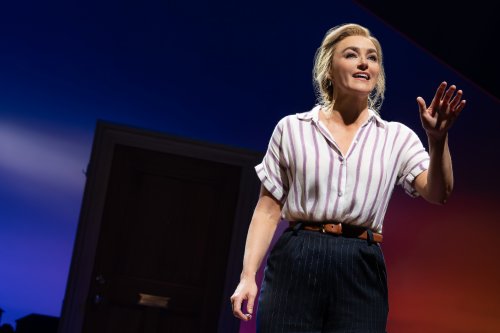
Betsy Wolfe in a scene from the new musical “Joy: A New True Musical” at Laura Pels Theatre (Photo credit: Joan Marcus)
Joy: A New True Musical (through August 17, 2025)
Laura Pels Theatre, Harold and Miriam Steinberg Center for Theatre, 111 W. 46th Street, in Manhattan
For tickets, visit http://www.joythemusical.com
Running time: two hours and five minutes including one intermission


Leave a comment