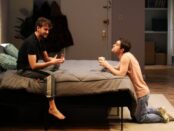
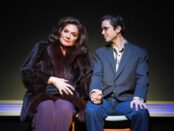
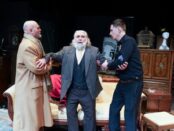
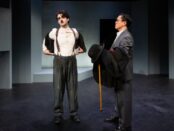
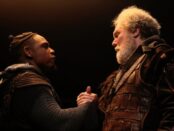
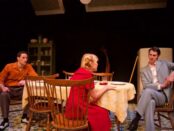
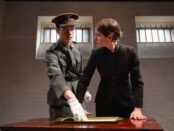
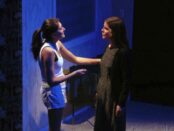
Now premiering at La MaMa’s Ellen Stewart Theatre in a co-production with the MART Foundation and En Garde Arts, "Seagull: True Story" is a barbed, meta-theatrical cri de coeur from creator-director Alexander Molochnikov, with a script by Eli Rarey. Drawing heavily on Molochnikov’s own experiences, the piece is not a retelling of Chekhov but a searing dispatch from the frontlines of artistic exile. It charts not only the cultural deep freeze imposed by Putin’s regime but also turns its gaze, with mordant wit, on the subtler constraints of the American arts ecosystem. The production skewers both overt authoritarianism and the velvet-gloved mechanisms of Western cultural gatekeeping with equal parts satire and sorrow. Bitterly funny and disarmingly candid, the play asks whether escape from tyranny guarantees liberation—or whether a different kind of captivity awaits on this side of the ocean. [more]
Unfortunately, The Fire Weeds’ production directed by Jaclyn Bethany (who appears in both plays) is very uneven. An attempt at expressionism handled differently in each does not work for these Tennessee Williams’ plays. While “The Pretty Trap” eschews props for pantomiming, in “Interior: Panic” lighting designer Zoe Griffith has taken the stage direction “the light is normal” and literally bathed the stage in pink-red light periodically to suggest Blanche’s hallucinations. However, this is both distracting and intrusive. Of course, theatergoers are likely to know the longer more famous versions which are more fleshed out and have pertinent information not in the one act versions. [more]
The show and production is perfect for the chosen venue, a newly opened theater. Director Lori Kee makes excellent use of the intimate space, full of bookshelves that wrap around the room to give a lived-in look that enhances the setting dramatically. Production manager Akash Inti Katakam and prop coordinator Josie Underwood arrange the set so the audience really feels as if they’re casually inside Ruth’s home. The cramped living room, old desk, and well-worn big chair all create the feeling that someone has lived there for decades. Even the books themselves seem carefully chosen to elucidate Ruth’s life and character, from a copy of "The Autobiography of Malcolm X" to tomes on psychology and classical music. [more]
Scenes progress, and it becomes clear that nothing which happens in Dick and Jane’s house makes a whole lot of sense, and that’s absolutely the point of Leverett’s witty, clever, and smart play. Giving a firm nod to the absurdist playwriting genre first popularized in the mid-1950s, "We Do the Same Thing Every Week" imparts the mindless, repetitive, and boring existence of humankind, which no amount of parlor games, huge vacuums (household or existential), duets, tap-dancing Things, or anthropomorphized cats and fish can overturn. [more]
"The United States vs Ulysses" by Colin Murphy is a multi-layered play about a seminal case concerning censorship in publishing. The story is set in 1933 in the studios of the CBS radio show "The March of Time." The radio show reenacted recent news stories, including one about the trial of James Joyce’s then controversial novel "Ulysses," but the tapes of it no longer exist. Murphy imagined what that show may have been like, and it forms the framework of the play. [more]
Timing, as they say, is everything in comedy—and in revolution. In "Fat Cat Killers," playwright Adam Szymkowicz delivers more than just a sharp-edged satire of corporate greed—he peels back the glossy veneer of big business to expose the raw, unsettling truths beneath. The play skewers the systemic exploitation of workers, the yawning chasm between executive privilege and employee precarity, and the emotional toll of soulless labor with biting wit and unflinching clarity. But while it aims its critique squarely at the power structures of late capitalism, it doesn’t let its would-be revolutionaries off the hook. [more]
The play is a nicely developing mystery fantasy story about the paranormal, but when the teenage boy is revealed as the Spirit Child, the show goes off track. The idea presented is that the Spirit Child is the child who would have been born except for the miscarriage. This idea is a stretch in believability for the dramatic structure of the show. It introduces the idea that a consciousness once attached to a developing embryo continues to be attached to the woman who was carrying that embryo even after the tissue has been expelled through a miscarriage. It turns on its head the whole idea of developmental psychology. How is it possible for the miscarried tissue that was not even old enough to definitively determine sex to become a spirit that ages as if it had been born? [more]
"Stranger Things: The First Shadow" concludes with a Netflix joke that, besides being pretty funny, also represents a bit of chest-thumping for the play's outsized number of developers who manage to successfully blur the line between theater and television. Whether that's a good thing is a matter of taste, or a lack of it, but there's no denying that "Stranger Things: The First Shadow," which has journeyed from the West End to Broadway, is exactly the type of experience it wants to be: immersive; scary; and, even if you've never seen an episode of the streaming series from whence it comes, familiar. That's because, imaginatively befitting its source material, the play is a storytelling stew of cultural callbacks that owes a debt--presumably unpaid-- to Stephen King, Wes Craven, and other unsettling shapers of Gen-X childhoods. [more]
At this vantage point 55 years after its premiere, like the Wilson plays which intentionally cover the previous 100 years, "Ceremonies in Dark Old Men" feels like an historical play wedded to its own time period. Its story and characters are a combination of a Black version of "Death of a Salesman" and a Harlem version of "A Raisin the Sun." Like the story of Willy Loman and his hapless family, the tale of Russell Parker and his two wastrel sons could only have a tragic ending, as their values are so hollow. And like "A Raisin the Sun," the Parker family is so desperate to succeed as Black people in Pre-Civil Rights Era America that they put their hopes in a man that even a child would not have trusted. [more]
That balance—between emotional vulnerability and razor-sharp humor—is what elevates "Hold Me in the Water" beyond the sea of solo shows that mine personal experience for applause. Haddad’s artistry lies in his fierce honesty and unsparing introspection. He examines his own longing, joy, and heartache with something approaching clinical precision, yet never loses the pulse of the deeply human. He never asks for pity, and when disappointment inevitably arrives, he extends surprising compassion—even to the one who’s let him down. [more]
Clarke's direction is uneven, giving the show a rehearsal or community theater vibe. The narrative line is unclear as to whether the main characters are real or a hallucination of one of them. The songs, what few there are, are extraneous to the action, adding nothing of importance to understanding the point of the story. The main characters are Cyrene (Shannon Wong) who is the wife of Caleb (Zachery Michael Shook), a construction manager. According to the play notes they are involved in pushing "the boundaries of love, desire, and intimacy." The major problem with this dramatic idea is Cyrene is a memory of Caleb's dead wife, who is directing him to find new and provocative sexual relationships with other women. The character is a constant presence with Caleb but is not seen by any other person. This dramatic element is hinted at but unclear until halfway through this short play. [more]
The performers inhabit a shared space that hums with latent connectivity, even in the absence of direct dialogue. Their presence to and for one another—unspoken yet palpable—forms the quiet backbone of the piece. What unfolds is a relentless swirl of Marxist theory and grand philosophical overtures, repeated like mantras against a backdrop of absurdist physicality. Narrative cohesion is eschewed in favor of thematic resonance: a professor marks chalk outlines around a silent woman while students volley fervent monologues; later, those same students offer murmured asides as the professor ascends to a pulpit-like presence. Though no linear thread binds them, their trajectories intersect often and with theatrical charge, forming a constellation of meaning just out of reach. [more]
Time passes slowly during "Grief Camp" as a bunch of adolescent characters and the audience watching them struggle collectively to figure out the point of being there. Playwright Eliya Smith fails to provide that enlightenment, though director Les Waters does his best to pretend it might be forthcoming, stretching the emptiness of Smith's script until it simply has to be acknowledged. Set in the actual town of Hurt, Virginia, the play's narrative development is mostly in its title and that correspondingly unsubtle location choice, where Smith hazily depicts a sleepaway camp for young people coping with death at an age when life is painful enough. [more]
The cumulative effect of the four plays is greater than the sum of its parts. The quartet of plays seems to demonstrate Caryl Churchill in a new mode. While the plots are slight, the themes are of major importance and suggest new ways of thinking about them. James Macdonald’s production and the acting of his cast are quite assured even though the plays are mainly non-realistic and require their own kind of suspension of disbelief. [more]
"minor•ity" is a wonder of a play written by francisca da silveira and skillfully directed by Shariffa Ali telling a tale of clashing artistic egos encompassing issues of Black identity, cultural influences, and financial support. The cast of three leaves no question in the viewers’ minds that what is being witnessed are real people telling a story through their actions, not actors playing roles. There is a message in the name of the show presented in the script but not in the show. [more]
While Belflower’s play is clever and insightful, it is also contrived and manipulative attempting to shoehorn almost every feminist hot button topic into one story overlaying "The Crucible": date rape, sexual abuse, sexual harassment on the job, toxic masculinity, patriarch dominance. It makes all of the male characters look like idiots and all of the women victims which is not exactly a reflection of real life. It also overloads the deck while at the same time copping out in the end. While New York teens are probably much more liberated than those in rural Georgia, the language of the play is incredibly devoid of swear or curse words which usually pepper the speech of adolescents. Finally, it borrows from Ivo van Hove’s 2016 staging of "The Crucible" in which a modern classroom also turns into a telling of Miller’s play. [more]
However, it is not just the remarkable video design which uses sometimes up to six screens to convey the action of the story plus live action, but we get inside of the head of protagonist Dorian Gray in ways not possible before. Also seeing or hearing Snook as all the characters in different voices is quite a remarkable feat. Andrew Scott only plays eight in his Vanya one-man show, but here Snook also changes costumes repeatedly before our eyes and emerges as someone else. Beginning as the narrator, she slowly becomes Dorian Gray who eventually takes over completely. We also see her as Lord Henry Wotton, painter Basil Hallward, actress Sibyl Vane and later her brother James, the Duchess of Harley, and former friend and Oxford classmate Alan Campbell. [more]
Bringley, making his theatrical debut as himself, delivers a performance marked by restraint and quiet intensity. His words, drawn largely from the memoir, reveal a man of thoughtfulness and delicacy—someone who seeks refuge not in action, but in observation, retreating to the hushed galleries of The Metropolitan Museum of Art, where he once worked as a guard. “You lose someone,” he tells us, simply, “and it puts a hole in your life—and for a time you huddle down in that hole.” It’s in that stillness, that huddling, that the piece finds its quiet power. [more]
Before he was a Nobel laureate, before his name was canonized in the firmament of world literature, Wole Soyinka was a young playwright—barely in his mid-twenties—when he penned "The Swamp Dwellers" in 1958. And yet, this early work bears the unmistakable gravitas of myth: a compact, hour-long domestic drama that pulses with elemental force. In director Awoye Timpo’s hauntingly grounded revival, the piece reverberates with contemporary resonance. It is at once a family portrait and a parable, steeped in the muddy waters of postcolonial Nigeria and rippling outward into modern-day concerns—climate change, disillusionment with institutions, and the aching silence left by absent gods. [more]
The Steppenwolf Theatre Company production of Branden Jacobs-Jenkins’ "Purpose" follows on the heels of their magnificently staged "August: Osage County," but unlike that dysfunctional family drama, this play has a great deal to say as well as major themes. Like the title of the author’s "Appropriate," "Purpose" has many meaning all used here at the same time. And never forget how much fun it is to have a private look in at the private lives of a rich and famous (but fictional) family when they are on their worst behavior. Do not be surprised if this play wins this year’s Tony Award followed by next year’s Pulitzer Prize. You can say you heard it here first. While the play is quite long, it is tremendously rewarding as great plays should be. [more]
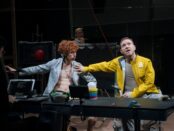
With one exception, however, Marber's cast of notable wisecrackers treats Mamet's punchy dialogue solely like punchlines, even when they're face down on the canvas. As Shelley "The Machine" Levene, a loser among losers, Bob Odenkirk opens an Act I triptych of two-handers that are all set within a capacious Chinese restaurant, nonsensically designed by Scott Pask to indicate a gigantic establishment apparently getting along just fine serving no more than a couple of liquid-lunchers at a time. On the verge of being fired for bringing up the rear in a sales contest for a shiny new Cadillac--that old-timey signifier of virile American success--Levene tries to sweatily sweet-talk the best leads from Donald Webber, Jr.'s insensate office manager, a pleading effort that quickly devolves into a pathetic attempt at bribery. [more]

Horwitz and Williams perfectly match each others’ energy on stage. Indeed, at times it seems as if each is trying to one-up the other’s exaggerated mannerisms. In one scene, a famous artist might dip into nonsensical French phrase, only for an interviewer to ratchet it up further by over-emphasizing an accent on a word that doesn’t need it. One might not-so-subtly flirt by bringing up a mutual past lover while the other awkwardly deflects, only spurring on further attempts. Throughout each scene, the pair’s back-and-forth is consistently excellent. They have an easygoing chemistry that makes every scenario feel fresh. [more]
If only film star George Clooney and his co-script writer Grant Heslov had hired an actual playwright to adapt their acclaimed screenplay for the 2005 film "Good Night, and Good Luck." for the Broadway stage. What worked in close up in the film does not have the same effect on the huge stage of the Winter Garden Theatre. And while David Strathairn as Edward R Murrow in the film, the role now played by Clooney on Broadway, also seemed wooden and unemotional, his every flicker of emotion on his face was telegraphed through the extreme close ups of every frame. With its cast of 22 on a huge CBS studio set, most of the characters are undefined or unidentified. At times it is difficult to know who is talking or where their voices are coming from on the multileveled setting. [more]
Eric Bogosian’s "Humpty Dumpty" was first written 25 years ago and premiered at the McCarter Theatre Center, Princeton, in 2002. At that time the idea of quarantining due to a local or national disaster seemed a fantasy. However, since then, we have all lived through the Covid Pandemic and what was inconceivable became our daily existence. Not only does Bogosian’s play seem tame now, it also seems predictable and dated. Director Ella Jane New does not help the script much by allowing the vapid characters to all seem one dimensional. Possibly with a satiric approach or powerhouse performances, the play might have something new to say to us as its entitled people show their true colors. [more]
Jack Serio directs a strong cast of seasoned actors whose personal chemistry gives the ensemble a solidly believable portrayal of their characters. Juan Castano is Edwin, a mid-30s man married to Christian, a man ten years older, believably played by Ryan Spahn. The two men are struggling with issues in their marriage when Margaret enters the picture. Julia Chan is Christian's "girlfriend" from high school. They have not communicated with each other in 20 years. [more]
The results of this updating are bold, and Andrews’ intellectual ambition is undeniable. At times, his revisions might seem questionable but when the production clicks, it strikes with a thrilling originality. The production pulses with an urgency often missing from more traditional revivals of "The Cherry Orchard," a play about people running out of time. The central conflict remains: Liubov, the bankrupt widow haunted by the ghosts of her past, returns to her family estate for the inevitable sale of the land that defines her family’s history. Practical solutions are needed, but neither she nor her hapless relatives can take decisive action. [more]

While most of the audience will probably not have graduated in the last ten years (though you never know), the play speaks to all of us about the closeness and personal relationships of our college years. Playwright Natalie Margolin knows how to create tension from hints casually dropped and director Jaki Bradley has created a cohesive cast who could have been together the last four years. "All Nighter" is one of the few plays set at a college that seems to come from the author’s own firsthand experiences. [more]
"Remembrance" by Patricia GoodSon is a story about her journey, for more than a decade, in dealing with her mother's Alzheimer's disease. As directed by Joan Kane, it is told from the perspective of a woman working with a therapist to unravel the emotional impact of those years of caregiving. It is not about the impact of the disease on the person with it but on the effect on the caregiver. [more]

In "Amm(i)gone," Mansoor masterfully delves into the delicate nuances of cultural and personal differences, exploring the connections that bind us even in our diversity. Co-directed with Lyam B. Gabel, this meta-theatrical production—spanning a compact yet potent 80 minutes—recounts the journey of Mansoor and his mother as they embark on the project of translating "Antigone" into Urdu. Surrounded by designer Xotchil Musser’s evocative set of wooden cutouts and intricate mosaics, and serene candles for effect, Mansoor guides the audience through their creative process, blending dialogue, video and audio recordings, and projected imagery to weave a story that is both intimate and expansive. The production’s clever use of multimedia enhances the emotional weight of their shared task, inviting the audience to reflect on the complexities of language, family, and legacy. [more]
In fact, the play Harmon has written is mainly about the conflict between the grandmother and the mother. While we are never really certain why Ellen and Susan refuse to be in the same room, we come to know all the details of the relationship between Renée and Ellen from three sides. The most entertaining parts of this long one-act delineate the relationship between Joshua and his Auntie Mame-like grandmother who did not believe in age-appropriate events: taking him at age seven to see "Dances With Wolves," attending a Mapplethorpe exhibit (which he did not understand) at age nine, seeing Diana Rigg in "Medea" when he was ten, and a three-movie marathon during a snow day off from school: "Secrets and Lies," "Sling Blade" and "The English Patient." Joshua credits his grandmother with changing his life making him want to be a playwright after seeing "Medea." [more]
"Maybe Tomorrow," written by Max Mondi and directed by Chad Austin, is a play about such a place and the person who created it. Inspired by a true story, Austin directs a cast of two in an exploration of a person lost in the present and locked within a mental space defined by the four walls of a bathroom, a person mediating the outside world through a computer and contact with one human caregiver but unable to move from a world they have defined as "safe" into the unknown world beyond the walls of a room. [more]
The new version by Irish playwright Mark O’Rowe uses contemporary and spare language but has made several events more literal as if not trusting modern audiences. The director has made the same mistake starting the play as a rehearsal in which we see the opening scene three times ranging from devoid of emotion to accomplished, which is both ineffective and pointless as it does not help us into the world of the play. The thrust stage by set designer John Lee Beatty (a room in unpainted wood, a single dining room table and mismatched chairs and a wall of French doors into a conservatory) is as stripped down and as spare as the language, a fitting place for a drama of tragic proportions, but does not offset the one- dimensional acting. The bland costumes mainly in black or white by Jess Goldstein straddle both the 19th and 21st centuries, seeming to want to have it both ways, but suggesting neither. [more]