
Plays
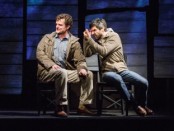
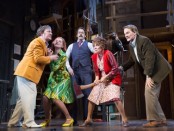
Patrick Brian Scherrer plays Peter, appearing in all 11 scenes, often in intense situations. The very personable Mr. Scherrer’s performance is quite heroic as he boldly embraces the play’s many painful episodes with his boyish charm. He is painfully believable as this wide-eyed struggling artist in the cruel big city and is instrumental to the play’s success. [more]
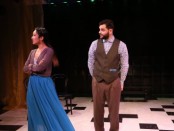
The Body of an American
The inspiration for the play began when poet and playwright Dan heard the Fresh Air interview. Paul was already famous as the photographer who took the now iconic 1993 picture of U.S. Staff Sgt. William David Cleveland’s body being desecrated in Mogadishu. As he took the photo, Paul heard a voice say, “If you do this, I will own you forever,” which led to his continuing post-traumatic stress syndrome. The public outcry caused President Clinton to pull the American forces out of Somalia which led to other political repercussions. Dan, suffering his own traumas, identified with Paul and emailed him. Surprisingly the reclusive Paul answered him and this led to a long correspondence and finally a face-to-face meeting in the Arctic. [more]
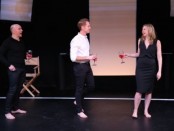
Familiar
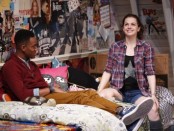
The family tension is defined in terms of the strong female relationships between mother Marvelous (Tamara Tunie) and the bride-to-be, who differ when it comes to wedding plans as well as the bride and her younger sister, Nyasha (Ito Aghayere) who clash over lifestyle choices. Big sister is the accomplished, serious professional woman who is strongly tied to her religious beliefs and customs, and the free-spirited little sister (who wasn't even asked to be a bridesmaid) who is tired of being berated for her choices. Tendi looks more to her aunt from Africa for guidance than her mother and is determined to have her look upon her choices as favorable. The source of comic relief in Familiar is Donald, the father (played by Harold Surratt), who sits back observing all the conflict and tries his best to take it all in stride. This family is one for the ages and how they deal with each other and common familiar issues is something all audiences can relate to. [more]
A Room of My Own
The most colorful character in more ways that one is Uncle Jackie (Cantone) who lives upstairs. A closeted gay man in a society that doesn’t accept him, he has become an angry, self-loathing misanthrope with a barbed tongue to match. Cantone gives a bigger-than-life performance that makes Jackie a truly memorable character. In the play’s quieter moments we find out what he has sacrificed all his adult life in order to remain in the old neighborhood and it is he who is keeping the family going with handouts that continually avert disaster. [more]
Pericles (Theatre for a New Audience)
Nunn’s adaptation rearranges some of the scenes and adds material from a prose version of the work by George Wilkins, believed to be Shakespeare’s collaborator. Using music, song, dancing, jousting and a veritable rainbow of colorful costumes, he has created an epic-sized revival that is always eye-filling and easy to follow. While some of the acting is uneven in this large cast of 29 including seven members of the Pigpen Theater Co., it must be said that this is not one of Shakespeare’s best plays as it makes use of unexpected events, many locations, and a large canvas, rather than psychological depth and deathless poetry. [more]
Rap Guide to Climate Chaos
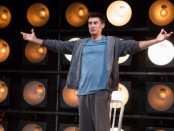
For his latest production, Brinkman has assembled over 20 songs which, cohesively, tackle every aspect of the climate crisis. Starting with a background of the physics and chemistry behind what’s happening in the world, he begins the show with a crash course in climate science. Brinkman’s clever lyrics are both informative and comical, and the unique way in which the information is presented to the audience makes learning fun and entertaining. Not only that, the conversational approach in his rapping also helps to make the information more easily digestible. [more]
Hughie
When the audience enters, the curtain is up and Christopher Oram’s imposing scenic design of the faded hotel lobby is in view. The visual effect of its industrial greenish walls, dirty stone columns, chipped wooden adornments, ancient elevator, central staircase, frayed threadbare furnishings, severe front desk, and grimy windows is that of a stunning representation of hellish imprisonment. Also on view while the audience waits the play to start is the night clerk staring into space. [more]
Nice Fish
Todd Rosenthal’s remarkably atmospheric and evocative setting is waiting for the audience when they come into the theater: a huge expanse of a corrugated ice flow in Northern Minnesota in forced perspective with miniature cars, ice fishing huts and a train in the far distance. Erik, a dour, taciturn ice-fishing enthusiast played by Jim Lichtscheidl, dressed in a green parka and yellow cap, and Ron (Rylance), a fishing novice dressed in a glowing orange parka and matching hat, appear on the ice to drill holes in the frozen lake on this last day of the ice fishing season. As Ron tells us in his first monologue, “If you go into the woods, the back country, someplace past all human habitation, it is a good idea to wear orange and carry a gun, or, depending on the season, carry a fishing pole, or a camera with a big lens. Otherwise it might appear that you have no idea what you are doing…” [more]
Dead Dog Park
At the onset of the production, each cast member is introduced by walking onto stage one by one. Starring intently out into the audience, there is a general sense of unrest to be found behind the eyes of each performer. The house lights of the theater are still on, and the piercing gazes coming from the actors scattered across the stage immediately destroys any notion of a fourth wall. The fourth wall, the theatrical device that the audience can usually hide safely behind, is taken away from the audience before the production even begins. There is no question: from the time the very first actor takes the stage, it is established that the audience is just as responsible for the events of Barry Malawer’s "Dead Dog Park" as any one of the fictional characters in the story [more]
Smokefall
The play seems to be saying that life is full of suffering but love will conquer all, not a very new or profound message. One flashback (Violet and Daniel’s first date) is replayed at least three times with no new significance with each repeat. The title is a quote from T.S. Eliot’s "The Four Quartets": “The moment in the draughty church at smokefall/ Be remembered; involved with past and future./ Only through time time is conquered.” Unfortunately, like a great deal of late T.S. Eliot, these lines are too abstruse to have much bearing on the play. Smokefall is the sort of work that you either go with its whimsy or hate it. This is definitely not a play for all theatergoers. [more]
Tennessee Williams 1982
Under the umbrella title "Tennessee Williams 1982" (the year of both play’s composition the year as well as that of playwright’s death), The Playhouse Creatures Theatre Company is presenting the world premiere of “A Recluse and His Guest” (to be published this summer) and the New York premiere of “The Remarkable Rooming-House of Mme. Le Monde,” (included in the 2008 volume, The Traveling Companion and Other Plays.) Not only are these unfamiliar plays uncharacteristic of the writer’s other work (a fable and a Grand Guignol), they have been given a surrealistic production by director Cosmin Chivu who directed the 2013 provocative revival of "The Mutilated" which demonstrated the viability of that black comedy once consigned to the scrap heap. Both plays in this doublebill are unified by their cynicism and their dark view of the world. While the plays may not be to everyone’s taste, the doublecasting of the two plays demonstrates remarkable versatility on the part of the talented cast, which is at times uneven. [more]
The Cherry Orchard
The focus too often strays from Chekhov and his darkly comic portrait of a Russia to a piece of silly business or a maladroit placement of rows of audience members, breaking the fourth wall. He has the working class upstart Lopakhin sing “My Way,” the Frank Sinatra classic, to celebrate his buying the cherry orchard—a jarringly farcical bit. [more]
Smart People
The satire begins early: it turns out that although the department likes having Brian doing his research proving that whites are genetically racist, they are not happy with his conclusions. Although Jackson may be the smartest doctor in the room, he has trouble working with others and bending to authority on the job. Although Valerie has a Harvard degree, she cleans houses to pay her rent which ticks off her upper middle-class mother. However, she is not pleased when she attends an audition for “Mary, the social worker” and is asked instead to read for the part of “Shlonda” from the ‘hood. Ginny finds that her therapy clients perceive her as white, but she knows that in the talk of race in America, she is invisible as race is defined as between blacks and whites in modern discourse. [more]
The Good Girl
The chemistry between Gabriel and Baessato is fierce and electrifying as they get to know each other, and intensifies as Van begins to observe the human-like behavior of the robot and is determined to find out more. Anjali is hesitant to let him in on the secret, but reveals that the robot has developed an emotional bond to her, and sometimes responds to certain feelings such as loneliness and separation – often uttering the words, "don't leave me" through the door. Van is fascinated at what he finds out and the two join forces to figure out how best to capitalize on the service of the sex robot and how she can accommodate a greater (and richer) clientele by playing into their fantasy of the obedient housewife. [more]
The White Stag Quadrilogy
An element of "The White Stag Quadrilogy" which cannot go overlooked is the amount of dancing incorporated into the production. In lieu of proper production techniques, Wolfert and company instead choose to depict stags parading across the desert, or eagles flying through the sky, by way of “interpretive” dancing. Enlisting the staff of the Plaza Michelle for this purpose, the dancing trio of Derek Smith, Michelle Uranowitz, and Jaime Wright are together a band of merry misfits who revel in their undulating, gyrating, style of dance (choreographed in hilariously gratuitous fashion by Chloe Kernaghan). Referred to on multiple occasions by Wolfert as “trained professionals,” the self-aware ensemble is a recurring aspect of the play which is, time and time again—and again, hilarious. [more]
Prodigal Son
Television and film actor Timothée Chalamet (Showtime’s "Homeland" and Christopher Nolan’s "Interstellar") makes an impressive New York stage debut as the play’s young protagonist. The role is almost too small to contain his bigger-than-life portrayal: kinetic, animated, provoking, questioning, vital, dynamic. His moods turn on a dime and he can shift from being a sophisticated adult back to being a little boy in a moment. Tall and lanky, he suggests the author but as he must have looked back in 1965. Also making his Manhattan Theatre Club debut, David Potters as his roommate Austin is tremendously sympathetic as a young man afraid of breaking the rules who has led a very sheltered life up until now. [more]
The Woodsman
The forest setting by Ortiz seems to envelop the audience as does the sound design which is created by the actors in tandem with violinist Naomi Florin who plays Edward W. Hardy’s melancholy original score throughout the evening. The impressive Bunraku-style puppets are the work of Ortiz who seems to be a one-man theater corporation able to do everything required himself including his co-direction with Claire Karpen. The only wrinkle is that at times it is a bit confusing as to what is happening since after the opening prologue there is no dialogue and some of the mime is ambiguous. However, the show with folk-style backwoods costumes by Molly Seidel and atmospheric lighting by Catherine Clark & Jamie Roderick is always theatrical, always hypnotic. [more]
Adults Only
Directed by Alex Correia, the seven different plays presented each serve a purpose. "The Heart Attack," which opens the show, is solemn yet silly. Taking place in a hospital, Nate Rollins is a patient who thinks he is having a heart attack, and Shane Allen is the Doctor assigned to his case. The premise is initially that of just a hypochondriac in action, but once the check-up has been completed, the tone changes to that of a more poignant and meaningful exchange between two grown men. While not all the plays are equally as funny, humor is present throughout the entire evening to keep the overall tone on the lighter side. [more]
Defendant Maurice Chevalier
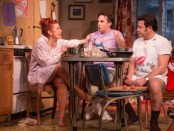
His great grandnephew, the French-born and raised Alexis Chevalier has written this well researched play with music that is based in part on Maurice Chevalier’s memoirs. It is structurally problematic with fantasy episodes, extraneous musical and dance sequences, and numerous often-lengthy scenes that don’t cohere. The dialogue is straightforwardly purposeful imparting historical facts and details with occasional bursts of poetic qualities. [more]
Broadway & the Bard
At the top of the show Cariou tells us that he made his Broadway debut in the Stratford Connecticut Shakespeare Festival’s transfer of "Henry V" in 1969 and six months later in the spring of 1970 appeared at the Palace Theatre in the new musical" Applause." Ever since then, he has had the idea to combine Shakespeare and song with “tunes that either support the text or are the antithesis.” The evening proceeds to pair Shakespeare and song thematically, like the opening sequence which offers Orsino’s “If music be the food of love, play on” from "Twelfth Night," followed by Sondheim’s “Love, I Hear” from "A Funny Thing Happened on the Way to the Forum" and Rodgers and Hart’s “Falling in Love with Love,” from "The Boys from Syracuse," based on Shakespeare’s "The Comedy of Errors." [more]
Utility
Schwend’s dialogue is realistic, believable, and true to life, as are the characters. As a play, however, it is a bit of a downer as we watch Amber become wearier without any relief in sight. Aside from Chris who is always putting everything off until tomorrow, Amber’s mother (who has been conned into liking him as a good father) is always begrudging about helping out though she lives down the block and doesn’t have anything else to do. The atmosphere and the characters are real, but each scene is just more and more of the same which becomes depressing and tiresome – just like Amber’s life. There is also the question of where the money comes from to buy all of the items that are carried in the door – unless the family is living on credit card debt which is never mentioned. This is also the sort of play where we hear a get deal about the children Janie, Max and Sammy, but the author manages to keep them off stage all evening. [more]
O, Earth
Nevertheless, Wills’ production is continually taking us by surprise both by his casting and his choices. His transgendered characters are played by transgendered actors. Moran’s Wilder and Angelos’ Ellen look a great deal like their counterparts, while Blankson-Wood and Heleringer as Spencer and Duncan, respectively, are a hoot as young entitled gay men who have totally bought into the capitalist system. “Mizz June” and Gentili, who are themselves transgendered icons, bring an air of authenticity to their roles as the colorful and outspoken Marsha and Sylvia. [more]
Chatting with the Tea Party
Cast as the curious playwright Rich, actor Jeffrey C. Wolf is the central focus of the evening. Wolf narrates the play by way of a series of monologues, which preface interviews with various members of the Tea Party or other pertinent political figures. Carrying the show on his back, Wolf is an agreeable narrator with an infectious curiosity. At times the play navigates deeply into American History, and when he dives into a fact or number heavy-preamble, his pace is cognizant of the fact that the audience is best assumed unfamiliar with it. Thanks to this, exposition regarding past political events is well-received and easily digestible. [more]
I and You
So begins a remarkable comedy-drama of two very opposite teenagers who shouldn’t have met and wouldn’t have if Anthony had not chosen the reclusive, mysterious Caroline for his partner. The play makes use of opposites, beginning with the theme of the poem, love and death, and in Whitman’s typical fashion, everything in between. But Caroline and Anthony are also opposites in every possible way: pessimistic/optimistic, sedentary/athletic, closed minded/open minded, white/black, friendless/popular, careless student/straight A student. They appear to have nothing in common, but by the end of the play they are drawn to each other through the magical words of Whitman and Leaves of Grass. Ultimately, Caroline and Anthony have revealed their dreams, fears and true selves to each other and to us. [more]
Sojourners
Ms. Udofia’s dialogue is richly expressive and she renders the four characters with depth and detail. The relationships between the characters are fully explored and their interactions where they voice their hopes and desires are often poignant. This is most particularly felt in the growing camaraderie between Abasiama and Moxie. [more]

The Burial at Thebes
Robert Langdon Lloyd’s eloquent performance as the blind prophet Tiresias energizes what had been a stilted presentation of this small-scale production of "The Burial at Thebes." Before Mr. Lloyd’s commanding midway appearance there had been a good deal of static expositional recitation and declaiming with only slight dramatic sparks. [more]
Tonight/Jungle: Two Plays by Philip Ridley
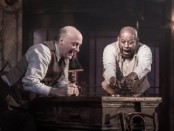
Both teenagers are desperate for our approval and understanding of their lives and what they did, unlike the tabloids which have apparently had headlines branding them as monsters. Listening to their sides of their stories, we are initially conned into a false sense of security – always a dangerous thing to do in a Philip Ridley play. By the end, we discover these are damaged youth we would not want to know personally, but we understand their motives entirely from their point of view. [more]

Noises Off
While Frayn’s roles are juicy parodies of very specific kinds of people, for the laughs to roll in one on top of the other, the play must be performed fast enough that we don’t have time to think about it or what we are laughing at. Consequently, though the production is entertaining for its comic portrayals, it fails to trigger all the laughs inherent in the script or become the laugh riot it is intended to be. Possibly, as the actors have more performances under their belts, the play may pick up speed and more laughs along the way. [more]
A Dream of Red Pavilions
A Dream of Red Pavilions is set in 18th century China during the reign of Emperor Qianlong. The framing story which gives the plot its mythic quality involves a stone and a flower that are reborn as cousins, the rich scion Baoyu and sickly Daiyu, who fall in eternal love. Like" The Forsyte Saga" or "Downton Abbey," the social context depicted is the rise and fall of an aristocratic family. Beginning with the birth of Baoyu, the oldest son on whom the Jia family’s future fortunes rest, the play which takes place in 30 short scenes follows the affairs of these nobles and their servants over 20 years until Baoyu’s young adulthood. [more]
The Gambler
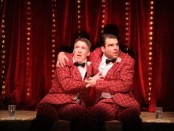
Director Lordi-Kirkham has unaccountable staged the play as though it were a radio play or a reading, making it more talky and static than it needs to be. While the text is faithful to the Russian novella with some trimming to reduce the number of characters, the use of both a narrator and much of the narration from the novel makes this seem like an interior monologue rather than a play. Unfortunately, the actors playing the twenty somethings who are given the most stage time do not have the technique necessary to bring off this psychological drama. At two hours and 10 minutes with no intermission, this is a long evening in the theater. [more]
Our Mother’s Brief Affair
Linda Lavin wears Anna in Richard Greenberg’s "Our Mother’s Brief Affair" like a chic couture outfit with many layers each of which reveals layers of colorful, woven cloth. There is a constant glow about her as she relates, mostly in flashbacks, the story of an illicit, but exciting affair with a stranger she met many years ago while waiting for her son, Seth (a bemused, but effective Greg Keller) to emerge from his Juilliard viola lessons. [more]
Wide Awake Hearts
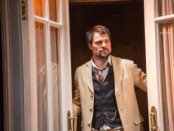
Brendan (NBC’s "Blindspot") Gall’s sexy and seductive new thriller, "Wide Awake Hearts," thrusts audiences into a challenging game of cat and mouse, as they are left to decipher the story of four friends in a case of art imitating life. An actor, director, writer and actress are faced with the intricacies of dealing with relationships, infused with passion and threats of infidelity, as they are in the process of creating a movie dealing with these very themes. [more]
What the Horse Saw
The collaborative script is by the One Idiot troupe’s writers that include Jon Bershad, Aaron Burdette, Allie Kokesh, Kristy Lopez-Bernal, Nathan Min and Katelyn Trela. It’s a smart mash-up of plot points and characters that those familiar with Williams’ play will recognize and those who aren’t would still find funny due to the franticly goofy presentation. The writing is also characterized by an abundance of vulgarity and scatological humor that is relatively tame rather then being offensive. [more]
Collaborators
Ross DeGraw as Joseph Stalin and Brian J. Carter as Mikhail Bulgakov in a scene from John Hodge’s [more]
Allen Wilder 2.0
Joe Casey is a charming actor. He exudes a “playboy” vibe which goes hand-in-hand with the character of Michael whose vices range from women to booze and back again. Casey shows an understanding of a man who is largely misunderstood and actually well-intentioned. Steph Van Vlack plays the role of Donna. Nearing 50 and a divorcée with a child, Donna is conflicted in light of the fact that she—a woman of her age—is engaging in an apparent “one night stand.” Among other things, this is also a character deeply disturbed that she’s actually considering sleeping with the child she used to babysit for all those years ago. Van Vlack brings a necessary uncertainty to the character. Playing a woman of certain age, Van Vlack’s performance indicates that Donna still has deep insecurities and still has quite a bit to learn about relationships. [more]
The Screwtape Letters
This Grand Guignol concept is sensationally realized by the striking physical production. John Gromada’s chilling sound design configures his spooky original score with its dominant organ along with bomb blasts and other sound effects for very effective results. Cameron Anderson’s scenic design is a dazzling haunted house affair with the stage wall covered in tiny bones and skulls, a ladder and ramp for the creature to scamper on, and manor-style furnishings. Hellish red hues are prominent features of Jesse Klug’s eerie lighting design. [more]
2016 LaBute New Theater Festival
The opening one is British author Lexi Wolfe’s delightfully wistful "Stand Up for Oneself." It’s a Chekhovian romantic comedy with clipped Noel Coward-style dialogue taking place in the room of a house where a party is going on. Lucas, a 42-year-old morose music professor sits alone drinking with his cane nearby when the free-spirited 26-year-old Lila enters. There is flirtation and revelations. Sensitively directed by John Pierson, the play’s very fine writing is boosted by the wonderfully detailed and effecting performances of Alicia Smith and Mark Ryan Anderson. [more]
A Man and His Prostate
Asner’s appearance in "A Man and His Prostate" is a delightfully thrilling opportunity to experience his considerable talents live. He vividly grouses, grimaces, and perfectly lands every joke with his monumental comic timing. The seriousness of the play is also conveyed when he skillfully tones his performance down to recite medical facts and to express the fears of the ramifications of the character’s condition and prognosis. Sitting raised above the audience at times he looks and sounds like a sage. [more]
In Quietness
Directed by Danya Taymor, 'In Quietness" excels in its exploration of intimacy. When dialogue is being spoken between two actors at a time, there are moments of silence that are loaded with implication. It is a credit to the director that more character development happens with nothing being said at all rather than when a character is speaking. Kristen Robinson’s set design is efficient enough—the whole stage is made to look like the inside of a chapel—though it is made much more effective by intelligent lighting design by Masha Tsimring and Caitlyn Rappaport. [more]
Key Change
Director Laura Lindow’s staging is a thrilling exhibition of pure stagecraft using very simple elements. The expressive actors are choreographed at times often in arresting tableaux especially a scene depicting drug addiction. There are powerful sequences visualizing violent clashes, flashbacks, fast-forwards and fantasies. A quite poignant one involves the complications of using the telephone in prison to keep in touch with loved ones. The pace is fast and vibrantly conveys the emotions of the characters’ situations. [more]
The Changeling
The interpretations are also open to question. Although she should be demure before her sexual awakening, Sara Topham plays Beatrice as experienced and sophisticated which allows her nowhere to take her character. While the beauty and the beast theme is much in evidence, Manoel Felciano’s make-up as the ugly De Flores fails to make him the monstrous embodiment of the play’s description. Christian Coulson’s Alsemero is described by his friend Jasperino as asexual and he seems to have taken this as the basis for his character. As a result he is extremely bland, as is John Skelley’s Alonzo, so that we never see what Beatrice is supposed to see in these men. [more]
China Doll
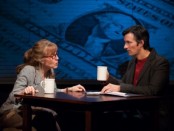
The title is never explained and remains a cryptic point of thought. Is it the name of the jet that the plot revolves around? Is it a reference to a woman? What could it mean? Knowing the work and personality of David Mamet, perhaps it’s a "House of Games" con device that has no significance at all just like the play itself. Muddled and rambling it comes across as an arrogantly tossed off minor exercise by an eminently established author solely for profit. The dialogue is a grating rehash of his patented style of staccato vulgarisms and explosive tirades interspersed with pauses that result in self-parody. If "Glengarry Glen Ross" was his zenith, "China Doll" is his nadir. [more]
Villain: DeBlanks
The personable Mr. Mitchell is the evening’s host and starts off the show by explaining the format. The six performers then go through the theater asking audience members for missing words that they then write in their scripts. After obtaining this material they then go onstage to sit in chairs with music stands on which they place their scripts and read from. For just over thirty minutes, they enact this silly and entertaining murder investigation with often funny results. [more]
2 Across
Jerry Mayer’s "2 Across" will remind of a great many other romantic comedies but in the hands of Andrea McArdle and Kip Gilman, it is a charming light-hearted evening in the theater. At least half way through the 90 minute encounter you will be rooting for this seemingly mismatched couple to get together – if not long before. Brought together by a love of the daily crossword puzzle, this warm and wise comedy covers a great many topics that engage couples to day. [more]
How Alfo Learned to Love
Directed by Daisy Walker, "How Alfo Learned to Love" is chock full of Italian-American stereotypes. The characters are just heightened enough that the gimmick works, but there is also a lot of heart behind this story. Walker has brought to life a group of characters who are quirky and lovable, and in the end it really feels like a family affair. All of this is contingent on Thom’s performance as Alfo whose character arc is fleshed out and brimming with variety. This redemption story about learning to love is a rollicking good time. Backed by strong performances and direction, a slick and consistent pace, and an entertaining script which sticks to a winning formula, nary a soul is likely to leave this theater without a smile. [more]
A View from the Bridge
Belgian–born director Ivo van Hove has brought his London Young Vic revival of Arthur Miller’s" A View from the Bridge" to Broadway in a production so stripped down to its essentials that it seem to reinvent theater as well as this play. The minimalist director already known in NYC for his seven stagings at the New York Theater Workshop (including "The Little Foxes" and "Scenes from a Marriage") and his five at Brooklyn Academy of Music (including "Angels in America" and "Antigone") has reduced the cast list from 15 to eight, eliminated scenery and props, has the actors go barefoot, and has washed out almost all color from the stage. The result once the plot is wound up has hypnotic power that is rarely seen in our theater. The cast led by British stage star Mark Strong as protagonist Eddie Carbone includes five of the actors from the London production, as well as British stage and screen star Russell Tovey. [more]
Marjorie Prime
Playwright Jordan Harrison is a graduate of the Brown University M.F.A. program and the recipient of several prestigious awards such as a Guggenheim Fellowship and the Kesselring Prize. On a technical level "Marjorie Prime" is expertly constructed and contains serviceable dialogue that propels the plot, but in totality it never rises above the level of an academic contrivance. The premise is a familiar but promising one, but in execution it is flat. The exposition and setup never really become emotionally involving and the closing revelations are consciously sensationalistic. [more]
Our Friends the Enemy
Besides playing Boyce, Gwyther depicts other British soldiers as well as Germans. It is an exhilarating display of rapid vocal and physical transformations subtly giving each brief characterization a fleeting depth. With his angular features, intense eyes, expressive voice, and limber physicality, his performance is a superb display of riveting solo theater acting. [more]
A Wilder Christmas
The Peccadillo Theater Company’s "A Wilder Christmas" is a gentle and genteel evening of theater: two early Thornton Wilder one-act plays, directed with an attention to detail and a leisurely sense of timing by Dan Wackerman, the company’s artistic director. "The Long Christmas Dinner" (1931) and "Pullman Car Hiawatha" (1930) together make for a rich sampling of Wilder’s familiar themes of family and the unavoidable specter of death (which, in Wilder, is only the beginning of another journey). These themes were perfected in his 1938 masterpiece, "Our Town," including the conceit of a godlike Greek chorus in the form of a Stage Manager who explains and even supervises the action. [more]
The Great Divorce
While C.S. Lewis’ famous theological allegory, "The Great Divorce," is written as a series of conversations, you might not expect that it would be suitable for stage dramatization as a religious treatise. However, the Michael McLean and Brian Watkins adaptation for Fellowship of the Performing Arts turns this into a high provocative and theatrical evening. Under the assured direction of Bill Castellino, three extremely talented actors (Christa Scott-Reed, Joel Rainwater, and Michael Frederic) play 19 characters among them, making them distinct and fully dimensional. The remarkable projections by Jeffrey Cady and the evocative original music and sound design by John Gromada make this a treat for the ear and eye as well as the mind.
[more]
Pylade
Marko Mandič is an award-winning acclaimed classical actor from Slovenia who has worked several times with Mr. Buljan. His talent, charisma, and physicality justify that acclaim as witnessed here by his performance in the title role. Vocally expressive and emotionally volatile, he is truly naked through most of the play’s second half and unselfconsciously performs heroically even through the most awkward sequences. These include the incident with the watermelon and later painting his genitals black to match those of the actor playing Orestes who doesn’t display his. [more]
Quantum Joy
Victor Morales enters and introduces himself and notes that we are at Dixon Place. Mr. Morales who created this piece is stocky, bald, bespectacled, and possessed of a quirky everyman presence. For just under an hour, he delivers an amusing lecture with serious overtones enhanced by the illustrative projections. [more]
The Bellagio Fountain Has Been Known to Make Me Cry
Every member of this trio has experienced love and loss, and this show explores what it truly means to be human. Moments of drama exemplify the character’s toughest challenges, and their individual approaches to solving them. The strength of a woman as the leader of a household is brought to the surface, as these women have been let down by the men in their lives. The bond they share ultimately proves that true happiness can be found whether you achieve your personal goals and dreams or find something beautiful within yourself. [more]
Rose, The Kennedy Story as Told by the Woman Who Lived It All
The legendary stage actress Kathleen Chalfant is appearing in her second one-woman show, a follow-up to her “Mrs. Dalloway” in The Party, from the Virginia Woolf stories in 1993. This time she plays Rose Fitzgerald Kennedy, the 79-year-old matriarch of the most famous political family in 20th century America. It is July 1969 and we meet her in the tasteful living room of her Hyannis Port, Massachusetts, home (designed by Anya Klepikov) one week after her youngest son Teddy’s tragic accident at Chappaquiddick. The premise of "Rose, The Kennedy Story as Told by the Woman Who Lived It All" is that we are members of the Ladies Auxiliary of the Knight of the Redeemer visiting from Dublin. We are invited to stay until Teddy comes back from sailing which he has been doing since the previous day. Her husband Joe, Sr., who has had a stroke eight years before is being cared for in an upstairs bedroom. [more]
H2O
Author Jane Martin has taken the familiar dramatic staple of a love story between two clashing opposites and rendered it compellingly here. There are plot twists, witty dialogue and violent incidents all with a tone-combining sweetness and melancholy. Jake is a depressive riddled with self-doubt and Deborah’s devoutness complicates her personal emotions. [more]
Nora
Pendleton has made some strange directorial choices. Characters appear on stage and stand silently long before their entrances. This is distracting as one wonders are they supposed to hear the conversations taking place. Many of the entrances and exits take place through the main aisle of the theater which breaks the fourth wall convention continually. He has also cast several actors as older than they are described so that this shifts the character relationships appreciably. The most famous scene in the play when Nora slams the door, possibly the most iconic moment in modern drama, is diluted considerably as there is no door for Nora to slam. Harry Feiner’s set design has the drawing room and bedroom visible side by side throughout the play which seems somewhat inappropriate for the 19th century setting. [more]
Night Is a Room
The pleasure of" Night Is a Room" is watching these three expert actors speak Wallace’s rich, insightful language which veers from wittily highfalutin to excitingly vulgar. Charting their emotional reactions which teem with hyperbolic outbursts, she has her finger on the pulse of these three self-deluders. Bill Rauch directed with total comprehension, walking a fine line between permitting the audience to observe the drama and also be mystified and appalled by these awful people.
[more]
Dear Elizabeth
The great mid-20th century American poets Elizabeth Bishop and Robert Lowell were friends from 1947 until his sudden death 30 years later. As they were usually in different cities and countries (Bishop lived in Brazil for many years while Lowell lived in New York City and Boston), they wrote each other over 450 letters which were published in 2008 as "Words in Air: The Complete Correspondence between Elizabeth Bishop and Robert Lowell." Sarah Ruhl, an adventurous playwright whose plays tend to be very different from each other, has adapted the letters for the stage in a homage to writing and friendship called Dear Elizabeth in which all of the words are that of the poets. Kate Whorskey’s fascinating production for WP Theater (formerly The Women’s Project) has staged the play much in the manner of last year’s revival of A.R. Gurney’s "Love Letters" and also with revolving casts. [more]
Incident at Vichy
Arthur Miller is having a great posthumous 100th birthday! "A View from a Bridge" opened on Broadway to sensational reviews to be followed soon by "The Crucible." Now a revival of "Incident at Vichy," his frightening, microcosmic examination of Nazi-occupied France during the height of World War II, is enjoying a fine revival at the Signature Theatre. While the first two plays are each experiencing radical re-assessments, the director of Vichy, Michael Wilson has opted for a straight-forward, naturalistic interpretation in which each character exists as a finely etched portrait and the set (by Jeff Cowie) is a real, frightening place down to the period French newspapers plastering the holes in the windows. [more]