Plays
"Christmas Magic in the Big Apple" continues Richard Holbrook's many years of presenting Christmas season shows. What sets his productions apart from many other performers is his view that this time of year is a time for celebrating family and friends. It is not simply a time of religious holidays but more of an all-encompassing recognition of the joyous spirit that moves people to engage with one another in a celebration of life. His shows are a creative mix of holiday songs with a universal theme. Holbrook commented, “Not everyone celebrates Christmas, and I don't want people coming to my show being made to feel uncomfortable." His playlists over the years have exemplified that view, with the current show being the latest in the series. [more]

Ohio State Murders
McDonald is mesmerizing as she speaks Kennedy’s strong, clear, poetic and evocative prose. We never forget that McDonald’s Suzanne Alexander is giving a lecture but she changes ages in an instant as she becomes the wide-eyed and innocent college student in love with learning and new ideas, and then return to being the mature author with a shocking story to tell. McDonald shifts beautifully between idyllic scenes of college life, the ugly face of racism in the dorm and on campus, and the off-stage violence that defines the murders. While the play is not told in strict chronological order there is no problem in following the story of these few years in the early 1950’s that shape Suzanne Alexander’s life. [more]
Des Moines
Michael Shannon, Hari Nef, Heather Alicia Simms, Arliss Howard and Johanna Day in a scene from [more]
Betsy: Wisdom of a Brighton Whore
Sommerville gives an exquisite reading of Betsy's emotional highs and lows, embracing the difficult range of expression so that the audience can experience the intensity of the feelings being shown. She also provides vivid characterizations of the people who populate her story, bringing them to life as it unfolds. Sommerville seduces the audience into empathizing and sympathizing with Betsy. She uses certain physical mannerisms in her presentation that may go overboard at times, but they do add truthfulness to the depth of emotions being shown. However, please make no mistake: this is ultimately a tragic story. [more]
The Wildly Inappropriate Poetry of Arthur Greenleaf Holmes
While Arthur Greenleaf Holmes is the creation of a talented comedian Gordon Boudreau as is Holmes poetry, the presentation is very much true to the era being presented. It is funny. It is bawdy, in the broadest sense of that word. Nevertheless, it is thought-provoking for those who are interested in the skillful use of language. It is not for those who may be offended by ribald, and some may call filthy imagery and poetic descriptions of bodily functions, but it is an immensely entertaining time in the theater. [more]
Becky Nurse of Salem
In any event, Ruhl has not written a play set in 1692 or a sequel to "The Crucible" but a comedy about free-spirited Becky Nurse, a descendant of the accused witch Rebecca Nurse, a pious 71-year-old woman who had nine children and was hard of hearing, who wishes to set the record straight. Although a fascinating premise, the problem with play is that it throws in everything except the kitchen sink – but, in fact, it makes use of metal freestanding toilet. The play attempts to cover multiple themes and topics: revisionist history, the opioid crisis, the generation gap, teenage suicide, the Salem Witch Trial, unemployment, medical care, the supernatural, adultery, and office harassment. Conceived and written between 2016 - 2019, the play also tries to connect Trump Rallies in which the crowds shouted “Lock her up” and Trump’s repeated use of the words “witch hunt” and his attempt to appear the victim to the hysteria of the Salem Witch Trial in 1692. All of this is too much weight for any one play. Director Rebecca Taichman’s uneven production does not help, though much of that is the fault of the shift in tone in the writing. [more]
The Far Country
All of the above occurs prior to the intermission and, if "The Far Country" has a shortcoming, it's that the second half feels like a sequel to what came before rather than a continuation of the same play, despite the sensitive efforts of director Eric Ting to emotionally stitch everything together. In part, that's because characters disappear entirely after Suh's story resumes, though the more salient cause is the relatively late introduction of Yuen (Shannon Tyo), a desperate, but still strong-willed, young woman to whom Gyet proposes marriage after returning to China with his U.S. citizenship, essentially replicating Gee's offer to him with an even more intimate bond. [more]
The Weak and the Strong
Erik Ehn’s title "The Weak and the Strong" taken from St. Paul may refer to the bad choices that some people make that others avoid, but it seems to only reinforce the clichés of most western films. The storytelling and production are mostly so obscure that the play becomes tedious as it is so difficult to follow. With a 70-minute first act, the play seems extremely long and overwritten. It is to be hoped that the play finds an audience that can follow its circuitous path to its conclusion and in its poetic speech and metaphors. [more]
Ain’t No Mo’
Jordan E. Cooper’s scathing new racial comedy, "Ain’t No Mo’" has made the successful transition to Broadway with five of the six original actors from the previous Public Theater staging in 2019 and a more elaborate physical production from an almost entirely different design team. Delving into Black life and attitudes now, the play is hilarious, but not laugh-out-loud funny, rather it's impressive because of its cleverness, but its satire does not trigger laughter. However, its outrageous form of satire may not appeal to all theatergoers. [more]
La Race
Taylor Reynolds has directed an excellent ensemble in bringing this play to life in an engaging, thought-provoking, and heartfelt way, but not without some issues. Through his direction and the actors' performances, "La Race" challenges the audience with clearly articulated and impactful ideas. However, the success in presenting those ideas depends on how they are performed, which is one of the problematic areas. Expressing strong emotions about an issue is challenging without being preachy or strident. There are scenes where certain key characters go into rants about racism, sexism, and gentrification that seem out of place with the carefully constructed plot lines that approach those issues in a less strident and more thoughtful way. [more]
A Tomato Can’t Grow in the Bronx
Under the permissive direction of Garfield-Szita—who also designed the costumes—the cast comes across more as members of a sitcom than a serious drama, not helped by Morgenstein’s dependence on shtick and clichés. The actors work hard to find some emotional resonance in their dialogue, particularly Kusher, O’Brien and Roche who occasionally rise above their lines. Bell Wolff as Gladys is in a world of her own. Her voice is a colorful instrument that takes Tomato into an almost surreal place. Morgenstein does have a good feel for what drives each of his characters. A sweet scene on a fire escape between Eleanor and Sammy shows that the playwright can be subtle and incisive. [more]
Underneath the Skin
Famed performance artist John Kelly has brought his latest show, "Underneath the Skin" to La MaMa, subtitled “A Penetrative Portrayal of a Queer Giant Based on the life and work of Samuel Steward 1909-1993.” Steward had a remarkable life in the first three-quarters of the 20th century as a college professor, a tattoo artist, a pornographer, an unofficial collaborator at the Kinsey Institute and a sexual renegade. He was also a friend of Gertrude Stein and Alice B. Toklas, Thomas Mann, André Gide, had trysts with Rudolph Valentino and Lord Alfred Douglas, and became the lover of Thornton Wilder. Underneath the Skin is a fascinating and engrossing blend of theater, dance, video, erotic art and a gay history of the 20th century. [more]
Eleanor and Alice: Conversations Between Two Remarkable Roosevelts
Ellen Abrams’ new play "Eleanor and Alice – Conversations Between Two Remarkable Roosevelts" explores their superficial courtesies in a series of conversations spanning 1904 until 1962, agreeable conversations that reveal an often disagreeable, if not downright adversarial relationship. Scenic designer Frank J. Oliva has divided the stage at Urban Stages into two discrete areas, one representing the Roosevelt estate, Sagamore Hill in Oyster Bay, Long Island, and the other Eleanor Roosevelt’s charmingly simple home, Val-Kill, in Hyde Park, New York. Kyle Artone’s costumes are simple representations of the two women as they travel their different paths through history. [more]
A Christmas Carol (Jefferson Mays)
Visually the show pulls out all of the stops continually making stage magic. Every scene offers new scenic effects and things that appear impossible but are right there on stage before you, and disappear in a twinkling of an eye to be replaced by new wonders. Beginning with Marley’s hearse in a flashback to seven years ago, Laffrey’s designs include Scrooge’s gloomy office, Scrooge’s staircase which somehow deposits him in his even darker bedroom on the second floor, the depressing all-boys school that Scrooge attended as a youth, Fezziwig’s warehouse (Scrooge’s first real job,) a colorful Christmas panorama filled with food and presents, the poor kitchen of the Cratchit family, the lavish dining room of his nephew Fred, and a brightly lit snow-filled cemetery. Using streaming video projection, a revolving stage and seemingly magic acts, as well as fog and snow effects, the production attempts all things that are possible on a stage. [more]
Sandra
Cale’s story uses many film noir devices from the 1940’s: exotic locale, strange encounters, searching down unknown streets, disappearing characters, a sexy stranger, danger signals avoided, clues that don’t add up, information that turns out to be fallacious, a damsel in distress, stolen objects, moments of high passion, etc. Yet all seem to be used as if for the first time. The elements are time tested, but the story is new. Cale is an excellent storyteller pulling us in with enough hints and clues to keep us interested until the very end. There are moments that sag but he always pulls out us into something new and unexpected. [more]
Evanston Salt Costs Climbing
Will Arbery’s Evanston "Salt Costs Climbing" (set in the city in which the author received his Master of Fine Arts Degree in 2015) is a perplexing experience as it shifts from realism to absurdism to surrealism. Its worthy topics of ecology and climate change notwithstanding, the play’s repetitiousness and unprepared-for events are frustrating as well as the missing backstories. While it begins interestingly enough , it very quickly turns tedious and inexplicable. A noble experiment, "Evanston Salt Costs Climbing" is either for the select few or needs a rewrite or second draft. [more]
Cocoon
Director Kotryna Gesait’s direction does not have the necessary distance from the material to realize that actors speaking simultaneously will blur content and intentions for the audience. Scenic design of Chantal Marks provides the obligatory cocoon-like fabrics draped from the ceiling as well as on the walls. Heather Crocker’s lighting design is supportive of the many changing moods of the piece from scene to scene. The sound design of Nadav Rayman underlines key shifts beautifully. [more]
Camp Siegfried
"Camp Siegfried" is a new departure for the author of "Small Mouth Sounds," "Continuity," "Make Believe" and "Grand Horizons." Depicting an important piece of history in an age when hate speech is on the rise, the play seems to be attempting something it doesn’t quite achieve. However, it is certainly a worthy effort and an engrossing piece in the theater though it leaves us hungry for more. [more]
The Rat Trap
Noel Coward’s "The Rat Trap" is not only entertaining but seems to have been ahead of its time. Discounted by critics and the author alike when it had its only production until now in 1926, the play turns out to be a cogent exploration of a creative woman’s search for her place in society, one which has no niche for her talents once she is a married woman. The Mint Theater Company does the play justice, restoring its reputation as an Edwardian period piece on the topic of the New Woman who is also a gifted artist. In Sarin Monae West and Elisabeth Gray we see the work of talented performers who we want to see more of in the future. [more]
George Kaplan
"George Kaplan" is a beautifully realized drama with comedic elements by Frédéric Sonntag, translated into North American English by Samuel Buggeln. The viewer will laugh but will also be brought to gently encounter deeper and possibly disturbing questions about our political and cultural perceptions. Questions such as What is the nature of a surveillance culture? How do fiction and disinformation relate to the perception of reality? Does myth lead to conspiracy theories? Who is manipulating us, and for what purpose? Does any of it matter in the whole scheme of things? [more]
Mike Birbiglia: The Old Man & The Pool
Still, rest assured, most of what Birbiglia says is funny, even for any fans well aware that Birbiglia is leading us somewhere that is not. Given the eponymous Hemingway allusion, the show's mortal endpoint is obvious, but the journey to it is full of surprising, and sometimes touching, laughs. They begin with an annual health checkup that includes a worrisomely poor performance on a spirometer, the ball-and-hose machine that measures lung function. The results baffle Birbiglia's doctor, since they seem to indicate he was having a heart attack while taking the test. [more]
Where the Mountain Meets the Sea
A touching portrait of a father and his alienated son unfolds in the Manhattan Theatre Club’s "Where the Mountain Meets the Sea" by Jeff Augustin, directed by Joshua Kahan Brody. ... "When the Mountain Meets the Sea" is not only about two different people, but two different time periods. Jean exists in memory while Jonah’s journey is to cross the country, retrieve Jean’s ashes and spread them over Haiti. [more]
Where We Belong
Writer/ director/actress Madeline Sayet is an engaging performer. Directed by Mei Ann Teo, her one-woman show “Where We Belong” is an autobiographical tale of her Mohegan roots and her seeking her place in the world as she travels to London to pursue a PhD in Shakespeare. While much of the play contains information and stories that will come as a revelation to most New Yorkers, the play often feels like a lecture with an agenda. The most interesting parts are her own discoveries about her roots and her encounters with other people in which she plays both characters. [more]
Downstate
Norris’ smart and effective script is packed with controversy; its characters are stained by the trauma in which their lives have been steeped, and it’s uncertain they will ever feel clean again. So many questions come to mind as this play unfolds. ... "Downstate" is a stirring, thought-provoking play about a deeply painful topic that plagues societies around the world. It’s an extremely tight piece of writing; every word and action is relevant. I can’t wait to see it again. [more]
My Broken Language
Hudes has directed her own play in a delightful vaudeville/musical comedy style with dancing between the scenes to choreography by Ebony Williams to live music played by pianist Ariacne Trujillo-Durand, supervised by Alex Lacamoire. Of the five actresses who perform each in their own inimitable style, three of them have appeared in Hudes’ plays before: Daphne Rubin-Vega and Zabryna Guevara (who play the Author twice each) have appeared in two New York productions and Marilyn Torres has appeared regionally in the Pulitzer Prize-winning, "Water by the Spoonful" at The Old Globe, San Diego. By the end of the evening we feel we have met all of the Perez women as well as know what makes the Author tick. [more]
The Piano Lesson
LaTanya Richardson Jackson (Samuel L. Jackson’s wife) has directed in a desultory fashion. Long, revealing monologues, the backbone of this particular play, are delivered directly to the audience rather than to the other characters, making them more speeches than important character revelations. She also chose to overdo the ending, which includes an ill-advised exorcism and won’t be ruined here. [more]
Merciful Delusions : 4 One Act Plays by Tennessee Williams
Director Lorraine Serabian is faithful to the spirit of when these plays were written. She delves into the spirited dreamers and chance takers that Tennessee Williams so faithfully showed us in very poetic theatre of the rawest psychological insight. The scenic design of JR Carter is economical for fast changes between plays, yet evocative of the period it is asked to enhance. Adrian Yuen’s lighting design captures the dinginess and the squalor, yet always craving that sliver of brightness. Williams wrote more one-act treasures than we see here, and this production definitely makes an audience want to experience more of his minor masterpieces. [more]
A Delicate Balance
The first Off Broadway revival of Edward Albee’s " A elicate Balance," his first Pulitzer Prize-winning play (of three), is also the first to feature an all Asian American cast as well as being the first New York production of an Albee play to be performed by a non-white cast. A coproduction of Transport Group and the National Asian American Theatre Company (NAATCO), it is has been directed by Jack Cummings III, Transport Group’s artistic director. The production is elegant and polished, if a bit leisurely. However, at two hours and 45 minutes the running time is the same length as the 2014 Broadway revival. The six character cast is led by Mia Katigbak, actor-manager and co-founder of NAATCO. [more]
Catch as Catch Can
Chung has the six characters played by three actors, each playing a parent/child duo switching from one to the other in confusing frequency. In addition, each actor plays a parent of the opposite gender. To muddy things even further, all the characters are played by Asian-Americans who make honest, but failing, attempts to adopt working class Italian and Irish Catholic accents and attitudes. Lon/Daniela are played by Cindy Cheung; Roberta/Robbie by Jon Norman Schneider; and Theresa/Tim by Rob Yang. [more]
You Will Get Sick
Ostensibly a comedy, or a tragi-comedy, or a dystopic mashup of "The Wizard of Oz" and "Field of Dreams," Diaz's play could possibly be enjoyed as a befuddling trifle if not for its serious pretensions about morbidity and mortality. Both aspects of this double downer involve a young man (the hopelessly adrift Daniel K. Isaac) recently diagnosed with a terminal disease that Diaz, desperately straining for universality, never identifies. He also doesn't note any character names in the program's cast list, referring to each of the actors only by the numbers 1 through 5, even though character names are used in the script. This concealment likely is a way of protecting the play's huge final reveal, or it could have another point that exists in Diaz's noggin but not in mine. [more]
38th Marathon of One-Act Plays: Series B
Ensemble Studio Theatre’s "38th Marathon of One-Act Plays," their first since 2019, is split up into two programs of five plays each, with an eleventh play, Vera Starbard’s “Yan Tután,” streaming free on-demand, in collaboration with Perseverance Theatre. Each of the plays in Program B is successful in telling us enough about the characters to make the audience care for them and empathize for what they experience in their short time on stage. ... The Marathon is a great venue for up-and-coming writers to hone their characterization skills. Some of these writers have already had full productions of other plays in their resumés, so for some their success is in full swing. Program B is a definite tease towards coming back to experience Program A. [more]
Vatican Falls
You won’t find Vatican Falls on any map about picturesque raging waters. No, Frank J. Avella’s new play, "Vatican Falls," is, instead, a passionate, sometimes humorous, indictment of the Catholic Church and its long history of concealing the sexual abuse suffered by hundreds of young men at the hands of priests. Tony DiBernardo’s vivid, yet simple set—red platforms that were eventually arranged into the form of a cross—help Avella—who co-directed with Carlotta Brentan—make his sometimes confusing storytelling clearer by dividing the stage into two playing areas. [more]
Topdog/Underdog
The 20th anniversary revival of Suzan-Lori Parks’ Pulitzer Prize-winning play, "Topdog/Underdog," is just as powerful and absorbing as before with its story of two African American brothers Booth and Lincoln who are searching for the American Dream in opposite ways. Under the astute but leisurely direction of Kenny Leon (Tony Award Best Revivals of "A Soldier’s Play," "A Raisin in the Sun" and "Fences"), rising stars Corey Hawkins (Tony nominated for "Six Degrees of Separation," and appearances in the film versions of "In the Heights" and "The Tragedy of Macbeth") and Yahya Abdul-Mateen II (Emmy Award winner for HBO’s "Watchmen" as well as ensemble awards for the cast of "The Trial of the Chicago 7") give riveted performances in this two-hander. [more]
Straight Line Crazy
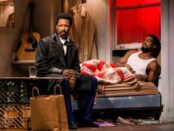
Ralph Fiennes’ towering performance as a megalomaniac who changes the face of New York as we know it is worth the price of admission. With his puffed out chest and nose in the air remaking himself physically, he creates a biographical portrait which will go down in the theater annals. Co-directors Nicholas Hytner and Jamie Armitage keep all the data and speechifying fascinating despite what could be the dryness of the material. And let’s not forget David Hare’s achievement to place the 30 year career of builder Robert Moses front and center on stage without overwhelming us with facts and figures but creating drama out of real life confrontations. "Straight Line Crazy" may just prove to be the dramatic high point of this theater season. [more]
Walking with Ghosts
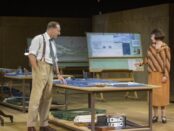
"Walking with Ghosts" is a decidedly intimate experience, one that seems tailor-made for an off-Broadway theater like the Irish Rep. Price and his production team try to expand the show to Broadway proportions through McKenna's lighting and aforementioned set and Sinéad Diskin's vivid sound design. But its true scale is human, which means all that's required is Byrne and his bravery. [more]

Our Voices, Our Time: One-Act Play Festival
The venerable, historic Negro Ensemble Company is presenting an intriguing program at the equally venerable, historic Cherry Lane Theatre: "Our Voices, Our Time: One-Act Play Festival." The three short plays, all insightful in very individual ways, reveal the ins and outs of relationships while also dealing with contemporary issues. [more]
What Passes for Comedy
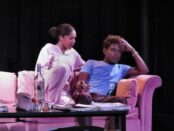
G.D. Kimble’s "What Passes for Comedy" depicts the fascinating era of early live television talk shows and the racism and anti-Semitism which was acceptable in those days. However, it also hints at hilarious comic interludes which it does not deliver. A much better play is hiding in this material and a rewrite could make it a much more successful evening. Its lack of focus camouflages its real intentions which are quite admirable. The play is also hampered by its conventional structure which requires a good many unnecessary exchanges. Nevertheless, this is an admirable attempt at something a little different from the usual run of historical plays on the stage, an absorbing evening even when it is not clear exactly where it is going. [more]
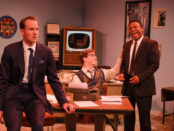
A Raisin in the Sun
Mandi Masden, Tonya Pinkins and Toussaint Battiste in a scene from Robert O’Hara’s production [more]
Montag
While director Dustin Wills has given 'Montag" a superb production, the meaning and message of Kate Tarker’s play remains obscure. Demonstrating female empowerment alone is not enough if the details remain murky and confusing. If the play has any geopolitical message about American-German-Turkish relations, it is entirely lost in the proceedings. The fact that both women are now single parents is not given much significance in the play. One gets the feeling that much of the play has a private meaning for the author who grew up in Germany on the outskirts of a U.S. military community. For those who do not know German, “Montag” is the word for Monday, the day when Clifford Andrews went missing and the women barricaded themselves in the apartment. [more]
Chushingura – 47 Ronin
It’s not clear what Amaterasu Za’s mission is. If, as Dachs’ program comments indicate, it is to bring Japanese culture to modern audiences, the company needs to be less stodgy and more contemporary in its approach to such vivid dramas as "Chushingura - 47 Ronin." If this production is representative of their efforts, Amaterasu Za is dedicated to first rate representations of high Japanese art. Their standards are high. Perhaps, Dachs and her company can figure out how to combine a reverence for traditional Japanese theater with appealing to a wider audience without sacrificing authenticity. [more]

Albert Camus’ “The Fall”
Belgian actor Ronald Guttman gives a subtle, yet wrenching performance in "The Fall," expounding the philosophies of Albert Camus trapped in the sad and now resigned character of the exiled Parisian lawyer Jean-Baptiste Clamence. Fellow bar mates, we the audience, are his confessors in a sailors’ dive bar in Amsterdam’s red-light district circa 1956. In adapting Camus’ last completed novel for the stage, Alexis Lloyd, has created a role of controlled emotions that belie the seething honesty struggling to rear its ugly head. Director Didier Flamand encourages the full use of the space to make constant contact with members of the audience. Turning around from ordering his drink at the bar, he is in the best position to orate at will. As the performance takes place (and fits very neatly) in the entirety of the Huron Bar (the lower level of the SoHo Playhouse), the original architect of the building should be entitled to a scenic design credit. The best seat in the house is occupied by the bartender. [more]
The Winter’s Tale (Bedlam)
Many of Bedlam’s productions have used small casts with most of the actors playing more than one role. In the case of "The Winter’s Tale," not one of Shakespeare’s more often produced plays, the casting uses so few actors that the play becomes confusing and difficult to follow, and a great many characters and much dialogue has necessarily been cut. In one head-scratching scene, Elan Zafir is required to play King Polixenes and his son Prince Florizel at the same time. While the sets and costumes are modern, with the Shakespeare poetry sacrificed to sound like contemporary speech, the characters are still referred to as “King Leontes” and his wife “Queen Hermione.” As the setting by John McDermott looks like three rooms in a frat house, one wonders why the Royal Family of Sicilia would be living in such shabby quarters and continually guzzling beer in the palace. [more]
Melissa Etheridge Off Broadway: My Window – A Journey Through Life
Etheridge may be 61, but she sounds just as she did when she first came on the American rock scene in 1988: full-throated emotion and raspy vocals that bring honesty and pathos to intensely personal and confessional lyrics. The accomplishment in "Melissa Etheridge Off Broadway: My Window – A Journey Through Life" is not in the many scenes of heartache and a dense song list, but in the strength and the resilience that carries her to artistry that she shares so unselfishly and unselfconsciously to speak to and heal a legion of fans. [more]
Death of a Salesman
To be clear, the casting isn't colorblind; it's just casting, with director Miranda Cromwell delicately drawing out a different set of lived experiences from Miller's almost untouched words. The play's West-End co-director Marianne Elliott has not made the journey across the pond with its ongoing contributors, all of whom deserve kudos for the revelatory production, especially Wendell Pierce ("Broke-ology," "The Wire," "Treme") as Willy and Sharon D. Clarke ("Caroline, or Change") as Linda, his long-suffering wife. Though Pierce devastatingly pulls Willy apart in front of our eyes until all that's left is his sense of failure, it's Clarke who gives Willy's downfall its saddest dimension, convincing the audience, beyond any doubt, that the very-flawed Willy is loved. If seeing previous productions of "Death of a Salesman" has inured you to Willy's ultimate fate, this one should bring back the tears, and Clarke deserves a lot of credit for that difficult gift. [more]
Leopoldstadt
Tom Stoppard’s "Leopoldstadt" is a powerful achievement, a history of our time as well as a cautionary tale. In depicting Jewish life in Vienna from 1899 - 1955, It also reveals a way of life and a culture rarely seen on our stage. Patrick Marber’s superb production keeps the story progressing at just the right tempo both to follow the plot as well as reflect family life as it is really lived. There is not a weak link among the 36 actors in which all of the children’s roles are double cast. The excellent design team puts four generations of Vienna on stage of Broadway’s Longacre Theatre. [more]
Everything’s Fine
Actor/writer/director Douglas McGrath is a charming storyteller and his one-man show "Everything’s Fine" is a total delight. He tells the entertaining and poignant story of his eventful 14th year when he was in ninth grade but also describes life in his family of five growing up in Midland, Texas. His tale of darkest adolescence is also nostalgic and reminiscent of the problems of life as a teen. The title turns out to be ironic as it was an expression his father used before announcing there was a new problem. [more]
Baldwin & Buckley At Cambridge
"Baldwin & Buckley at Cambridge" should stir up controversy as their 1965 topic is still relevant. Such a debate today would have a great deal more ammunition than either of these men had at the time. However, one can still hear both points of view today given by liberals and conservatives, respectively. The fact that the Baldwin/Buckley debate is still relevant can be witnessed from the rise of the Black Lives Matter Movement in 2013 as well as the 2019 publication of "The Fire Is Upon Us: James Baldwin, William F. Buckley, Jr., and the Debate over Race in America" by Nicholas Buccola. This is a question which has not been resolved in the intervening 57 years. [more]
Powerhouse
Harms’ play never lets up in its homage to corporate intrigue laced with humor. The audience’s caring for how Regan and Guy end up is a given, so that we can forgive his “poetic license” in that all legal personnel involved would be fully aware that the illegal recording of someone without their knowledge is a Class E felony in the state of New York, but nevermind. Director Ken Wolf keeps the story moving at a great clip and gently supports all five of the thoroughly believable characterizations, to the point we hope even Meena will be okay after her hysterical breakdown akin to professional suicide. [more]
Cost of Living
Perhaps because of its prestigious accolade, or just undeniable merit, "Cost of Living" is the first of Majok's heartfelt efforts to make the journey from off-Broadway to on-Broadway in the Manhattan Theatre Club’s production, a transition that, thanks to director Jo Bonney's returning and unflinching guidance, hasn't diminished any of the play's intimacy or daring. If anything, on Wilson Chin's Bergman-meets-Bayonne turntable set, gloomily lit in unrelenting twilight by Jeff Croiter, "Cost of Living" has become even more persuasive and poetic. Invaluably serving that dramatic growth are actors Gregg Mozgala and Katy Sullivan, repeating their roles from the play's 2017 New York City Center premiere by MTC. [more]
The Sea Lady
Neith Boyce’s "The Sea Lady," a Broadway-bound play in 1935, only now having its world premiere at Metropolitan Playhouse is an attempt at a Shavian play of ideas. Based on a 1901 novel by socialist H.G. Wells, this very Edwardian story resembles Shaw’s "Misalliance" but without the wit or the scope of ideas. Extremely tentative in how far it dares to go, "The Sea Lady" seems like a relic of an earlier age. It has charm but it lacks depth; its message may have been new in 1901 when the novel came out or 1935 when the play was finished, but today it seems extremely old hat. [more]
Washington Square
On what is either a shoestring budget or a conscious effort to strip Henry James’ novel down to its essentials, Randy Sharp’s new adaptation of "Washington Square" is both exciting theater and entirely true to its source material. The quartet of fine actors make this story of 1840’s New York entirely credible and engrossing at all times. While it avoids the beautiful trappings usually associated with the period, it is so gripping that they are not missed for a moment. [more]
Our Town…but Wilder
Krevolin is a clever writer, turning Wilder’s American folk tale into a modern comedy/drama with relevance to today’s audiences. Although he often makes his points a bit too obviously with the rantings of the bigots veering too close to cliché, he nimbly juggles the complex inter-relationships. His staging is simple, helped by Aurora Winger’s lighting. Characters often enter down the aisle as they approach the stage tossing off their lines, cheerfully lit by Winger. While waiting for the next inevitable production of Wilder’s Our Town, whet your appetite with its modern cousin, "Our Town…but Wilder." [more]
Complicity
On paper, Diane Davis’ play "Complicity" offers a stark, yet refreshing take on the now familiar Harvey Weinstein-tainted Hollywood story of women being victimized by a male-run, male-driven industry. On stage what we have instead are sometimes too-clipped scenes where an audience is left the chore of filling in the many blanks. The actors sometimes attempt to do just that with histrionics that are unfortunately not reined in by director Illana Stein. [more]
I’m Revolting
There are two truisms in life in addition to the one about death and taxes: it takes all kinds of people to make a world and something will get everyone in the end. The world premiere of Gracie Gardner’s "I’m Revolting" beautifully proves both points. A sensitive and perceptive play set in the waiting room of a private New York City skin cancer clinic, the play introduces us to all walks of people and many reactions to medical reports. The ensemble cast includes several veteran actors (Laura Esterman, Glenn Fitzgerald, Peter Gerety and Patrice Johnson Chevannes) and several not so well known faces. Knud Adams’ direction is subtle and unobtrusive allowing life to pass on the Linda Gross stage of the Atlantic Theater Company. [more]
This Beautiful Future
If you like your W.W. II history unadulterated, you may object to a love story between a French teenage girl and a Nazi soldier even if they are inexperienced and innocent and unaware of what is to come. The fact that they are both hopeful of life in the future in the middle of war and devastation notwithstanding, were people ever this naïve and unworldly? While "This Beautiful Future" is tastefully presented, it does not deal with the moral issues that the play hints at but refuses to recognize. [more]
Fauna
Is it possible to be completely truthful in attempting to tell the life of a famous author in a biofilm? That is the premise of Argentinian novelist and playwright Romina Paula’s "Fauna" now having its English language premiere at New York’s Torn Page Theater. As the play is philosophical, poetic, cerebral, and literary with quotes from many authors including Argentinian writers unfamiliar to Americans, it may be too erudite and esoteric for most theatergoers. However, April Sweeney’s production at the vest pocket Torn Page Theater is so intense that it carries its audience with it. With the actors only feet from the viewers so that you feel you are in the room with them, the play is a powerful experience that few productions ever achieve. [more]
Burn
Although Alan Cumming is a charismatic performer, the distracting video design, the often overpowering music, and the often flashing lighting by Tim Lutkin, gets in the way of viewing the show. Much of the effect is created by the atmospheric lighting which periodically changes color (blue, green, red) yet at times it turns the evening into a multimedia event. Since none of the poems are clear enough to be understood, we learn little of Burns’ output as a poet though we do hear about his triumphs that lead to being lionized in Edinburgh. The contemporary music only rarely suggests the period. The dance elements also seem an eccentric way to portray this 18th century man who attempted to live life to the fullest. Cumming charmingly depicts this Scottish icon though he does come off as a lovable rogue. It is all an example of too much being too much. The rather coy ending has Cumming sitting on the edge of the stage declaiming Burns’ now famous poem, “Auld Lang Syne,” after the final curtain has already descended. [more]
Four Saints in Three Acts
Greenspan isn’t always totally clear when switching points of view, but made up for this by turning the entire, long script into a wonderland of gestures, vocalizations, postures and movements. His eyes and his hands are masterful communicators. His lean body’s dancelike movements add dimension to the onslaught of words. This is a performance that must be seen to appreciate how mindboggling his accomplishment is. [more]
Jasper
Most poignantly, when Drew starts to wonder if maybe their son's survival has been the opposite of a blessing, Andrea expresses horror for a thought that, thanks to Pimentel's touchingly subtle performance, we know she's had herself. To its strongest credit, MacDermott's play affords all three of its actors the opportunity to find meaning beyond their characters' words. Though, of course, with a less capable trio, this sort of dramatic freedom could have been a disaster. [more]
Our Man in Santiago
Mark Wilding’s "Our Man in Santiago" is billed as a “raucous political farce” but it is neither loud and noisy nor hilariously funny. Inspired by Gabriel Garcia Marquez’s 1974 article in Harper’s Magazine concerning the CIA involvement in the death of democratically elected President Salvador Allende, the play supposes that the CIA had operatives in Santiago ready to kill Allende when General Pinochet launched his coup that took out Allende’s government and democracy in Chile for the next 16 years. While Charlie Mount, who also directed LA’s Theater West production in 2021, keeps the play bubbling along, the one-dimensional characters and the lack of real farcical stage business diminish the play to an overlong attempt at satire. [more]