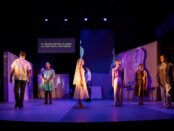
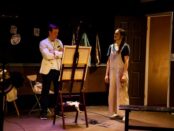
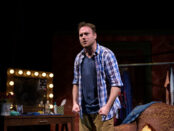
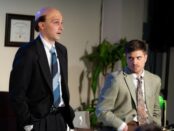
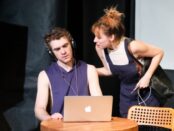
Clearly, "Zoetrope" often becomes difficult to follow for non-Spanish speakers. The dearth of realistic sets makes knowing which location is which confusing, despite the occasional descriptive titles. Then, the fact that most of the actors—all of whom are terrific—play several parts in a rapidly time-shifting plot makes figuring out who’s who and who is in a relationship with whom difficult to ascertain. Why is Puerto Rican independence glossed over? How does Claudio become a filmmaker? It’s the debut of his movie that ends "Zoetrope." [more]
Somewhere there are rules for what theatre is supposed to do: it should entertain, it should instruct, it should provoke. To say that Annie Dorsen’s "Prometheus Firebringer" checks all the boxes is an understatement of what she has done here. It is a brilliant reactionary, and yes, even cautionary, piece that takes a 2,500-year- old play that doesn’t really exist anymore (what is left of it is the title and a fragment or two – the rest has been lost over time) and thrusts it into an exercise for the unwitting specter of Artificial Intelligence. The results are fascinating, yet unremarkable; provocative, yet giddy. [more]
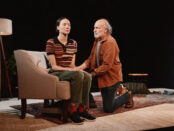
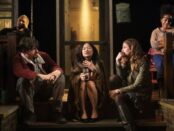
Ever since Pulitzer Prize-winning playwright Annie Baker adapted 'Uncle Vanya" for a 2012 production at the Soho Rep, her plays like "The Flick," "John" and "The Antipodes" have becomes more Chekhovian: not a great deal happens but characters live out their daily lives. In her new play "Infinite Life," she has gone even further with the silences and the pauses that she has become famous for. Under James Macdonald’s superb direction, we watch five women and one man read, sleep, talk and sip water or juice on the patio of a wellness clinic in Northern California trying to deal with their chronic pain. Not much happens but, on the other hand, these people reveal their whole lives before they complete their treatments and go back to their previous existences. [more]
Max Wolf Friedlich’s "Job" is as tense as a thriller, as compelling as a psychological drama and as up-to-date as tomorrow’s headlines. As directed by Michael Herwitz, Peter Friedman and Sydney Lemmon are living their roles, rather than just acting them. While the play will grab you by the throat while you are in the theater, it will give you a great deal to think about after you leave. In that it resembles other two-character plays by such authors as David Mamet and Harold Pinter. It is to be hoped that the play will be extended or better yet moved to a larger theater so that more people will be able to see it. [more]
This play demands attention to the smallest details and a thoughtful encounter with what truth is being hidden and revealed in both the spoken text and the silent actions. It leaves one with a need to make sense of the experience and the feelings that it engenders. It is drama to be experienced and savored. See the show if you like intense, thoughtful, well-acted drama. [more]
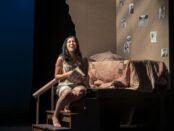
Shaye tells of a pot and drug-addicted couple who are totally disgusting parents to a two year old. That’s just not acceptable even though it is told as a funny hippy-dippy anecdote. Even so, Shaye is a great storyteller, her narration a perfect substitute for the absent camera. However, she is a poor developer of characters. Her insights end with naming the drugs each character takes. None of the characters seem to have any means of support, however colorful they are. [more]
"alt-Hamlet," written and directed by Suzanne Willett, loosely uses "Hamlet' 's plotting and character types in a carnivalesque/grotesque black comedy. Inspired by the US Supreme Court's 2022 decision on abortion rights, Willett penned an indictment of the court’s imposition of legally sanctioned restrictions on women’s control over their bodies. She uses Hamlet as the vehicle for the story since it was a play centered on the Elizabethan view of inheritance as a right. Her play centers on a woman’s right to control her body. She also uses pregnancy and "morning-after" and "abortion" pills as elements in the story. While the topics dealt with are important, this production does not effectively deliver on those topics, not for want of trying, but because of the venue and some directorial choices. It reads better than it plays. [more]
Elisha has written a refreshing new take on Anne Frank’s life. Called "Anne Being Frank" (a title that should, perhaps, be reconsidered), the one-person, multi-character show posits a surreal possibility, that Frank managed to survive the War and decided to rewrite her oft-expurgated famous Diary [more]
Everyone loves a good immigrant story, from The Godfather on down. 'No Good Things Dwell in the Flesh" doesn't reach that high, but it succeeds in what it tries to do, which is to be an accurate portrayal of a specific experience. Agata (played by reliable veteran Kellie Overbey) is an aging Russian tailor with a shop in Queens who wants to retire. She's 64 years old and hasn't had a vacation in 12 years. She'd like to give the shop to her young assistant Janice (Carmen Zilles). Janice is interested but also boy crazy and generally doesn't have good judgment. [more]
Catherine Waller’s one person show, "The Creeps", has all the elements of a successful horror show: a macabre setting, dark lighting, off-beat characters, and strange unexplained going-ons. Unfortunately, several things get in the way of its registering. Created and starring Waller dressed entirely in form fitting black, the production has eschewed a director who is very much needed as there is too much dead time in this slightly less than one hour show. At this length it still seems long with too many undramatic pauses. Presented in the renovated four-sided Playhouse 46 at St. Luke’s, the audience is also aware of each other throughout which makes the evening a great deal less scary than it ought to be. Scott Monnin’s lighting is never dark enough to make us feel that we are in some place other than the theater with other people. [more]
"Click" by Drew Pisarra and directed by James Dean Palmer is a play inspired by the film "Breathless," written and directed by Jean Luc Godard and considered a seminal work in establishing French film noir. Pisarra is paying homage to Godard in creating a play that attempts to present the bleak, dark characters and settings of a noir film such as "Breathless" on stage. He is only partially successful in the task, and ultimately, the play fails to be an entertaining evening of theater. [more]
Director Rick Hamilton effectively steers the sad tale away from an endless maudlin saga. After all, the “spoiler” is in the program. Helena Weinrauch is alive and well and in her late 90’s, living in New York City. She attended the opening night of this production. We are carried by Helena’s travails – some are ultimately uplifting, like her about-face on her relationship with Wladek, a Jewish guard. She takes him to task for his participation in the black market, but he steps in to save her from death more than once. Earlier, she leaves the safe haven of living with a German couple who think Helena is married to a German officer on the front so not to put them in harm’s way when she knows she will ultimately be found out to be a Jew masquerading as a young German bride. Hamilton is conscious of needing every scene to be driven by intense depictions of rapid change in what was once a beautiful place to live. [more]
Directed by Karen Carpenter, "Pay the Writer" by best-selling novelist Tawni O’Dell is slick and superficial but entertaining and engrossing. The play about the 45 year friendship between an ultimately successful gay literary agent and an unknown African American novelist who becomes celebrated and wealthy plays like a novel or mini-series with its 13 scenes and many two-character encounters but is ultimately satisfying by the time it reaches its denouement. The high powered cast plays it to the hilt, belying the fact that the characters are superficial and stereotyped, which, of course, doesn’t make it untrue. Some of the play is extremely funny with one-liners worth repeating. [more]
Redman’s "A Séance with Mom" at the Chain Studio Theatre veers dizzyingly from one character to another, characters that include middle-aged Nadine who searches for her Mom; her mom, Gussie; an old Reformed Jewish Rabbi; several other Gussies; and, oh yes, Jesus and Gary Cooper, not to mention Shakespeare. It has to be mentioned that Nadine is the only character who isn’t dead. [more]
Another problem with the play is that although the subject is “Improv” we never actually witness any, just theater games to prepare for group improvs. Games like Mind Meld, Mating Call, 99 Problems, Zip Zap Zop and the Pattern Game are practiced but as the rules are not made clear, many in the audience be confused by what is happening. Throughout the play we are told that Miles is the most brilliant of them all, based on his auditions and performances, but except for a brief moment in the next to last scene in which he performs two characters in an improv alone, we are never shown any evidence of this. [more]
"Baby Foot," written and directed by Tim Venable, follows the interactions between three addicts in the very early morning in the lounge room of a rehab facility. The two central characters are Alexis, who is leaving the program facility, and Blackie, who is on his first day. There is a third, pivotable character, Fred, the janitor, a recovering addict who has worked at the rehab facility for thirty years. "Baby Foot" effectively deals with psychologically and emotionally heavy topics in a thought-provoking way without being overly dark. It has moments of humor within the serious drama but ultimately provides a sense of hope and fulfillment. It is a show worth experiencing for skillful performances and a view of the world of a recovering addict. [more]
Pee-Wee Herman looms large in Cowl Girl, now playing through August 27 at the Steve & Marie Sgouros Theatre of The Players Theatre. The play, written by Anna Capunay, began its life back in 2013 and this Off Off Broadway production started around the time Paul Reubens passed away. How could the playwright or the producers (Unattended Baggage) have known that their show would have extra resonance for fans? In fact, anyone with a deep fandom for nerd culture in general will be able to relate to this play, and most will be envious of the incredible collection of memorabilia on display. [more]
It takes great skill and imagination to make an impromptu idea flow with conviction and commitment. And, so it is with the wonders of As You Will, a company of engaging, talented actors who invent Shakespearean “epics” from thin air, or more literally from the confines of the renowned, Off-Off Broadway theater UNDER St. Marks. The production is presented as part of the 2023 Little Shakespeare Festival. The actors/directors ask the audience to provide a name for a Shakespearian play that has never been produced, or written, for that matter, and from which they will spend 50 minutes creating, directing, and acting in whatever the title from the audience suggests. My evening was the wonders of "Julius MacHamlet," and, oh what a delicious dish served cold it was, if revenge be the name of the presentation. [more]
What appears to be filmmaker Jing Ma’s first stage play, "Wheel of Fortune" is a touching story of a depressed man about to turn 30 and without a job or a girlfriend. His bad luck changes when his mother visiting from Delaware becomes a Tarot card reader and predicts a change of life with the “Wheel of Fortune” card. Directed by the author, the play has a few too many scenes and set changes (like a film script) for the tiny stage of UNDER St. Marks Theater but it remains both engrossing and poignant. [more]
Whether you follow basketball or not, Candrice Jones’ "Flex" is exciting theater. Actually, the play is not only about women’s high school basketball but also passions, future plans, romance, sex, ethics, friendships, rivalries, betrayals, and possible dreams deferred for all of the play’s five teammates as we follow them from their home town games in Plainnole to the 1997-98 Arkansas High School State Championship. Using a cast of relatively unfamiliar performers all of whom are making their Lincoln Center Theater debuts, director Lileana Blain-Cruz best known for her work on new plays has kept the performance as taut as a real game throughout its two hours and 20 minutes length. [more]
Lightweight, the cleverly titled one-woman play currently being performed at the SoHo Playhouse, shines an important light on the subject of anorexia, and who better to tell her own story with this condition than the playwright herself, Amie Enriquez. Enriquez has taken her serious challenges with anorexia and put them into an engaging script. She, her character of “Amie,” a lone anorexic among drug addicts in a long stay rehabilitation center, regales the audience with stories of her behavioral obsessions about food, being watched through an open toilet stall to make sure she doesn’t throw up, powering up on laxatives and defecating in her clothes being some of them. She can so barely contain her excitement when Natalie, a bulimic, is admitted to the rehab, that Jayne, the head therapist (who “looks like a walking Barbie doll… how am I supposed to learn to love my body from a Bond Girl?”) insists she give up the talking stick to Natalie. [more]
Another head scratcher is that advance publicity on the play calls it “an uproarious comedy”; however, as there are no more than two laughs in the whole play as currently produced on the stage of the wild project this is a false appellation. While the play involves a story of a married urban couple who travel to Vermont to join a self-sustaining commune run by his former college roommate, there are no surprises and the events are very predictable, with all of the revelations left for the final scene. [more]
Among the problems with the production is the fact that there is no chemistry between Siff and Alexander. We are supposed to believe that their encounter not only brings Lady Torrance back to life but that Val falls in love for the first time. However, this is not demonstrated by their performances. Williams’ requirement that his heroine use a Southern yet Italian accent is a difficult assignment and Siff seems uncomfortable at this while her Italian accent comes and goes. More damaging still is that while we are told that Val Xavier has a positive effect on all the women who encounter him, Lady Torrance, Carol Cutrere, Vee Talbott (the Sheriff’s wife), and causing the men to be jealous, Alexander fails to exude the kind of charisma needed for this role. Not only is he too bland, he often fades into the woodwork when we should be conscious of his presence at all times. [more]
Playwright Samantha Hurley does beautiful justice to the life and times (and the inner workings of the mind) of this early teen with not a lot going on but for her own fantasy world and self-importance in the face of neglect, emptiness and lack of love. Shelby kidnaps Tobey Maguire because she has figured out how to get it done. Trapped inside her house with the object of her affection she realizes “Be careful what you wish for” only too well. We watch her growing pains as we see the actor she traps come to terms with his own failure to make success bring him happiness. In the end, they leave us with our own hearts full. [more]
"A Girl Far From Normal" by Robyn Bishop-Marin takes us on that stroll down the lanes of her memory, and it is fearsome, delightful, heartfelt, wrenching, and funny. Matthew Harrison's direction allows Bishop-Marin to engage in a conversation with the audience. It is a technique that allows, as he puts it, for her "...courage, humility, and passion..." to shine and share some deeply personal aspects of her life. The play is, in a sense, a romantic comedy, in the grand tradition of those types of shows. Still, it is also a revelatory therapeutic journey into how the rom-com idea is a pale substitute for reality. It is a play that will take you on a journey into your places of light and dark, but do it with empathy and compassion for what a daunting trip can be. It will be worth your while to spend some time with Robyn. [more]
Pyle is an engaging performer. However, not only does her story wander around but the interruptions by her father or rather her day dreams about past lovers become hard to follow due to all the disconnects. Her father follows an ex-wife to Texas from Indiana while Pyle ends up in Los Angeles from New York. The message is not clear until she explicitly states that she is “in the exact right spot.” When she removes her parka, she wears a t-shirt that states: “What if it all works out?” which appears to be the take away from the evening. [more]
For this year’s Free Shakespeare in the Park, director Kenny Leon has set his modern dress "Hamlet" in what looks like the same Georgia estate as his acclaimed 2019 production of "Much Ado About Nothing." However, Beowulf Boritt’s set this time around looks as though the Georgia suburban mansion has been destroyed by a hurricane with the main house off its foundation and the main room missing three of its walls. The set also features two American flags, a partly buried “Stacey Abrams 2020” poster (used in the "Much Ado") and a jeep nosed into a huge puddle with an Elsinore license plate. While the production is chock full of ideas (too many of them), it creates the new problem that Shakespeare’s "Hamlet" doesn’t make much sense set in America. After all, when is the last time we had a king and queen? Obviously, the parallel is that something is rotten in America but where is this Never Neverland? [more]
Based on a range of Eisenhower’s memoirs, speeches and letters, the play demonstrates without a doubt his belief in moderation and his liberal bent of which many people today are unaware. Set at his Gettysburg farm in 1962, two years after the end of his presidency at age 71, the premise is that while recording his memories for a book on his White House years, he is incensed by a New York Times poll of 75 historians which places him 22 out of 31 presidents, “a great American, not great president.” He then attempts to defend his life and work in the two acts that follow, with the first half taking us through W.W. II and the second half delineating his presidency. [more]
While the show approximates a magic show, it also is a lecture demonstration. However, if you are hoping to hear how the tricks are accomplished you will be disappointed. Cuiffo who has a charming demeanor is both low-key and casual, dispassionate and nonchalant. "A Simulacrum" is a diverting evening but it may leave you hungry for more – or at least the explanations of what you have just seen before your eyes. The rapport between Hnath and Cuiffo is that of friends and by the end of the evening you may feel like you have been admitted to their inner circle. [more]
"Freedom Summer," written by Toby Armour and directed by Joan Kane, is a semi-autobiographical story of the playwright's experiences that summer as one of those students risking their lives in the cause of racial justice. It is an important story in the present time as the same "Jim Crow" racist attitudes that controlled the social and political structures of Mississippi in 1964 have come out of the shadows in an effort to restore the white supremacist mechanisms of voter suppression and control. Unfortunately, this play does not deliver the drumbeat of tension that a deeply felt sense of fear, bordering on terror, engenders. That type of feeling was experienced by the participants that summer. Sadly, this production does not well serve that critical, timely subject matter. [more]
Branden Jacobs-Jenkins’ "The Comeuppance," the culmination of his decade as a Premiere Resident playwright at Signature Theatre, does for the millennials what "The Big Chill" did for the Baby Boomers. Astutely directed by Eric Ting, this fascinating but uneven play also reviews the stresses and traumas of the last 20 years for that generation. This five-character reunion of people who knew each other at St. Anthony, class of 2002, in Prince George’s County, Maryland, is densely plotted and packed with dramatic moments. And then there is a new wrinkle, an uninvited guest. [more]
Caswell’s dialogue for and wry observation of a family this dysfunctional is quite compelling. Scenes where two of the siblings verbally gang up on the third are fraught with humor as much as real-life situations. Communication is “at your own risk,” with each goading the other about their addictions, instigating full-on relapses at every turn. It is no secret this is a very personal piece for the author. The dedication to the play reads: ”For my father if he’s out there. And for my siblings.” It is a play as much about love and loss (and grief) as it is about the addictions that create chasms in a family. And it is a play that deep down reveals a family with a lot of heart. [more]
The problem with the play is that it has a one joke plot, simply what will happen when Maurice appears – if he does. The play runs out of steam very early on. However, if the drunken scene is played as over the top it will generate the comedy that the play doesn’t offer. Unfortunately, accomplished actresses Elizabeth Hayden as Julia and Jenny Tucker as Jane have been directed to remain two upper-class matrons throughout. Neither of them seem drunk enough to cause the chaos that ensues. Otherwise, the acting is of a high caliber though the play peaks much too soon. [more]
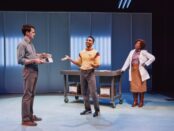
As for the play itself, "Love + Science" tells a good story, even if not necessarily a new one. It’s largely another history of AIDS with a few scientific sprinkles thrown in. Where Glass’ script succeeds is in its characters and their determination. There are two especially poignant moments, conveyed by Melissa and Jane (both played by Williams), where they each confront Matt about how damaging his indecisiveness over owning his homosexuality is. And the scene where Jeff reproaches Matt for telling James that AIDS is 100% fatal is riveting. Lastly, it’s in the final scene where Glass’ play provides its most powerful message, when a now middle-aged Matt in 2021 compares the body count of AIDS to that of COVID-19, contrasting the swiftness with which the governments of the world produced a vaccine for COVID-19 where they have yet to create a vaccine for HIV, 40 years into the AIDS pandemic. [more]
Einhorn has reshaped the dramatic elements of the original play to focus primarily on antisemitism. What he achieves is a show that highlights how the antisemitism of the 16th century is connected to the religious dogma of that period, with aspects of it extending to the present day. Although it is superficially faithful to the themes of the source, it is still a play that deals with the elements of prejudice, justice, love, and societal norms within the context of antisemitism. It is for an audience that enjoys a well-acted, thought-provoking story with a solid point of view. [more]
In its earliest scenes--as a Marvin Gaye record spins on the turntable, Adam Honoré's lighting design pairs naturalistically with Wilson Chin's meticulous set, and Dominique Fawn Hill and DeShon Elem's beautifully redolent costumes delight our eyes with vibrant patterns--"This Land Was Made" achieves an authenticity that makes you want to sit at the bar and order some lunch, too. Ironically, it's when Newton (Julian Elijah Martinez) and his comrade Gene (Curtis Morlaye) enter the story that the play's verisimilitude begins to come undone. Abandoning realism for audacious dramatic license, "This Land Was Made" turns into an intellectual showdown between Newton and Troy, with the latter becoming entangled in the fatal incident that led to Newton's imprisonment. [more]
Whether you are a basketball fan or not, Rajiv Joseph’s "King James" is an intriguing depiction of an unlikely friendship over 12 years. Under Kenny Leon’s polished direction, Glenn Davis and Chris Perfetti hold the stage with their complicated relationship and representation of male friendship. Although the play doesn’t tackle new ground, it remains absorbing as time passes and the men’s careers take different paths. [more]
The six-member cast creates a believable ensemble though their roles are not all clearly defined. While the play reveals much about the Haitian community living in Brooklyn, as 'Bernarda’s Daughters" feels almost plotless it seems to drift from one conversation to another with little or no structure. The idea of an updated Americanized version of Lorca’s very Spanish tragedy "The House of Bernarda Alba" is a good one. However, this is not as compelling or successful as Marcus Gardley’s "The House That Will Not Stand" which reset the play in 1813 New Orleans. [more]
"GAS" by Charles Cissel explores the “never-never land” of a war without end. It is a time when the characters examine the unreality of the experience. It occurs within an ill-defined dimension resembling a bombed-out children's playground. Felicia Lobo guides the able cast through what is, at times, a complicated, multilayered story that ultimately fails to deliver the nuances of the script engagingly. [more]
The world premiere of Emma Sheanshang’s "The Fears" is a hilarious and poignant satire on self-help groups and the sort of people who take their emotional temperature all day long – literally. It is the latest in a new genre of plays in which the humor comes from something that may be painful but it is still possible to laugh at. Smoothly and astutely directed by Dan Algrant who has mainly worked in film, the ensemble of seven actors are entirely convincing as a group of damaged people who meet once a week at a Buddhist center in New York City to deal with early traumas that are keeping them from moving on in their lives. While the play fails to make a bigger statement, it remains entertaining and engrossing throughout. [more]
While the painstaking entry upon entry yearn to be something of import, we can’t help but feel it takes a certain steadfastness and desperate commitment to make the banal seem so extraordinary. This is where the brilliant attack of performance by Ms. Lauren as Evelyn, and Violeta Picayo as Evelyn Brown, come into play. Ms. Picayo can be thought of as the younger Evelyn, but the fact is they are both the same person usually on the stage at the same time, experiencing the same ennui. Ms. Lauren is the human map of a sometime wordless exploration of isolation. There is nothing secretive about it. We are witnesses to every one of her emotions as it makes its way across her face and into her beaten down yet stalwart physical life. Ms. Picayo sometimes has that innocent wide-eyed wonder that gets her through to the end of a scene, making us pity her for her stiff upper lip and beatific smile in the face of a life not well-lived. [more]
Eboni Booth’s "Primary Trust" at the Roundabout Theatre Company’s Laura Pels Theatre is a genial, gentle tale of a genial, gentle young man and his difficulty negotiating the speed bumps of life. What keeps "Primary Trust" afloat is the light touch of its director, Knud Adams, who never lets Booth’s play bog down. Rather than wallow in sadness, Adams permits the actors—all fine—to ride the gentle waves of their fates. [more]
As directed by the astute Josh Sharp, Kayne begins his show as a stand-up act, but warns us “This is a comedy show. BUT it is also sad. There will be long stretches where you will not be laughing. I don’t want to feel like I tricked you, so I’m telling you in advance.” However, Kayne is able to find the absurdity in things that are inherently sad so that there is much humor in his one-man show. After his stand-up comedy routine, he gives a short math lesson using a white board and a black board (set design by Brett Banakis) to demonstrate that things are often not what they seem. [more]
Abortion, pro or con? The Blessed Unrest theater company has taken on this thorny issue. Steven Wangh’s "Misconceptions"—an ironically perfect title—unfolds in the form of a series of interviews which take us into every nook and cranny of the issue—pro and con. It is by no means just a dry documentary or a blasting screed, but a warm, sophisticated and ultimately moving humanization of the subject. [more]
All of this is told by Baer in Twain’s humorous and inimitable style filled with anecdotes both true and untrue. As we are told from the author himself, “I have never been a man to allow the truth to stand in the way of a good lie.” The presentation also includes sections from travel letters in Twain’s own words besides a large section of Huckleberry Finn’s adventures down the Mississippi. The presentation also sets Twain’s life in the context of the growing America of those days, events like the Gold Rush, the transcontinental railroad, the election of Abraham Lincoln, the burgeoning of literacy and the press, etc. Even if you know a good deal about the life of Samuel Clemens a.k.a. Mark Twain, Joe Baer’s one-man show fills in a great many gaps with fascinating adventures of a world traveler who had a keen eye for the ridiculous and the satiric. In "Samuel Clemens: Tales of Mark Twain," he remains good company throughout the evening. [more]
And the production is loaded with action. Except for the tender love scenes, the play moves at almost breakneck speed. Where most modern productions of Shakespeare tend toward languor, this "Romeo & Juliet," skillfully directed by the playwright and her co-director Dustin Wills, fills the moments that traditionally let the mind wander. A couple of back-to-back scenes that inform the audience, but with virtually the same content, are now played simultaneously. This makes the audience work more industriously to listen and separate out the conversations and Hansol Jung’s contemporary take on Shakespeare’s text make it that much easier to accomplish. [more]
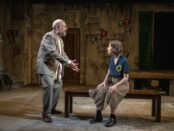
The play is structured as a mystery and that is being revealed with sensitivity and care. As each element is shown, a clearer picture of what is at stake emerges. A discussion in Act II about Hannah Arendt's work "Eichmann in Jerusalem, A Report on the Banality of Evil" triggers a conversation on the meaning of evil. This discussion of the idea of the banality of evil is the thought-provoking idea being acted out in the play: How does one judge what is truly good and what is truly evil? [more]
However, both every scene as written by Maldonado and directed by Theatre East’s artistic director Judson Jones is staged as though it were the climax. It is one thing to enact a play up to the hilt. Here there is no arc or build up. Every scene begins at the top and leaves the actors with nowhere to go. Although performed by a tight quartet of actors, as written the characters are two dimensional, telling us no back story and little about them. [more]
"shadow/land" by Erika Dickerson-Despenza is a play about the August 2005 disaster, Hurricane Katrina. It is the first episode of a ten-part magnum opus. "shadow/land," though, is more than a play. It is a painfully rich vision of what hundreds and hundreds of stranded rooftop denizens, so touted in the media, must have gone through behind the waterlogged walls of New Orleans. It is the rare theatrical work that recreates the agony and frustration of a natural disaster that transcends the fourth wall, seemingly without artifice, so involving is the entire endeavor. [more]
There’s no shortage of race-related storytelling in today’s theater and film arenas, and it takes a special entry to become seen among the offerings. "Being Chaka" is one such play; thoughtful, sensitive, and earnest, it weaves an exploration of racism throughout its distinct and intriguing characters, with compassion and without a heavy hand. [more]
Under the direction of Chad Austin, Droxler uncannily becomes not only Williams (and all of Williams cinematic characters who each serve up different helpful advice), but also his father Ed; mother Mary; and other characters, all, of course, just facets of his own persona. He even conjures the comic actor Jim Carrey who, for a short time replaces Robin Williams as an ad hoc advisor. Even Jack Nicholson makes a guest appearance. [more]
From the moment he walks out with a stuffed “Disneyfied” dragon to tell us a fairy tale his mother told him when he was little, we are enraptured by Pinky, an 11-year-old Chinese boy growing up in San Francisco’s Tenderloin. Written and performed by Wesley Du, "Hong Kong Mississippi" is a coming-of-age tale that speaks innocently, yet often in frank terms, of racism. And providing the real dose of irony, the only other character to experience a seismic shift in the play is the man who resents Pinky the most, a man who against his better judgment unknowingly becomes Pinky’s mentor and father figure he never had. [more]
Directors Noah Brody and Emily Young, both of the Fiasco Theater, have neatly trimmed the dialogue and some of the minor characters so that the play comes in at two hours and 15 minutes. However, they have made some choices that work much less well. Except for a rolling doorway to designate Merrythought’s home, Christopher Swader & Justin Swader’s scenic design does not differentiate one scene from another due to its lack of design elements. Other than the musical interludes, the productions lacks atmosphere in all its scenes. They have also used doubling and tripling to the point where it is difficult to keep straight who most of the actors are when they appear on stage in this play that has probably never been seen by most members of the audience. Most distracting is actress Royer Bockus playing three male roles – Merrythough’s son Michael, Little George, and a Servant as well as a horse named George. The role of Venturewell has had a change of gender but as Tina Chilip is still called “Merchant” but does not suggest one in her 17th century matron costume, this remains a little disconcerting. Characters who play major roles in one scene return to play minor roles in others which is more than a little confusing. [more]
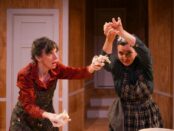
The direction by Nicholas Viselli ultimately misses a key point in this plot, which is that Alan and Annette should be staged as perpetually trying to leave Veronica and Michael’s apartment. These two couples are strangers to each other; they are not friends or even acquaintances. Yet the staging plunks the four of them together with too much familiarity and intimacy. Their situation does not call for them to remain in each other’s company for so long, or for backrubs to be exchanged, etc.; it’s just not believable. The entire premise of the plot is made implausible by blocking and acting choices that should have been redirected. [more]
I left with questions about what I had just experienced. It was not a feeling of dismissal but one of consideration for the experience. It was and is not a question of good or bad but whether it works or not as a play. The average theatergoer thinks "Waiting for Godot" or "Endgame" are bad plays because understanding them is not readily accessible. While "The Singing Sphere" is not an easy play to engage with, I think it does work, but it is for a select audience. [more]
While the playlets seem too slight to have much dramatic weight as they are mainly about one minute long, they do have a cumulative effect summing up a year that was like no other in recent memory. Often the scenes feel like they want to go and continue, but Parks keeps them short. Periodically, we have a one sentence scene telling us how many people have died from Covid as of that date. Beginning on March 13, 2020, the first full day of the shutdown, the playlets continue until April 13, 2021, a year and a month from when Parks started. An electronic sign above the stage states the date of each scene and its name which include such titles as “Home,” “Broadway Is Closed,” “The City at 7 PM,” “Who’s Gonna Pay For This?,” and “Hiatus 4 Months: Holding It Together Together.” [more]
Where does one begin to tell the story of two manifestly successful lawyers who mixed professionalism with adolescent ideation? A case where one wants a career as a serious law practitioner and the other not so much. But they both want to make money, and they both have egos that want to be in the spotlight. I suspect that Mike Breen and David Rafailedes, the writers, performers and directors of "Cellino v. Barnes: The Play," asked themselves the same question in 2017 when they decided to write a humorous play about the creation and impending demise of the Cellino & Barnes personal injury law firm. Unfortunately, in their effort to find the broad humor in the partnership's creation and end, Breen and Rafailedes missed the mark. [more]
Tangredi’s script has some lines that could stand revisiting, but even in its lack of polish it does have good dramatic bones. Unfortunately, "Muse" fails utterly on delivery. Although the direction by Hazen Cuyler demonstrates some inventive staging in scenes which take place simultaneously in different times, it completely misses the mark by not insisting the actors listen to each other in earnest and find their dialogue organically. Thus, the acting is unilaterally unbelievable; the performances are stiff and filled with maudlin, melodramatic mugging and grandstanding. [more]