What truly distinguishes the show is Dixon’s fearless psychological focus on Rose and himself. The predominant theme is of hero worship and its bruising disappointments. It also attempts to explore the issue of the often-dark contrast between the on-stage and off-stage lives of great entertainers. In examining their involvement, Dixon doesn’t spare Rose or himself from honest scrutiny. [more]
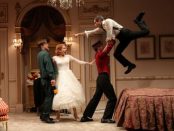
One problem is that the play (unlike Noel Coward’s "Design for Living" or Somerset Maugham’s "The Constant Wife" which cover similar territory) is neither witty not clever, and none of the lines are particularly sparkling or original. While the play may delineate liberated sexual behavior, its drawing room comedy format is too conventional and refined. All five performers always seem to be acting as their style is too arch to be truly believable. [more]
Mr. Refael’s simple but well-crafted scenario takes place in a contemporary apartment in Israel, and has the elderly Salvado looking back at his past. This is theatrically achieved by having him directly addressing the audience. His best friend and fellow survivor is to be honored at the Holocaust memorial center Yad Vashem during a ceremony where he will light a torch. When he becomes incapacitated, that task falls to Salvado. This situation instigates a flood of painful reminiscences that explore his guilt at having survived. [more]
Essentially it’s a glorified and arch 90-minute, scripted, sketch comedy show. The conceit is that it’s inspired by audience suggestions. The composition of the program changes from performance to performance. Throughout the show, slides are projected of printed extracts from online surveys of people’s theatrical preferences with the dates that they responded. These have been collected over a period of many months. The cast then performs a scene based on these answers. [more]
On the one hand, it is a punch in the gut dramatizing the cold hard facts of disintegrating with this disease; on the other, the non-linear time scheme is difficult to follow, offering more questions than it answers. What "Orange Julius" really is could be described more accurately as a screenplay or a teleplay with cuts and fades. There is a powerful work hiding in this material but it still remains unshaped. Under Dustin Wills’ fast-paced direction, Jess Barbagallo, Ruy Iskandar, Irene Sofia Lucio, Stephen Payne and Mary Testa give fine performances despite the fact that the play seems to wander around trying to find its center. [more]
What Evett delivers—using ample quotes from the poem and robust contributions from himself and Spangler—is a terrifying inside look of the Mariner’s experiences, beginning with being hijacked by a friend at a pub. He breathlessly illuminates what the day-to-day life was like with lurid descriptions of illnesses and exciting second-by-second reports of battles with other ships. [more]
Reading David Foster Wallace’s Infinite Jest while lying on a couch is Jay, a slacker-looking type in his 30’s. Sitting in the living room nearby is his 60ish mother who enjoys watching Dr. Phil on television and complaining about her ailments. Gabe McKinley’s Homebody is an enthralling black comedy with shades of Grey Gardens. Mother and son bicker, rehash recriminations and share their joy over the possibility of Jay’s novel being published. In 35 minutes, Mr. McKinley delivers a very well written, plotted and satisfying one-act play. It’s so pleasurable that a full-length version would be most welcome. [more]
As Paul Harold, a 60ish artist, Pendleton has a leading role that wonderfully showcases his idiosyncratic and considerable talents. With his unruly white hair, limber physicality and distinctive vocal twang, he mines all of the humor and depth of this fascinating character. Sharing the memory of when he met Pablo Picasso in his youth is a vivid moment. [more]
O'Connell’s script is a well-structured series of confessional anecdotes interwoven with the lore of the movies. His performance is a riveting blend of stand-up comedy and grand stage acting with Shakespearean flourishes. The audience is on three sides of the very small theater. This intimate space at times feels too constrained for the unbridled emotionalism on display. [more]
In "DannyKrisDonnaVeronica," playwright Lawrence Dial bitingly delves into the lives of two Brooklyn couples each with two small children. Through his precise, often humorous and realistic dialogue, Mr. Dial has his very well-drawn characters who all in their mid 30’s eloquently express their conflicted feelings and despair. Short on actual plot, the play is rich in incident and is a wistful character study. [more]
The stories included are equal parts humorous, stirring or sobering but always meaningful and intimately personal. Deblinger is a natural storyteller, and every tale is polished and fully developed, and--more importantly--consistent with the show’s overall theme. Further, Deblinger is a fantastic impressionist, and the show contains no less than 15-20 fully realized character impersonations. The versatility he displays is a testament to both his natural abilities as well as his dedication to his craft. [more]
Set in The Afterlife, a crossroad between Heaven and Hell, the play presupposes a trial of Luther on the grounds of being guilty of “the unforgiveable sin.” The prosecuting attorney is The Devil and the defending attorney is Katie von Bora, also known as Mrs. Martin Luther, with Saint Peter acting as judge. The witnesses called are Hitler on Luther’s anti-Semitism in his later years, Dr. King on Luther’s stance on civil rights, Dr. Freud on Luther’s Oedipus complex, and the current Pope on the Catholic Church’s stance on Luther’s objections today. Along the way, the play also dramatized scenes from Luther’s life. Ultimately, it ends with a recreation of Luther’s trial before the Diet of Worms officiated over by the Holy Roman Emperor in 1521. [more]
Playwright Beth Hyland’s very effective conceit is that we’re watching the dress rehearsal of Annie Lambert’s memorial celebration in an auditorium of the State University of New York at Onondaga. There, students act out Ms. Lambert’s story in the manner of a Greek chorus often directly addressing the audience. “What would Annie have wanted?” [more]
While Harms has a fine ear for dialogue, the play moves by revelation and incident. Consequently, it plays like a sophisticated soap opera as every scene brings a new wrinkle not previously suggested. Drew Foster’s direction is smooth and polished but he can’t prevent the play’s plot from having too many incidents that aren’t foreshadowed. Steven Hauck, Elizabeth Rich and Amy Bodnar are charming in a worldly, cultivated way. However, we learn so little about each of them other than how events affect them that they seem one-dimensional. Important facts are left out: what is the rooming situation, are Julian and Agnes married, etc.? The sexual tension is clearly defined: dancing seems to be foreplay to sex. But one can’t live on love alone. [more]
Surprisingly, Eleanor Reissa’s production for New Yiddish Rep has made some debatable choices which damage the power of the play. First of all and most obviously, although not a word has been updated, the characters wear contemporary clothing and use modern objects like headphones, a plastic umbrella and platform shoes. Since there are references to opening a horse stable and the sexual mores of 1907 have changed considerably, this is both distracting and confusing. (The word “roubles” has been eliminated for the more innocuous bucks and coins.) [more]
Director and choreographer Jessica Burr has created a number of dazzling moments with her precise unison of expressive staging, movement and dance. With only a few vintage trunks and a door, all on wheels, Ms. Burr achieves many vivid stage pictures. Walking up a flight of imaginary stairs is a thrilling display of mime. Burr’s work with the ensemble, most of whom play several roles is excellent with their colorful characterizations as evidence. [more]
Two ways to invigorate Shakespeare in our time is to either cast actors not identified with classical roles or to reset the play in some unfamiliar setting. Sam Gold’s magnificent production of "Othello" at the New York Theatre Workshop has done both. [more]
Aaron Port (Josh Radnor), a down on his luck writer, is reduced to teaching Adult Ed classes in middle class/middle brow 1960’s Levittown, Long Island. Richard Greenberg ("Take Me Out," "Our Mother’s Brief Affair") in his new play, "The Babylon Line" at the Mitzi E. Newhouse, has Port frequently speak directly to the audience, doling out information and setting the scene, from the vantage point of 2015. Although it’s an awkward device it does come in handy, particularly at the end when a number of plot strands come together. Port’s frustration with his career is exacerbated by having a successful friend, Jay, confront him en route to his teaching assignment. [more]
Seven musicians of Egypt’s Alexandria Ceremonial Police Orchestra have been sent to Israel to open the new Arab cultural center at Petah Tivah. Due to a mix up at the border, they end up in the dead-end desert town of Bet Hatikva which has no hotel, no culture, and no bus until the morning. However, their visit is the most interesting thing to happen in Bet Hatikva in years as these unlikely visitors represent something different from the outside world. Restaurant owner Dina (Lenk) once a dancer in a big city, now resigned to her boring fate, takes pity on them, feeds them and arranges for them to stay the night in three places including her home. She takes dour, formal conductor Tewfiq (Shalhoub) and young ladies’ man, Haled (Ari’el Stachel). Although the visit is only one night, none of them will ever be the same again. [more]
Raucous highlights include a jive reinterpretation of A Christmas Carol, “by Chazzie D, about a cat called Scrooge...who lives in Scrooge Tower.” There’s also Buckley’s irreverent take on The Gettysburg Address, “I’m a Lincoln cat.” Intertwined are Broder’s cool renditions of “On The Sunny Side of The Street” and “Georgia On My Mind.” He also demonstrates excellent saxophone and tambourine playing. [more]
The audience sits on either side of the large runway stage that set designer Laura Jellinek has arrestingly fashioned into an indoor soccer field. It’s a green vista of Astro Turf that gives the sense “…that the field goes on forever,” writes playwright Sarah DeLappe in her stage directions. [more]
LeFranc’s dialogue is a marvelous blend of the realistic and mundane. The well-delineated main characters all express themselves with true to life simplicity. Plot developments are the combination of subtle details that gradually do build to a satisfying resolution. It all has the sense of John Cheever’s suburban short stories where the darkness behind bonhomie is revealed. Swimming pools are mentioned in passing. [more]
"The Big Uncut Flick is a 1953 live, mid-day movie program broadcast on the Dumont network. The audience is addressed as if they were the studio audience. The stereotypical hosts are a married couple. Jack Sheldon is a hyper announcer type and Arlene Lewis is a grand dame. During commercial breaks they extoll dog food, cigarettes, frozen dinners and laxatives. There’s a quiz show portion as well. References to Sen. Joseph R. McCarthy and the Red Scare are also tossed in. [more]
"This Day Forward" shows much tighter control than many of Nicky Silver’s early anarchic plays. However, aside from offering a few wonderful characters in Malka and the older Irene, the play is disappointing as it sets up expectations which don’t play out. When "This Day Forward" is over, it leaves a feeling of something missing that has failed to take place. It can’t simply be saying that the sins of the parents are visited on the children – or could it? [more]
There is no plot, just a series of verbal jousts played out on Riccardo Hernandez’ sleek, two-tier set with just the image of trees looming over the actors wearing Montana Blanco’s colorfully exaggerated costumes. From the childlike Prunes and Prisms of Ms. Sithole to the angrily twisted Bigger (a reference to Richard Wright) of Mr. Piniella, the actors recite the difficult lines, goaded to do their finest by director Lileana Blain-Cruz who totally understands the work. [more]
The real life Internet hacktivist and Reddit developer Aaron Swartz contrives to have his fictional childhood friend Billy, who is a theater teacher of prisoners, to collaborate on a play about Bradley Manning in order to galvanize public opinion in favor of his clemency. During the moving climax, they act out the roles of Manning confronting President Barack Obama. [more]
The framework is a fictional fiftieth anniversary party given in a New York art gallery by collaborating media/visual/performing artists Malik “Mk Ultra” (Christopher Livingston) and Jimmy “Primo” (William Ruiz a.k.a. Ninja) to commemorate the creation of both the Black Panther Party and the Young Lords. Their interest is familial: Jimmy is the nephew of Tito (Jesse J. Perez), a former Young Lords Party member still involved with union organizing, and Primo is a “Panther Cub” as he is the son of a Panther member now in prison. They want to pay homage as well as reveal unspoken truths. Malik and Primo have created a video of the many former party members that they have interviewed that they plan on debuting at the event. The party with people who have not spoken for years will be a charged reunion. The troubled legacy of the two organizations is thoroughly explored in the course of "Party People." [more]
It isn’t until the second act of Dan Gordon’s stage adaptation of "Terms of Endearment," based on both the Larry McMurtry novel as well as the Academy Award-winning screenplay by James L. Brooks, that the play takes off. Featuring the now grown-up film star Molly Ringwald in the role of Aurora Greenway that won Shirley MacLaine the 1984 Oscar for Best Actress, the first act jumps around, skipping huge chunks of time as you can in movie cutting, but seems like something is has been left out on stage. [more]
Watching these three actors is an incredible experience. As Willie, the slower, funnier tea room worker, Sahr Ngaujah, often the butt of the jokes, never loses his humanity. Noah Robbins finds all the complexity in the adolescent Harold, and Leon Addison Brown makes dignity palpable and believable as Sam. [more]
Besides guiding these engaging performances, director Christopher Martin has meticulously staged the action on the arresting minimalist set that he designed. The floor and brick walls are white. There is a small black rug on the floor near the two plush black cube chairs. Red leaves are strewn about and there’s a pile of them as well. In view are the theater’s windows, an air conditioner and a shelf with a coffee service and drinks. [more]
"Man in Snow" begins and ends in tragedy. In between there is an insightful, sometimes banal, study of a middle-aged man, David (an awesomely complex Will Lyman), his bumpy relationship with his wise wife, Franny (Sandra Shipley, whose even-handed façade hides deep emotions), his daughter Emily (lovely, bright Ashley Risteen) who harbors grudges that pore out at the most unfortunate times and his beloved son Joey whose death in a car accident opens the play. [more]
Mr. Irving has an amazing singing voice that soars from octave to octave. His witty songs include a funny one about texting. He tells an epic story about his parents meeting. His musicianship is tremendous as he plays banjo, bouzouki, shruti box, mbira, jew's harps, whirly tube, scacciapensieri, and the ocean harp during the show. He does a wild dance to America’s “A Horse With No Name.” [more]
That sequence is just one of the highlights of John Doyle’s commanding direction. Best known for his vibrant minimalist approach to musicals, Mr. Doyle brings that precise and visually expressive focus to this play. The cast of ten is expertly placed and moved around the relatively bare and spacious stage creating tension, excitement and striking tableaus that all connect to the story. There are also many presentational flourishes. [more]
Though the premise is an interesting device for dissecting the friendship between two men--for surely many men are curious how they are perceived by their better halves (self included), the play doesn’t aim to say much otherwise. Acting choices, pacing and thematics are all appropriate thanks to Lee Sunday Evans' seamless direction, but it’s the script itself which is the production’s biggest hurdle. Though there are some interesting and engaging ideas presented regarding the mind of the male, the untidy and nondescript ending make no attempt to make any significant statement about any of it, ultimately shrouding the entire production in a veil of murky, middle-ground mediocrity. [more]
“He” and “She” are a 40ish upper middle class couple who divorced ten years earlier following the traumatic death of their young son who was hit by a car. Due to toxic waste from a nearby gas factory, 200 graves, including their son’s will have to be dug up and the remains reinterred elsewhere. This unpleasant circumstance instigates this reunion after a long estrangement at a cemetery in Holland. [more]
The actors make the characterless space come alive. Elizabeth Van Dyke (Zora Neale Hurston) shrouds Zora with the same purity and authority that she conveyed in the 1998 production. Zora never pandered to convention -- Harlem Renaissance beliefs (Langston Hughes or Richard Wright) or white America politics. Zora walked her own path and was unwaveringly true to who she was and her ideas about art, politics, men and women, academia, and Black culture. Van Dyke towering performance is one that depicts Zora's all these character traits, as well as having a vulnerability and zest for life.
[more]
Told in real time from five to seven PM on Election Day, November 8, 2016, not much happens in the play but as the Gabriel women talk, they reveal their hopes, their fears, their desires and their memories. By the end of the play, we know everything there is to know about them. Under Nelson’s direction, his cast of six who now have played these people in three plays since February 27 (first "Hungry" and then "What Did You Expect?" which began previews on Sept. 19) are not so much acting these characters as living them. [more]
Shrouded by clear shower curtains, the actors enter the stage and bring out furniture, including a gramophone, and chat with each other. There is newsreel footage proclaiming the end of W.W. II in Great Britain. Half-baked anachronisms pile up during the next two hours and half hours. These include the intermission shtick of old-time drive-in movie announcements, “The show will start in five minutes…visit the snack bar… for buttered popcorn.” [more]
"Sweat," which won the 2016 Susan Smith Blackburn Prize, is reputed inspired by interviews conducted by playwright Nottage and director Kate Whoriskey in Reading, Pennsylvania, named the poorest city in America in 2011. By 2007, Reading had seen its factories and mills closing as NAFTA and globalization made it cheaper to produce goods in Mexico or China, without offering its residents anything but unemployment insurance. The play could probably have taken place in one of a dozen places in the Rust Belt. "Sweat"’s main characters are all eventually affected by this downward trend in a community that has few opportunities. [more]
Just as Ulysses S. Grant and Dwight D. Eisenhower did centuries later, Coriolanus, urged on by his powerful mother, Volumnia (a startling, stinging Lisa Harrow), uses his military success as a springboard for a high political office, Consul, which he easily wins with help of two Tribunes of Rome, Sicinius Velutus (a wily Stephen Spinella) and Junius Brutus (Merritt Janson, playing cross gender to perfection) and a friend, Menenius Agrippa (Patrick Page, using his weighty voice and commanding eyes brilliantly). [more]
The pomposity of the Tony Kushner-style title extends to naming its leading characters “The Academic” and “The Writer.” They’re two gay men in their late 20’s and the play charts their meeting, relationship, breakup and aftermath. This is accomplished by a dizzying structure of non-linear, rapid-fire, time shifting brief scenes. This intrusive device undercuts emotional involvement with the couple, as all of the jumping around of the narrative becomes artificial, repetitious and uninvolving. The period covered ranges from 2006 to 2011. [more]
Focusing on a group of roughly fifteen regulars that attend the homeless shelter in question, the play is a series of intimate and telling conversations between homeless people of all different walks of life--and their myriad ways of ending up in their current position. Playwright Zeiger, who is also founder and artistic director of producing company The Platform Group, plays Diana, a recovering addict and recent widow who is constantly struggling with staying clean. Playing a woman who is broken and beaten down, Zeiger’s familiarity with the script gives her performance an authenticity which is truly garnering of sympathy. Joanie Anderson plays a community college student named Melissa, who sleeps on the subway and desperately wants to better herself but just can’t seem to break the cycle. [more]
Not only does Nguyen have a unique sensibility and style, but the story is told entirely from the Vietnamese-American point of view, one not often seen on our stages. We hear the Americans as the Vietnamese do and as the Americans attempt to speak in Vietnamese. While the structure of the play is quite challenging going backwards and forwards in time from July 1975 in a Middle America relocation camp and breaking out in rap songs periodically, "Vietgone" is a very compelling portrait of displaced people trying to make a new life for themselves while wishing they were back home where they cannot go. [more]
Whether you see one or both of Gurney’s "Two Class Acts," these are provocative plays of ideas on topics of the day. The playwright continues to demonstrate that he has a wise and discerning view of the human condition. Director Stafford Arima has done a beautiful job of obtaining all of the nuances and humor out of the two sharp and intelligent situations. The casting for both plays could not be improved as the actors make their roles their own. The Flea Theater leaves White Street on a high note with two entertaining and superior productions that will close the space with honor and distinction. [more]
British actor Richard Armitage making his New York stage debut and Tony and Academy Award nominee Amy Ryan work hard to make Kenneth and Sandra three-dimensional, likeable people, but, as written by Mr. Bartlett, their crassness is the fatal flaw in "Love, Love, Love." Why should we enjoy spending so much time with two people who so adroitly care only for themselves? [more]
Healy’s treatment is faithful to the novel with a good deal of it being Clegg’s narration addressed to the audience. There are lengthy conversations between Miranda and Clegg, and her escape attempts are depicted. No matter how skillful Healy’s stage version is, it’s still two hours of often-philosophical talk between two characters in an unpleasant situation. [more]
Founded in 1991, the National Asian American Theater Company’s mission is to present theater with all Asian-American casts. This is accomplished by producing classics of European and American works of dramatic literature, or adaptations of these works by Asian-American playwrights or new plays written by non-Asian Americans, not for or about Asian Americans. That last precept is the case of this East coast premiere of "Sagittarius Ponderosa." [more]
Benjamin Stuber’s puppetry designs are a disappointment and should be more thoughtful and complementary to the play. Ghoulish puppets that are meant to disturb seem make-shift and thrown together. There is only one disturbing and appropriately quirky puppet effect – the appearance of a huge eye, set into a collage background of assorted textiles. [more]
In his Broadway productions, David Leveaux has often used a strong directorial concept such as his Chekhovian 'Fiddler on the Roof" and his interracial "Romeo and Juliet" which did not work for all theatergoers. Here he seems to have decided that Susan finds life in Britain gray on her return and all of the sets by Mike Britton other than the final one (ironically suggesting the hope of the post-war generation) are made up of gray walls. As a result, none of them have any atmosphere aside from all resembling each other. It is left to the costumes by Jess Goldstein to give clues to the year of each scene which they sometimes do, and sometimes not. [more]
Company XIV has applied its inimitable Baroque-Burlesque style to the Greek myth of the Judgement of Paris for the second time and come up with Paris, an exotic and erotic adults-only entertainment that is like nothing else you will see this year. Conceived, directed and choreographed from the fevered imagination of Austin McCormick, Paris combines the arts of dance, opera, circus, theater, storytelling and high fashion to tell its story of the competition between the goddesses Athena, Juno and Venus for the Golden Apple. As you may know, the future outcome was eventually The Trojan War. [more]
The play is both satiric and trenchant. The conversations of the men are laced with profanity much like David Mamet’s real estate men in Glengarry Glen Ross. Eliza is called everything in the book (arrogant, aggressive, disrespectful, impatient, a loose cannon) as well as names you can’t print in a family newspaper. Eventually it rubs off on Eliza and Janice and they are cursing as crudely as the men: if you can’t beat them at their own game, then join them. The men’s fear of the women getting ahead would be pathetic if it weren’t so typical and true. Rebeck dramatizes office politics as each member of the staff worries about his or her own skin, either with lies, evasions or manipulation, and the circle keeps widening, until Eliza beats them at their own game. [more]
Pierce coolly addresses the audience while delivering this mundane litany. His superb comic timing, long evident on the television situation comedy "Frasier," is on glorious display here. That quality combined with his dramatic depth and soothingly funny delivery makes this opening sequence mesmerizing. [more]
British author Stephen Sharkey’s new translation is faithful to Brecht, but the Phoenix Theatre Ensemble has fashioned the presentation as an old-time radio show. Brecht was known for his self-conscious style of distancing and alienation, where the audience is made aware that they are watching a play but this additional device is a distraction and not as funny as intended. [more]
While S. N. Behrman was one of the leading Broadway playwrights from the twenties through the early sixties, he went into an eclipse after his death in 1973. Since 2000, however, there have been New York revivals of his major comedies "The Second Man," "Biography," "No Time for Comedy" and "Rain from Heaven." Set in the living room of a summer cottage on an estate in Northern Maine where the rich Frothinghams go to get away from the problems of the world, circa 1936, End of Summer resembles Chekhov’s "The Cherry Orchard" in that they both concern wealthy people refusing to recognize the changing social order. However, S. N. Behrman’s play is very much a comedy with its cool, urbane witticisms and very American in its outlook and content. [more]
Visual artist and puppeteer Jessica Scott navigates through a satiric and fascinating new media “seascape” with a dysfunctional ship’s crew, albeit all women. Scott’s "Ship of Fools" uses nightmare structure, intentionally drawing from Book VI of Plato’s "Republic" (from whence its title came), Bosch imagery and other surreal allegories, depicting the fine line between heroines and madness. [more]
In "The God Projekt," the “Divine He” repeatedly tries to make reparations for his past destructive deeds, but to no avail. God is wrestling with dementia and in a time loop. Yet, he is determined to correct, well, his god-awful mistakes -- one of which is not only acknowledging the “Divine She” in his heavenly order, but atoning for a heinous crime against her. [more]
Obie award-winning playwright José Rivera is an Oscar nominee for his adapted screenplay for "The Motorcycle Diaries." For this adaptation, he has set "The Maids" (which premiered in Paris in 1947) in Vieques Island in Puerto Rico in 1941. This was a politically tumultuous era with native factions resisting the U.S. presence there. Mr. Rivera’s script reflects this situation and locale and is filled with cultural references to sugar cane, bustellos and revolutionaries. [more]
The scenic design by Brett Banakis is a functional, minimalist configuration of a slightly raised wooden performance platform surrounded by a wooden frame dotted with small antlers suggesting the pub. There’s an assemblage of vintage furniture, potted plants, screens and vines that are shifted about to designate the various locations. This all contributes to a deficit of visual grandeur that the production is understandably striving for on a limited budget but doesn’t achieve. These design flaws could be superseded by an abundance of bravura performances, but there aren’t. [more]
Ibsen’s "An Enemy of the People" is a classic of modern drama but at times it can seem musty in a poor translation. David Harrower’s "Public Enemy" is not only a shrewd, accessible adaptation, it also makes clear the contemporary relevance of the dangers of the herd instinct in a seemingly just society. The Pearl Theatre Company production is a must-see for all good citizens, particularly in these perilous times. [more]
Playwright Helen Edmundson whose stage plays have been mostly adaptations of famous literature ("The Mill on the Floss," "War and Peace," "Anna Karenina," as well as "Coram Boy" and "Thérèse Raquin" both seen on Broadway) tells her story in the leisurely way one might write a novel. While the material is both shocking and surprising, director Pamela Moller Kareman has undercut the inherent tension in the play by the choices she has made. [more]