Off-Broadway
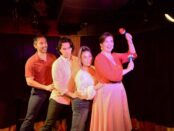
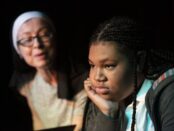
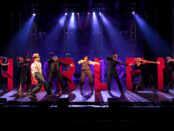
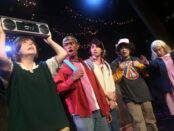
The show is a deft combination of action and humor with elements of horror. One of the production numbers, "Dissection Dance," is an homage to the "Time Warp" choreography of "The Rocky Horror Picture Show." The name of the high school, George R. Romero High School, invokes the zombie horror films he created. And with the ensemble's comedic timing, the show delivers an entertaining romp, with a feminist twist, through the psyche of three adolescent girls: Madison, Stella, and Grace. It needs a bigger stage and more actors but it is still an entertaining theatrical experience. [more]
Lizard Boy
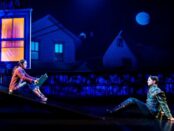
Scheduled to run only until July 1, "Lizard Boy" deserves a longer life as one of the most satisfying musical theater offerings to be seen currently in New York. While the message of tolerance and diversity is not heavy, the theme is dramatized so that no one can mistake its intent. The three-person cast is superb in the acting, singing and musical departments. Brandon Ivie’s staging is clever and imaginative, while the book, music and lyrics by Justin Huertas make audience goers look forward to his next project with eager anticipation. [more]
Singfeld! A Musical Parody About Nothing!
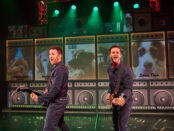
Picking the easiest possible creative path, a decision the effort-averse George would no doubt admire, the McSmiths forgo imaginative risk-taking in favor of simply copying their source material, shaping "Singfeld!" as a parody musical about writing a parody musical. In other words, "Singfeld!" is also about nothing, which makes the entire endeavor feel, at times, akin to a Sartrean spiral or, as Jerry's archnemesis Newman (Jacob Millman) more bluntly puts it, "hackey." That's not to say there aren't some funny moments during "Singfeld!," but when humor is largely based on "remember when?," the comedic ceiling is right above your head. [more]
Days of Wine and Roses
Lucas’ script remains faithful to Miller’s teleplay (with the excision of Joe’s delirium tremens in the psycho ward or his second hospitalization) and much of the dialogue is actually Miller’s. However, the problem is the score. Guettel’s 18 songs (including four reprises) are often atonal, unmelodic, unrhymed and don’t scan. While this is true of the Tony Award-winning "The Light in the Piazza" that score had such a lush sound that it was automatically romantic and appropriate for its story. Here it is almost as though Guettel is striving for opera but without the orchestral underpinnings to make it so. The lyrics are mostly recitative, abstract and metaphorical. Aside from three songs in which Joe or Kirsten are joined by their seven-year-old daughter Lila (played by Ella Dane Morgan), only the couple sing, with O’Hara given seven solos. The real problem is as Stephen Sondheim said about his musical Do I Hear a Waltz?: these are characters that wouldn’t sing so the only way to solve this is to have made "Days of Wine and Roses" an opera with a great deal of orchestral music. Here the songs do not add anything to the story. Like Marvin Hamlisch’s score for the stage version of "Sweet Smell of Success," Guettel’s music is devoid of atmosphere, period or otherwise, unless this is the fault of the orchestrations by Guettel with additional orchestrations by Jamie Lawrence. [more]
Khan!!!The Musical, A Parody Trek-tacular
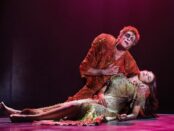
The music is well-done, with the songs fully integrated into the storyline and lyrics that help define essential elements of the character's nature and are filled with inside Star Trek references and jokes. For example, when Theerakulstit skillfully sings "Young," entirely in character as Kirk, we hear Kirk as an older man regretting getting old and no longer able to be the arrogant swashbuckling starship captain of his youth. When we meet Khan for the first time, Kropp sings “My Wrath,” which gives a history of how he came to be in this place and the reason for his extreme anger at Kirk. Although many of the references will be missed by a non-Star Trek audience, the songs are well-constructed, and more importantly, they are sung by a cast that knows how to sing on key and on pitch. While you may not leave the show humming a tune, they are the types of songs that one will return to without getting bored. [more]
Bliss Street
The main issue with this show is the lack of clarity in the book. Who is the play about, the father or the son? Act I is primarily a story about Paul Sub and his business ventures leading up to the creation of The Coventry. Act II is more about Charlie Sub and how his father's business decisions impacted Charlie's life. In both cases, the story's elements need to be restructured to make it more compelling. Does it matter what type of romantic relationship Charlie develops in LA? Did Paul's liquor store fail after the robbery? The book needs to be edited to define clearly which story is being told and to eliminate the scenes that do not advance the story. [more]
New York City Center Encores!: Oliver!
When Mary-Mitchell Campbell’s baton brought out the first notes of the "Oliver!" overture from the Encores! Orchestra, the memorable tunes just flowed and didn’t stop until more than two hours later at the standing ovation and exit music. Lionel Bart’s score is rich in melody, the lyrics and the libretto evoking Dickens while still being theatrical. (The late William David Brohn did the lavish orchestral arrangements.) Lear deBessonet, the show’s director (and the Encores!’ artistic director) has fashioned a fast-moving evening filled with great performances starting with the sweet, fresh-faced Oliver of Benjamin Pajak and the incredibly talented ensemble of kids who gambol about with abandon. [more]
On the Right Track
The latest collaboration by composer lyricist Albert M. Tapper and bookwriter Tony Sportiello, "On the Right Track," proves to be a charming chamber musical for three performers playing seven roles. The show combines realism with magic and the supernatural as it tells three stories which take place on a New Jersey Transit train. The Conductor, the narrator, also is a mystical figure who is able to give the characters second chances in life and lea them to a better place than when they came on board. Owing some inspiration to such classics as Sir James M. Barrie’s "Dear Brutus", Sutton Vane’s "Outward Bound" and Frank Capra’s "It’s a Wonderful Life," "On the Right Track" avoids being preachy at the same time that it offers suggestions about how to live one’s life. [more]
Vanities – The Musical
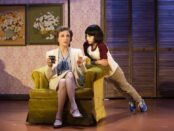
Although the women grow up and change over the 26 years we see them, Heifner’s book tends to stay away from politics and the women’s movement other than mentioning markers like Kennedy, Nixon and Bob Dylan. However, the dialogue is bright and lively. The show is definitely a period piece ending as it does in 1990 but there are probably women who still live these lives. While in no way taking a feminist point of view, the characters do evolve and change over the years. [more]
The Harder They Come
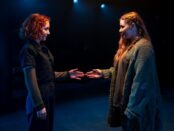
Celebrating the 50th anniversary of its original film release, Pulitzer Prize-winning playwright Suzan-Lori Parks has turned "The Harder They Come," the cult Jamaican film that starred later reggae legend Jimmy Cliff, into an exuberant stage musical now at The Public Theater. Led by British stage star Natey Jones and American Caribbean actress Meecah, the large cast does full justice to the new score which includes the ten songs used in the movie plus 26 other Jamaican and traditional songs, additionally interpolated ones by Cliff and others, and some with additional lyrics by Parks. There are also three original songs by Parks herself who when she is not involved with one of her plays fronts her own rock band. [more]
Dear World (New York City Center Encores!)
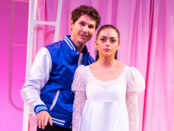
"Dear World," the not terribly successful 1969 Jerry Herman musical based on Jean Giraudoux’s "The Madwoman of Chaillot" (1945), was basically a vehicle for the brilliant Angela Lansbury. It needs a star to pull off its quirky inconsistency and New York City Center Encores! has a gem, Donna Murphy, who, though under-rehearsed due to a Covid scare and carrying her script, gives a colorful and moving performance as its central character, Countess Aurelia. [more]
I Love My Family, But…
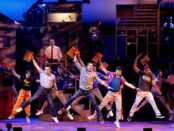
The show is billed as a musical, but it is more concert than play, strong in music and weak in the storyline. The songs cover a lot of emotional ground, many with a humorous edge, but the book only provides a slim dramatic structure for the characters' actions. What is missing is more detail about who the characters are and for what reason we should care about the events being depicted. The dialogue is more of an introduction to the songs than a dramatic link to the overall story. [more]
Cornelia Street
Although British playwright Simon Stephens has written three musicals with composer/lyricist Mark Eitzel, formerly of the indie rock band American Music Club, Cornelia Street, set on a quiet back street in the West Village, is the first to arrive in New York where it is having its world premiere courtesy of Atlantic Theatre – Stage 2. Led by two-time Tony Award winner Norbert Leo Butz who is on stage almost throughout the show, "Cornelia Street," an elegy for a bygone age of unique Village restaurants and coffee houses, does not give its cast enough to do. The songs do not forward the plot but tell us what we already know, and the plot such as it is does not get going until the second half. An interesting attempt to create a place and its regular denizens on stage, "Cornelia Street" in this form does not make a satisfying statement. [more]
Who Murdered Love?
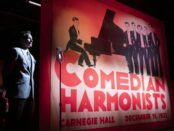
What is a mystery inside a riddle wrapped in an enigma? A Winston Churchill question from 1939 aptly fits a play with music set in 1924 that toys at being a murder mystery. As a play with music "Who Murdered Love?" doesn't work. As a play without music, it doesn't work as well. It is Dadaism with Surrealist overtones, and Surrealism with Dadaist overtones, if anyone in the audience knows what Dada or Surreal means. [more]
Lady in the Dark
Unfortunately, this is musical comedy and does not need operatic voices, Lawrence being famously a singer with a very small range, while Kaye came from cabaret and night club. With all of the leads double cast, Sunday matinee’s singers seemed either miscast or poorly directed by Eric Lamp and Benjamin Spierman. Matthew Imhoff’s sets which are carried on and off by the singers took an inordinately long time and there were moments of dead time during office scenes which also seemed underpopulated. While conductor and artistic director Michael Spierman gave a creditable performance of the complete score, it did not seem to hang together but felt like individual numbers, unlike many other Weill scores which feel integrated and whole. [more]
F*ck7thGrade
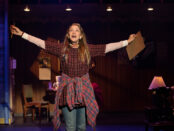
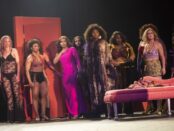
Singer/songwriter Jill Sobule’s life story is on display in the charming cabaret musical "F*ck7thGrade" – with a difference. Sobule, the original “I Kissed a Girl” composer/lyricist, plays herself in this one-woman musical which features a band of three voicing other roles. The score is made up of her greatest hits plus four new songs. Since so many of her songs are autobiographical, they segue beautifully into the story of an unhappy childhood and later success as a performer and writer. Liza Birkenmeier’s book is based on months of interviews with some of the names changed while others are left intact. [more]
Hoagy Carmichael’s Stardust Road
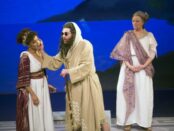
The York Theatre Company’s masthead reads “Where Musicals Come to Life…” and that couldn’t be more evident in their new production, "Hoagy Carmichael’s Stardust Road." Originally scheduled for a Fall 2015 run at London’s St. James Theatre (cancelled due to a key investor pulling out), then workshopped during a summer student production at Indiana University’s Department of Theatre, Drama and Contemporary Dance in 2018, the show finally arrives in a beautifully crafted production at York’s Theatre at St Jeans, deserving of an open-ended run or commercial transfer. Conceived by director Susan H. Schulman, choreographer Michael Lichtefeld and musical arranger Lawrence Yurman, and developed with Hoagy Bix Carmichael (Hoagy’s son), "Hoagy Carmichael’s Stardust Road" succeeds not by showing the audience another “And Then I Wrote” compendium, but by allowing the endless riches of the Carmichael songwriting catalogue to say it with music. We are treated to five extended “parts” where we meet seven characters, all friends, as they traverse the decades from the 1920’s to the 1950’s, through every high point and every heartache. [more]
Parade
World events have inadvertently raised the significance of the New York City Center’s Annual Gala presentation of the brilliant new staging of the Jason Robert Brown/Alfred Uhry musical Parade which debuted over two decades ago. Anti-Semitism and xenophobia have risen to epidemic levels. This moving dramatization of actual events drives home the inevitable results of such unreasonable hatred. "Parade" is the gripping story of Leo Frank (Ben Platt), a Brooklyn Jew, who moved to Atlanta, Georgia for a better job. He married a Southern Jew, Lucille (Micaela Diamond), whose southern version of Judaism confuses him. Frank was the manager of a pencil factory and was accused of raping and murdering a 14-year-old white employee, Mary Phegan (Erin Rose Doyle), on Confederate Day, 1915. This almost operatic musical drama impeccably depicts how Phegan’s death led to a flowering of the anti-Semitism (twisted to the prosecution's benefit, horribly during Frank’s trial) and the KKK. [more]
HOUND DOG
Director Machel Ross does little to guide this play to any semblance of cohesion. Scenes 1 and 13, between Hound Dog and Ayse, her childhood best friend, begin with the exact same lines and stage blocking up to a point…so, did one scene happen and the other one not happen? Which is the real scene? Scene 6, between Hound Dog and Yusuf, the neighborhood trash collector and best friend to Hound Dog’s father Baba, happened three days after their meeting in Scene 4, or is it, as Hound Dog perceives, only yesterday? [more]
Weightless
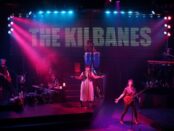
"Weightless" is an engaging little indie rock musical, little in the sense that it has only three characters plus a narrator and runs only 75 minutes of playing time. The show features the Bay Area rock band The Kilbanes (married songwriting and performing duo bassist Kate Kilbane and keyboard player Dan Moses) who also wrote the show, and the cast that also filmed the show in 2021 during the pandemic. Like "Hadestown," "Weightless" is based on a story in Greek mythology and includes the gods on Mount Olympus; in this case the source material is from Ovid’s "Metamorphoses," a work written in Latin. "Weightless" is performed as if it were a concept album staged as a concert with the characters all played by the six member band who sit or stand on the stage placed on various platforms. Peiyi Wong’s set design does not allow for much stage movement and Tamilla Woodard’s direction does not give the actors much to do in the way of stage business. However, the storytelling is clear and the characters well defined. [more]
Cheek to Cheek: Irving Berlin in Hollywood
As conceived, directed and choreographed by Randy Skinner, who was also part of the creative team that brought the stage version of the 1954 classic Irving Berlin’s "White Christmas" to Broadway, "Cheek to Cheek" is a welcome addition to The York Theatre’s homages to Broadway and film composers. They strike gold again with this charming revue that focuses on the lesser known classic songs from the decades of Berlin moving seamlessly from movie lot to movie lot. The very talented Jeremy Benton and Kaitlyn Davidson, returning from the original run of this show, are joined by the radiant Darien Crago, Danny Gardner, Darrell T. Joe and Melinda Porto. The entire cast is made up of consummate singer-dancers, each featured in dance numbers and/or their own solo songs. [more]
My Onliness
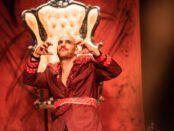
"My Onliness," Robert Lyons’ latest stage work, is a musical homage to Polish avant-garde playwright Stanislaw Ignacy Witkiewicz (active 1918-1934) but who resurfaced during the 1960’s when his works began to be published and translated. Directed by Daniel Irizarry who also plays the leading role as the Mad King, "My Onliness" with lyrics by Lyons and original music by Kamala Sankaram, resembles the anarchic East Village plays and happenings of the 1960’s. It is part of a through line from Alfred Jarry’s "Ubu Roi" (1896) to Eugene Ionesco’s "Exit the King" (1962). A political fable for adults, "My Onliness" is performed as a cabaret and circus entertainment with exaggerated costumes, outrageous stage business, and audience participation. While the often obscure text is for the adventurous, it does touch on many hot current issues. [more]
Los Otros
A fresh antidote to the usual brassy, loud rock musicals of today, "Los Otros" slows down the tempo and the sound level with a story of the experiences of two people who learn to love, cope and risk over the course of many decades. Luba Mason and Caesar Samayoa are quite endearing as the two California residents whose lives overlap. They give remarkable performances mainly appearing alone on stage telling and singing their stories. Cudos to librettist Ellen Fitzhugh and composer Michael John LaChiusa for bucking the trend and giving us a deep but small-scale musical revealing two lives through variously well-chosen experiences which add up to lives well lived. Long after you see it, it you will recall incidents that Lillian and Carlos recount. This may be the result of the fact that Los Otros is based on real people and true life experiences. [more]
As You Like It (Public Works)
Public Works’ musical adaptation of "As You Like It" is an enchanting evening of summer fun under the stars. Trimmed to a long one act, the story is accessible for both those who know the Shakespearean original and those who don’t. The score is always easy on the ears and has many crowd pleasers. The huge cast led by Rebecca Naomi Jones as Rosalind and including non-professional community partners is totally comfortable with the Elizabethan language and the contemporary score by Shaina Taub. With this show, Shakespeare in the Park has a real winner. [more]
Kinky Boots
Several years after vacating its Broadway home, "Kinky Boots" has settled in to a cozier off-Broadway venue, Stage 42, at a presumed discount for theatergoers, albeit with a much smaller orchestra and actors whose talents far exceed their name recognition (and no mask mandates, which might be a dealer breaker for some). Also returning is director/choreographer Jerry Mitchell who gives the resized production the same energy as the original, nurturing a buoyant vibe that, as before, underscores the show's positive messages about celebrating difference, particularly as it relates to hoary conceptions of masculinity. But, when everything is said and sung, Fierstein and Lauper's joyously uplifting, but shallow, efforts are only memorable for meaning well. That's not nothing, especially these days, but the show could have been so much more. [more]
Titanique
"Titantique" is the most hilarious musical parody to play New York in many a year. Since international superstar Céline Dion only got to sing one song at the end of James Cameron’s blockbuster "Titanic," the now iconic “My Heart Will Go On” which went on to win the Academy Award for Best Song, why not turn the film into a cabaret musical with a score made up entirely from the Céline Dion catalog? That is just what Marla Mindelle, Constantine Rousouli and Tye Blue’s book has uproariously done, casting Mindelle in the leading role as a perfect mimic of Céline Dion, Rousouli as hero Jack Dawson, and Blue directing the show. Whether you recall the film from 25 years ago or not, the satire is pungent and the jokes skewer many pop culture icons. [more]
The Inconvenient Miracle: A Mysterious Birth Musical
Samantha Streich and Deijah Faulkner in a scene from “The Inconvenient Miracle: A Mysterious [more]
Adventures in Vegas
A tiny dynamo, Bell Wolff, early in her career, found the perfect role as Ermengarde in several productions of "Hello, Dolly!". She yearned to perform the bigger part of Minnie Faye and nearly got the chance when she auditioned for the film version of "Hello, Dolly!". She tells of the disappointment of being passed over and sings “Moving the Line” (Mark Shaiman/Scott Wittman) about her frustration, one of 13 songs that punctuate "Adventures in Vegas," illuminating her life experiences. She is reprieved with an invitation to join a new act in Las Vegas, the "Bottoms Up Revue" at Caesars Palace, and jumps at the chance, starting a whole new chapter in her life which will include romance and, eventually, heartache. [more]
Notre Dame de Paris
It may be a bit unfair, but there’s no escaping comparing "Notre Dame De Paris," currently exploding on the stage of the David H. Koch Theater at Lincoln Center, with its immensely popular French-literature-inspired brethren "Les Misérables" and "Phantom of the Opera." All three are audience-pleasing spectacles with lusty, manipulative scores that hit the audience right between the eyes. The major difference involves how their stories are told. The latter two are constructed as bigger-than-life plots driven by bigger-than-life songs. "Notre Dame," on the other hand, is a series of very French pop songs that are the plot, storytelling not particularly effective due to their being sung in French, albeit with good translations flashed on several screens. There is very little non-sung dialogue. All the songs were brazenly amplified to rock concert level so that their ubiquitous crescendos and climaxes could be savored. [more]
Between the Lines
"Into the Woods" is not the only fairy tale for adults in New York right now. "Between the Lines," based on the best-selling novel by Jodi Picoult and Samantha van Leer, has been turned into a charming and delightful new musical which is actually an improvement over the overlong original. Featuring a talented and attractive cast headed by Arielle Jacobs, Julia Murney and Vicki Lewis as well as several unfamiliar faces, the show offers a melodic and bouncy score to witty and clever lyrics by Elyssa Samsel and Kate Anderson in their New York theater debuts. Jeff Calhoun’s direction is sharp and smart making this an extremely entertaining show. [more]
Love Quirks
Four appealingly performed single Manhattan roommates’ tangled romantic lives are depicted in the pleasant contemporary Off-Broadway musical, "Love Quirks," which has a rapturous score. Composer and lyricist Seth Bisen-Hersh’s striking melodies and literately crafted lyrics render the variety of songs with the polish of accomplished cabaret numbers. A standout is a gay male schoolteacher wryly ruminating while on a date. [more]
The Bedwetter
Comedian Sarah Silverman has turned her bestselling memoir, "The Bedwetter: Stories of Courage, Redemption and Pee," into a musical with the help of co-book writer Joshua Harmon, author of this year’s award-winning "Prayer for the French Republic," and composer Adam Schlesinger ("Cry-Baby"), who passed away in 2020 just as the show was about to go into rehearsal prior to the pandemic. The new musical, simply called "The Bedwetter," like the book is by turns amusing, first hilarious and later serious. Anne Kauffman’s production has a top-notch cast headed by Bebe Neuwirth, Caissie Levy, Darren Goldstein and Rick Crom. [more]
Islander: A New Musical
An import from the Edinburgh Fringe Festival, "Islander" embraces that renowned international jamboree's artistry and experimentalism, most notably by forgoing musicians for sound looping machines operated by Findlay and Tennick themselves. Especially for the technophobic (cough, cough), it's an extraordinary feat to witness actors become part of the production crew without the conceit ever feeling gimmicky or compromising the flow of the storytelling. That's no doubt due mostly to Findlay and Tennick's on-the-spot sound engineering abilities, which, to be sure, still take a backseat to their even more remarkable singing and acting. [more]
Romeo & Bernadette: A Musical Tale of Verona & Brooklyn
"Romeo & Bernadette" is a musical comedy worthy of the name that delivers on all counts. Mark Saltzman’s spoofing of the old story is great fun and his lines are very clever. The score with its famous melodies transformed in new ways is a lush feast for the each particularly as sung by this excellent cast. Under Justin Ross Cohen’s direction the cast brings this far-fetched story to brilliant life. One only hopes that the threat of the real story of Hamlet comes as a follow-up. [more]
¡Americano!
Tony Valdovinos who grew up in Phoenix, Arizona, was 18 before he found out that he was an undocumented immigrant. The new musical "¡Americano!" is based on the true story of his life and challenges. Impassioned and spirited with an animated cast that seems to be living their roles rather than acting them, the show is a superior musical entertainment. Staged with vigor and energy by Michael Barnard, artistic director of The Phoenix Theatre Company where the show premiered in 2020, and choreographer Sergio Mejia, ¡Americano! is both moving and entertaining, moving along with the speed of an express train with never a minute wasted in its urgent storytelling. [more]
Suffs
Unfortunately, while Wells (Nikki M. James) and Mary Church Terrell (Cassondra James), another renowned Black suffragist, occasionally pop up to offer intersectional insights, they mostly come across as an addendum to the all-female and nonbinary musical's Paul-centric narrative. Taub knows Wells and Terrell obviously belong in the story she's trying to tell, but she hasn't figured out how to dramatize their inclusion yet. Other suffragists whose names should be much more well known today also receive paper-thin characterizations: Lucy Burns (Ally Bonino); Doris Stevens (Nadia Dandashi); Ruza Wenclawska (Hannah Cruz); Inez Milholland (Phillippa Soo). [more]
Harmony
Although 25 years have gone by since "Harmony" first tried out at the La Jolla Playhouse in San Diego, the Barry Manilow/Bruce Sussman musical about the Comedian Harmonists is still relevant and timely. This historical musical based on true events which took place mainly in Germany from 1927- 1935 is a necessary reminder of the rise of Nazism and the naïve people who thought it would blow over. Produced by the National Yiddish Theatre Folksbiene at the Museum of Jewish Heritage, "Harmony" could not be in a more fitting setting to tell this story. Directed and choreographed by Warren Carlyle, the musical has been given a big Broadway-style production for its first New York appearance starring Chip Zien and Sierra Boggess as well as a cast of featured players. [more]
Songs About Trains
As a piece of theater, "Songs About Trains" is earnest and unique. Lead author (and performer) Beto O’Byrne, along with contributing authors Eugenie Chan, Reginald Edmund, Jay B Muskett and Rebecca Martínez (who also co-directs) have constructed a work that’s not definitely a musical and not quite a play, but more of a performance piece which sews stories together with music, dance and songs. [more]
The Life
The ubiquitous Billy Porter was given command of the most recent New York City Center Encores! presentation, the 1997 musical "The Life." His direction and re-interpretation of this tawdry portrait of 42nd Street left a great deal to be desired, but strong performances by the leading players made vivid impressions. Originally written by the estimable Cy Coleman (music/book), Ira Gasman (lyrics/book) and David Newman (book), "The Life" is set in the 1980’s as seen from the point of view of a narrator, Old JoJo (Destan Owens, fine in a thankless, add-on role) who observed and commented on his past which included watching himself, Young JoJo (Mykal Kilgore, fine singer, but looking nothing like his counterpart) behave badly. The concert adaptation was by Porter himself. [more]
Penelope, Or How the Odyssey Was Really Written
The musical gets a great deal of mileage out of its humor particular in its parody of recognizable tropes. "Penelope, Or How The Odyssey Was Really Written" is an entertaining musical comedy which turns into a feminist statement in the final scenes between husband and wife at the end of the show which gives this ancient Greek tale a modern sensibility. From the way the audience greeted the new musical comedy "Penelope" at the preview performance under review, The York Theatre Company may have a big hit on their hands. [more]
Little Girl Blue
Nina Simone’s vocal talents, physical presence and spirit are all dazzlingly channeled by Laiona Michelle in her engaging self-written biographical concert-style musical, "Little Girl Blue." Ms. Michelle employs just enough of Simone’s cadences, facial expressions and physical gestures to create an authentic characterization while supremely singing over a dozen songs associated with the charismatic vocalist. The show’s well-researched spoken word portions deliver historical facts, life details and cultural commentary in the manner of Simone. [more]
Space Dogs
Heyman and the rest of the production team quickly turn "Space Dogs" into an exercise of quantity over quality. More lights. More noise. More projections. More props. It's theater as sensory overload, with success measured by distraction. The major problem is that it also leads to a lot of other annoyances, with Nathan Leigh's sound design doing nothing for the intelligibility of Hughes and Blaemire's lyrics, Mary Ellen Stebbins' concert lighting occasionally blinding the audience in MCC's small off-Broadway space, and Stefania Bulbarella's numerous projections just stoking the meaningless hurly-burly. [more]
Black No More
"Black No More," the new musical inspired by George S. Schuyler’s 1931 Afrofuturist novel, is the most exciting and inventive new show to be seen so far this season in New York though it is still in need of work. With a book by Academy Award-winning screenwriter John Ridley (12 Years a Slave), the stage version drops Schuyler’s scathing satire of Harlem Renaissance and Depression figures as well as its political election hijinks for a more direct story about race and racism in the United States. As brilliantly staged by Scott Elliott for The New Group, Black No More is also a play of ideas and will keep you thinking and debating long after the final curtain in this story of the sacrifices people have to make to change the world. [more]
The Tap Dance Kid
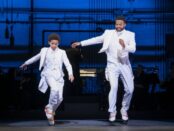
Let’s start with the best: The great Joshua Henry’s 11 o’clock number, “William’s Song,” a gut-wrenching revelatory song sung by the title character’s emotionally distant father. Henry endows the number with the emotional punch of “And I Am Telling You” from "Dreamgirls." Since Henry Krieger wrote the music to both songs the striking similarity is understandable. Of course, Tom Eyen wrote the "Dreamgirls"’ vivid lyrics and librettro; Robert Lorick wrote the words for the pleasant, plot-moving score of "The Tap Dance Kid." "The Tap Dance Kid"—book by Charles Blackwell, based on the novel "Nobody’s Family Is Going to Change" by Louise Fitzhugh—is a simple domestic tale now reset in the 1950’s, gussied up with the brilliant tap choreography of Jared Grimes and the keen, vivifying direction of Kenny Leon. But, even under Leon’s artful hand and Grimes’ beautifully performed numbers, "The Tap Dance Kid" remains a defiantly unimaginative story. [more]
The Hang
After a grand Pippin-style introductory opening, one exhilarating number follows another in acclaimed theater maker Taylor Mac’s "The Hang." Derived from jazz and opera, this vibrant musical fantasia is inspired by the Greek philosopher Socrates’ last hours in 399 BC Athens. He’d been sentenced to death by drinking the poison hemlock for “corrupting the youth” and “impiety.” The show is based on his student Plato’s account of these events. As there’s a homoerotic strain to the Greek philosophical milieu, "The Hang" has a raucous queer vibe. [more]
Whisper House
The songs which are mainly sung by Alex Boniello (usually with a guitar) and Molly Hager as the ghostly narrators are folk ballads which though lovely sound like a continuation of the same song. While the theme of racism against Asians is extremely timely, the treatment is wedded to the 1940’s and seems to be many years late. There is a great deal we do not learn about the characters which leaves holes in the plot. The tale is very derivative of earlier stories with the same tropes: haunted lighthouse (Thunder Rock), boy goes to live with strange relatives (The Grass Harp), malevolent ghosts, one male, one female (The Turn of the Screw), etc. [more]
Kimberly Akimbo
David Lindsay-Abaire’s early plays ("Fuddy Meers," "Kimberly Akimbo" and "Wonder of the World") were all whimsical or at least otherworldly. He has gone on to create musicals based on previously written stories, particularly "Shrek the Musical" with composer Jeanine Tesori. Now they have musicalized his play "Kimberly Akimbo" into a very impressive new show at Atlantic Theater Company which many may find works better than it did as a play due to the music and the songs. With a cast led by Tony Award-winner Victoria Clark in the title role, Jessica Stone’s production becomes more and more involving as it progresses to its satisfying climax. [more]
The Streets of New York
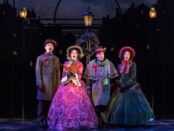
Cue the Irish Rep and its remounting of artistic director Charlotte Moore's musical "The Streets of New York," which the theatre first premiered twenty years ago in the aftermath of September 11. An affectionate adaptation of Dion Boucicault's 1857 melodrama "The Poor of New York," it returns in the wake of a different tragedy--a global pandemic that has claimed nearly 800,000 American lives and more than five million human beings worldwide--sharing the same social conscience as the Dickens classic but also encouraging the audience to do something more fun and cathartic: hiss at the greedy old man. Perhaps it's the Christmas story we actually need this year. [more]
Cheek to Cheek: Irving Berlin in Hollywood
This show is conceived, directed, and choreographed by Randy Skinner, and his four-time Tony Award-nominated talents shine throughout the production. The choreography is inventive, interactive, fun and impressive. His staging is well-balanced and keeps the transitions moving. The opening number, “Let Yourself Go” ("Follow the Fleet," 1936), sets the bar high with dynamic tapping that leaves the audience exhilarated and ready for more. Barry Kleinbort’s book is packed with interesting Berlin history and is full of charm and wit. Thank you, casting director Michael Cassara, for the great ensemble cast! Six performers were chosen to present this material: Phillip Attmore, Jeremy Benton, Victoria Byrd, Kaitlyn Davidson, Joseph Medeiros, and Melanie Moore. All six actors move through the evening in harmony, both physically and vocally, interacting with each other in song and dance as though in conversation. [more]
A Sherlock Carol
Directed by playwright Mark Shanahan, A Sherlock Carol offers six actors playing 23 roles in this entertaining new adaptation. In the iconic role of Sherlock Holmes with so much history behind it and such well-known performances as those by Basil Rathbone and Jeremy Brett, Drew McVety is to be forgiven for seeming a bit bland, though he warms up as the story evolves and he becomes more invested in the solution to the two cases. As the Ghost of Ebenezer Scrooge, Thom Sesma is a sinister presence, suggesting that he is also the Ghost of Professor Moriarty who has previously haunted Holmes. Memorable is Isabel Keating who is required to use a variety of accents from the American Irene Adler to the Cockney sister of Tiny Tim, as well as singing a beautiful aria as the Countess of Morcar. Keating it may be recalled is the Tony Award nominee and Theatre World winner for her performance as “Judy Garland” in "The Boy from Oz." [more]
The Visitor
David Hyde Pierce taking off his suit trousers to practice on a drum in his boxer shorts is one of many hilarious bits that are meshed with drama in "The Visitor." It’s a faithful, resonant and well-done musical adaptation of the acclaimed 2007 independent film of the same title. Book writers Kwame Kwei-Armah and Brian Yorkey stick closely to director/screenwriter Thomas McCarthy’s original vision while skillfully translating it for the stage. [more]
Assassins
As always in a John Doyle presentation, the production is professional, polished and accomplished. This time around he has not made changes to the script or the score except to include the climactic song “Something Just Broke” which was not in the original Off Broadway production but was added to the first London version in 1992 and has been used ever since. While the actors give excellent performances, the revival lacks emotion and heart which is strange considering the number of characters who die or who are wounded in the course of the show. It is as though they (and we) are numbed by much depiction of killing. Is there a way to fix this in a show which repeatedly has its cast shooting at presidents of the United States, in this case only in a fun house setting? [more]
Trevor: The Musical
The writers seem afraid to state what the story is all about, the word gay being mentioned exactly once. At two hours and 15 minutes including one intermission, today’s audience is way ahead of the plot, knowing exactly what will happen in advance. While the 1994 movie was 23 minutes, the musical seems padded and dragged out. Davis’ music is pleasant enough, but Collins’ lyrics are pedestrian and repetitious. The songs seem to have a limited vocabulary such as children’s books often do, but 13 year olds have a slang and vernacular that is hardly used. The biggest problem with the score is that the dream Diana Ross (played flamboyantly and spiritedly by Yasmeen Sulieman) gets to sing seven of her most iconic songs (“Do You Know?,” "It’s My Turn,” “Upside Down,” “Ain’t No Mountain High Enough,” “Remember Me,” “Endless Love” and “I’m Coming Out”) which are far superior to any of the new songs, always a mistake in a non-jukebox musical. [more]
A Turtle on a Fence Post
Unfolding from a stand-up comedy routine—“A prisoner walks into a bar…!”—and set in a comedy venue designed with ingenuity and style by Walt Spangler, Turtle veers from hokey to horrible helped by the spiffy routines staged by choreographer Kenny Ingram in over-the-top, sometimes kitschy, routines. Where else can you see dancing prison guards waving their batons as they tap dance in a circle or the flexible actor Josh Marin portraying an ATM and a basketball hoop? [more]
Disney’s Winnie the Pooh: The New Musical Stage Adaptation
The question arises who is the intended audience. The 60-minute show is too slow for young children and too repetitious for adults. Possibly this is meant for the nostalgia crowd of which there are apparently legions. The thin story line is a watered-down version of the original A.A. Milne stories that inspired the animated films Winnie the Pooh and the Honey Tree, Winnie the Pooh and the Blustery Day as well as a tale of Tigger’s infamous bouncing. All of the famous characters put in an appearance: easily frightened Piglet, gloomy Eeyore, cranky Rabbit, wise Owl, energetic Tigger, maternal Kanga and curious Roo. Christopher Robin (played alternately by Kaydn Kuioka, Max Lamberg, and Cooper Lantz) spends the day at school but is reunited with Winnie the Pooh just before the final curtain. Surprisingly, he does not have a British accent. [more]
Swan Lake Rock Opera
Now there’s "Swan Lake Rock Opera" created by Mirit Shem-Ur (book and lyrics), Tsedi Sarfati (director and dramaturge) and Sharona Pick (music production and additional music). The show uses orchestral themes from the original Tchaikovsky score and clever pop variations to create witty songs and underscoring. The libretto of "Rock Opera" follows the original Swan Lake plot points which tell of Young Prince Siegfried, ordered by his mother the Queen to choose a fiancée from a list of foreign princesses she has assembled. He goes off to hunt to avoid making a decision and meets the Swan/Woman Odette and falls in love only to be deceived by her doppelganger Odile, an agent of the evil Von Rothbart who has cast a spell that turned women into swans. This deception leads to tragedy. [more]
A Commercial Jingle for Regina Comet
While Marshall Pailet’s direction is breezy and fastpaced, the dialogue has too many Borscht belt jokes (“Take my Grandma, for instance. No really take her-,” Camp Rosenblatt, “As my Grandma used to say,” etc.”) and lyrics with too many quotes from much better song writers such as Cole Porter, Stephen Sondheim and Bock and Harnick. References to Barry Manilow and Hanson don’t really land and the show counts on a great many current memes like making Wyse’s neurotic lyricist gay and Fankhauser’s self-effacing composer straight. Unfortunately, they are rather bland when they should be bigger than life in this three-character musical. The fact that they have no names and are referred to in the program as “Man 2” (there is no “Man 1”) and “Other Man” is pretentious rather than endearing. [more]
Yeah, But Not Right Now
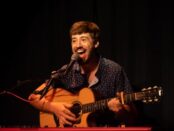
Holmes’ songs include clever lyrics particularly “Facebook,” “I Can Be That Guy” and "Beautiful Girl in the Front Row.” His expert playing on the keyboard allows him to have duets with himself and making it sounds like many instruments. He also accompanies himself on the guitar and a drum. The show is a confessional in which Holmes reveals the worst, most embarrassing parts of himself which seems to be the latest thing with comedians, except this show is partly sung. However, it is bright and upbeat even when telling unlikable characteristics. Craig Bundy’s sound design is usually clear, but occasionally makes it difficult to catch the lyrics. Director Caitlin Cook keeps this one-man show moving swiftly along. [more]
George M. Cohan Tonight!
It is definitely worth a gander for both its subject matter and its performer, the disarming and immensely talented Jon Peterson who also adapted the one-man play from Chip Deffaa’s original stage production which Deffaa previously staged. Peterson directed this filmed adaptation and choreographed the scintillating tap routines matched with joyous precision to Cohan’s repertoire of gung-ho Americana. (Think “Over There,” “You’re a Grand Old Flag,” “Give My Regards to Broadway” and “Forty-five Minutes from Broadway.”) The choreographic high point was Peterson’s hip-swinging dance to “The Hinkey Dee.” [more]
Stranger Sings! The Parody Musical
Since it's difficult to make fun of something that was never meant to be taken seriously in the first place, Hogue and director Nick Flatto are often left to spin their wheels by simply rehashing their subject matter's underbaked characters and shamelessly derivative storytelling, which all-too-often turns "Stranger Sings! The Parody Musical' into a glorified clip show. Hogue further hampers himself by largely sticking to the series' first season, as if he only had time to skim the second and third. It's an especially odd choice that leaves Hogue needing to rely on unfunny, if not downright offensive, parodic padding. [more]